The role of the library and teacher librarian is to support the explicit instruction of multiliteracies and resourcing of multimodal text types in a school as highlighted in ETL401 and ETL504 (ALIA & ASLA, 2004). Whilst print literacy competency is still an essential attribute, the promotion of information, digital and visual literacies are rapidly emerging as essential 21st century skills.
FACT:
Information literacy is the ability of a person to seek, find, access, use and evaluate information successfully for personal, educational and professional purposes (Kaplowitz, 2014; Kong, 2015). It is essential due to the prevalence of mal-information, disinformation and misinformation. This means that in order to navigate these perils of modern society, young people need to be adept at seeking, finding and using information. They also need to be competent at evaluating the difference between gold and dross.
Visual literacy is rapidly becoming an essential skill in a multimodal society because it effectively broadens the parameters of traditional literacy and assists with text deconstruction and analysis, as well as builds competency in language, texts and symbols (Marsh, 2010).
TL REALITY:
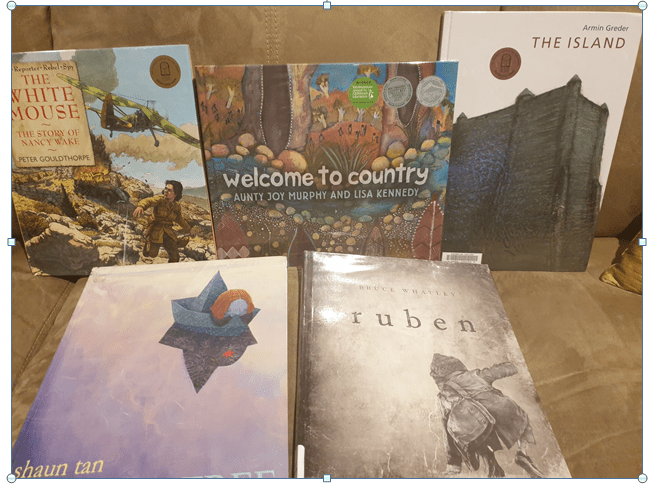
Picture books (PB) are effective at developing visual literacy because they can positively impact the academic, behavioural, developmental, cognitive development of learners. This is because PB are polysemic, promote critical thinking, encourage reflection, support constructivist pedagogies and are also excellent tools for class discussion (Marsh, 2010). Their value is in their ability to encourage readers to construct their own meaning from the imagery which then encourages multiple perspectives and creates opportunities for robust discussion (Marsh, 2010).
Picture books for older readers.Sophisticated picture books.
MY LEARNING:
I was under the false assumption that PB were for young children because developing readers require the interdependency of images and texts for comprehension. However, PB can be effectively used in secondary classrooms through literary learning, read alouds and within classroom practice. This is because post-modern or sophisticated picture books places a higher cognitive load onto the reader and require critical thinking from the reader to decode the contradiction of text and images, or lack of text.
In ETL402 and INF533 I learned about the various strategies to improve digital literacy in the classroom. These included the inclusion of digital texts into classroom practice and innovative pedagogical practices. Some examples of these strategies are:
Ferguson, S. (2019). Digital Literacy: A Constantly Evolving Learning Landscape. Alki, 35(2), 12–13. CSU Library
Kaplowitz, J. (2014). Designing information literacy instruction: the teaching tripod approach. Rowman & Littlefield. Ebook. CSU Library.
Kong, S. (2014). Developing information literacy and critical thinking skills through domain knowledge learning in digital classrooms: An experience of practicing flipped classroom strategy. Computers & Education. 78, pp.160-173. DOI https://doi.org/10.1016/j.compedu.2014.05.00
Levitov, D. (2016). School libraries, librarians and inquiry learning. Teacher Librarian 43(4), p.28. CSU Library.
Thomas, J., Barraket, J., Wilson, C., Cook, K., Louie, Y., Holcombe-James, I., Ewing, S., and MacDonald, T. (2018). Measuring Australia’s Digital Divide: The Australian Digital Inclusion Index 2018. RMIT University, Melbourne, DOI: https://doi.org/10.25916/5b594e4475a00
Learning: Pedagogical practice for teacher librarians
FACT:
Libraries are intrinsically connected with learning because they have consistently preserved and shared the documented histories and cultural knowledge of society (Ryan & Swindells, 2018). However, my time at ACU Library for my placement showed me that academic libraries differ because being an information repository is secondary to supporting their community in developing critical thinking, knowledge construction and independent inquiry (Higgins, 2017, Ch.1).
TL REALITY:
This active assistance that academic and school libraries offer is pertinent because the way people learn has changed significantly. From ancient times, learning was seen as a transfer of knowledge from one generation to another either through the forms of oral traditions or from written texts. However, evidence has shown that learning is increased when a learner is able to build new knowledge upon prior learning. This constructivist approach to learning is appropriate for diverse classrooms because the method and product is dependent on the learner’s histories and perspectives. Additionally, constructivist pedagogies such as inquiry and literary learning promote the development of a range of ‘soft skills’ such as problem solving, communication, collaborative practice, as well as critical and creative thinking, which is ideal for a knowledge economy.
Inquiry Learning
FACT:
Inquiry learning (IL) requires students to ask questions, design investigations, research information, interpret evidence, draw conclusions and communicate their findings in a variety of formats (Dept of ESE, 2021). As a constructivist pedagogy, IL puts the onus of knowledge construction onto the learner and in the process students learn valuable skills (Garrison & FitzGerald, 2016; Kuhlthau et al., 2015). Therefore it is clearly evident that access to information resources and sufficient information literacy skills to achieve positive learning outcomes is required. This means that TLs are integral to IL because they are information experts and can explicitly and implicitly embed information literacy skills throughout the inquiry process (ASLA & ALIA, 2004; Levitov, 2016, p.29).
TLs can also support IL through team teaching and collaboration with department leaders. In 2020 I collaborated with the Year 8 Science and Year 8 English team leaders to help them implement inquiry learning in their respective disciplines. Both team leaders were concerned about the robustness of student research questions and were concerned if it would sufficiently address the learning outcomes. So from my prior knowledge as a science teacher and learning in ETL401, I created a reverse’ lotus chart with embedded questions to assist students in creating their inquiry questions for tasks. The integrated questions increased critical thinking and enabled students to connect to their topic to a deeper level. It also allowed teachers and students to visualise their learning. The experiment worked so well that I presented my findings at ASLA’s 2021 School Library conference and the corresponding article was published in ACCESS’s Volume 35, Issue 3, September, 2021 (Check out the contents page!).
Here is an example of another cross curricular inquiry task that I created for my school:
2. Literary learning
THEORY:
Literary learning (LL) is the embedding of literature across the curriculum in order to convey subject specific information. It turns students from codebreakers into participants by using texts for learning and analysing. This means LL can be effectively used across the curriculum, in all year levels and can be adapted to suit diverse learners because literature based learning allows students to construct their own bank of knowledge from information that is more easily accessible to them.
Cornett, C. E. (2014). Integrating the literary arts throughout the curriculum. In Creating meaning through literature and the arts: arts integration for Classroom teachers (5th ed., pp. 144-193). USA
Derewianka, B. (2015). The contribution of genre theory to literacy education in Australia. In J. Turbill, G. Barton & C. Brock (Eds.), Teaching Writing in Today’s Classrooms: Looking back to looking forward (pp. 69-86). Norwood, Australia: Australian Literary Educators’ Association. CSU Library
Garrison, K., & Fitzgerald, L. (2016). ‘It’s like stickers in your brain’: Using the guided inquiry process to support lifelong learning skills in an Australian school library. In A School Library Built for the Digital Age45th IASLC Conference. CSU Library.
Higgins, S. (2017). Managing academic libraries: Principles and practice [ebook]. Amsterdam. Chandos Publishing. CSU Library.
Kuhthau, C., Maniotes, L., and Caspari, A. (2015). Guided inquiry: learning in the 21st century. 2nd Edition. Libraries unlimited, USA.
Levitov, D. (2016). School libraries, librarians and inquiry learning. Teacher Librarian 43 (4), p.28. CSU Library.
Maniotes, L. (2019). Guided Inquiry Design: Creating curious inquirers. SYBA Academy workshop. Sydney
Ryan, M., & Swindells, G. (2018). Democratic practice: Libraries and education for citizenship. Portal: Libraries and the Academy 18 (4), pp.623-628. John Hopkins University Press. CSU Library.


 Learning through the Library