Who am I? What do I do? – When an identity crisis occurs.

What do I do all day?


Just chillin – Courtesy of Pixabay


To my mother, I read books all day and tell people to shush!


To my husband, well he is only concerned that I am happy (and I can still manage my children’s school drop offs and pick ups).  Oh and there is no need for vacation care. Winning!!


To my children, mummy goes to work in a library and reads books and then comes home with more books all the time…. Oh and mummy is home in the holidays.


To my colleagues, I am that Energiser bunny that nabs you in the corridor asking to come into the library to work on your next task; the idjit that goes to departmental meetings and ‘volunteers’ to help with planning. I am also that nutter that gets over enthusiastic during Book week, Roald Dahl day, Harry Potter day, Jane Austen day

What’s your skill? This is mine.


To me.  Well, I am a teacher of information.  I teach students (and their teachers) how to find, seek, use and create information.  I find resources that support the curriculum and wellbeing of my students. I teach students how evaluate their sources, protect themselves online, be aware of the legislation around copyright and academic integrity. I help students and teachers in their teaching and learning by co-creating units of work that promote critical thinking and reflection.  I create lesson plans and collate resources to commemorate special events such as Reconciliation week, Anzac Day, Eid, Diwali and Samhain.

Each teacher librarian will have different priorities depending on the school they are attached to and the personality they were born with.  Some TL are brilliant at curriculum planning and get heavily involved with the co-creation of units. Other TLs are great collaborators and involve themselves with the teaching and learning aspect.  Some TLs are fantastic at resource collection management and development. Their collections are constantly evolving with the community’s needs. Each TL’s practice will differ from the TL next to them, the one down the street, the next suburb, or interstate.  That’s the beauty within the practice of teaching. Each practice is unique as it is the individual’s interpretation and implementation of the teaching standards that leads to such distinctiveness.

Each teacher, in their own sphere has an impact on their students, peers and community.  Individually we cannot change the world, but we can change the experiences of the people around us.  We can change how our students learn about internet safety, about how to use online information ethically.  We can teach the skills to differentiate fake news from real news (and in an election week… OMG!). We can show them how to seek, identify, use and create information that is meaningful to them and others.

How we do it will vary… but the point is that teacher librarians are trained and equipped to teach others the skills to survive and thrive in an information society. 

We can show the next generation how to become active citizens in this digital world. 

Guided Inquiry Design – An analysis

The world is changing before our eyes.  I have previously expounded upon Information society and the literacy that is required in order to engage with this new society, so will not go on about that now.  As teachers we can see the declining literacy ability of our students. We can see their lack of engagement and motivation. We know that this disengagement and apathy leads to poor behaviour within the classroom and consequently, poor life choices externally.  Many students fall through this gap, citing boredom and disconnection to the school paradigm. This is even more true for low achieving students and or students in low socio-economic zones, where education is paramount to break generational cycles of dysfunction.  Some schools focus their teaching and learning to address standardised testing (Kuhlthau et al., 2015). Whilst those schools may test high, their students struggle to translate their learning to an out of school context. As teachers we are frustrated and hamstrung by the politics of school.  

Guided inquiry is a method of teaching and learning that has changed how students learn.  Rather than a behaviourist method with stand alone teacher, GI promotes a constructivist team approach to teaching practices (Garrison & FitzGerald, 2016).  This style of pedagogy promotes students to gain a deep understanding of the curriculum content and learn valuable skills in the process (Kuhlthau et al., 2015).  The benefit is its fluid nature and this allows a flexible approach to learning which can be applied for all abilities and styles, as it seeks to explicitly teach skills rather than content.  This is simply because skills are transferable and therefore of a higher value to both students and teachers. After all, in this information age, everyone can find out anything, provided they have the skills to do so.

A guided inquiry teaching and learning activity is designed to engage students in the content using their own intrinsic motivation (Maniotes, 2019).  By utilising the 3rd space of learning, teachers can challenge students to connect to the curriculum content. This connection, based upon a constructivist ideology, allows students to question, explore and formulate new ideas based upon their own knowledge and perceptions (Kuhlthau et al., 2015, p.4).  The learning itself is involves students finding and using a variety of information, to address an aspect of the content through an inquiry approach.  During this process, students pose questions, make decisions, develop areas of expertise and learn life long skills (Kuhlthau et al., 2015, p4). As an educator there are two steps to GI.  The first step is to apply the GI design framework when creating units of inquiry.  These units incorporate curriculum content, literacy goals and information literacy concepts (Kuhlthau et.al,, 2015) and have specific learning goals as well as skills that will be addressed during the activity.  The second step is to guide students through this learning with interventions, assessments and strategies (Kuhthau et al, 2015).  It is quite common for teachers to explicitly teach ‘just in time’ skills during this process as teaching them any earlier usually has less relevance to them (Maniotes, 2019).

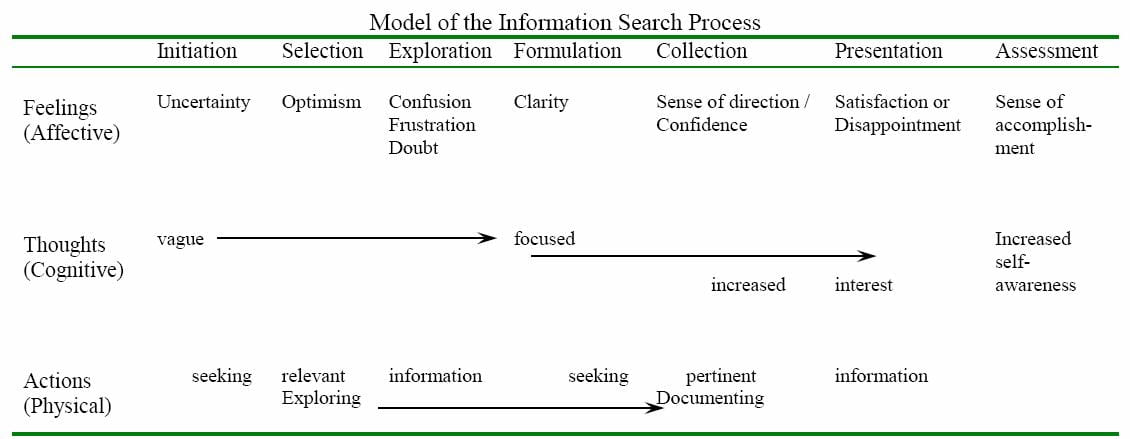
There are seven stages in GID unit.  The stages go from an introduction phase through immersive, gathering, creative and sharing.  As students progress through these stages they develop a whole range of skills and undergo a variety of emotional stress.  It is this emotional stress and achievement over stress that assists with overall competence and self esteem. This figure shows the changing affective stages of an inquiry task.

Inquiry learning has many forms including project based learning; blended learning, International Baccalaureate programs and expeditionary learning.  In Australia there are several IL models including Herring’s 2004 PLUS, NSW information search process, Newman’s 2014 iLEARN and Big6. But the superior form of inquiry learning is Guided inquiry design as it has a research based framework to substantiate its method of practice and the design understands the importance of affect in student behaviour.  This affect is important to understand as it indicates to educators where motivation is and where guiding becomes important.

Whilst students are guided through the project, they get to pose their own question and explore ideas.  This posing of question, is formulated from their own experiences, reflection and understanding. It acknowledges their learning is valid and promotes self esteem and self efficacy.  Guidance can be tailored to individual students needs thus allowing for differentiation. As this process is a collaborative, students work with their peers in creating and investigating together.  This sense of ownership and accomplishment leads to independence, expertise and competence (Kuhthau et al., 2015). Unfortunately, like all skills based learning, regular practice is required to maintain competency. Kong (2014) points out that classroom integration of IL leads to an increase in competency.  Therefore, GI needs to be part of the learning and teaching across all grades and curriculum. It cannot be taught as a single subject in an ad hoc method as information literacy is cumulative (Lupton, 2014).

One of the many positives of Inquiry learning is that it promotes critical thinking skills (CCT).  CCT, as part of the Australian curriculum’s general capabilities, needs to be embedded in teaching and learning practices.  These skills are essential for participation in modern society. Within inquiry learning – CCT assists students in five major components.  Curriculum content, information literacy, learning how to learn, literacy competence and social skills (Kuhlthau and Maniotes, 2010, p.19; Kong, 2014, p.2).  All these skills are interwoven throughout the whole activity and an educator can choose which skill to assess at any given time.

The other interesting aspect of GI design unit is that the task comes halfway into the unit.  Unlike current pedagogical practices where students get given a summative task at the beginning of the unit and then ‘do what is necessary’ and submit it a few weeks later.  Inquiry tasks take students on an exploration of the unit. They are immersed in the unit of work either with field trips or excursions. They browse broadly among the literature, gaining various perspectives BEFORE the question is even posed.  This means that when the question is posed by the student is truly authentic (Maniotes & Kuhlthau, 2014). It comes from what they DON’T know about a topic, rather than a regurgitation of facts. This process forces student to engage with the unit of work or they simply become mired in an information overload.  This information overload occurs commonly outside school, where adults of all backgrounds, refuse to participate with something because they do not know or understand it. GI teaches students how to persevere and understand what the information is saying.

Collaboration is key to guided inquiry for both teachers and students.  As the creation and implementation of GI units is multifaceted and complex, a team of teachers is required (Kuhlthau & Maniotes 2010). Ideally, this unit has three teachers co-creating the unit with additional experts involved as required. This team approach has the benefit of collaborative learning, in that many minds are better than one.  It also models to students how collaboration occurs in the workspace. Students use the teaching team as role models for their interactions with their peers. These interpersonal skills are essential.

Figure -1 – KUHLTHAU, MANIOTES, CASPARI, 2012

The genius behind GI is that it is based up the information search process model which compares feelings, thoughts and actions  of students as they progress through the unit. This understanding of student’s behaviour is of great insight to the educator. Teachers can predict when students are suffering from confusion and doubt and assist them in finding their way.  I am musing if Marcia’s work on Erik Erikson’s theory of identity development is related to this process. After all, Erikson’s theory about adolescents facing moments of crisis and their response to the crisis shapes their identity. So theoretically, students who have their moment of crisis during an inquiry task move through to identity achievement, in that they have made a commitment to a value or role (David, 2014).  Then once they have formulated a question or concept, students feel a sense of confidence, a sense of purpose. This sense of purpose and confidence translates to other aspects of learning and thus builds self efficacy.

The problem with the Australian curriculum is that IL is not embedded within and across the curriculum in all KLAs.  Information literacy is cumulative. To have an IL education, sustainable development is required across all years and areas of study.  It is should be part of the content, structure and sequence of learning; and definitely not the outcome of a single subject (Lupton, 2014).    There has been some attempt by Bonanno & Fitgerald (2014) to map the Australian curriculum to the Guided inquiry design by Kuhlthau, Maniotes & Caspari (2012).  The scope and sequence suggests the introduction of inquiry skills, which could be adapted throughout the curriculum. Lupton (2014) correctly surmised that inquiry strands are only currently within science, history and geography KLAs.  Whereas Bonanno & Fitzgerald (2014) try to extend those skills in different areas of the curriculum. This is definitely possible as these ‘skills’ are transferable and there is no reason why one can pose a question in History that leads to an insightful understanding of the unit, but cannot do the same in math.  

In summary, GI units of work are designed with the student in mind. They are student centred and place the onus of learning upon the student rather than the teacher.  This is a seismic shift in pedagogy from a behaviourist to constructivist perspective. Students will engage with content if it is in their third space.  They will commit to a task if they have a vested interest in the outcomes. They will learn more in collaborative groups. Mostly, they will work at their level of cognition and thus achieve a sense of accomplishment when the task is completed.  We talk a great deal about student centred learning, about making the student the centre of the pedagogy. Well… lets just do it then.


Bonanno, K. with Fitzgerald, L. (2014) F-10 inquiry skills scope and sequence, and F-10 core skills and tools. Eduwebinar Pty Ltd.

David,  L., (2014) “Identity Status Theory (Marcia),” in Learning Theories.  Retrieved from https://www.learning-theories.com/identity-status-theory-marcia.html.


Garrison, K., and FitzGerald, L., (2016) ‘It’s like stickers in your brain’: Using the guided inquiry process to support lifelong learning skills in an Australian school library.  A school library built for the digital age.


Kuhlthau, C., and Maniotes, L., (2010) Building guided inquiry teams for 21st century learners. ZZ School library monthly.  Volume 26: 5.

Kuhlthau, C., Maniotes, L. & Caspari, A. (2012) Guided inquiry design: A framework for inquiry in your school. Libraries Unlimited.

Kuhthau, C., Maniotes, L., and Caspari, A., (2015) Guided inquiry: learning in the 21st century. 2nd Edition. Libraries unlimited, USA.

Maniotes, L., and Kuhlthau, C., (2014) Making the shift. Volume 43:2.

Lupton, M.(2014)  Inquiry skills in the Australian Curriculum v6, Access, November

Maniotes, L., (2019) Guided Inquiry Design: Creating curious inquirers. SYBA Academy workshop. Sydney

Walton, G., Cleland, J., (2016) Information literacy. Empowerment or reproduction in practice? A discourse analysis approach. Journal of Documentation, Vol. 73 Issue: 4, pp.582-594, https://doi.org/10.1108/JD-04-2015-0048

Digital literacy and its impact on pedagogy and the role of a TL.

The world’s economy has evolved with the transfer from production lines to one structured upon the creation and dissemination of information.  This era has been revolutionised by the ubiquitous presence of the internet and the speed in which it is generated. Combined with rapidly evolving technology; access, use and production of information is easier.  The education sector has been particularly affected by this insurgence of documentation and the skill sets required to seek, harness and use information successfully. This essay will define digital literacy and its pivotal role in information seeking behaviour trend of adolescents, its impact on educational practices and the role of the teacher librarian in this knowledge society.

Literacy has evolved from simply being able to read and write in text form into something more dynamic.  ACARA (2016a) has expanded the definition to include; the ability to interact with, engage and use language across modalities for a variety of purposes and a diversity of contexts.  In this knowledge rich society, information is available in multiple formats and can be often simultaneously engaged with (Jacobson et al., 2018). Therefore, digital literacy (DL) is the ability to appreciate the need for; the expertise to access; the capacity to evaluate, use and integrate information within the school environment and in general society (Lofton, 2016).   Thomas et al. (2018) acknowledge, even though access is widespread, individuals are grappling with the ability to use the new technologies in all areas of life (p.12).

The modern student is heavily reliant upon the internet for both information seeking and retrieval due to the widespread availability of mobile devices (McGrew et al., 2018, Mussell & Croft, 2013, Lanning & Mallek, 2017 and Mills & Angnakoon, 2015).   Teachers are often frustrated at student’s poor information seeking behaviour (ISB) and vexed by their blind dedication to Google and Wikipedia, despite a lifetime exposure to technology (Saunders et al., 2017).  The exasperation tends to peak at the student’s inability to successfully identify relevant and reliable resources online.  Unlike a library, where the librarian acts like a gatekeeper, the internet and thus everything on there, including unsubstantiated and vitriolic materials, are freely accessible.  Search engines are the most common starting point as students are familiar with their visual design, their mechanism and are viewed as fast and reliable (Lanning & Mallek, 2017; Qayyum & Smith, 2018 and Mussell & Croft, 2013).  Adolescents often base their entire study upon the virtue of Wikipedia and Google (Ricautre, 2016 and Qayyum & Smith 2018).  Wikipedia, as Ricautre (2016) elaborates, is built upon the concept of crowd-sourcing, as the public is encouraged to contribute information.  Whilst understandably these parameters allow for open dialogue and the precept of an open learning environment, it brings validity and accuracy of information presented into disrepute.

Google is an omnipresent search engine in modern society. Its pervasive presence has led to ‘google it’ often replacing ‘search for it’ in modern jargon.   Regrettably, as McGrew et al., (2018) point out, students determine the usefulness of a website based upon superficial points, such as the hierarchy of results displayed by Google.  Students fail to comprehend that Google, a corporation, controls results based upon an algorithm determined by the user’s own personal digital history (Ricautre, 2016).  In this way, Google ensures that the search results match closely to the user’s state of mind, previous search parameters and thus is more likely to be accepted (Ricautre 2016).  Some students do not even open up the individual sources but rather just peruse the content on the main search page and accept the information as correct without understanding context (Russell & Callegaro, 2019).   Other students rarely venture away from the initial website due to insufficient DL skills, so they accept information without verifying authenticity and or bias (McGrew et al., 2018). This creates a moral dilemma as they are willingly restricting access to information simply because it is easier.

The problems with students’ ISB are numerous.  Firstly, their techniques used to seek information are based most often on predetermined algorithms, ineffective search terms and minimum effort expended.  In order to cope with the overload of information available, students covertly reduce their search techniques so as to minimize the amount they are presented with (Qayyum & Smith, 2018).  Russell & Callegaro, (2019) point out correctly, that students place the whole query into the search bar and expect a complete response instantly, as there is an unwillingness to construct a bank of knowledge (Mussell & Croft 2013).  Qayyum & Smith (2018) corroborate, by suggesting that the speed in which the internet produces results prevents reflection of content. The DL skills of skimming and scanning cannot keep up with the flow of information and sources are rejected if not exactly correct.

Kobayashi (2018) found that whilst students preferred engaging with technology, they are unwilling to use advanced software and hardware, as they are unable to troubleshoot.  This self-censorship is due to an inability to interpret multimodal sources with a rich media presence (Head et al., 2018, p.4, Jacobson et al 2018; Kobayashi, 2018). This is especially true for students, who already have low literacy, as they often get overwhelmed by embedded multimedia, slowing comprehension (Kobayashi, 2018).  Other students find the layering of sources distracting which also slows cognition down. The majority of adolescents are unable to use search terms properly and when faced with an overwhelming number of sources, they simply use the first few and disregard the rest, despite the possibility of their importance (Mussell & Croft, 2013).  Their ability to navigate the internet is hampered by a lack of literacy and critical thinking skills.

Once students have managed to find sources they understand, they are unable to determine veracity.  McGrew et al., (2018), in their study, concluded that the pattern in which students investigate the reliability of a website is mainly determined by the visual appeal and seemingly professional appearance, whilst often disregarding the bias and or dubious authorship.  Jacobson et al (2018) argued that students are receptive to emotive language and the presence of speculative data was used as evidence of reliability (McGrew et al 2018). Students will also accept the reliability of sources if they subconsciously agree with the information and disregard sources that they disagree with, due to the challenges this new data imposes upon them (Jacobson et al 2018 and Russell & Callegaro 2019).   Even when presented with alternate sources, like databases, many preferred search engines due to the visual appeal and navigation ease (Lanning & Mallek, 2017, and Mussell & Croft, 2013). Shenton (2018) attributes this literacy to, in that students with lower literacy are often unable to decode more complex text and use familiarity of structure to determine reliability and rationality. In terms of DL, this ISB highlights a lack of critical thinking skills, as accessibility is preferred over validity, which is a significant issue for education and beyond.

The presence of the internet has forever changed how public policy and societal issues are addressed, and it is imperative that students are proficient at ISB so that they can do the same hereafter (McGrew et al., 2018 and Thomas et al., 2018).  DL is a citizenship issue and true democratic societies require the voter to be able to find reliable information, evaluate multiple perspectives and communicate their ideas on current issues (McGrew et al., 2018; Jacobson et al., 2018). If students are incapable of DL at school when investigating tasks simple and direct, then their ability to navigate for information on more controversial topics is hampered (McGrew et al., 2018).  This is particularly evident in an election year when society is bombarded multi-modally in an effort to persuade the voter. If one is unable to filter, understand and evaluate the information effectively, then the scope of information is greatly narrowed. One only has to look at the media about the upcoming federal election to realise how important DL is within society.

Modern pedagogy is shifting to a digital interface and it’s important that the DL skills are taught so that students and their teachers engage successfully (Jacobson et al., 2018 and Qayyum and Smith, 2018, p257).  As each generation learns to use, transfer and create knowledge in schools, it is logical that in schools, effort should be placed in establishing digital literacy and efficacious use of technology (Ricautre, 2016, McGrew et al., 2018; Berg, 2018).   A liberal attitude to DL by educational authorities will lead to an ineffectuality for critical thinking and targets for scammers such as the Nigerian scam that has played havoc within numerous households across Australia (ACCC, n.d.). It is evident that digital literacy is important in ISB beyond the classroom.

The dramatic change in ISB and budgetary squeeze has added pressure onto teacher librarians (TL) to adapt their roles to ensure their viability in the school context (Lamb, 2011, p.27).  This adaptation has redefined the role of the TL from an archivist and curator of knowledge, into facilitators of knowledge or information specialists, curriculum leaders, information management leaders (CC, ALIA & ASLA, 2016).  This facilitation ranges from the acquisition of materials that build a school collection, text and digital, and the implicit and explicit teaching of life long skills. From their central position within the library, a TL is able to view the school as a whole and identify and analyze learning holistically (ACT Directorate, n.d.).  As the information specialist and curator of knowledge, a TL is able to assist in building positive ISB by embedding DL through the curriculum (McGrew et al., 2018; Berg, 2018). In the instructional partner role, a TL can instigate various pedagogical practices to support teaching and learning via implicit and explicit actions. Implicit methods could be characterised by the presence of maker spaces within the library, embedding of skills into curriculum units, the inclusion of carefully curated resources that support learning, and explicitly via direct instruction and assessment of skills in tasks.  

Educators need to realise that DL is not independently discovered during research tasks but rather they need to be explicitly taught and then assessed to evaluate understanding (McGrew et al., 2018).  Explicitly teaching DL in collaboration with other staff, TL can assist students in improving their ISB across the school (Shenton, 2018). As technology is an augmentation of learning, regular pedagogy on DL can increase the confidence of students in their ability to use media rich resources for example Google Docs, OneDrive and Endnote (Ricautre, 201; Berg, 2018).  This increase in digital self-efficacy will allow students to engage with more diverse sources and improve their ability to troubleshoot any potential challenges (Kobayashi, 2017).   Makerspaces are an alternative, as they encourage students to be creative, collaborate, problem solve, research and experiment and challenge the student into higher order thinking (Lofton, 2016, p.18; Berg, 2018).  A TL is an ideal person to facilitate these activities, as they are curriculum leaders, and the information expert in the school (CC, ALIA & ASLA, 2016). They can support all forms of inquiry learning and research, by either explicitly teaching correct ISB, and or implicitly, by assisting colleagues in creating coursework and assessments with supporting resources and technology.

Another method is to teach alternate methods of ISB, such as the use of the library catalogue and databases (El-Khayat, 2016).  Mussell & Croft, (2013) determined that many students were unaware of the presence of catalogue and often made it synonymous with a database search. Saunders et al., (2017) and Qayyum & Smith, (2018 p259) advocate that the explicit teaching of search terms, synonyms, and key words is the most fundamental skill, as it is the underpinning concept that illustrates critical thinking and evaluation.  Shenton (2018) interestingly noted that whilst students can often be persuaded to use databases for educational goals, this does not extend elsewhere. There appears to be a dichotomy when it comes to obtaining information. This bears thought of where do these adolescents go to access information for personal or professional reasons? Unfortunately, Google and Wikipedia continue to be the main tools of information seeking, which in itself is fraught with complications.  McGrew et al., (2018) and Lanning & Mallek (2018) both propose that DL be a course that is explicitly taught and formally assessed as a unit of work.   Lanning & Mallek (2017) counsels DL in standardised tests to monitor student progress and the recent move by NAPLAN to online testing could be a step in the right direction in assessing DL skills as DL is pivotal to academic success (ACARA 2016a; ACARA 2016b). Lanning & Mallek (2018) surmises that this is due to the student’s reluctance to learn skills unless there is an assessment attached,  which is just an unfortunate testament to the current education system’ assessment focused approach.

Occasionally, teachers do forget that students can be ignorant of digital practice such as search terms or database availability (Qayyum & Smith, 2018, p259; Miller, 2018).  This is very common in schools with a transient student population. Instead of exhibiting frustration, a TL can use this opportunity as a refresher activity, to explicitly teach that particular skill to the entire cohort in collaboration with colleagues (Qayyum & Smith 2018 p259).  Teaching suggestions include rewording search terms into keywords, keeping extra tabs open in order to read broadly , and realising that the perfect answer rarely comes up within the first few responses (Russell & Callegaro, 2019; Berg, 2018). Head et al., (2018) suggests that teachers and teacher librarians are trusted to provide access to reliable sources by students even if they may not be (p27).  Consequently, teachers themselves need to be digitally literate in order to assist their students in their learning, which is why the presence of a qualified TL is paramount.

Budgetary constraints and a lack of understanding of digital literacy have led to many schools dispensing with a qualified TL and or the library itself (Wood, 2017).  This poses a great problem for students and their ability to engage with the digital world (Berg et al., 2018). Some argue that digital resources and new seeking software is so instinctive that it compensates for student inadequacies and librarians are unnecessary (Saunders et al., 2017).  But it seems impractical to depend on an algorithm and its superficial limitation of results. This is just censorship under an alias. Others suggest the pervasive mobile device does not warrant the cost of outfitting hardware. This is a fallacy, as mobile only users, individuals with a disability and ethnic minorities are sub sections of society who are digitally disadvantaged (Thomas et al., 2018, p.16).  Mobile only users in particular are reluctant to engage in media rich practices as their device often does not have the speed and data allowance (Thomas et al., 2018 p.16). Considering the diversity within schools, the lack of a school library and TL is a clear affront to educational needs.

Students with low DL will have poor decision making skills due to an inability to filter, evaluate and critically analyse information (Berg 2018, Wood, 2017; Kachel, 2016).  This inefficacy with DL is further pronounced in lower socio-economic households where there are already hurdles due to lack of access, generational disadvantage and disability (DIIS, 2016; Thomas et al., 2018). The removal of libraries and teacher librarians infringe upon the freedom and right to access information (OIAC, N.D; UN, 1948).  Libraries seek to provide equity of access to students, and teacher librarians seek to provide self-efficacy in digital literacy to both students and teachers, for the successful navigation in this current knowledge society. The irony is that under legislation, prisons must have a library and a qualified librarian, but not schools (Kechel 2015, ALIA 2015; Bevan, 1984).

Digital literacy is essential and plays a vital role in ISB as the behaviour practiced in school is repeated in adulthood.  There is a strong correlation between low DL and poor ISB, which impacts pedagogical practices. The role of the TL in this changing information landscape, is to ensure that all students have access to information and have the ability to seek, use and share that information in a variety of formats.   In a world where there is a constant barrage of information, fake news interspersed with real news, a digitally illiterate citizen will be isolated, vulnerable and unable to self-advocate. They will be unable to participate wholly with this new society as an economic contributant. Access to the digital world is a necessity in modern times, as is the ability to navigate this information age.

REFERENCES

ACARA (2016a) National literacy learning continuum. Australian Curriculum. Retrieved from https://www.australiancurriculum.edu.au/resources/national-literacy-and-numeracy-learning-progressions/national-literacy-learning-progression/what-is-literacy/

ACARA (2016b) NAPLAN online. National Assessment Program. Retrieved from https://www.nap.edu.au/online-assessment

ACCC (N.D) Nigerian Scams. Scamwatch. Retrieved from https://www.scamwatch.gov.au/types-of-scams/unexpected-money/nigerian-scams

ACT Government (n.d.) School Libraries: The heart of 21st century learning. Education Directorate.   Retrieved from https://www.education.act.gov.au/__data/assets/pdf_file/0020/916301/School-Libraries-21st-Century.pdf

ALIA (2015) Australian Library and Information Association Minimum Standard Guidelines for Library Services to Prisoners

Retrieved from https://www.alia.org.au/about-alia/policies-and-guidelines/alia-policies/prison-guidelines

ALIA and ASLA (2016) Statement on Teacher Librarians in Australia. Retrieved from  https://asla.org.au/resources/Documents/Website%20Documents/Policies/policy_tls_in_australia.pdf

Berg, C., Malvey, D., and Donohue, M., (2018) Without foundations, we can’t build: Information literacy and the need for strong library programs. In the Library with the Lead pipe.  Retrieved from http://www.inthelibrarywiththeleadpipe.org/2018/strong-school-library-programs/

Bevan, C., (1984) Minimum standard guidelines for Australian prisons 1978 (Editor), Australian Institute of Criminology. Retrieved from https://aic.gov.au/publications/archive/min-standard-guidelines-prisons

Curriculum Corporation, Australian School Library Association and Australian Library and Information Association (2001). Learning for the future : developing information services in schools (2nd ed). Curriculum Corporation, Carlton South, Vic. pp60-62

Department of Industry, Innovation and Science (2016). Australia’s digital economy update. Retrieved from https://apo.org.au/sites/default/files/resource-files/2016/05/apo-nid66202-1210631.pdf

El-Khayat, Y (2016) Librarians help high school students improve research skills. Journal of Medical Library Association. 104:3. DOI 10.3163/1536-5050.104.3.009

Head, A., Wihbey, J., Metaxas, P., MacMillan, M., and Cohen, D., (2018) How students engage with news. Five takeaways for educators, journalists and librarians.  Project Information Literacy Research Institute. Retrieved from http://www.projectinfolit.org/uploads/2/7/5/4/27541717/newsreport.pdf

Jacobsen, R., Halvorsen, A., Frasier, A., Schmitt, A., Crocco, M., and Segall, A., (2018) Thinking deeply, thinking emotionally; how high school students make sense of evidence. Theory & Research in Social Education. I46:232-276. DOI 10.1080/00933104.2018.1425170

Lamb, A. (2011). Bursting with potential: Mixing a media specialist’s palette. Techtrends : Linking Research & Practice To Improve Learning, 55(4), 27-36.

Lanning, S,. and Mallek, J., (2017) Factors influencing information literacy competency of college students. The Journal of Academic Librarianship. 43: 443-450.  DOI: 10.10.16/j.acalib.2017.07.005

Lofton, J., (2016) Students are makers! Building information literacy skills through makerspace programs. CSLA Journal. 40 (2). Retrieved from https://www.questia.com/magazine/1P3-4305515741/students-are-makers-building-information-literacy

Kachel, D., (2015) The calamity of the disappearing school libraries. {Blog Post} Theconversation.com. Retrieved from https://theconversation.com/the-calamity-of-the-disappearing-school-libraries-44498

Kobayashi, M., (2017) Student’s media preferences in online learning. Turkish Online Journal of Distance Education. 18:3. ISSN 1302-6488. Retrieved from https://eric.ed.gov/?id=EJ1147585

McGrew, S., Breakstone, J., Ortega, T., Smith, M., and Wineburg, S., (2018) Can students evaluate online sources? Learning from assessments of civic online reasoning. Theory & Research in Social Education. 46: 165-193. DOI 10.1080/00933104.2017.1416320

Miller, S., (2018) Diving dee; Reflective questions for identifying tacit disciplinary information literacy knowledge practices, dispositions and values through the ACRL framework for information literacy. The Journal of Academic Librarianship. 44: 412-418.  DOI: 10.1016/j.acalib.2018.02.014


Mills, L., and Angnakoon, P., (2015) How do high school students prefer to learn? CELDA 2015. Retrieved from https://files.eric.ed.gov/fulltext/ED562093.pdf

Mussell, J., and Croft, R., (2013) Discovery layers and the distance student: online search habits of students. Journal of Library and Information Services in Distance Learning.  7:1-2, 18-39, DOI 10.1080/1533290X.2012.705561

Nickpour, F., (2017) Information Behaviour in design; a conceptual framework. Design, User Experience, and Usability: Theory, Methodology, and Management.  pp 152-162.   DOI: 10.1007/978-3-319-88634-2_12

OÇonnell, J., (2017) School Libraries. In I.Abdullahi (Ed) Global library and information science: A textbook for students and educators. Berlin, Boston; De Gruyter Saur. Retrieved from https://heyjude.files.wordpress.com/2017/11/ifla-174_16_o-connell.pdf

Office of Australian Information Commissioner (N.D) Freedom of Information Act 1982. Retrieved from https://www.oaic.gov.au/freedom-of-information/foi-act

Qayyum, M., and Smith, David., (2018) Changing research behaviours of university students with progression through a course. Journal of the Australian Library and Information Association. Vol 67: 3 pp256-277 DOI: 10.1080/24750158.2018.1502243

Ricaurte, P., (2016) Pedagogies for the open knowledge society. International Journal of Educational Technology in Higher Education. 13:32 DOI: 10.1186/s41239-016-0033-y

Russell, D,. and Callegaro, M., (2019, March 26) How to be a better web searcher: secrets from Google scientists. Scientific American Retrieved from https://blogs.scientificamerican.com/observations/how-to-be-a-better-web-searcher-secrets-from-google-scientists/

Saunders, L., Severyn, J., and Caron, J., (2017) Don’t they teach that in high school? Examining the high school to college information literacy gap. Library & Information Science Research. 39: 276-283. DOI 10.1016/j.lisr.2017.11.006

Shenton, A., (2018) Reading in information behaviour and information literacy frameworks. Collection and Curation. 37:2. Pp6-64. DOI 10.1108/CC-04-2017-0013

Thomas, J., Barraket, J., Wilson, C., Cook, K., Louie, Y., Holcombe-James, I., Ewing, S., and MacDonald, T., (2018) Measuring Australia’s Digital Divide: The Australian Digital Inclusion Index 2018. RMIT University, Melbourne, DOI: https://doi.org/10.25916/5b594e4475a00

United Nations (1948) Human Rights Charter. Retrieved from https://www.un.org/en/universal-declaration-human-rights/

Wood, P., (2017) School libraries disappearing as as the digital age is over. ABC News.  Retrieved from https://www.abc.net.au/news/2017-09-25/school-libraries-disappearing-as-the-digital-age-takes-over/8980464

Information Literacy – 21st Century skills

The fact we live in an information society will come to no surprise to anyone.  Our lives are constantly bombarded with information, some real, some fake, most of it tainted.  Active and informed citizens need to be literate in this information society in order to be able to differentiate between the facts and fallacies.  They need to be able to seek, identify, use, evaluate and create information in all formats; for economic, social, vocational and recreational purposes.  Governments and in turn education sectors, seek to ensure that the current and future generations of youth are equipped to deal with this information overload in the present and in the future (Kaplowitz, 2014; Kong, 2015).   Information literacy is the phrase used to describe this skill set.

Information literacy within education as described by Lloyd (2010) is often viewed as literacy in a digital format, with close association to searching, analysing and evaluation skill with information.  Kong (2015) describes it as a “mastery of necessary knowledge to identify a need for; seek, use, interpret and synthesise information” (p.2). But before we can progress too far, we need to clarify what information is?  Information is a separate entity and that it needs to be discoverable by an individual (Lloyd, 2010). Its format can vary from text, audio, oral and visual images; but the result is it is absorbed by the brain and converted to information.  These groupings of data, now identified as information, are available to be discovered and made sense of by an individual’s cognition power. The process in which information is identified, collated, synthesised and comprehended can be assessed using benchmarks as a guide.  These benchmarks are most commonly known as rubrics, which place results on a continuum of learning.


A information literate person would have competency due to their cognitive approach.  This approach ensures that competency is achieved in knowledge, skills, abilities and attitudes; which correlate to literacy standards (Lloyd, 2010).  As competency is achieved through multiple applications, the assumption is that once students are unconsciously competent in information literacy, they are able to transfer those skills outside the classroom.  This need for literacy to be transferable to life outside school means that information literacy needs to be embedded across the curriculum and year levels. It cannot be the outcome of a single subject or taught in an ad hoc manner as this is a cumulative process.


The other important aspect of information literacy is that it is collaborative (Lloyd, 2010).  Many educators would agree that learning is a social construct, as the collaborative gain of ideas far outweigh a single person’s cognitive strength.  This need to collaborate means that students are learning interpersonal and communicative skills at the same time as they are investigating. This holistic style of learning seeks to fulfil the emotional affect and cognitive strength of an individual.  


Kaplowitz, J., (2014) Designing information literacy instruction: the teaching tripod approach. Lanham: Rowman & Littlefield. ISBN : 9780810885851. Retrieved from https://ebookcentral.proquest.com/lib/csuau/reader.action?docID=1687304&ppg=6

Llyod, A., (2010) Chapter: 6 Landscapes of information literacy. Information literacy landscapes. Elseview.  DOI: https://doi.org/10.1016/B978-1-84334-507-7.50006-9

Analysis of Lupton (2014) paper – Module 5.3a

Edwin01 / Pixabay
Late to the ball


We live in an information rich society.  Our world is quickly adapting from industrial to one based upon the creation and dissemination of information.  This economic revolution needs a society that is fluent in information literacy.  Unfortunately, the education sector is resembling Cinderella with their late arrival to the information literacy ball.  Even though the national curriculum was designed with the goal of active and informed citizens, it has failed to meet the task at hand.

Lupton (2014) points out succinctly that there is no information literacy embedded within the Australian curriculum in her analysis.   It does seem fairly obvious that inquiry skill strands are the place to look for the elements that then link back to IL. A teacher librarian is ideally the perfect person to identify these elements and create the links due to their knowledge of the curriculum and holistic view of the learning and teaching within a school.  Unfortunately, we also know that there are many schools that there is no teacher librarian and thus there is no one to make these links in an effective manner. Consequently, teachers and students are often unable to have a planned learning sequence that builds upon prior knowledge. This inability to construct new knowledge upon prior knowledge, is a direct contradiction to the constructivist theory of guided inquiry.

As Lupton (2014) surmises, there is an inquiry focus within the national curriculum in three KLAs; science, history and geography.  Each of these areas addresses inquiry skills with slightly different applications. These mannerisms illustrate the strength and weaknesses of the curriculum to address IL.  Unfortunately, these subjects are not equally structured with respect to IL and thus, the embedding of these skills are inconsistent.

geralt / Pixabay

This variance between KLA’s has lead to science being the weakest of the three in regards to information literacy.  Whilst the research process is vigorous, the data is just gathered with the role of interpretation insufficient. The inquiry skills aspect is aligned only to the experimental procedure and there is limited correlation between the strands.  There is also a lack of consideration of the social, cultural, economic context of the investigation. This lack of social context means that the investigation is often difficult for students to apply newly gained information to real world applications which in turn defeats the ‘action’ part of the process.

Free-Photos / Pixabay

History KLA has strong IL embedded into its curriculum.  The nature of the strands mean that both the questioning and information seeking behaviour are important.  The strong dependence on primary and secondary sources means that students are constantly utilising skills in information seeking and using.  There is appropriate scaffolding within the curriculum that promotes independent learners. Geography, according to Lupton (2014) has the strongest in IL because; the questioning is stronger and varied, action is required in some form and lastly, it promotes personal and social growth and that the tasks are multidisciplinary.  As questioning is the cornerstone of inquiry, the Geography KLA allows for different perspectives of the same question as well as it forces the student to consider the views of the audience. It is clearly the most sophisticated and comprehensive inquiry skills based subject within the curriculum.

The problem with the Australian curriculum is that IL is not embedded within and across the curriculum in all KLAs.  Information literacy is cumulative. To have an IL education, sustainable development is required across all years and areas of study.  It is should be part of the content, structure and sequence of learning; and definitely not the outcome of a single subject.


Bundy, A. (Ed.) (2004). Australian and New Zealand Information Literacy Framework principles, standards and practice. 2nd ed. Australian and New Zealand Institute for Information Literacy.

Lupton, M.(2014)  Inquiry skills in the Australian Curriculum v6, Access, November


Module 2 – online access

geralt / Pixabay


Owned resources belong to the library.  Positives include that bar accidental mishap, the library will always have access to the resource.  It can be borrowed multiple times, though often not by multiple users. The cost is usually upfront and no further money is required to maintain access to it. Unfortunately, the resources also becomes outdated from the moment of publication.  Obviously for fiction and some aspects of non-fiction this is not too much of a dilemma but for cutting edge non fiction such as nanotechnology, science, engineering and law as well as journal articles, access to new information is important.

Content via online access has its benefits through universal access, multiformat capability and presence of new material.  The challenges it presents though, can be quite critical for libraries. Tillack (2014) says that “libraries have transformed from owners to renters of increasingly larger and larger proportions of their collections”.  The summary of this, is that the budget previously kept for the acquisition of resources is now allocated to their rental. But it is not a lifetime rental. Most licences do not confirm indefinite access to materials for indefinite periods of time and this means that access to these materials can be easily cut off or priced out of most library budgets.  It is obvious to me that online access benefits the publisher and retailer more than the consumer.

The presence of online access to resources is a major budgetary concern to most libraries.  By committing to the cost of online journals or eBooks via Wheelers, the library is not only proportioning money this year BUT every year.  With budgets constantly under pressure from school boards and department authorities, is it wise to commit a large chunk of funds to a resource that you have not guarantee to?

Tillack, T., (2014) Pressures, opportunities and costs facing research library acquisitions budgets: an Australian perspective. The Australian Law Journal. 63 (3) p206-219 .  DOI: 10.1080/00049670.2014.915498.

Module 1 – Publishers to Perish!

rawpixel / Pixabay


The lure of a bookstore is a siren call to many including myself.  Shelves filled with stories and adventures beckoning you forward with teasing front covers and titles.  Brightly coloured displays featuring best sellers line the walls to show the world what is popular and what is not. They beguile and tempt readers both adult and child. 

Today bookstores are shrinking.  Both in quantity of stores and in the quantity of products on the shelves.  The advent of Amazon and its incestuous relationship with Google, Facebook and Apple have forever changed the way readers pick up a book.  Gone are the days of browsing shelves to discover new authors and titles as Shatzkin (2016) points out. Instead the modern citizen tends to use social media ie Facebook, search engines ie Google and online merchandising as reference points.  Compared to previous times where book reviewers, book store buyers and collection developers were the ones that promoted books to the public (Shatzkin, 2016).

 The advent of ebooks and audio books (text to hear) have also had their impact on the bookstore.  The vicious cycle of purchases online only leads to lower sales in bookstores and then the inevitable reduction of shelf space and then the buyer heads online to find their elusive title.  With reduced shelf space Shatzkin (2013) points out that publishes lose out on the ability to market to their readers. The death noll is tolling for many publishing houses across the world as its more efficient for authors to self publish and market their own books than wade through publishing house red tape (Shatzkin 2013).

But what does this change mean?  To put it bluntly, the evidence is pointing to a grim future for the humble book.  Amazon currently has over half the sales of books whether they be online or physical as Esposito (2014) points out.  This is only going to get larger with the steady increase in ebook sales. Such a monopoly on an industry is ominous.  With their strength, one could predict Amazon placing pressure on publishers to print books that they deem ‘viable’. Smaller publishing houses will struggle to ‘muscle’ their way into this industry as the margins are ever shrinking (Shatzkin 2013). Combined with the aforementioned entangled relationship between Amazon, Google, Facebook and Apple, the publishing market is being strangled slowly.

 The undertone of this monopoly is evident.  Since the profit margins from ebooks is significantly higher than print editions, Amazon can in actuality force the consumer from physical to electronic resources.  This has wider implications on readers, both recreational and academic. This isn’t just “the death of a bookstore, but the slow succumbing death of the book itself” (College.Candy.com 2011)

 The Shatzkin files paint a dismal picture for the local school library.  The demise of publishing houses will only lead to a few print copies that are unsuitable for ebooks. Libraries, should they still exist, will now be hosting a larger ebook collection compared to print copies. This change in resources means that more effort must be made to equip students with digital literacy in order to engage with suitable material.  Reading digitally or using audiobooks requires more from the reader to be vigilant from distractions and lacks the sensory satisfaction a book can give (Copyright Agency, 2017 and Schaub 2016).


References

 CollegeCandy.com (2011) The death of the book store. HuffingtonPost  Retrieved from ://www.huffingtonpost.com/college-candy/the-death-of-the-bookstor_b_809104.html

Copyright Agency. (2017, February 28). Most teens prefer print books [Blog post]. Retrieved from https://www.copyright.com.au/2017/02/teens-prefer-print-books/

Esposito, J., (2014) Who can rival Amazon https://scholarlykitchen.sspnet.org/2014/01/22/who-can-rival-amazon/

Schaub, M. (2016). 92% of college students prefer print books to e-books, study finds. Los Angeles Times. Retrieved from http://www.latimes.com/books/jacketcopy/la-et-jc-92-percent-college-students-prefer-paper-over-pixels-20160208-story.html

Shatzkin, M., (2013) An innocent story with dramatic implications. The Shatzkin Files.  Retrieved from https://www.idealog.com/blog/an-innocent-story-with-dramatic-implications/

Shatzkin, M., (2013) An innocent story with dramatic implications. The Shatzkin Files.  Retrieved from https://www.idealog.com/blog/losing-bookstores-is-a-much-bigger-problem-for-publishers-than-it-is-for-readers/

Shatzkin, M. (2016).  Book publishing lives in an environment shaped by larger forces and always has. The Shatzkin Files. Retrieved from http://www.idealog.com/blog/book-publishing-lives-in-an-environment-shaped-by-larger-forces-and-always-has

Shatzkin, M. (2018) Words-to-be-read are losing ground to words-to-be-heard.  The Shatzkin Files. Retrieved from https://www.idealog.com/blog/words-to-be-read-are-losing-ground-to-words-to-be-heard-a-new-stage-of-digital-content-evolution

Inquiry learning – thinking about it – Module 4.1b

PoseMuse / Pixabay


Standardised testing has been present in Australia for almost two centuries.  From parochial schools and their itinerant school inspectors; external examination boards and modern day NAPLAN; testing was designed to determine the quality of teaching and learning (Munro, 2017).  This trend has lead to schools and teachers being held accountable for what students learn and achieve within the classroom, often to the detriment of learning. Often this scenario is described as high stakes, as test scores often correlate to level of status for student, teacher and school.  Unfortunately, this accountability has inadvertently forced many teachers and schools to ‘teach to the test’ to bolster up their average scores. Teaching to the test as Popham (2001) points out is when teachers use learning activities that mimic the test conditions in that the cognitive demand is unchanged between the learning activity and the test.    

A curriculum based on content is easier to teach and to test.  Facts and figures are straightforward to assess compared to creativity and critical thinking which require understanding of nuances and emotional intelligence.  This is especially true for automated tests in which answers are displayed in a multiple choice format. But are standardised test truly identifying if learning is actually occurring?

Education is changing and it is inevitable in this information age that fundamental basis of teaching and learning practices is to prepare students for the future.  This preparation should include the opportunity to generate ideas, build creativity and encourage critical thinking as a process in order to create either a product or an idea (Markham, 2013).  Markham (2013) even goes further to suggest that skills based assessments will eventually overtake content as markers of achievement.

Skills that are easily acquired, explained, evaluated and estimated are known as hard skills.  These skills can be quantified and scaled against other people’s results. As this competence can be taught in stages, it can also be assessed with ease.  Soft skills though are harder to teach as it requires more than just rote learning (Doyle, 2019). It requires a student to actively engage with the information and using their own cognition, construct this new information into their knowledge bank in order to create something from it.  In this process of learning, students assemble their own learning content and develop a mastery of skills. Constructivist pedagogy is based upon the theory that people build or construct their own understanding of their world based upon what they already know and experience and what they discover in their learning (McLeod, 2018).  Constructivism is the foundation of inquiry learning.

Inquiry learning as defined by LEQ (n.d.) is a constructivist approach in which the goal of learning is that students construct their own meaning from the task.  As the learning is student centred, it requires the teacher to set the parameters and guide the students through the process as their motivation is intrinsic. The Melbourne Declaration of 2008 clearly describes the goals of education as enabling young Australians be successful in their learning, confident and creative in their endeavours and active and informed citizens (MCEETYA, 2008).  Therefore, this form of learning has been included into the Australian national curriculum but only recently aligned with subject areas (Lupton, 2014). Whilst the research shows the widespread benefits to inquiry learning in schools there are a several barriers into implementing this process across the country.

The main issue with the implementation of inquiry learning is that it requires the teacher to hand over control of the learning to the student.  The power of a content based curriculum lies within a teacher, and it’s entrenched traditions of ‘chalk & talk’ and ability to control learning outcomes within a prescribed time frame.  It requires the teacher to understand that each student will maximise their learning if it is their individual third space and that collaboration is essential. Another facet of this disinclination in implementing inquiry learning is that teachers can be confused as to what aspects of the content needs to be taught explicitly and what strands need to be discovered.  This is a fine art as Markham (2013) points out. In some circumstances, content is best taught explicitly before and or during an inquiry project. In other times, it can be taught at at the end of a unit as a ‘mop up lesson’ to address any learning outcomes that were accidentally missed. In some cases the skills need to also be taught such as the ability to question prior to commencing a task. This shift of educational thinking is more psychological rather than logistical.  

Inquiry learning requires teachers to work along with their colleagues and para-professionals.  Once again, it is a psychological shift in thinking that forces a teacher to realise that they are not the only font of all information but rather it is the collaboration of minds that build the best teaching and learning experiences for students.  Classroom teachers who practice inquiry learning in its entirety need to be open to collaborating with their teacher librarian and other teachers. They need to create a safe learning space for their students to engage with other members of staff and not feel like its a personal rebuke.  This can be difficult for many practitioners who through their teaching years have isolated themselves within their departmental and or classroom silos.

Inquiry learning requires redefining success within teaching and learning as measures of success cannot be simplified to a percentage or a score, but rather a demonstrated ability on a rubric (Markham, 2013).  A performance rubric that identifies a students level of expertise in an individual strand. As the current standardised testing is aimed at an individual’s ability to address content, it needs to evolve to identify student’s cognitive ability along a continuum of growth and not restricted to age levels like the current system of NAPLAN.  

References:

Doyle, A., (2019) The hard skills employers seek. The Balance Careers. Retrieved from https://www.thebalancecareers.com/what-are-hard-skills-2060829

The Educator (2018) Inquiry based learning: what the research says. Retrieved from https://www.theeducatoronline.com/au/news/inquirybased-learning-what-the-research-says/255693

Lupton, M., (2014) Inquiry skills in the Australian Curriculum v6: a bird’s eye view. Access November 2014. http://eprints.qut.edu.au/78451/1/Lupton_ACCESS_Nov_2014_2pg.pdf

Lutheran Education Queensland (n.d.) Approaches to learning. Inquiry based learning. Retrieved from https://www.australiancurriculum.edu.au/media/1360/lutheran-education-queensland-inquiry-based-learning.pdf

MCEETYA (20019) MCEETYA four-year plan 2009 – 2012. Retrieved from http://scseec.edu.au/site/DefaultSite/filesystem/documents/Reports%20and%20publications/Publications/National%20goals%20for%20schooling/MCEETYA_Four_Year_Plan_(2009-2012).pdf

McLeod, S., (2018) Piaget’s theory of cognitive development. Simply Psychology. Retrieved from https://www.simplypsychology.org/piaget.html

Markham, T., (2013) Inquiry learning vs. standardised content: Can they coexist? KQED. Retrieved from https://www.kqed.org/mindshift/28820/inquiry-learning-vs-standardized-content-can-they-coexist

Munro, J., (2017) Support for standardised tests boils down to beliefs about who benefits from it. Retrieved from  https://theconversation.com/support-for-standardised-tests-boils-down-to-beliefs-about-who-benefits-from-it-86541

Popham, W., (2001) Teaching to the test. Educational leadership. 58:6. Retrieved from http://www.ascd.org/publications/educational-leadership/mar01/vol58/num06/Teaching-to-the-Test%C2%A2.aspx


A dying profession?

Majabel_Creaciones / Pixabay

When I told my friends and family that I was starting my Masters in Teacher Librarianship, the most common answer was why?  After recently losing my previous career as a scientist to automation and downsizing, my family was worried that I had once again picked a career with a terminal illness.  

After all, it is a rather inauspicious time to become a teacher librarian.  A recent report by BBC News (2016) highlights the loss of 8000 librarian jobs just within the United kingdom.  Did I really need to go into debt to pay for a course that would be redundant in a few years time? What are my motives for even wanting to complete this course and becoming a teacher librarian?  What does a teacher librarian do that is so different from a classroom teacher? After all, we all went to university and obtained our teaching qualifications and registered with the appropriate governing bodies.  Why could I not do the role with just my education degree? Dewey isnt that hard and I do know my alphabet so … What’s the problem?

I posed a question on my Facebook wall to all my to ask them if their children attend a school with a library, the frequency of their attendance and if they knew their librarian was qualified.  Out of the thirty five responses, only five of my friends knew with authority that their children’s school librarian was qualified and two were not even sure if they were teachers. As a parent I was astounded, as a teacher I am outraged.

There is no way we would accept unqualified teachers teaching our children english, maths, science or music.  Then why are we as parents and voters accepting our children having a library not staffed with a qualified teacher librarian?

It then occurred to me that they did not know if the person their kids saw weekly was even qualified at their job.  Teacher librarians are  not on the forefront of the parent-school interaction and Bonanno (2015) corroborates that the profession is often invisible to the community.  Upon thinking further, I realised that this is so true. The work that many T/Ls do is often behind closed doors, in meetings, collaborating with staff after hours, working late at night working on curriculum mapping, organizing resources, embedding technology into teaching practice.  Quite often, even our own teaching colleagues are unaware of the work that is done behind the scenes. So teacher librarians and libraries need  marketing tools to showcase their importance to the school, community and society.

One way of definitely promoting the profession is data analysis. We live in a world of budgets, KPIs and performance markers.  School boards, P&C committees and the money holders are servants to data and data analysis and outputs are calculated carefully and measured against various markers. Teacher librarians need to make their contribution to the school and learning community tangible like actual data.  Not just that the kids read more and are happier, but specify that reading rates are up 40% and wellbeing up by 15%. Be definite with data. Use the school’s NAPLAN scores to elucidate how effective the programs are within the school, or the lack of programs causing lower results.    

Evidence based research is the most authoritative way on bolstering a library and a teacher librarian position within a school.  Consider using research from around the world to prove your point. Bonanno (2015) points out very specifically, the direct correlation between the number of qualified staff members within a library and learning outcomes.   Point out how literacy outcomes directly correlate to the library budget. Share educational articles and journals highlighting the importance of libraries to student wellbeing. Organize student surveys and evaluate the data.  Teacher librarians know that they are highly capable and confident professionals with an innate sense of leadership but need to seen as part of the school community rather than a separate entity (Bonanno 2011).

So the next time some buffoon suggests that teacher librarians are not integral to a school community, remind them that in the information age, digital literacy is an essential skill and teacher librarians are the experts in information literacy.  After all, who else will assist teachers in the planning and implementing of the curriculum, integrate multimodal resources into teaching and learning, as well as be the information expert of the school? We live in a complex digital environment, and a qualified teacher librarian is the gateway that connects curriculum to resources and classroom dynamics.  Don’t you want that gateway in your school?


References


BBC News (2016) Libraries: The Decline of a profession? England.  https://www.bbc.com/news/uk-england-35724957


Bonanno, K,l (2011) A profession at the tipping point: Time to change the game plan. ASLA conference. Retrieved from https://vimeo.com/31003940


Bonanno, K,. (2015) A profession at the tipping point (revisited). Access

http://kb.com.au/content/uploads/2015/03/profession-at-tipping-point2.pdf


Burton, S., (2017) Does the digital world need libraries.  [BLog] Internet Citizen. Retrieved from https://blog.mozilla.org/internetcitizen/2017/09/04/libraries/


The Guardian (2017) What jobs will still be around in 20 years? Retrieved from https://www.theguardian.com/us-news/2017/jun/26/jobs-future-automation-robots-skills-creative-health


Stripling, Barbara K 2014, ‘The peril and promise of school libraries’, Advocating for School Librarians, American Libraries. from http://www. americanlibrariesmagazine.org/article/ advocating-school-librarians


Endangered or Adaptable

Once upon a time, when the air was clear, there lived a family of moths with pretty white 

wings speckled with black spots.  This moth thrived in the woodland, blending in nicely with the fungus covered trees, living merrily among the birds, bees and butterflies of 18th century England.  Their cousins, the melanic moths, with their black wings were the poor cousins that hid in the shadows, hiding from the daylight hours that would highlight them against the drab grey green tree trunks.  

Courtesy of Flickr

But then, darkness descended upon them.  The Industrial age had arrived and with it, smog and soot filled the air and covered the trees.  The poor little speckled moths stood out with their white wings and soon became prey to all the predators around them.  They were dismayed and cried for help to their unfortunate cousins. Instead, the tides had turned. It was the time for the melanic moth to fly.  Their black wings blended in with the soot and coal dust covered trees and buildings. It was their time!! It was their day!! But, being the kind and caring moths, they shared their genetic material with their erstwhile peppery cousins and soon their little speckled moth cousins became black too and life was merry.  

Courtesy of Flickr

Adaptation.  The ability to adjust or change your behaviour, physiology or structure to become more suited to the environment (NAS 2019).  Those peppered moths defied extinction by adapting to the world around them.


This is exactly what libraries have done.  They have evolved from hallowed grounds, sanctified and silenced by volumes of knowledge,held in trust for the future generations; to hubs of energy and have completely embraced this fourth age, known as the digital age.  This digital age, Rouse (2005) elaborates is one in which information, its control, creation and conferment are the basis of the economy. Individuals who are not actively involved cannot call themselves digital citizens and the ramifications of this are immense.  But thats a whole other post – Read it now.

Back to libraries and teacher librarians.  Have they become an endangered species?

Arguably, everything in the modern world is at risk from extinction with the advent of automation and technology. An article from the Guardian (2017) finds  that in about 60% of occupations would face partial employment reduction due to aspects being phased out by technology. Combined with BBC News (2016) doomsday report about the slow extinction of libraries, one could extrapolate that teacher librarian role would soon become a figment of the past and unable to exist with the digital age.  

BUT THEY ARE WRONG!

Teacher librarians are another of these defiant species.  Like our moth mates, rather than lay stagnant and shrink away, teacher librarians, consummate professionals as always, have embraced the digital age and evolved with it.  Libraries are now filled with computers and other technology. Wifi is synonymous with public libraries and Burton (2017) found that almost a third of patrons visit a library just to access the internet.  For many, libraries are the bridge between them and rest of the world. Burton (2017) points out that libraries are becoming the information hubs of society by providing this crucial access to information

Courtesy of Flickr

The question though lies, whilst libraries have evolved into knowledge hubs, has society as a whole, sufficiently evolved to engage with this new age of information.  Is the world equipped to work with Google?

Besides providing access to technology, librarians more importantly provide programs that teach digital literacy.  Todd (2012) found that whilst there is an obvious trend in the proliferation of personal digital devices, and that this technology is the dominant platform for information access and use, he did query the ability of students to actually engage with the content and its medium.  

The question must be asked… are young people, who have used an ipad before a crayon actual able to navigate the digital world successfully? Are they able to use this technology for more than just games and social media? If not, then how are they going to become citizens of this digital world.  Herring (2007) theorized that students needed to be taught how to use search engines based upon the evaluation and understanding of the content rather than the simple act of seeking an answer. As you can plainly see, the demand is for digital citizenship education.

Digital education most commonly happens in schools and and theoretically are programmed into the curriculum by a qualified teacher librarian.  But these days of tightening budgets, schools are often forgoing the need for a qualified teacher librarian and replacing them by either a classroom teacher or an administrator, often under the false assumption that Google can solve everything.  

The problem with this is according to Bonnano (2015) is that the specialist skills that a TL brings is missing, such as understanding learner needs, comprehensive knowledge of the curriculum INCLUDING the general capabilities.  Todd (2012) goes on further to say that teacher librarians have “recognised multimodal nature of literacies that emerged from digital environments and its importance of addressing these literacies”. It is information expert component of a teacher librarian role that can ensure these literacies are addressed properly (ALIA & ASLA 2016a).  

Teacher librarians are tasked by ALIA/ASLA (2016b) to implement programs that embed information literacy within the curriculum so that students become adept at seeking and using relevant and authoritative information.  It is our profession duty, that we teach students to be able to analyse, create and disseminate information ethically in multiple formats. Teacher librarians are tasked with ensuring that students become active and informed digital citizens.   

The absence of a school library and or the absence of a qualified teacher librarian will only be detrimental to the educational outcomes of the learning community.  It is clear to me that the presence of a teacher librarian is essential for the educational outcomes of the students. Teacher librarians are certainly not endangered, rather I think the profession will soon become a necessity if society is to survive.  

References  

ALIA and ASLA (2016a) Statement on teacher librarians in Australia. Retrieved from

https://asla.org.au/resources/Documents/Website%20Documents/Policies/policy_tls_in_australia.pdf


ALIA and ASLA (2016b) Statement on information literacy. Retrieved from https://asla.org.au/resources/Documents/Website%20Documents/Policies/policy_Information_Literacy.pdf

BBC News (2016) Libraries: The Decline of a profession? England. Retrieved from https://www.bbc.com/news/uk-england-35724957

Bonanno, K,. (2015) A profession at the tipping point (revisited). Access. Retrieved from  http://kb.com.au/content/uploads/2015/03/profession-at-tipping-point2.pdf


Burton, S., (2017) Does the digital world need libraries.  [BLog] Internet Citizen. Retrieved from https://blog.mozilla.org/internetcitizen/2017/09/04/libraries/


The Guardian (2017) What jobs will still be around in 20 years? Retrieved from https://www.theguardian.com/us-news/2017/jun/26/jobs-future-automation-robots-skills-creative-health

Herring, J., (2007) Libraries in the 21st Century. Chapter 2. Retrieved from https://www-sciencedirect-com.ezproxy.csu.edu.au/science/article/pii/B9781876938437500028

National Academy of Science (2019) Definitions of Evolutionary terms. National academies of Sciences, Engineering Medicine. Retrieved from http://www.nas.edu/evolution/Definitions.html


(Purcell, M. (2010). All librarians do is check out books right? A look at the roles of the school library media specialist. Library Media Connection 29(3), 30-33


Todd, Ross J. School libraries as pedagogical centres [online]. Scan: The Journal for Educators, Vol. 31, No. 3, Aug 2012: 27-36. Availability: <https://search-informit-com-au.ezproxy.csu.edu.au/documentSummary;dn=585228491693277;res=IELHSS&gt; ISSN: 2202-4557.