Reluctant Readers – Would facts be better than fiction?

Reluctant readers.  I didnt even realise this was a phrase.  As an avid reader myself, and from a family of bibliophiles, the concept of people who choose not to read was astounding.  Teaching and the education profession is my second career.  I spent many years as a practicing scientist and reading both professionally and for recreation was common.  We had many water cooler conversations about recent academic publications along with Oprah’s uncanny knack of turning an average book into a best seller.  So my foray into the world of reluctant readers has been recent and startling.


Reluctant readers as people that “may struggle with reading, not show any interest in reading or simply refuse to read independently” (learningpotential.gov.au). These students in a classroom tasked with silent reading either pretend to read to avoid censure, get easily distracted or flat out refuse to read citing boredom, disinterest or illiteracy (www.k12reader.com).  Some children and young teens chose negative behaviour even if it leads to disciplinary actions just to avoid reading a book.  Such machinations are just a student’s way to avoid doing something they don’t like. When questioned, most of these readers describe reading as a chore and that there is nothing that interests them.    

My school has just implemented a silent reading program for the year 7 and 8 students to improve literacy levels and promote reading for recreational purposes.  The program is still in its infancy and we have noticed that out of the 470 students within these two year levels the majority of the students are complying. We do however, have about 50 students who have on multiple occasions been noted for failing to bring a book to class as well as others being identified as ‘fake reading’.  Fake reading, as I have casually defined it, is pretending to read to avoid censure by having a book in front of them but not actually looking at it. Stereotypically, a vast majority of our reluctant readers are boy as many of them are disinterested in books as they view them as ‘unrealistic’ and ‘unnecessary’ as well as ‘unconnected’ to the real world (www.k12reader.com).  

To combat this trend of disinterest, my fellow TLs and I have been searching our collection for various resources to help them find that connection to a book.  The strategies we have implemented to combat the various hurdles are the following:

Short attention span: these kids are not likely to wish to read big compendiums so we have sourced shorter books that are usually completed in 10-15minutes.  This means that students are more likely to read another book as they feel they have accomplished something in a short amount of time. The Libraries of Doom series have been excellent for this.

Low literacy: our school is an inclusive school and we have a wide range of literacy levels.  Many of our reluctant readers have low literacy and are unable to read the plethora of young adult fiction we have.  But they are also loathe to read the simpler books as they feel they are ‘not cool’ enough and self esteem is important during those teenage years.  Hi-lo books have been useful in this setting.  These books purchased jointly with our Inclusive education team have helped with implementation of our reading program.  Hi-Lo books are intriguing to the students because their topics resonate with our students but the language used is at an appropriate level.  They have been particularly popular with our male cohort of reluctant readers. We also have subscribed to Wheelers elibrary for those that have vision disabilities.  These students can elect books with larger print and or use the audiobook function to participate with the reading program.  In most circumstances we can also provide the print copy to help them follow the words.

Disinterested readers:  these are are most challenging students.  They usually rank highly on their literacy results for NAPLAN but show complete disinterest in reading recreationally as they do not find a purpose for it. Fiction books just hold no interest to them. Harper (2016) very truthfully points out “that fiction isn’t for everyone. Some readers just don’t connect with made up characters and imagined scenarios”.  It was surprising though the unwillingness of the English department to support the reading of non fiction texts in the silent reading program. Granted that non fiction is not literature and will not placate the soul, but non fiction texts do lead to life long passions and career choices (National library of NZ 2014).

The addition of non fiction texts and audiobooks have assisted with most of our disinterested reluctant readers.  Whilst their enthusiasm to read is still low, they are slowly coming around to the idea. The recent purchases of print texts on Formula 1 racing and sporting biographies have helped engage some of them.  Others are still fighting the concept but perseverance from my fellow colleagues is making headway. We discovered with a small cohort of year 8 boys that non fiction was just not ‘cutting it’ and a suggestion from their technology teacher about sourcing dirt bike magazines has been a boon.  These magazines with their glossy pictures and simple language style have had some appeal. Whilst we are unable to currently procure an online subscription to this series, we have a print copy on order. These six young men come to the library each time for silent reading and get a current or back issue and read on the very comfy beanbags in our reading area.  It seems obvious that choice matters for recreational reading.  Its only been a week and there have been hiccups but the future is suddenly full of hope

Sharrock (2009)

References

Australian Government – DET (2018) Reluctant readers, how to help. Learning Potential. Retrieved from https://www.learningpotential.gov.au/reluctant-readers-how-to-help

Harper, H. (2016) Books for reluctant readers. [Blog post] Readings. Retrieved from https://www.readings.com.au/news/books-for-reluctant-readers

K12 reader(2018) Strategies to help engage reluctant readers in reading. Retrieved from https://www.k12reader.com/strategies-to-help-engage-reluctant-readers-in-reading/

National Library of NZ. (2014). Non-fiction. National Library of New Zealand Services to Schools. Retrieved from https://web.archive.org/web/20160729150727/http://schools.natlib.govt.nz/creating-readers/genres-and-read-alouds/non-fiction

Mosle, S. (2012, November 22). What should children read? [Blog post]. Opinionator: The New York Times. Retrieved from https://opinionator.blogs.nytimes.com/2012/11/22/what-should-children-read/?_r=0

Sharrock, J (2009) Interview with Dave Eggers. Mother Jones Magazine. Retrieved from https://www.motherjones.com/media/2009/03/mojo-interview-dave-eggers/


Module 1 – Library Collections

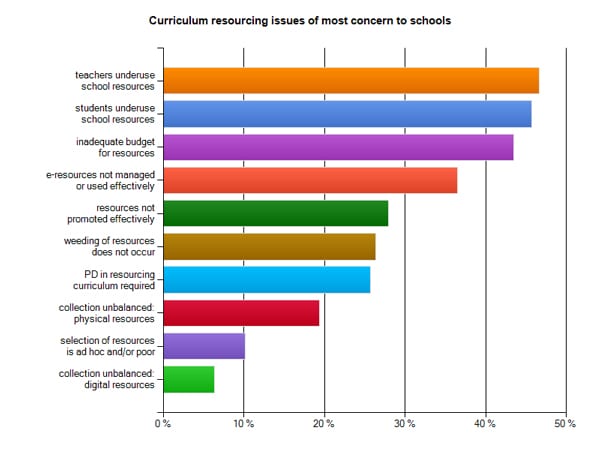
I discovered a new word today. Tsundoku, according to Macmilland Dictionary (2017) is the habit of purchasing and piling up books that never get read.  This seems rather wasteful when most libraries are suffering major budgetary concerns to waste precious funds on resources that are rarely used. Unfortunately in many school libraries the two biggest curriculum resourcing issues are that staff and students under utilise the resources followed quickly by funding pressures  (SCIS 2014).

I know at my school, we have an impressive 100 000 print copies of books plus additional eResources such as Wheelers ebooks, online databases, newspaper subscriptions and access to Clickview for interactive videos.  It is disappointing that even though our library is so well resourced, teachers and students seem to prefer to use google and youtube instead of accessing information from our library catalogue.  It seems preposterous to me that many of the school community were unaware we even had a library management system.  Their ignorance of the platforms we have in place, could extrapolate to acknowledging that lack of resource usage is proportional to the ability of the staff and students to use the OPAC system to identify and select resources.  

Something needs to change.  But what? The library collection development policy at the school endeavours to create a balanced collection that promotes teaching and learning as its primary goal.  Other aspects such as catering to diverse learners and fitting into the budget are also relevant. All the physical and digital assets meet the policy guidelines, which is why we have this policy but what is the point if they are under utilised? What else can we do in the library to promote our resources to the staff and students?  What can we do to remind them that we are not practitioners of Tsundoku?

I was musing about this problem when it occurred to me that many libraries fail in promoting their resources and capabilities.  How were the staff and students going to know about new or fabulous resources in the school library? How would we remind them of what is held within and what can be accessed?  It was then i remembered this post from Hamm (2016) who sends newsletters out to the faculty regularly advising them of the new and popular resources within the library. This idea seems magnificent to me as our school has several teachers who had no idea that we even subscribed to databases.  Their looks of pleasure and interest peaked when I explained how they could access with ease them from both work and home with just their device and password.  A quarterly newsletter published on the staff page of the school intranet would greatly improve our circulation at little cost to the library itself.  

So with these thoughts in mind I thought that for my particular independent high school library in the ACT there needs to be certain parameters necessary before a resources are added to the collection.

Firstly the information source MUST match the needs of the learning community.  It seems superfluous to point out that a resource is unlikely to be used if it is not relevant to the teaching and learning needs and must meet learning outcomes.  The next step is to ensure that the learner traits are accounted for. We have a wide range of student learning ‘attributes’ ranging from varied literacy levels, physical and mental handicaps that need to be catered for in a variety of formats to ensure equity is maintained for the entire student body.  One thing in particular our school library has done is acquire graphic novels of most of the major literature texts.  With many students of varying literacy levels and acknowledging our ‘reluctant’ readers still need to be able to engage with the text, we are trialing out graphic novels in print forms in several titles including classics such as Macbeth, Hamlet, To Kill a mockingbird and the Diary of Anne Frank with the student body.  Our Inclusive Education Team informs the library staff which students have been identified with low literacy levels and then these students are provided with audio books on an iPod as well as the physical text for their class work.  For our reluctant readers, graphic novels are popular as the combination of the text and imagery holds greater appeal. The inclusion of these texts has bolstered up our borrowing rates and appears to help students understand the task ahead.  We have also recently added Wheelers elibrary to our catalogue.  This has not been as popular as predicted but has provided access to resources for our vision challenged students.  Due to the nature of the licensing, only two ‘copies’ of a book can be ‘borrowed’ out at any particular time and this is restrictive with class texts.  The last consideration mentioned by Hughes-Hassel, S & Mancall (2005) is budget. Resources must fit within the budget in order it to be a viable purchase for the school.  We are very lucky in our school to have a principal that values education and our library budget is consistent.

We need a shift in attitude from Tsudonku.

References

Australian School Library Association / Australian Library and Information Services Association. (2001). Learning for the future. (2nd ed). Carlton South, Vic.: Curriculum Corporation.

BBC News (2018) Tsundoku: the art of buying books and never using them. Retrieved from https://www.bbc.com/news/world-44981013

Department of Education and Children’s Services, Government of South Australia. (2004). Choosing and using teaching and learning materials: guidelines for preschools and schools. Hindmarsh, South Australia : DECS Publishing

Hamm, S (2016) Library newsletters. Retrieved from https://www.teenservicesunderground.com/library-newsletters/

Hughes-Hassell, S. & Mancall, J. (2005). Collection management for youth: responding to the needs of learners Retrieved from http://ebookcentral.proquest.com.ezproxy.csu.edu.au/lib/csuau/detail.action?docID=289075

Johnson, P. (2009). Fundamentals of collection development and management [American Library Association version]. Retrieved from http://ezproxy.csu.edu.au/login?url=http://search.ebscohost.com/login.aspx?direct=true&db=nlebk&AN=267756&site=ehost-live

SCIS ( 2014) Survey of school library collections. Retrieved from ://www2.curriculum.edu.au/scis/connections/issue_88_2014/articles/school_library_collections_survey_2013.html

Resources for School Librarians () School library promotion through advocacy, special events and bulletin reports. Retrieved from http://www.sldirectory.com/libsf/resf/promote.html

Lawhimsy.com (2015) Word Nerd: Tsundoku. Retrieved from https://lawhimsy.com/2015/10/14/word-nerd-tsundoku/

Macmilllian Dictionary (2027)  https://www.macmillandictionary.com/dictionary/british/tsundoku