Augmented Reality in the classroom- Part 1

zedinteractive / Pixabay

The technology revolution, pervasive use of the internet and plethora of personal devices have changed the way society engages in employment, recreation, education and personal endeavours.

Educators need to keep abreast of emerging technologies so that they can ensure students possess the necessary digital skills and strategies to thrive in the 21st century  (Wolz, 2019).  Emanating software such as augmented and virtual reality are being trialed by many teachers seeking methods in which to improve engagement, bolster ICT acuity and meet the needs of the modern student.  This article seeks to define AR, identify its role in pedagogical practice, role in meeting curriculum outcomes, and inferences of future applications.  

WHAT IS AR 

Augmented reality (AR) is when a computer generated layer of information is placed over a person’s experience of the world (Townsdin & Whitmer, 2017; Oddone, 2019).  Wu, Lee, Chang & Liang (2013) define AR as technology that uses accurate 3D visual representations to combine real with virtual worlds.  Generally viewed using mobile device applications or wearable computers, AR displays the augmented media in the form of images, sounds, videos, graphics or GPS data (Townsdin & Whitmer, 2017; Wu et al. 2013). At this point, AR is already in use within military machinery, theatre, flight navigation, entertainment industry and various mobile applications, i.e. Pokemon Go (Pope, 2018a; Townsdin & Whitmer, 2017).  There are two forms of AR.  The first  form is when an interaction is stimulated between an image and a smart device, and the second is when the GPS triggers the digital information over the user’s location (Oddone, 2019, p.3).  Whereas virtual reality (VR) is when a user is completely immersed into an artificial world with the aid of technology (Oddone, 2019).  This technology has the ability to flood the senses and trick the mind into believing that the user is actually experiencing the event.  

AR resources are activated by an application that ‘reads’ a QR code, image or illustration so that the interactive content is released.   Levski (2018) points out that this added material could be as simple as a hidden photo or video, but could also be animated sequences or even an embedded game.  The addition of these interactive elements is based upon the gamification principle, which relies on positive feedback to keep students motivated.  By supporting interaction between the real and virtual world, AR allows the user to actively manipulate a tangible interface and thus increase the learner engagement and boost information retention (Saidin, Abd Hali & Yahaya, 2015; Wolz, 2019).  This interaction means that AR is self paced, promotes independent learning and allows students to progress at their own cognitive capabilities.  There is great potential for AR in educational practices, it can be embedded into print or digital resources, used across disciplines, and its multimodal nature gives diverse learners multiple entry points into the content (Levski, 2018).  

References:

Levski, Y. (2018). 10 Augmented Reality Books That Will Blow Your Kid’s Mind. AppReal- VR [Blog]. Retrieved from https://appreal-vr.com/blog/10-best-augmented-reality-books/

Oddone, K. (2019). Even better than the real thing? Virtual and augmented reality in the school library. SCIS Connections. (110). Retrieved from https://www.scisdata.com/media/1921/scis-connections-110.pdf

Pope, H. (2018a). Virtual and augmented reality in libraries. Library Technology Reports – American Library Association, (54)6.

Saidin, N. Abd Halim, N., & Yahaya, N. (2015). A review of research on augmented reality in education: Advantages and applications. International Education Studies, 8(13). Retrieved from http://citeseerx.ist.psu.edu/viewdoc/download?doi=10.1.1.730.8456&rep=rep1&type=pdf

Townsdin, S., & Whitmer, W. (2017). Technology. Public Services Quarterly. 13. Pp190-199. DOI: 10.1080/15228959.2017.1338541

Wolz, K. (2019). Building faculty competence and self efficacy for using ZSpace virtual reality (VR) software in the classroom. All Regis University Theses. Retrieved from https://epublications.regis.edu/cgi/viewcontent.cgi?article=1930&context=theses

Wu, H., Lee, S., Chang, H., & Liang, J. (2013). Current status, opportunities and challenges of augmented realiy in education. Computers & Education, 62. Pp41-49. Retrieved from https://doi.org/10.1016/j.compedu.2012.10.024

Location Learning – Virtual reality in the classroom.

When COVID-19 ruins your plans!

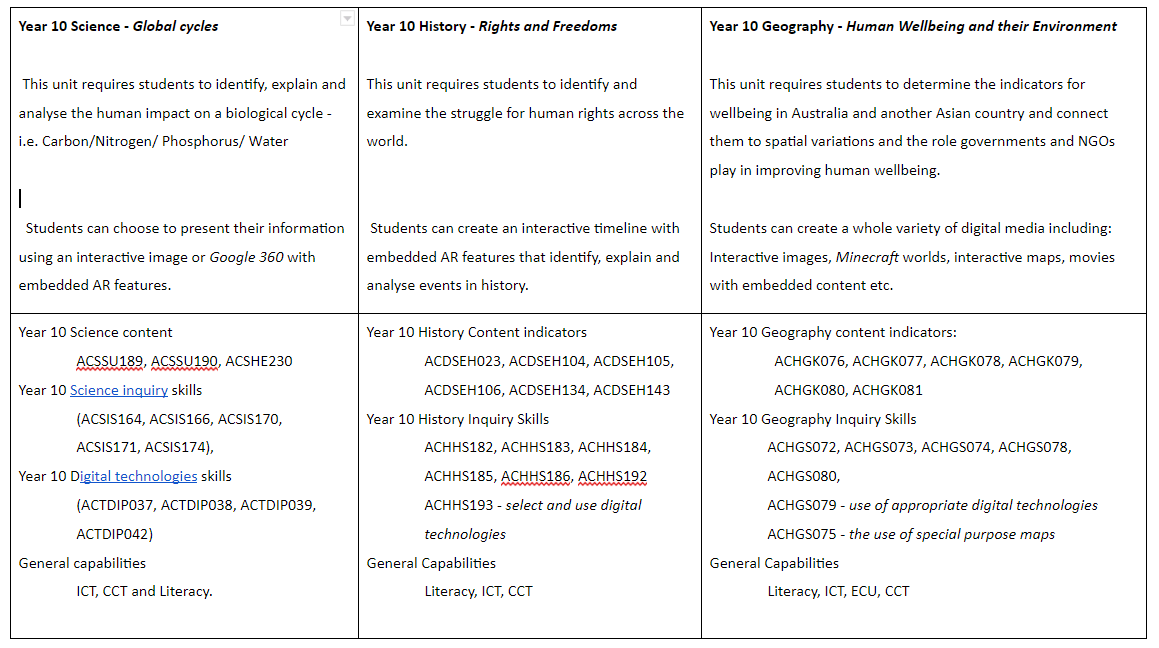
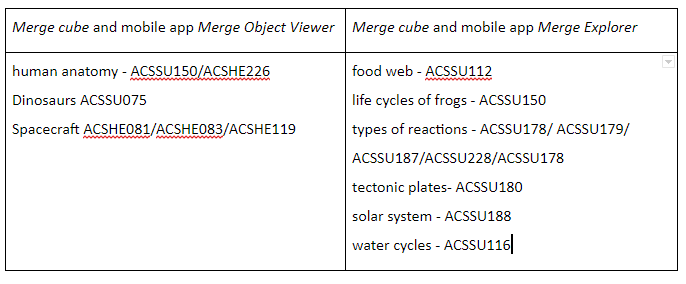
The group of Year 8 students had just finished a unit of work on the history of the Catholic Church from the fall of Rome to the Reformation as part of their Religious Education subject (Curriculum link – ACDSEH052/ ACDSEH054).  At the culmination of the semester, they were supposed to go on an excursion to explore the various different Christian churches and analyse how their structure, design, and use of symbols support faith based practices (Curriculum link – ACAVAM119/ACHASSK198). 

However, the COVID-10 pandemic and resulting restrictions prevented that adventure.  Therefore, in an effort to address the gap in their learning, the teacher librarian and classroom teacher collaborated to create a lesson that would virtually explore various churches by introducing emerging technologies in the form of virtual reality to the classroom with Google Cardboard and Google Streetview.  In the process students would learn essential note taking skills using a graphic organiser and paragraph writing skills.   Evidence of learning would be the written TEXAS or TEEL paragraph illustrating their analysis of the building structure and design and how it supports faith practices and community. 

Rosenblatt’s reader response theory was the underlying pedagogical principle for this activity (Woodruff & Griffin, 2017, p.110).  Commonly used in literature circles, Rosenblatt’s constructivist theory acknowledges each student’s contribution as valid, which enables them to become active agents in their own learning, and the activity appropriate for a diverse classroom (Woodruff & Griffin, 2017, p.109-110).  However, instead of investigating texts in a literature circle, the students investigated and analysed religious sites in a similar immersive experience.  This virtual exploration required them to combine the new visual information to their own prior experience in order to create new knowledge (Woodruff & Griffin, 2017, p.111).  The collaborative atmosphere allows students to have an equal exchange of ideas, increases their problem solving skills as well as developing interpersonal skills and promotes collegian discussion  (ACARA, 2014a; Tobin, 2012, p. 41).  

The students were given a choice of six different churches to visit and had to select three for comparison purposes.  As location was no longer an issue, the TL identified a variety of churches from different Christian denominations across the world that were suitable.  It is important that careful research be undertaken to ensure that the sites are accessible freely via Google Streetview and the associated images provide relevant information.  

The students were requested to note down the similarities and differences between the different types of churches using a triple venn diagram.  This part of the task involved student collaboration and ideally students would have selected a different church site each and then shared their information through discourse.  However this did not happen as the students all looked at sites sequentially rather concurrently, which was a poor use of time from a teacher perspective, but did increase the length and breadth of discourse.  

Teaching note taking and the use of graphic organisers simultaneously was a pedagogical strategy.  Note taking is an essential skill that needs to be explicitly taught across the curriculum as the style of note taking and vocabulary choice will vary depending on the discipline.  Good note takers have generally higher academic outcomes because they are able to succinctly summarise ideas, concepts and information using their own vernacular, and then use their notes to create content to communicate their understanding and analysis (Stacy & Cain, 2015).  Graphic organisers have been proven to improve learning outcomes because it increases connections between ideas, and organises information in a visual and spatial manner (McKnight, n.d.; Mann, 2014).  By utilising the two strategies together, the students are given an opportunity to explore different methods of learning which they can use throughout their learning both in and outside classroom walls.  

Good notes lead to a strong author’s voice and content in paragraphs.  The culmination of the task required students to create a paragraph identifying and describing the structure of the church and its alignment to faith based practices, as well as evaluating how the design of the church’s spiritual and aesthetic design holds value to their congregation and society.   The question was created using Bloom’s taxonomy of cognitive domains so that all the diverse learning needs of the class would be catered for appropriately (Kelly, 2019b). 

Questions are an intrinsic and ancient practice of teaching (Tofade, Elsner & Haines, 2013).  Carefully designed questions are all features of good pedagogical practice and are able to, stimulate thinking, promote discourse, further connections between prior and new knowledge as well as encourage subject exploration. (Tofade et al., 2013).  Teachers that stage questions in order of Bloom’s taxonomy are addressing all the cognitive domains, as well as building students to achieve that higher order thinking (Tofade et al., 2013).  

The virtual exploration of churches around the world was designed to compensate students for their inability to connect their learning to the real world to the pandemic.  The task overtly sought to get students to experiment with emerging technologies, work in collaborative groups and communicate their learning in written form.  In addition students covertly learned to note take using graphic organisers, engage in collegial discourse and use Bloom’s taxonomy to work toward higher order thinking.  These skills are in addition to the content learning outcomes and even if the students did not learn any new content, they had a good crack at learning some valuable skills!  

Curriculum links:

Overall content outcomes:

  • ACDSEH052Dominance of the Catholic Church and the role of significant individuals such as Charlemagne
  •  ACDSEH054Relationships with subject peoples, including the policy of religious tolerance 
  • ACAVAM119Analyse how artists use visual conventions in artworks
  • ACTDIP026 – Analyse and visualise data using a range of software to create  information, and use structured data to model objects or events 
  • ACHASSK198 – Identify the different ways that cultural and religious groups express their beliefs, identity and experiences
  • ACELA1763 – writing structured paragraphs for use in a range of academic settings such as paragraph responses, reports and presentations. 
  • ACELY1810 – Experimenting with text structures and language features to refine and clarify ideas and improve text effectiveness. 

                   (ACARA, 2014h; ACARA, 2014i; ACARA, 2014j)

Using VR

  • GC – ICT -Locate, generate and access data and information  
  • GC – CCT –  Identify and clarify information and ideas
  • GC – Literacy – Understanding how visual elements create meaning (ACARA, 2014c; ACARA, 2014b; ACARA, 2014h)

Graphic organisers

  • GC – CCT – 
    • Organise and process information
    • Imagine possibilities and connect ideas                (ACARA, 2014b)

Collaborative Learning groups

  • GC – PSC
    • Appreciate diverse perspectives
    • Understand relationships
    • Communicate effectively
    • Work collaboratively
    • Negotiate and resolve conflict

                                   (ACARA, 2014d)

TEXAS Paragraph

GC – IC – 

  • Investigate culture and cultural identity
  • Explore and compare cultural knowledge, beliefs and practices

GC – Literacy 

  • Compose spoken, written, visual and multimodal learning area texts
  • Use language to interact with others
  • Use knowledge of text structures
  • Express opinion and point of view
  • Understand learning area vocabulary

(ACARA, 2014f; ACARA, 2014c)

REFERENCES

ACARA. (2014a). Personal and social capability. General Capabilities Curriculum.  Educational Services Australia. Retrieved from https://www.australiancurriculum.edu.au/f-10-curriculum/general-capabilities/personal-and-social-capability/

ACARA. (2014b). Creative and critical thinking continuum.  F-10 Curriculum – General Capabilities Curriculum. Educational Services Australia.  Retrieved from  https://www.australiancurriculum.edu.au/media/1072/general-capabilities-creative-and-critical-thinking-learning-continuum.pdf

ACARA. (2014c). Literacy continuum. F-10 Curriculum – General Capabilities Curriculum. Educational Services Australia. Retrieved from https://www.australiancurriculum.edu.au/media/3596/general-capabilities-literacy-learning-continuum.pdf

ACARA. (2014d). Personal and social capabilities continuum. F-10 Curriculum – General Capabilities Curriculum. Educational Services Australia. Retrieved from https://www.australiancurriculum.edu.au/media/1078/general-capabilities-personal-and-social-capability-learning-continuum.pdf

ACARA. (2014e). Ethical understanding continuum. F-10 Curriculum – General Capabilities Curriculum. Educational Services Australia. Retrieved from https://www.australiancurriculum.edu.au/media/1073/general-capabilities-ethical-understanding-learning-continuum.pdf

ACARA. (2014f). Intercultural understanding continuum. F-10 Curriculum – General Capabilities Curriculum. Educational Services Australia. Retrieved from https://www.australiancurriculum.edu.au/media/1075/general-capabilities-intercultural-understanding-learning-continuum.pdf

ACARA. (2014h). Information and communication technology capability learning continuum. F-10 – General Capabilities Curriculum. Educational Services Australia. Retrieved from https://www.australiancurriculum.edu.au/media/1074/general-capabilities-information-and-communication-ict-capability-learning-continuum.pdf

ACARA. (2014h). English. F-10 – General Capabilities Curriculum. Educational Services Australia. Retrieved from https://www.australiancurriculum.edu.au/f-10-curriculum/english/?strand=Language&strand=Literature&strand=Literacy&capability=ignore&priority=ignore&year=11582&elaborations=true&el=15718&searchTerm=TEEL+paragraph#dimension-content

ACARA. (2014i). History Curriculum. F-10 Curriculum – Humanities and Social Sciences Curriculum. Educational Services Australia. . Retrieved from https://www.australiancurriculum.edu.au/f-10-curriculum/humanities-and-social-sciences/history/

ACARA. (2014j). Visual Arts Curriculum. F-10 Curriculum – Humanities and Social Sciences Curriculum. Educational Services Australia. . Retrieved from https://www.australiancurriculum.edu.au/f-10-curriculum/the-arts/visual-arts/

Kelly, M. (2019a). Organising compare-contrast paragraphs. ThoughtCo [Blog]. Retrieved from https://www.thoughtco.com/organizing-compare-contrast-paragraphs-6877

Kelly, M. (2019b). Bloom’s taxonomy in the classroom. ThoughtCo [Blog]. Retrieved from https://www.thoughtco.com/blooms-taxonomy-in-the-classroom-8450

Mann, M (2014). The effectiveness of graphic organisers on the comprehension of social studies content by students with disabilities. Marshall University Theses, Dissertations and Capstones. Retrieved from https://mds.marshall.edu/cgi/viewcontent.cgi?referer=&httpsredir=1&article=1895&context=etd

McKnight, M. (n.d.). Use graphic organisers for effective learning. TeachHUB.com. Retrieved from https://www.teachhub.com/teaching-graphic-organizers

Stacy, E., & Cain, J. (2015). Note taking and handouts in the digital age. American Journal of Pharmaceutical Education (79) 7. Retrieved from https://www.ncbi.nlm.nih.gov/pmc/articles/PMC4812780/

Tobin, M. (2012). Digital storytelling: Reinventing literature circles. Fischer College of Education. 12. NSU. Retrieved from https://nsuworks.nova.edu/cgi/viewcontent.cgi?article=1000&context=fse_facarticles

Tofade, T., Elsner, J., Haines, S. (2013). Best practice strategies for effective use of questions as a teacher tool. American Journal of Pharmaceutical Education 77 (7). Retrieved from https://www.ncbi.nlm.nih.gov/pmc/articles/PMC3776909/.

Woodruff, A., & Griffin, R. (2017). Reader response in secondary settings: Increasing comprehension through meaningful interactions with literary texts. Texas Journal of Literacy Education (5) 2 pp.108-116. Retrieved from https://files.eric.ed.gov/fulltext/EJ1162670.pdf


Breaking down the barriers

Breaking down the barriers


Break out boxes are a fabulous activity that engage and excite students of all ages.  These boxes mirror how an escape room works in that students puzzle their way through to find the code that will unlock the box and obtain their prize! 

These boxes were amazing all throughout book week!! My fabulous colleague Jordan is a whiz at creating activities that stimulate the brain, evoke critical thinking, creativity, collaboration and communication.   Using the Critical and creative thinking continuum from the General capabilities, the puzzles were selected to address the various strands at the appropriate stage for each class.  Our students were thoroughly engaged in the pursuit of a grand prize.  TBH, the grand prizes were lollies as that was what the budget permitted.  

The boxes were such a hit that we have been clamoured with requests to repeat them with other classes.  The 2IC of RE has asked the boxes be available for Year 8 RE to sum up their World Religions unit at the end of next term as well as 7 RE for their unit on ‘Gospels, Parables and Miracles’.  9 History wants it for exam preparation in two weeks. 10 English want it next week to reinvigorate the flagging interest in ‘Lord of the flies’ that I have previously grumbled about.   We even managed to get an elusive science class requesting it – 11 Biology is going to trial one to introduce the next unit of work.  

So what does this mean for us as a TL?

Besides embedding the Gen Caps into the teaching and learning, breakout boxes draw in the skeptical teachers by breaking down barriers.  We all know there are teachers in every school that have strong aversions to libraries and teacher librarians.  There are ones that are not sure of what a TL can contribute to the classroom, and others that avoid the library like its a contagious disease.  Some are not even sure why we are there at all!

We have found that breakout boxes are so captivating that its plainly obvious how it can work in the classroom teacher’s favour.  But this indulgence comes at a cost…  They need to book a TL to do this activity either in the library or their classroom.  And maybe then they will see, we aren’t all that scary.  And then… maybe then, they will come back, to borrow books, request teaching spaces and most importantly, collaborate together in planning units of work.  

Maybe then they will understand what we do, and who we are.

Now who is feeling smug?

(my HOD…  this whole concept wasnt my idea, but as my HOD and colleagues are not going to blog about it. I might as well)

Where was that green sheep (cake)?

Can you see the green sheep (cake)?


Getting the word about Book week out.  We have asked the kids to bring in food that has a book theme.  They will be judged and then prizes awarded before selling them to raise money for the Pajama Foundation.  We had a lovely student bring in some a few days early to drum up support.  So far we have had 40 students agree to bring in something delectable for next week.

stay tuned …

Out of the Box!

How do you teach students about the context behind texts such as Jackie French’s Hitler’s daughter or William Golding’s Lord of the flies to very disinterested teens? 

I am not sure about you but I found both those books dull, dry and depressing as a teen; and I will say they have not improved with age!

Our graduate English teachers were struggling with the rampant disengagement with those two novels.  The indifference was causing the teachers great distress as they were concerned how the students were going to submit their essay assessment task if they would not engage with the book.    More experienced teachers were able to forge through the disengagement but our newest recruits were finding teaching the text challenging.

It then occurred to me that memorial boxes could be the answer!

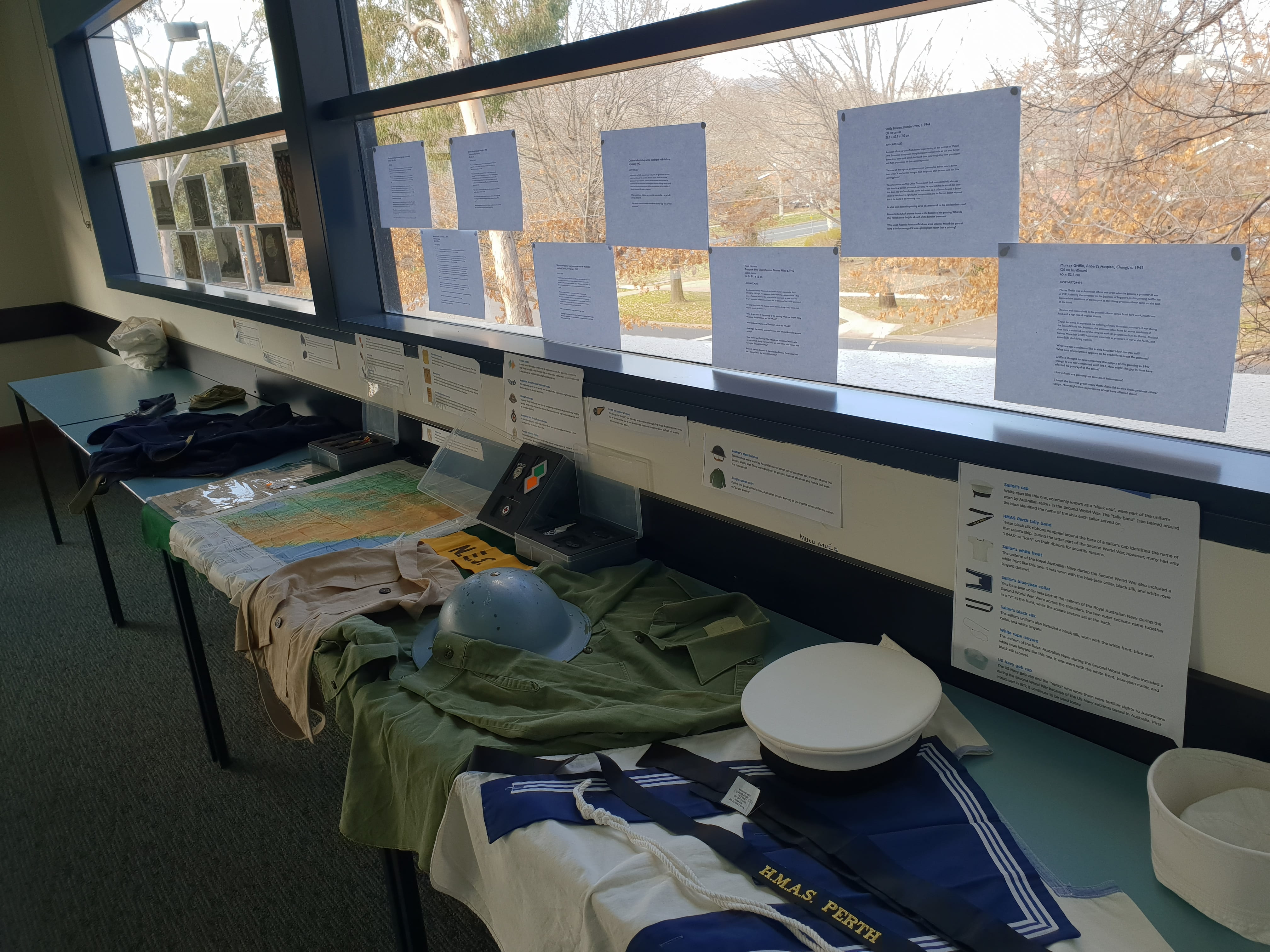
WW2 Memorial Box set up

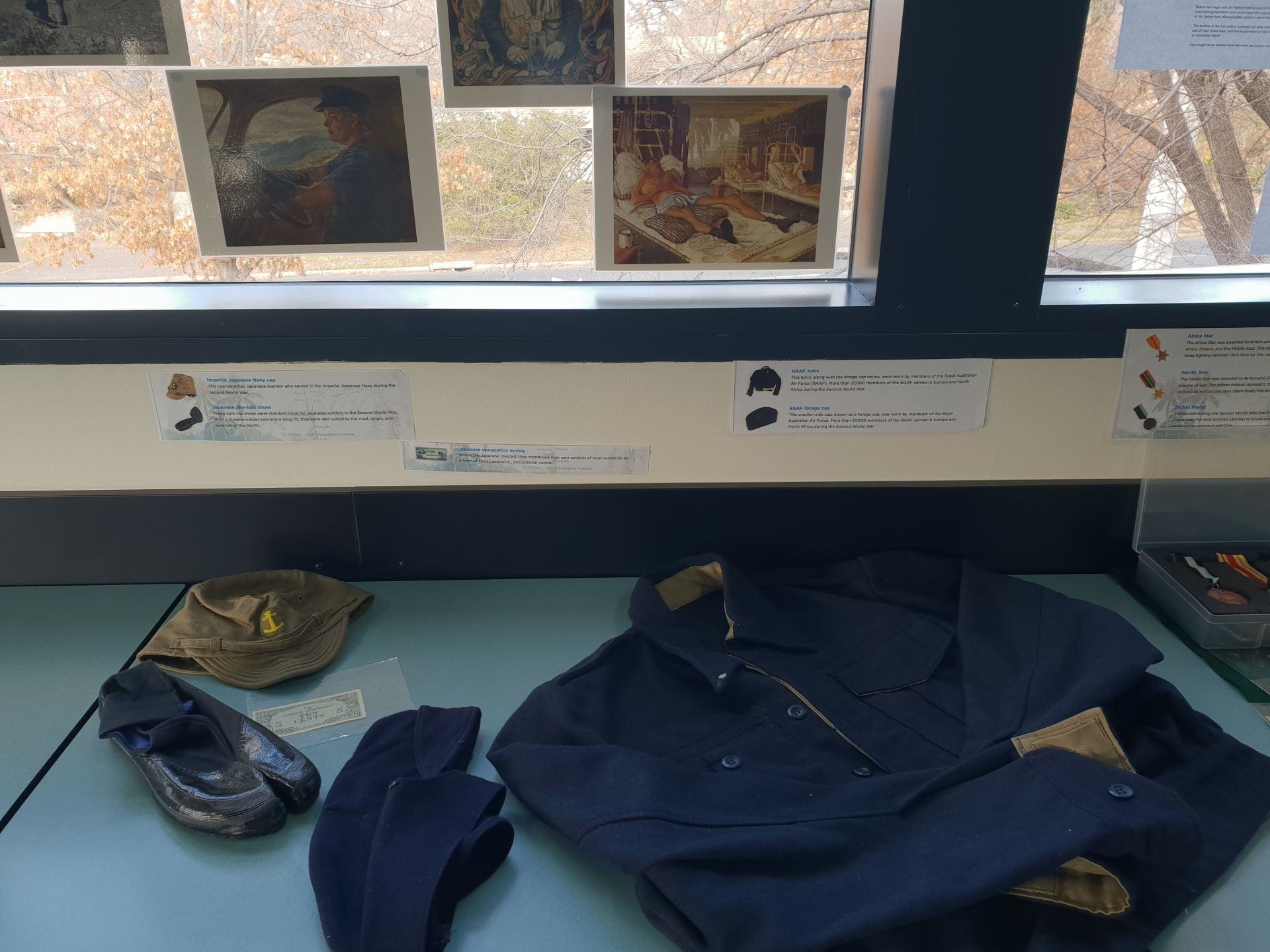
I had discovered that the Australian War Memorial had a whole host of educational resources available for loan to schools in the form of memorial boxes.  These boxes contain genuine artifacts from various military events in Australian history. I had requested a box for our 10 History classes earlier this semester as a ‘hook’ factor to engage and elicit interest at the commencement of their World War 2 unit.  

Artifacts from the memorial box

My cognitive connection between our great English dilemma and the memorial box was very much delayed!  It wasn’t until I was unpacking the resources in our library seminar room that it occurred to me that the same artifacts that were engaging our Year 10 history students could also stimulate our year 7 and 10 English students. 

I had an epiphany of sorts!

I was so happy my HOD agreed with my madcap proposal about using the memorial box as a stimulus for English.  The scheme was simple.  The students would come to our ‘library museum’ and view the various artifacts displayed within. Then in pairs, the students would interview each other to create a podcast with an accompanying transcript.  A very clever English teacher quickly whipped up a worksheet  and then, just like that… our immersive experience had begun.

Pictures and Memorabilia

Now I would love to tell you it was all a huge success, but I would be lying. 

The memorial boxes were a great triumph with our 10 History students but success was variable with our English classes.  This lackluster response could be attributed to the inadequate time for the students to complete the activity. The classes that visited the library twice had more success than ones that came just once. 

What we did discover was that students were stirred out of the apathetic stance towards the books because they began to understand the context  surrounding it. The memorial box activity connected the students to the mileu of the books and engaged them in the character’s turmoil.  As the worksheets were collected at the end of the session, the teachers were able to use those responses to formatively assess student literacy and other learning goals.  

The focus of a school library has changed in the past decade from archivist and curator of information to being an active facilitator of knowledge both physical and digital.  This means that teacher librarian may need to think out side the box for some more out of the box thinking!

The in class essays are all occurring this week for year 7 and next week for year 10.  I would be very intrigued to know if the memorial boxes assisted in increasing student engagement with the books and the outcome of the assessments.  I would also like to analyse the results of the English classes that declined to attend our library museum and compare them to the classes that did come.  If there is a significant difference, then I would have sufficient evidence to run this activity for more teachers and students.  

I await reporting time with great avidity.

Its more than just a place for books. Its a place of safety.


eslfuntaiwan / Pixabay

Lunchtime in`my school library is always an interesting event.  We have 1500 students from years 7-12 on a single co-educational campus.  On some days, we would easily see 500-600 bodies wander through our doors.  Most lunchtimes we average about 120-150 students per day but on busy days, the numbers peak at around 220 during the lunch rush.  We obviously host various members of the whole school community but the main people that find joy in the library include, our senior students; lunchtime minecrafters, gamers and social misfits.  

Our library is a haven for many of our students.  They seem to find refuge within our walls. Our biggest clientele are our seniors; who have the freedom to wander to the local shops, cafes and parklands but somehow prefer to be sprawled across the beanbags retellíng fart jokes (or worse) or playing Uno or Chess in their study area.  I’d like to say they were coming as they love my company, but I’d be lying.  What they do love is our temperature controlled climate, our beanbag zone and free wifi.  Whilst some of our seniors do study in their frees/study lines; most of them tend to play on their phones and or watch videos on their devices.  We used to rouse on them… reminding them that study lines were for study. But then we realised that the reasons our seniors visited us was that they felt safe and happy here; and not because they wanted to use the resources.  For these students – the library was a source of wellbeing.

AdultsOnlyMinecraft / Pixabay

Another demographic that truly enjoys the library are our little minecrafters.  These little year 7 & 8 boys (mostly, with the odd girl) race to the library before school, recess and lunchtime EVERYDAY to play minecraft.  They get so excited when they line up outside our cyber room. I tend to walk VERRRYYY slowly up to them drawling my Hellos and social chatter.  Their impatience is palpable. You can see their little shoulders rising and hands itching to log on.   So I stop, ask them about their day, query the state of the weather or some small talk; only to have one of them finally ask;


“Miss!  Can you please just open the door and then talk?”.  


“OF COURSE boys!! Silly me… just jabbering on like a turkey on thanksgiving.  Have… “


“Miss!! The door!!”


Then I open the door and in whoooooooooooooooosh go all the boys (and odd girl).  They speedily log on and start to build stuff and kill each other (online only) in Minecraft  world.  The happiness in that room is patently visible and a better beacon of hope than any Patronus that Harry could ever make.  


I have a very astute department head that saw a need for a wellbeing space within our school and set up a section of the library to fill the emotional buckets of our students.  We currently own about 10 different types of board games, 10 packs of uno cards and another 10 packs of playing cards. Well we start every semester with those numbers…. They do get lost, misplaced… go on walkabout, etc … BUT, our games are so popular that they fly off the shelves as the kids bolt in at the start of lunch.  The seniors tend to take most or all the UNO cards, till I discovered some year 8 girls were hiding sets under a shelving unit between lunch breaks to get ahead.

SNAP!     422737 / Pixabay


SHHEESSH that was sneaky… admirable.. Yet sneaky… well done girls!  


Our board games range from the classics such as battleship, scrabble and chess to other games like dungeons and dragons, connect 4 and backgammon.  We have now added a puzzle corner (a 5000 piece work in process, that i think may amuse the staff more than the students) and a box of lego for our sensory kids.  

As I sat at my desk last Friday afternoon after school, I watched my usual suspects lounge around the beanbags.  A great sense of protectiveness rose from me about their welfare. I know Tom# is having a rough time at school as he has argued with his mates.  I know James# is exhausted from footy training 3x week and is barely keeping up at school (he naps in the cushions most afternoons and I have to wake him up when I close the library up). I know Alice# is unhappy about having to move interstate next semester; Ethan# is angry that he didn’t get picked for the football team; Sophie# broke up with the boyfriend; Andrew’s# anti depressants are wearing off; and Gina# is not getting along with her mum.  I also know that Steve# drinks too many energy drinks and Miki# has fallen in love with another idiot boyfriend.

sweetlouise / Pixabay

For some of our students, the library staff are the ones that see them the most frequently.  I know with my usual crew, I see them before school, recess, lunch and after school. Then you can add the number of free periods they spend in the library plus the classes they play truant for whilst they spend time within our walls.  This means, that it is highly likely that we are the most frequently seen adults in their life after their parents. And for many of our students who have busy households; I may just be the adult that they see the most often.

Graehawk / Pixabay

Libraries are a place where you can find and use information.  They are also a place of recreation and wellbeing. A school library is a place where students should be able to read, study, learn, recreate and relax.  My department head said that there are four fundamental aspects to being a school teacher librarian. The first is Research – which is understandable as TL are information specialists.  The second is Resources – obviously as libraries have collections. Collaboration is the third pillar. TL need to collaborate with their colleagues to ensure that teaching and learning continues to thrive.  And lastly, Wellbeing. Libraries are a place of wellbeing for students. Besides providing resources for learning, we also need to provide resources to improve student wellbeing. Think of Maslow’s hierarchy of needs…. Unless we address the needs of students to feel like they belong to a community, then we cannot expect them to reach self actualisation.  


So when the little darlings are bumming around in the library telling another ‘fart joke’ that obviously isn’t funny to my middle aged brain, I take a deep breath.   I certainly do not want them to feel like they cannot come back to their safe place. I don’t want to rouse on these kids if they like to chill in the library, sprawled across the beanbags like giant squid. So instead of getting cranky when I hear bad jokes or when they play battleship, I only tell them to quieten down so they don’t disturb others.  The thing is that I only cranky if I can HEAR them play the game.  Afterall, what I cannot see nor hear, I can’t get upset with 😉


#student names have been changed.

Module 2.3 – Bundled together

stevepb / Pixabay


Bundling is a marketing concept where complementary goods and or services are collated and marketed at a sale price that seemingly appears to be lower than the collective price of the individual prices (businessdirectory.com). For libraries, bundling seems to proliferate among the educational sector as a system of obtaining a range of resources (either print or online) to booster up the collection of the library (som.yale.edu).  For a regular fee, retailers or providers, provide a range of resources that would appeal to a majority for a ‘reduced’ cost. In theory, bundling can be cost effective as the prices are lower due to the group discount and there usually is a range of sources. In reality there are a host of possible problems that can affect the quality and breadth of a library collection.

 As a high school library servicing students from years 7-12 we have access to databases to ensure our students are able tor research.  Like many other colleges and universities around the world, we have subscribed to a ‘BIG DEAL’ journal package. Machovec (2014) surmises that the advent of the internet and movement of journals from print to digital has lead publishers to creating “packages either in subject collections or as complete sets”.  To put it bluntly, its a ‘one size fits all’ that has a fixed fee and the lure that one can easily forecast into future budgets with its often temporary price-cap time period (Frazier 2001). Carson and Pope (2009) point out that licencing thus pricing is a major issue as should a library decide against a subscription or part of a subscription, it could lead to complete lack of access to both “previously subscribed or future content” (Carson & Pope, 2009).  This can have ramifications as libraries will be unable to provide the much needed access that is required by Freedom of Information Act 1982 (OIAC, n.d.).

 The other issue with online journal bundling is that often essential or important journals are aligned with weaker and irrelevant titles and the library is unable to disentangle and separate the wheat from the chaff.  The follow on from this ‘equality’ among journals is that lower quality ones continue to thrive as their sales targets are being met. Additionally, the seemingly successful low quality journal continues to thrive and newer, more astute publications often struggle to compete with them as they are not affordable once the libraries pay out their fee for a Big Deal package.  Market control much? Libraries and librarians are unable to supply their local community with materials that are relevant to them. (Machovec, 2014)

 With print books ie from Lamont books or Australian standing orders, books are preselected by the retailer and then sent to the schools for their perusal.  In our school, we have Standing orders and Lamont sends over books intermittently for our perusal. What we have noticed is that all the books sent over are rarely read by our student population.  Granted that there would be a few books that appeal to the demographics at our school but the majority just move to the shelves and become attractive dust catchers for the rest of their life till Marie Kondo appears.  We have also noticed that controversial books and challenging books are not always in the order and we often have to go and order them separately from booktopia.com.au or bookdepository.com to add balance. This why bundling of library resources does not always work as the only source of material for a collection.

 As a school library, we are mandated by ALIA’s tenants that our collection suits our students and staff.  Breeding (2019) points out that library staff “should be able to evaluate and acquire preferred products in each category and not be locked into a bundle”. We know what our students want and need, it feels that our collection should be based upon the ‘wants and needs’ of our community.  It appears that bundling, whilst a cheaper option up front, may not be necessarily the best.


References

Business.dictionary.com (N.D) Bundling. Retrieved from http://www.businessdictionary.com/definition/bundling.html

ALIA (2016) Guidelines, standards and outcome measures for Australian public libraries. Retrieved from https://read.alia.org.au/sites/default/files/documents/guidelines_standards_and_outcome_measures_for_australian_public_libraries.pdf

Breeding, M., (2019). Discovery Services. American Libraries. Jan/Feb2019, 50 (1/2), p71. Retrieved from http://web.b.ebscohost.com.ezproxy.csu.edu.au/ehost/pdfviewer/pdfviewer?vid=8&sid=dc4a076e-7901-44ba-aceb-c3fe854d74bd%40pdc-v-sessmgr05

Frazier, K. (2001). The librarians’ dilemma: Contemplating the costs of the ‘big deal’. D-Lib magazine, 7(3), 1–9. doi: 10.1300/J123v48n01_06

Machove. G., (2014) Consortial and the future of the big deal journal packages. Journal of Library Administration. Oct2014, 54 (7), p629-636. DOI: 10.1080/01930826.2014.96403.

OIAC (N.D) Freedom of Information Act 1982.  Retrieved from https://www.oaic.gov.au/freedom-of-information/rights-and-responsibilities

Module 1 – Library Collections

I discovered a new word today. Tsundoku, according to Macmilland Dictionary (2017) is the habit of purchasing and piling up books that never get read.  This seems rather wasteful when most libraries are suffering major budgetary concerns to waste precious funds on resources that are rarely used. Unfortunately in many school libraries the two biggest curriculum resourcing issues are that staff and students under utilise the resources followed quickly by funding pressures  (SCIS 2014).

I know at my school, we have an impressive 100 000 print copies of books plus additional eResources such as Wheelers ebooks, online databases, newspaper subscriptions and access to Clickview for interactive videos.  It is disappointing that even though our library is so well resourced, teachers and students seem to prefer to use google and youtube instead of accessing information from our library catalogue.  It seems preposterous to me that many of the school community were unaware we even had a library management system.  Their ignorance of the platforms we have in place, could extrapolate to acknowledging that lack of resource usage is proportional to the ability of the staff and students to use the OPAC system to identify and select resources.  

Something needs to change.  But what? The library collection development policy at the school endeavours to create a balanced collection that promotes teaching and learning as its primary goal.  Other aspects such as catering to diverse learners and fitting into the budget are also relevant. All the physical and digital assets meet the policy guidelines, which is why we have this policy but what is the point if they are under utilised? What else can we do in the library to promote our resources to the staff and students?  What can we do to remind them that we are not practitioners of Tsundoku?

I was musing about this problem when it occurred to me that many libraries fail in promoting their resources and capabilities.  How were the staff and students going to know about new or fabulous resources in the school library? How would we remind them of what is held within and what can be accessed?  It was then i remembered this post from Hamm (2016) who sends newsletters out to the faculty regularly advising them of the new and popular resources within the library. This idea seems magnificent to me as our school has several teachers who had no idea that we even subscribed to databases.  Their looks of pleasure and interest peaked when I explained how they could access with ease them from both work and home with just their device and password.  A quarterly newsletter published on the staff page of the school intranet would greatly improve our circulation at little cost to the library itself.  

So with these thoughts in mind I thought that for my particular independent high school library in the ACT there needs to be certain parameters necessary before a resources are added to the collection.

Firstly the information source MUST match the needs of the learning community.  It seems superfluous to point out that a resource is unlikely to be used if it is not relevant to the teaching and learning needs and must meet learning outcomes.  The next step is to ensure that the learner traits are accounted for. We have a wide range of student learning ‘attributes’ ranging from varied literacy levels, physical and mental handicaps that need to be catered for in a variety of formats to ensure equity is maintained for the entire student body.  One thing in particular our school library has done is acquire graphic novels of most of the major literature texts.  With many students of varying literacy levels and acknowledging our ‘reluctant’ readers still need to be able to engage with the text, we are trialing out graphic novels in print forms in several titles including classics such as Macbeth, Hamlet, To Kill a mockingbird and the Diary of Anne Frank with the student body.  Our Inclusive Education Team informs the library staff which students have been identified with low literacy levels and then these students are provided with audio books on an iPod as well as the physical text for their class work.  For our reluctant readers, graphic novels are popular as the combination of the text and imagery holds greater appeal. The inclusion of these texts has bolstered up our borrowing rates and appears to help students understand the task ahead.  We have also recently added Wheelers elibrary to our catalogue.  This has not been as popular as predicted but has provided access to resources for our vision challenged students.  Due to the nature of the licensing, only two ‘copies’ of a book can be ‘borrowed’ out at any particular time and this is restrictive with class texts.  The last consideration mentioned by Hughes-Hassel, S & Mancall (2005) is budget. Resources must fit within the budget in order it to be a viable purchase for the school.  We are very lucky in our school to have a principal that values education and our library budget is consistent.

We need a shift in attitude from Tsudonku.

References

Australian School Library Association / Australian Library and Information Services Association. (2001). Learning for the future. (2nd ed). Carlton South, Vic.: Curriculum Corporation.

BBC News (2018) Tsundoku: the art of buying books and never using them. Retrieved from https://www.bbc.com/news/world-44981013

Department of Education and Children’s Services, Government of South Australia. (2004). Choosing and using teaching and learning materials: guidelines for preschools and schools. Hindmarsh, South Australia : DECS Publishing

Hamm, S (2016) Library newsletters. Retrieved from https://www.teenservicesunderground.com/library-newsletters/

Hughes-Hassell, S. & Mancall, J. (2005). Collection management for youth: responding to the needs of learners Retrieved from http://ebookcentral.proquest.com.ezproxy.csu.edu.au/lib/csuau/detail.action?docID=289075

Johnson, P. (2009). Fundamentals of collection development and management [American Library Association version]. Retrieved from http://ezproxy.csu.edu.au/login?url=http://search.ebscohost.com/login.aspx?direct=true&db=nlebk&AN=267756&site=ehost-live

SCIS ( 2014) Survey of school library collections. Retrieved from ://www2.curriculum.edu.au/scis/connections/issue_88_2014/articles/school_library_collections_survey_2013.html

Resources for School Librarians () School library promotion through advocacy, special events and bulletin reports. Retrieved from http://www.sldirectory.com/libsf/resf/promote.html

Lawhimsy.com (2015) Word Nerd: Tsundoku. Retrieved from https://lawhimsy.com/2015/10/14/word-nerd-tsundoku/

Macmilllian Dictionary (2027)  https://www.macmillandictionary.com/dictionary/british/tsundoku