
Ready for tomorrow’s storytime.

Literacy, learning and literature are at the heart of excellent teacher librarian practice.
Ready for tomorrow’s storytime.

Lunchtime in`my school library is always an interesting event. We have 1500 students from years 7-12 on a single co-educational campus. On some days, we would easily see 500-600 bodies wander through our doors. Most lunchtimes we average about 120-150 students per day but on busy days, the numbers peak at around 220 during the lunch rush. We obviously host various members of the whole school community but the main people that find joy in the library include, our senior students; lunchtime minecrafters, gamers and social misfits.
Our library is a haven for many of our students. They seem to find refuge within our walls. Our biggest clientele are our seniors; who have the freedom to wander to the local shops, cafes and parklands but somehow prefer to be sprawled across the beanbags retellíng fart jokes (or worse) or playing Uno or Chess in their study area. I’d like to say they were coming as they love my company, but I’d be lying. What they do love is our temperature controlled climate, our beanbag zone and free wifi. Whilst some of our seniors do study in their frees/study lines; most of them tend to play on their phones and or watch videos on their devices. We used to rouse on them… reminding them that study lines were for study. But then we realised that the reasons our seniors visited us was that they felt safe and happy here; and not because they wanted to use the resources. For these students – the library was a source of wellbeing.
Another demographic that truly enjoys the library are our little minecrafters. These little year 7 & 8 boys (mostly, with the odd girl) race to the library before school, recess and lunchtime EVERYDAY to play minecraft. They get so excited when they line up outside our cyber room. I tend to walk VERRRYYY slowly up to them drawling my Hellos and social chatter. Their impatience is palpable. You can see their little shoulders rising and hands itching to log on. So I stop, ask them about their day, query the state of the weather or some small talk; only to have one of them finally ask;
“Miss! Can you please just open the door and then talk?”.
“OF COURSE boys!! Silly me… just jabbering on like a turkey on thanksgiving. Have… “
“Miss!! The door!!”
Then I open the door and in whoooooooooooooooosh go all the boys (and odd girl). They speedily log on and start to build stuff and kill each other (online only) in Minecraft world. The happiness in that room is patently visible and a better beacon of hope than any Patronus that Harry could ever make.
I have a very astute department head that saw a need for a wellbeing space within our school and set up a section of the library to fill the emotional buckets of our students. We currently own about 10 different types of board games, 10 packs of uno cards and another 10 packs of playing cards. Well we start every semester with those numbers…. They do get lost, misplaced… go on walkabout, etc … BUT, our games are so popular that they fly off the shelves as the kids bolt in at the start of lunch. The seniors tend to take most or all the UNO cards, till I discovered some year 8 girls were hiding sets under a shelving unit between lunch breaks to get ahead.

SHHEESSH that was sneaky… admirable.. Yet sneaky… well done girls!
Our board games range from the classics such as battleship, scrabble and chess to other games like dungeons and dragons, connect 4 and backgammon. We have now added a puzzle corner (a 5000 piece work in process, that i think may amuse the staff more than the students) and a box of lego for our sensory kids.
As I sat at my desk last Friday afternoon after school, I watched my usual suspects lounge around the beanbags. A great sense of protectiveness rose from me about their welfare. I know Tom# is having a rough time at school as he has argued with his mates. I know James# is exhausted from footy training 3x week and is barely keeping up at school (he naps in the cushions most afternoons and I have to wake him up when I close the library up). I know Alice# is unhappy about having to move interstate next semester; Ethan# is angry that he didn’t get picked for the football team; Sophie# broke up with the boyfriend; Andrew’s# anti depressants are wearing off; and Gina# is not getting along with her mum. I also know that Steve# drinks too many energy drinks and Miki# has fallen in love with another idiot boyfriend.

For some of our students, the library staff are the ones that see them the most frequently. I know with my usual crew, I see them before school, recess, lunch and after school. Then you can add the number of free periods they spend in the library plus the classes they play truant for whilst they spend time within our walls. This means, that it is highly likely that we are the most frequently seen adults in their life after their parents. And for many of our students who have busy households; I may just be the adult that they see the most often.

Libraries are a place where you can find and use information. They are also a place of recreation and wellbeing. A school library is a place where students should be able to read, study, learn, recreate and relax. My department head said that there are four fundamental aspects to being a school teacher librarian. The first is Research – which is understandable as TL are information specialists. The second is Resources – obviously as libraries have collections. Collaboration is the third pillar. TL need to collaborate with their colleagues to ensure that teaching and learning continues to thrive. And lastly, Wellbeing. Libraries are a place of wellbeing for students. Besides providing resources for learning, we also need to provide resources to improve student wellbeing. Think of Maslow’s hierarchy of needs…. Unless we address the needs of students to feel like they belong to a community, then we cannot expect them to reach self actualisation.
So when the little darlings are bumming around in the library telling another ‘fart joke’ that obviously isn’t funny to my middle aged brain, I take a deep breath. I certainly do not want them to feel like they cannot come back to their safe place. I don’t want to rouse on these kids if they like to chill in the library, sprawled across the beanbags like giant squid. So instead of getting cranky when I hear bad jokes or when they play battleship, I only tell them to quieten down so they don’t disturb others. The thing is that I only cranky if I can HEAR them play the game. Afterall, what I cannot see nor hear, I can’t get upset with 😉
#student names have been changed.

As a high school library servicing students from years 7-12 we have access to databases to ensure our students are able tor research. Like many other colleges and universities around the world, we have subscribed to a ‘BIG DEAL’ journal package. Machovec (2014) surmises that the advent of the internet and movement of journals from print to digital has lead publishers to creating “packages either in subject collections or as complete sets”. To put it bluntly, its a ‘one size fits all’ that has a fixed fee and the lure that one can easily forecast into future budgets with its often temporary price-cap time period (Frazier 2001). Carson and Pope (2009) point out that licencing thus pricing is a major issue as should a library decide against a subscription or part of a subscription, it could lead to complete lack of access to both “previously subscribed or future content” (Carson & Pope, 2009). This can have ramifications as libraries will be unable to provide the much needed access that is required by Freedom of Information Act 1982 (OIAC, n.d.).
The other issue with online journal bundling is that often essential or important journals are aligned with weaker and irrelevant titles and the library is unable to disentangle and separate the wheat from the chaff. The follow on from this ‘equality’ among journals is that lower quality ones continue to thrive as their sales targets are being met. Additionally, the seemingly successful low quality journal continues to thrive and newer, more astute publications often struggle to compete with them as they are not affordable once the libraries pay out their fee for a Big Deal package. Market control much? Libraries and librarians are unable to supply their local community with materials that are relevant to them. (Machovec, 2014)
With print books ie from Lamont books or Australian standing orders, books are preselected by the retailer and then sent to the schools for their perusal. In our school, we have Standing orders and Lamont sends over books intermittently for our perusal. What we have noticed is that all the books sent over are rarely read by our student population. Granted that there would be a few books that appeal to the demographics at our school but the majority just move to the shelves and become attractive dust catchers for the rest of their life till Marie Kondo appears. We have also noticed that controversial books and challenging books are not always in the order and we often have to go and order them separately from booktopia.com.au or bookdepository.com to add balance. This why bundling of library resources does not always work as the only source of material for a collection.
As a school library, we are mandated by ALIA’s tenants that our collection suits our students and staff. Breeding (2019) points out that library staff “should be able to evaluate and acquire preferred products in each category and not be locked into a bundle”. We know what our students want and need, it feels that our collection should be based upon the ‘wants and needs’ of our community. It appears that bundling, whilst a cheaper option up front, may not be necessarily the best.
References
Business.dictionary.com (N.D) Bundling. Retrieved from http://www.businessdictionary.com/definition/bundling.html
ALIA (2016) Guidelines, standards and outcome measures for Australian public libraries. Retrieved from https://read.alia.org.au/sites/default/files/documents/guidelines_standards_and_outcome_measures_for_australian_public_libraries.pdf
Breeding, M., (2019). Discovery Services. American Libraries. Jan/Feb2019, 50 (1/2), p71. Retrieved from http://web.b.ebscohost.com.ezproxy.csu.edu.au/ehost/pdfviewer/pdfviewer?vid=8&sid=dc4a076e-7901-44ba-aceb-c3fe854d74bd%40pdc-v-sessmgr05
Frazier, K. (2001). The librarians’ dilemma: Contemplating the costs of the ‘big deal’. D-Lib magazine, 7(3), 1–9. doi: 10.1300/J123v48n01_06
Machove. G., (2014) Consortial and the future of the big deal journal packages. Journal of Library Administration. Oct2014, 54 (7), p629-636. DOI: 10.1080/01930826.2014.96403.
OIAC (N.D) Freedom of Information Act 1982. Retrieved from https://www.oaic.gov.au/freedom-of-information/rights-and-responsibilities

I discovered a new word today. Tsundoku, according to Macmilland Dictionary (2017) is the habit of purchasing and piling up books that never get read. This seems rather wasteful when most libraries are suffering major budgetary concerns to waste precious funds on resources that are rarely used. Unfortunately in many school libraries the two biggest curriculum resourcing issues are that staff and students under utilise the resources followed quickly by funding pressures (SCIS 2014).
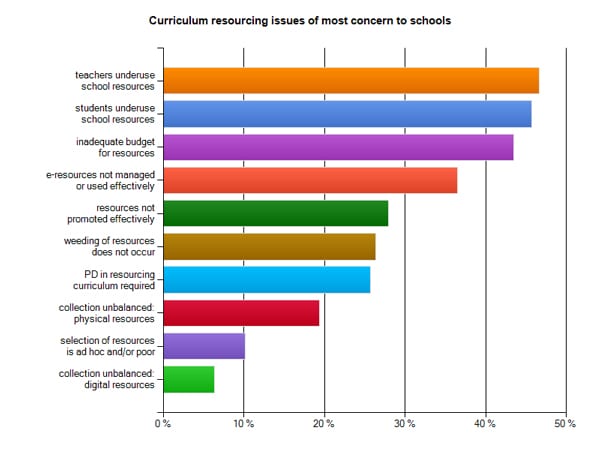
I know at my school, we have an impressive 100 000 print copies of books plus additional eResources such as Wheelers ebooks, online databases, newspaper subscriptions and access to Clickview for interactive videos. It is disappointing that even though our library is so well resourced, teachers and students seem to prefer to use google and youtube instead of accessing information from our library catalogue. It seems preposterous to me that many of the school community were unaware we even had a library management system. Their ignorance of the platforms we have in place, could extrapolate to acknowledging that lack of resource usage is proportional to the ability of the staff and students to use the OPAC system to identify and select resources.
Something needs to change. But what? The library collection development policy at the school endeavours to create a balanced collection that promotes teaching and learning as its primary goal. Other aspects such as catering to diverse learners and fitting into the budget are also relevant. All the physical and digital assets meet the policy guidelines, which is why we have this policy but what is the point if they are under utilised? What else can we do in the library to promote our resources to the staff and students? What can we do to remind them that we are not practitioners of Tsundoku?
I was musing about this problem when it occurred to me that many libraries fail in promoting their resources and capabilities. How were the staff and students going to know about new or fabulous resources in the school library? How would we remind them of what is held within and what can be accessed? It was then i remembered this post from Hamm (2016) who sends newsletters out to the faculty regularly advising them of the new and popular resources within the library. This idea seems magnificent to me as our school has several teachers who had no idea that we even subscribed to databases. Their looks of pleasure and interest peaked when I explained how they could access with ease them from both work and home with just their device and password. A quarterly newsletter published on the staff page of the school intranet would greatly improve our circulation at little cost to the library itself.
So with these thoughts in mind I thought that for my particular independent high school library in the ACT there needs to be certain parameters necessary before a resources are added to the collection.
Firstly the information source MUST match the needs of the learning community. It seems superfluous to point out that a resource is unlikely to be used if it is not relevant to the teaching and learning needs and must meet learning outcomes. The next step is to ensure that the learner traits are accounted for. We have a wide range of student learning ‘attributes’ ranging from varied literacy levels, physical and mental handicaps that need to be catered for in a variety of formats to ensure equity is maintained for the entire student body. One thing in particular our school library has done is acquire graphic novels of most of the major literature texts. With many students of varying literacy levels and acknowledging our ‘reluctant’ readers still need to be able to engage with the text, we are trialing out graphic novels in print forms in several titles including classics such as Macbeth, Hamlet, To Kill a mockingbird and the Diary of Anne Frank with the student body. Our Inclusive Education Team informs the library staff which students have been identified with low literacy levels and then these students are provided with audio books on an iPod as well as the physical text for their class work. For our reluctant readers, graphic novels are popular as the combination of the text and imagery holds greater appeal. The inclusion of these texts has bolstered up our borrowing rates and appears to help students understand the task ahead. We have also recently added Wheelers elibrary to our catalogue. This has not been as popular as predicted but has provided access to resources for our vision challenged students. Due to the nature of the licensing, only two ‘copies’ of a book can be ‘borrowed’ out at any particular time and this is restrictive with class texts. The last consideration mentioned by Hughes-Hassel, S & Mancall (2005) is budget. Resources must fit within the budget in order it to be a viable purchase for the school. We are very lucky in our school to have a principal that values education and our library budget is consistent.
We need a shift in attitude from Tsudonku.
References
Australian School Library Association / Australian Library and Information Services Association. (2001). Learning for the future. (2nd ed). Carlton South, Vic.: Curriculum Corporation.
BBC News (2018) Tsundoku: the art of buying books and never using them. Retrieved from https://www.bbc.com/news/world-44981013
Department of Education and Children’s Services, Government of South Australia. (2004). Choosing and using teaching and learning materials: guidelines for preschools and schools. Hindmarsh, South Australia : DECS Publishing
Hamm, S (2016) Library newsletters. Retrieved from https://www.teenservicesunderground.com/library-newsletters/
Hughes-Hassell, S. & Mancall, J. (2005). Collection management for youth: responding to the needs of learners Retrieved from http://ebookcentral.proquest.com.ezproxy.csu.edu.au/lib/csuau/detail.action?docID=289075
Johnson, P. (2009). Fundamentals of collection development and management [American Library Association version]. Retrieved from http://ezproxy.csu.edu.au/login?url=http://search.ebscohost.com/login.aspx?direct=true&db=nlebk&AN=267756&site=ehost-live
SCIS ( 2014) Survey of school library collections. Retrieved from ://www2.curriculum.edu.au/scis/connections/issue_88_2014/articles/school_library_collections_survey_2013.html
Resources for School Librarians () School library promotion through advocacy, special events and bulletin reports. Retrieved from http://www.sldirectory.com/libsf/resf/promote.html
Lawhimsy.com (2015) Word Nerd: Tsundoku. Retrieved from https://lawhimsy.com/2015/10/14/word-nerd-tsundoku/
Macmilllian Dictionary (2027) https://www.macmillandictionary.com/dictionary/british/tsundoku


