Book Week – Making reading fun!

Book week.  

Two simple words.

Two words that can excite little kid hearts, big teacher hearts and terrify parents who have to organise costumes for their kids’s parades. These are also two words that hold little excitement for those teen hearts.  

Why?

Oh please, ask me why? 

Never mind I will just tell you.

It may come as no great surprise to you – but teens don’t read…

Well they do not read as much as they used to and they certainly do not read the variety and depth of texts that their parents and grandparents read. To put it mildly, many teens do not read for recreational purposes.  A modern teen is overwhelmed by the variety of recreational activities they could choose from including the persistent lure of technology and glitzy apps, which as we all know, hold far more appeal than stodgy texts. For a bibliophile like me and an emerging Teacher librarian, this dilemma has coined a phrase known as ‘reluctant readers’ which means people, both adults and children that do not read for pleasure. 

Why does this occur?  We are all aware of how important literacy and reading are in primary school.  Students have readers that come home weekly and library visits as a class. Parents are constantly bombarded to read to their children by advocates from both the health and educational faculties.  Reading is fun! Schools run literacy activities that boost skills as well as point out the pleasure in reading, such as the CBCA book week. Within this week, teachers and other educational providers seek to promote books and the love of reading to children of all ages.  It is thrilling to see little children so excited by costumes and parades. Their faces light up when they hold up their favourite book against their outfit with happy eyes and grins to match. Primary schools across the country go through great lengths to set up parades. Teachers get dressed up in elaborate costumes and there is a general feeling of goodwill and happiness to all.  But when does this joy with reading decline? 

The answer sadly is high school.  

The same attitude for recreational reading does not translate into the latter years of schooling.  High school students are not encouraged to find pleasure in reading. There are multiple reasons for this decline.  Arguably the primary reason is that teenagers are often plagued by compulsory texts that hold little appeal for them.  Texts that have endured generations of disengaged students. I know from my own memory of high school two decades ago, and the apathy that quickly follows William Golding’s “Lord of the Flies”.  But yet the text’s presence in the curriculum continues. Yes, I agree that it has valuable social commentary. But I am sure that there are more engaging texts exist- “Hunger Games” by Suzanne Collins is plausibly a good replacement for Goldings dry and dismal story.  But forcing students to read books that they have no interest in only elicits anger and disgust for the text and its taint spreads to even the activity of reading.  

Douglas (2013) prescribes that an ability to read for pleasure as a teen is an indication of an ability to thrive in social environments. He goes on to explain that children that derive intrinsic pleasure and joy from reading are also the ones who end up being life-long learners.  This could simply be because those that find that inherent motivation to read are also the ones that have that immanent drive to succeed. Or it could be that those, even when cajoled, bribed and begged to read, with no innate motivation, are guided into the habit of reading, which over time could develop into something that brings great joy’ as Marie Kondo is often quoted.   Either way, the importance of reading is no longer just an educational issue but rather a social issue

Elphaba, 2018

Douglas (2013) elucidates that the demise of recreational reading in teens is based upon gender, attitude and societal expectations.  I can only tell you how many times I have rolled my eyes backwards when I hear parents and occasionally some teachers excuse reluctant readers with the banal phrase ‘boys will be boys’.  In some circumstances, my eyes have rolled back so hard they have gotten stuck against the back of my head! But I digress!! This gender based preference for reading is societal in origin rather than biological as Wong (2018) points out, “the brain is a unisex organ”.  But first world nations such as Britain, US and UK, the disparity in reading statistics between boys and girls is no longer just a fable, a myth. It is a disturbing statistic that affects half our student body. This inability to read translates to less dexterity in processing words, less sophistication in communication, and a consistent decline in educational outcomes.  On the note of societal disparity – in developing countries, the gender gap is primarily based upon unequal access to education. 

Queen of Hearts – 2018

 The other problem lies in that once a student is considered to be a competent reader in upper primary school, the focus changes from ‘learning to read’ to ‘read to learn’.  Ill informed parents believe that their children can now read and after years of being forced to read “Where is the green sheep” (by Mem Fox), (#mylife!), they dance their way from having to read to their children.  I must include myself with this charge. I too stopped reading to my eldest once she could read and have had only re-started after seeing the research. my Netflix time can wait a little longer. 

Malificient – 2018


As educators and as teacher librarians, we need to make reading FUN for our high school students.  We need to remind them of when a book character could make you laugh, cry and fall in love. We need to show them how reading books is not just about school work and assignments, but rather reading can be the quickest escape from it all. 


Cruella 2018

I am going all out for book week this year.  I am going to make a complete idjit of myself and show my students that reading is FUN! That reading books you are interested in brings great joy!  Most of all, I am going to show my colleagues that recreational reading is still important for teenagers.  And I am going to show them that whilst looking FABULOUS!


This year’s theme!

Douglas, J. (2013) The importance of instilling a need to read. The Telegraph UK. Retrieved from https://www.telegraph.co.uk/education/educationopinion/10035473/The-importance-of-instilling-a-need-to-read.html


Wong, A. (2018) Boys don’t read enough. The Atlantic- Education. Retrieved from https://www.theatlantic.com/education/archive/2018/09/why-girls-are-better-reading-boys/571429/

Where was that green sheep (cake)?

Can you see the green sheep (cake)?


Getting the word about Book week out.  We have asked the kids to bring in food that has a book theme.  They will be judged and then prizes awarded before selling them to raise money for the Pajama Foundation.  We had a lovely student bring in some a few days early to drum up support.  So far we have had 40 students agree to bring in something delectable for next week.

stay tuned …

Out of the Box!

How do you teach students about the context behind texts such as Jackie French’s Hitler’s daughter or William Golding’s Lord of the flies to very disinterested teens? 

I am not sure about you but I found both those books dull, dry and depressing as a teen; and I will say they have not improved with age!

Our graduate English teachers were struggling with the rampant disengagement with those two novels.  The indifference was causing the teachers great distress as they were concerned how the students were going to submit their essay assessment task if they would not engage with the book.    More experienced teachers were able to forge through the disengagement but our newest recruits were finding teaching the text challenging.

It then occurred to me that memorial boxes could be the answer!

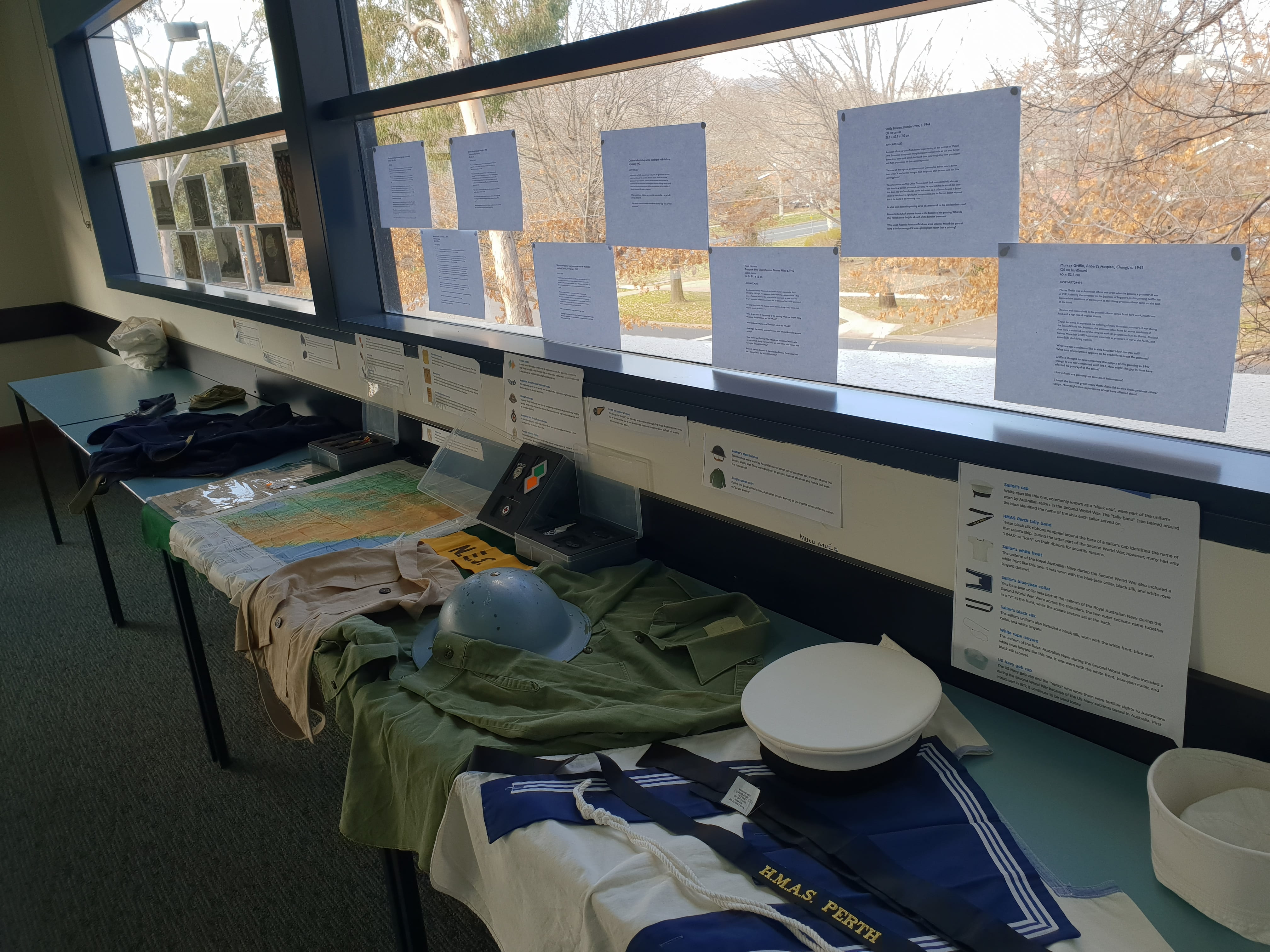
WW2 Memorial Box set up

I had discovered that the Australian War Memorial had a whole host of educational resources available for loan to schools in the form of memorial boxes.  These boxes contain genuine artifacts from various military events in Australian history. I had requested a box for our 10 History classes earlier this semester as a ‘hook’ factor to engage and elicit interest at the commencement of their World War 2 unit.  

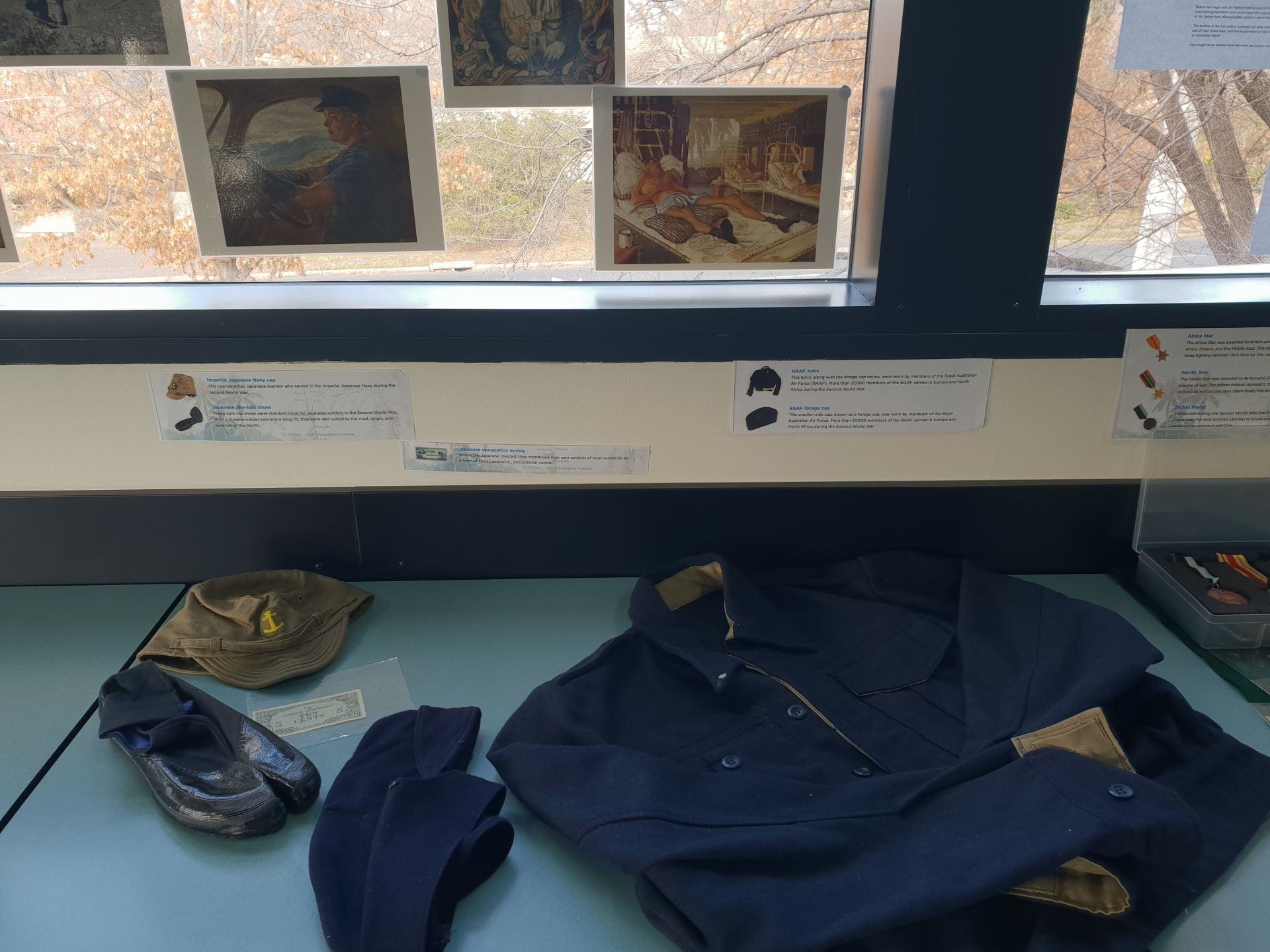
Artifacts from the memorial box

My cognitive connection between our great English dilemma and the memorial box was very much delayed!  It wasn’t until I was unpacking the resources in our library seminar room that it occurred to me that the same artifacts that were engaging our Year 10 history students could also stimulate our year 7 and 10 English students. 

I had an epiphany of sorts!

I was so happy my HOD agreed with my madcap proposal about using the memorial box as a stimulus for English.  The scheme was simple.  The students would come to our ‘library museum’ and view the various artifacts displayed within. Then in pairs, the students would interview each other to create a podcast with an accompanying transcript.  A very clever English teacher quickly whipped up a worksheet  and then, just like that… our immersive experience had begun.

Pictures and Memorabilia

Now I would love to tell you it was all a huge success, but I would be lying. 

The memorial boxes were a great triumph with our 10 History students but success was variable with our English classes.  This lackluster response could be attributed to the inadequate time for the students to complete the activity. The classes that visited the library twice had more success than ones that came just once. 

What we did discover was that students were stirred out of the apathetic stance towards the books because they began to understand the context  surrounding it. The memorial box activity connected the students to the mileu of the books and engaged them in the character’s turmoil.  As the worksheets were collected at the end of the session, the teachers were able to use those responses to formatively assess student literacy and other learning goals.  

The focus of a school library has changed in the past decade from archivist and curator of information to being an active facilitator of knowledge both physical and digital.  This means that teacher librarian may need to think out side the box for some more out of the box thinking!

The in class essays are all occurring this week for year 7 and next week for year 10.  I would be very intrigued to know if the memorial boxes assisted in increasing student engagement with the books and the outcome of the assessments.  I would also like to analyse the results of the English classes that declined to attend our library museum and compare them to the classes that did come.  If there is a significant difference, then I would have sufficient evidence to run this activity for more teachers and students.  

I await reporting time with great avidity.

Are Classroom libraries a real option?

It would come as no surprise to any of you that education budgets are constantly being stretched.

The slow erosion of funding has led many schools to debate the value of their resources to determine which ones need to be cut in order to survive fiscally.  Unfortunately, school libraries are the department that is being most adversely affected. This adverse effect can be seen either by the absence of a qualified teacher librarian and or the complete absence of a school library. Cook (2018) suggests that libraries are robbed of their funding because they are deemed useless in this internet age. I have spoken previously about the importance of a teacher librarian so this post is not about that.  But some schools, overburdened by numbers, convert their library spaces into additional classrooms. When this occurs, most often than not, these schools sometimes set up classroom libraries to combat the loss of a school library.  

According to Cook (2018), libraries are essential to a school’s success. 

But are classroom libraries the same as having a school library with a qualified teacher librarian?  We are all aware that exposure to books is positively correlated to improved literacy (Neuman, n.d.).  We are also know that not all households have the same bibliophilic tendencies. This means that there are a proportion of students who are not exposed to books in the home.  Neuman (n.d.) elucidates that it is the presence of books in close proximity that correlate directly to increased literacy.  

Schools historically are known for exposing young minds to the wonderful world of imagination and literature via the school library.  But with no school library, is the alternative a classroom library? But what if the classroom library is poorly executed? By executed, I mean poorly stocked and unable to meet the needs of the students.  This can lead to limited student engagement with the classroom materials and if there is no school library, then there is no safety net for these disengaged readers. Implementing an assortment of books in a box is not equivalent to the presence of a qualified professional. After all, teachers are not trained in information management and resourcing, and it seems foolhardy to leave the resource management to at the hands of an already overburdened classroom teacher.  

One suggestion is that the classes each have their own classroom library but they are managed by a teacher librarian. 

So rather that rather than a random assortment of materials, the books are carefully curated by the teacher librarian to meet the evolving needs of the students.  An example of this would be a box of books are rotated in regular intervals and that the reading levels within are appropriately aligned to the needs of the students (Sacks, 2018).  But whilst in theory is outstanding, the practicality is far more complicated. Sacks (2018) surmised that consistency and equity are the largest issues with classroom libraries as the titles will vary between classes.  The primary problem is that schools would need to almost double their collection for them to adequately service the needs of all their classrooms. This would incur extra costs for the school. There would also be greater difficulty in tracking the books and ensuring that they are maintained.   

The downside of having a teacher librarian manage physical classroom collections is that they are then limited in their ability to create, manage and implement information literacy programs.  

Lance & Kachel (2018) indicate that the research is clear about the correlation between high quality library programs and increased student achievement. Frierson & Virtue (2013) believe that it library programs that need to be embedded into classroom practice.  They go on to illustrate that this improvement is not just for affluent schools but for all schools. In fact, arguably the lack of a school library is discriminatory to students from lower socio-economic backgrounds, that do in desperate fact, require regular access to libraries, their programs and books in order to engage equitably with educational practices.  

There are currently teacher librarians in Australia that are creating LibGuides that are specifically relevant to units of work and use the school’s learning management systems to reach their audience.

This method also means that students that are away from school due to ill health or other personal reasons are still able to engage with their learning off site.  An example of this would be the class novel study with appropriate supporting materials and related works. So with our Year 7’s currently studying the Jackie French novel “Hitler’s Daughter”, the LibGuide contains the ebook version as well as; study notes, worksheets, supporting extracts from other similar novels such as “Boy in a wooden box” by Jim Boyne, “Book Thief” by Mark Zusack and “Dollmaker of Krakow”by R M Romero.  I have also created an online museum with images relating to the book where students can view artefacts and watch short video-clips.  

All of this take time.  Time that I have because I am not curating classroom library boxes.  But if I was not there, or if the position of teacher librarian was not there, then students would not have access to these resources.  Yes, there are teachers who do have the time and energy to go beyond the normal to create amazing learning experiences for their students.  But with 50% of teachers leaving the profession within 5 years, and nearly ⅓ of employed teachers suffering from a mental illness and or addiction, overburdening them further is foolish.

If prisons have mandated librarians to ensure that their collections are servicing the needs for their community, then I think our children can have the same access.  Removing school libraries to minimise costs is short sighted.  It is not beneficial for the teachers, the students and society.  

Cook, H., (2018) Extending the shelf life of the school library in the internet age. SMH. Retrieved from https://www.smh.com.au/education/extending-the-shelf-life-of-the-school-library-in-the-internet-age-20181016-p50a0l.html

Frierson, E., & Virtue, A. (2013) Integrating academic library services directly into classroom instruction through discovery tools; Bringing library resources into the online classroom. Infotoday.com. Retrieved from https://www.questia.com/magazine/1G1-345277685/integrating-academic-library-services-directly-into

Lance, K., & Kachel, D. (2018) Why school librarians matter: what years of research tell us. Phi Delta Kappan. Retrieved from https://www.kappanonline.org/lance-kachel-school-librarians-matter-years-research/

Neuman, S. (n.d.) The Importance of a classroom library. Scholastic Teacher Resource. Retrieved from http://teacher.scholastic.com/products/paperbacks/downloads/library.pdf

Sacks, A. (2018) Why school librarians are the literacy leaders we need.  Teaching the whole story [blog].  Retrieved from https://blogs.edweek.org/teachers/whole_story/2018/05/why_school_librarians_are_lite.html

Dewey this…


Dresses galore


My closet is a veritable rainbow of pretty dresses, skirts, tops and cardigans.  Each item is lovingly washed, ironed and replaced in its place with care. Starting from the right, the dresses start as formal, and work their way to day dresses, before moving on to skirts, tops, cardigans and jumpers. In each subsection they are further organised by colour.  At a glance, I can see what I have hanging up and locate an item with ease.

Then my husband comes along to ‘help’.  He ‘helps’ by putting away my carefully washed and ironed dresses by shoving them into the wardrobe in whatever spot seems available.  Needless to say this causes me mild panic when I cannot find my ‘Florelle’ (orange cotton dress) which should be in between ‘Neroli’ (yellow print dress) and ‘Melody Rose’ (orange print dress).  Instead ‘Florelle’ been shoved between ‘Cascade’ and ‘wish upon a star’ (both black and white patterns). 

I was horrified.  How on earth was I supposed to find my precious dress buried in the wrong spot???  

My husband was miffed.  Here he is helping me by putting away my clothing all I am doing is complaining. 

Apparently my wardrobe organisation is too complicated to understand, and I have too many dresses that look exactly the same.  

Now I was miffed.  I certainly do not.  There are nuances between them and I definitely do not have too many clothes.  (note that picture of my wardrobe was from January 2019 and I can honestly say I have added a few (maybe more than a few) to that collection since then.  

But I digress. 

This blog post is not about my dress acquisition nor my marital disagreements about my wardrobe organisation or Imelda Marcos tendencies. 

Instead, this post is a prelude to the subject that I will commence tomorrow morning. ETL 505 will open my mind to how resources are cataloged.  I will learn how the records are created and use that information to benefit the users within my community. This knowledge will also help me with giving constructive feedback to metadata specialists as part of my role as a TL.  

Last semester in ETL 401 I learned about what the role of a TL encompasses as a whole.  In ETL 503 I learned how important it was to correlate the resources within the library to the curriculum.  This is simply because the point of a school library is to address the needs of the curriculum. This semester, it appears my learning is aimed more at the librarian aspect of a TL than the teacher component.  As an information specialist and information services manager, my role involves ensuring that the collection is easily accessible by the student population using the information management system available.

To sum it up succinctly.  I need to learn how a library is organised so that the kiddos can use it successfully. 

The point of organisation is to easily find and locate an item when you wish to use it.  How it is organised depends on who is doing the work, but the underlying point is ACCESS!  If the item cannot be found and used when it is needed, then the system is broken. The resource is underutilised and the monies wasted.  In school libraries this is a travesty when budgets are often stretched and funds scant. 

Libraries are famous for their organisation. 

Neenuvimalkumar – Pre computerised Library management system


Dear ole Mr Dewey revolutionised the information world with his Dewey Decimal System.  Known famously as the ultimate in organisation and classification, DDS organises the information within a library into groups and then further divisions for specifics areas (Encyclopaedia Britannica, 2018).  Due to its comprehensive and adaptive nature, the system is universally used across the world (OCLC, 2019). A bibliophile in New York city can find a book about Bonnie Prince Charlie in the same location as they would in a suburban library in Melbourne’s suburbs.  

But information isn’t so simple in this modern day.  Gone are the days where libraries only stocked books and maps.  A modern day library will have shelving of books, but will also have access to other formats such as videos, audiobooks, eReaders and images.  All of these resources need to be catalogued and organised so that they can be accessed by the user. They also need to be differentiated within the catalogue records so that the user can easily identify that their request for ‘The Odyssey’ includes versions of the epic tale, even if the creator and format differs.  

So as the last day of my uni holidays draws to a close I ponder the knowledge I will gain from this subject.  I am a bit apprehensive as the assessment tasks are not essays but rather more practically based tasks. I am far better at blathering out epochs than being useful.  So this may be a steep learning curve for me. Also, I burnt out a bit last semester so I am just doing the one subject now.  


Bring on Session 2, 2019.  

References

Encyclopaedia Britannica (2018). Dewey Decimal System. Encyclopaedia Britannica, Inc. Retrieved from https://www.britannica.com/science/Dewey-Decimal-Classification 

OCLC (2019) How one library pioneer profoundly influenced modern librarianship. Retrieved from https://www.oclc.org/en/dewey/resources/biography.html

Its the standards that matter – Module 3.1


I recently moved from provisional /graduate teacher to proficient teacher whilst I was working as a Teacher librarian.  I’ve only ever taught as a casual teacher for about two years and only just scraped  my 180 days minimum as TQI required in the ACT when I moved to proficient.  Gathering evidence for my ATSIL standards was ridiculously hard when you never have had a class to yourself.  So the thought of having to even think about ASLA TL standards was enough to make me avoid this task for a week.

Then I spent a week assisting the RE co-ordinator and his 2IC plan next semester’s units from Years 7-8.   Using their unit plans I worked with the teachers to embed the general capabilities curriculum firmly into the teaching and learning.  I used scootle to find resources that would promote critical and creative thinking, inter cultural understanding and ICT.   I assembled a range of fiction titles that would support the units of work, including locating an audio-book for our visually challenged student.  I also looked for interactive websites and videos that would enhance the learning process.  Then I collaborated with the inclusive education team to work on modified programs for the students with learning needs.  It took us all day but we came up with several scaffolded tasks that could be used interchangeably.

It was then the TL standards made sense.  The standards set the benchmark of professional behaviour of what teacher librarians bring to the school community.  I am too new a teacher and  definitely too new a TL to be proficient at all the standards.  But what I can do is achieve each one slowly, bit by bit.


2.2 Learning and teaching

Excellent teacher librarians:

• collaborate with teachers to plan and implement information literacy and literature programs that result in positive student learning outcomes

• ensure that their programs are responsive to the needs of learners in the school community

• support learning and teaching by providing equitable access to professionally-selected resources

• assist individual learners to develop independence in their learning

• teach the appropriate and relevant use of ICTs and information resources

Who am I? What do I do? – When an identity crisis occurs.

What do I do all day?


Just chillin – Courtesy of Pixabay


To my mother, I read books all day and tell people to shush!


To my husband, well he is only concerned that I am happy (and I can still manage my children’s school drop offs and pick ups).  Oh and there is no need for vacation care. Winning!!


To my children, mummy goes to work in a library and reads books and then comes home with more books all the time…. Oh and mummy is home in the holidays.


To my colleagues, I am that Energiser bunny that nabs you in the corridor asking to come into the library to work on your next task; the idjit that goes to departmental meetings and ‘volunteers’ to help with planning. I am also that nutter that gets over enthusiastic during Book week, Roald Dahl day, Harry Potter day, Jane Austen day

What’s your skill? This is mine.


To me.  Well, I am a teacher of information.  I teach students (and their teachers) how to find, seek, use and create information.  I find resources that support the curriculum and wellbeing of my students. I teach students how evaluate their sources, protect themselves online, be aware of the legislation around copyright and academic integrity. I help students and teachers in their teaching and learning by co-creating units of work that promote critical thinking and reflection.  I create lesson plans and collate resources to commemorate special events such as Reconciliation week, Anzac Day, Eid, Diwali and Samhain.

Each teacher librarian will have different priorities depending on the school they are attached to and the personality they were born with.  Some TL are brilliant at curriculum planning and get heavily involved with the co-creation of units. Other TLs are great collaborators and involve themselves with the teaching and learning aspect.  Some TLs are fantastic at resource collection management and development. Their collections are constantly evolving with the community’s needs. Each TL’s practice will differ from the TL next to them, the one down the street, the next suburb, or interstate.  That’s the beauty within the practice of teaching. Each practice is unique as it is the individual’s interpretation and implementation of the teaching standards that leads to such distinctiveness.

Each teacher, in their own sphere has an impact on their students, peers and community.  Individually we cannot change the world, but we can change the experiences of the people around us.  We can change how our students learn about internet safety, about how to use online information ethically.  We can teach the skills to differentiate fake news from real news (and in an election week… OMG!). We can show them how to seek, identify, use and create information that is meaningful to them and others.

How we do it will vary… but the point is that teacher librarians are trained and equipped to teach others the skills to survive and thrive in an information society. 

We can show the next generation how to become active citizens in this digital world. 

Digital literacy and its impact on pedagogy and the role of a TL.

The world’s economy has evolved with the transfer from production lines to one structured upon the creation and dissemination of information.  This era has been revolutionised by the ubiquitous presence of the internet and the speed in which it is generated. Combined with rapidly evolving technology; access, use and production of information is easier.  The education sector has been particularly affected by this insurgence of documentation and the skill sets required to seek, harness and use information successfully. This essay will define digital literacy and its pivotal role in information seeking behaviour trend of adolescents, its impact on educational practices and the role of the teacher librarian in this knowledge society.

Literacy has evolved from simply being able to read and write in text form into something more dynamic.  ACARA (2016a) has expanded the definition to include; the ability to interact with, engage and use language across modalities for a variety of purposes and a diversity of contexts.  In this knowledge rich society, information is available in multiple formats and can be often simultaneously engaged with (Jacobson et al., 2018). Therefore, digital literacy (DL) is the ability to appreciate the need for; the expertise to access; the capacity to evaluate, use and integrate information within the school environment and in general society (Lofton, 2016).   Thomas et al. (2018) acknowledge, even though access is widespread, individuals are grappling with the ability to use the new technologies in all areas of life (p.12).

The modern student is heavily reliant upon the internet for both information seeking and retrieval due to the widespread availability of mobile devices (McGrew et al., 2018, Mussell & Croft, 2013, Lanning & Mallek, 2017 and Mills & Angnakoon, 2015).   Teachers are often frustrated at student’s poor information seeking behaviour (ISB) and vexed by their blind dedication to Google and Wikipedia, despite a lifetime exposure to technology (Saunders et al., 2017).  The exasperation tends to peak at the student’s inability to successfully identify relevant and reliable resources online.  Unlike a library, where the librarian acts like a gatekeeper, the internet and thus everything on there, including unsubstantiated and vitriolic materials, are freely accessible.  Search engines are the most common starting point as students are familiar with their visual design, their mechanism and are viewed as fast and reliable (Lanning & Mallek, 2017; Qayyum & Smith, 2018 and Mussell & Croft, 2013).  Adolescents often base their entire study upon the virtue of Wikipedia and Google (Ricautre, 2016 and Qayyum & Smith 2018).  Wikipedia, as Ricautre (2016) elaborates, is built upon the concept of crowd-sourcing, as the public is encouraged to contribute information.  Whilst understandably these parameters allow for open dialogue and the precept of an open learning environment, it brings validity and accuracy of information presented into disrepute.

Google is an omnipresent search engine in modern society. Its pervasive presence has led to ‘google it’ often replacing ‘search for it’ in modern jargon.   Regrettably, as McGrew et al., (2018) point out, students determine the usefulness of a website based upon superficial points, such as the hierarchy of results displayed by Google.  Students fail to comprehend that Google, a corporation, controls results based upon an algorithm determined by the user’s own personal digital history (Ricautre, 2016).  In this way, Google ensures that the search results match closely to the user’s state of mind, previous search parameters and thus is more likely to be accepted (Ricautre 2016).  Some students do not even open up the individual sources but rather just peruse the content on the main search page and accept the information as correct without understanding context (Russell & Callegaro, 2019).   Other students rarely venture away from the initial website due to insufficient DL skills, so they accept information without verifying authenticity and or bias (McGrew et al., 2018). This creates a moral dilemma as they are willingly restricting access to information simply because it is easier.

The problems with students’ ISB are numerous.  Firstly, their techniques used to seek information are based most often on predetermined algorithms, ineffective search terms and minimum effort expended.  In order to cope with the overload of information available, students covertly reduce their search techniques so as to minimize the amount they are presented with (Qayyum & Smith, 2018).  Russell & Callegaro, (2019) point out correctly, that students place the whole query into the search bar and expect a complete response instantly, as there is an unwillingness to construct a bank of knowledge (Mussell & Croft 2013).  Qayyum & Smith (2018) corroborate, by suggesting that the speed in which the internet produces results prevents reflection of content. The DL skills of skimming and scanning cannot keep up with the flow of information and sources are rejected if not exactly correct.

Kobayashi (2018) found that whilst students preferred engaging with technology, they are unwilling to use advanced software and hardware, as they are unable to troubleshoot.  This self-censorship is due to an inability to interpret multimodal sources with a rich media presence (Head et al., 2018, p.4, Jacobson et al 2018; Kobayashi, 2018). This is especially true for students, who already have low literacy, as they often get overwhelmed by embedded multimedia, slowing comprehension (Kobayashi, 2018).  Other students find the layering of sources distracting which also slows cognition down. The majority of adolescents are unable to use search terms properly and when faced with an overwhelming number of sources, they simply use the first few and disregard the rest, despite the possibility of their importance (Mussell & Croft, 2013).  Their ability to navigate the internet is hampered by a lack of literacy and critical thinking skills.

Once students have managed to find sources they understand, they are unable to determine veracity.  McGrew et al., (2018), in their study, concluded that the pattern in which students investigate the reliability of a website is mainly determined by the visual appeal and seemingly professional appearance, whilst often disregarding the bias and or dubious authorship.  Jacobson et al (2018) argued that students are receptive to emotive language and the presence of speculative data was used as evidence of reliability (McGrew et al 2018). Students will also accept the reliability of sources if they subconsciously agree with the information and disregard sources that they disagree with, due to the challenges this new data imposes upon them (Jacobson et al 2018 and Russell & Callegaro 2019).   Even when presented with alternate sources, like databases, many preferred search engines due to the visual appeal and navigation ease (Lanning & Mallek, 2017, and Mussell & Croft, 2013). Shenton (2018) attributes this literacy to, in that students with lower literacy are often unable to decode more complex text and use familiarity of structure to determine reliability and rationality. In terms of DL, this ISB highlights a lack of critical thinking skills, as accessibility is preferred over validity, which is a significant issue for education and beyond.

The presence of the internet has forever changed how public policy and societal issues are addressed, and it is imperative that students are proficient at ISB so that they can do the same hereafter (McGrew et al., 2018 and Thomas et al., 2018).  DL is a citizenship issue and true democratic societies require the voter to be able to find reliable information, evaluate multiple perspectives and communicate their ideas on current issues (McGrew et al., 2018; Jacobson et al., 2018). If students are incapable of DL at school when investigating tasks simple and direct, then their ability to navigate for information on more controversial topics is hampered (McGrew et al., 2018).  This is particularly evident in an election year when society is bombarded multi-modally in an effort to persuade the voter. If one is unable to filter, understand and evaluate the information effectively, then the scope of information is greatly narrowed. One only has to look at the media about the upcoming federal election to realise how important DL is within society.

Modern pedagogy is shifting to a digital interface and it’s important that the DL skills are taught so that students and their teachers engage successfully (Jacobson et al., 2018 and Qayyum and Smith, 2018, p257).  As each generation learns to use, transfer and create knowledge in schools, it is logical that in schools, effort should be placed in establishing digital literacy and efficacious use of technology (Ricautre, 2016, McGrew et al., 2018; Berg, 2018).   A liberal attitude to DL by educational authorities will lead to an ineffectuality for critical thinking and targets for scammers such as the Nigerian scam that has played havoc within numerous households across Australia (ACCC, n.d.). It is evident that digital literacy is important in ISB beyond the classroom.

The dramatic change in ISB and budgetary squeeze has added pressure onto teacher librarians (TL) to adapt their roles to ensure their viability in the school context (Lamb, 2011, p.27).  This adaptation has redefined the role of the TL from an archivist and curator of knowledge, into facilitators of knowledge or information specialists, curriculum leaders, information management leaders (CC, ALIA & ASLA, 2016).  This facilitation ranges from the acquisition of materials that build a school collection, text and digital, and the implicit and explicit teaching of life long skills. From their central position within the library, a TL is able to view the school as a whole and identify and analyze learning holistically (ACT Directorate, n.d.).  As the information specialist and curator of knowledge, a TL is able to assist in building positive ISB by embedding DL through the curriculum (McGrew et al., 2018; Berg, 2018). In the instructional partner role, a TL can instigate various pedagogical practices to support teaching and learning via implicit and explicit actions. Implicit methods could be characterised by the presence of maker spaces within the library, embedding of skills into curriculum units, the inclusion of carefully curated resources that support learning, and explicitly via direct instruction and assessment of skills in tasks.  

Educators need to realise that DL is not independently discovered during research tasks but rather they need to be explicitly taught and then assessed to evaluate understanding (McGrew et al., 2018).  Explicitly teaching DL in collaboration with other staff, TL can assist students in improving their ISB across the school (Shenton, 2018). As technology is an augmentation of learning, regular pedagogy on DL can increase the confidence of students in their ability to use media rich resources for example Google Docs, OneDrive and Endnote (Ricautre, 201; Berg, 2018).  This increase in digital self-efficacy will allow students to engage with more diverse sources and improve their ability to troubleshoot any potential challenges (Kobayashi, 2017).   Makerspaces are an alternative, as they encourage students to be creative, collaborate, problem solve, research and experiment and challenge the student into higher order thinking (Lofton, 2016, p.18; Berg, 2018).  A TL is an ideal person to facilitate these activities, as they are curriculum leaders, and the information expert in the school (CC, ALIA & ASLA, 2016). They can support all forms of inquiry learning and research, by either explicitly teaching correct ISB, and or implicitly, by assisting colleagues in creating coursework and assessments with supporting resources and technology.

Another method is to teach alternate methods of ISB, such as the use of the library catalogue and databases (El-Khayat, 2016).  Mussell & Croft, (2013) determined that many students were unaware of the presence of catalogue and often made it synonymous with a database search. Saunders et al., (2017) and Qayyum & Smith, (2018 p259) advocate that the explicit teaching of search terms, synonyms, and key words is the most fundamental skill, as it is the underpinning concept that illustrates critical thinking and evaluation.  Shenton (2018) interestingly noted that whilst students can often be persuaded to use databases for educational goals, this does not extend elsewhere. There appears to be a dichotomy when it comes to obtaining information. This bears thought of where do these adolescents go to access information for personal or professional reasons? Unfortunately, Google and Wikipedia continue to be the main tools of information seeking, which in itself is fraught with complications.  McGrew et al., (2018) and Lanning & Mallek (2018) both propose that DL be a course that is explicitly taught and formally assessed as a unit of work.   Lanning & Mallek (2017) counsels DL in standardised tests to monitor student progress and the recent move by NAPLAN to online testing could be a step in the right direction in assessing DL skills as DL is pivotal to academic success (ACARA 2016a; ACARA 2016b). Lanning & Mallek (2018) surmises that this is due to the student’s reluctance to learn skills unless there is an assessment attached,  which is just an unfortunate testament to the current education system’ assessment focused approach.

Occasionally, teachers do forget that students can be ignorant of digital practice such as search terms or database availability (Qayyum & Smith, 2018, p259; Miller, 2018).  This is very common in schools with a transient student population. Instead of exhibiting frustration, a TL can use this opportunity as a refresher activity, to explicitly teach that particular skill to the entire cohort in collaboration with colleagues (Qayyum & Smith 2018 p259).  Teaching suggestions include rewording search terms into keywords, keeping extra tabs open in order to read broadly , and realising that the perfect answer rarely comes up within the first few responses (Russell & Callegaro, 2019; Berg, 2018). Head et al., (2018) suggests that teachers and teacher librarians are trusted to provide access to reliable sources by students even if they may not be (p27).  Consequently, teachers themselves need to be digitally literate in order to assist their students in their learning, which is why the presence of a qualified TL is paramount.

Budgetary constraints and a lack of understanding of digital literacy have led to many schools dispensing with a qualified TL and or the library itself (Wood, 2017).  This poses a great problem for students and their ability to engage with the digital world (Berg et al., 2018). Some argue that digital resources and new seeking software is so instinctive that it compensates for student inadequacies and librarians are unnecessary (Saunders et al., 2017).  But it seems impractical to depend on an algorithm and its superficial limitation of results. This is just censorship under an alias. Others suggest the pervasive mobile device does not warrant the cost of outfitting hardware. This is a fallacy, as mobile only users, individuals with a disability and ethnic minorities are sub sections of society who are digitally disadvantaged (Thomas et al., 2018, p.16).  Mobile only users in particular are reluctant to engage in media rich practices as their device often does not have the speed and data allowance (Thomas et al., 2018 p.16). Considering the diversity within schools, the lack of a school library and TL is a clear affront to educational needs.

Students with low DL will have poor decision making skills due to an inability to filter, evaluate and critically analyse information (Berg 2018, Wood, 2017; Kachel, 2016).  This inefficacy with DL is further pronounced in lower socio-economic households where there are already hurdles due to lack of access, generational disadvantage and disability (DIIS, 2016; Thomas et al., 2018). The removal of libraries and teacher librarians infringe upon the freedom and right to access information (OIAC, N.D; UN, 1948).  Libraries seek to provide equity of access to students, and teacher librarians seek to provide self-efficacy in digital literacy to both students and teachers, for the successful navigation in this current knowledge society. The irony is that under legislation, prisons must have a library and a qualified librarian, but not schools (Kechel 2015, ALIA 2015; Bevan, 1984).

Digital literacy is essential and plays a vital role in ISB as the behaviour practiced in school is repeated in adulthood.  There is a strong correlation between low DL and poor ISB, which impacts pedagogical practices. The role of the TL in this changing information landscape, is to ensure that all students have access to information and have the ability to seek, use and share that information in a variety of formats.   In a world where there is a constant barrage of information, fake news interspersed with real news, a digitally illiterate citizen will be isolated, vulnerable and unable to self-advocate. They will be unable to participate wholly with this new society as an economic contributant. Access to the digital world is a necessity in modern times, as is the ability to navigate this information age.

REFERENCES

ACARA (2016a) National literacy learning continuum. Australian Curriculum. Retrieved from https://www.australiancurriculum.edu.au/resources/national-literacy-and-numeracy-learning-progressions/national-literacy-learning-progression/what-is-literacy/

ACARA (2016b) NAPLAN online. National Assessment Program. Retrieved from https://www.nap.edu.au/online-assessment

ACCC (N.D) Nigerian Scams. Scamwatch. Retrieved from https://www.scamwatch.gov.au/types-of-scams/unexpected-money/nigerian-scams

ACT Government (n.d.) School Libraries: The heart of 21st century learning. Education Directorate.   Retrieved from https://www.education.act.gov.au/__data/assets/pdf_file/0020/916301/School-Libraries-21st-Century.pdf

ALIA (2015) Australian Library and Information Association Minimum Standard Guidelines for Library Services to Prisoners

Retrieved from https://www.alia.org.au/about-alia/policies-and-guidelines/alia-policies/prison-guidelines

ALIA and ASLA (2016) Statement on Teacher Librarians in Australia. Retrieved from  https://asla.org.au/resources/Documents/Website%20Documents/Policies/policy_tls_in_australia.pdf

Berg, C., Malvey, D., and Donohue, M., (2018) Without foundations, we can’t build: Information literacy and the need for strong library programs. In the Library with the Lead pipe.  Retrieved from http://www.inthelibrarywiththeleadpipe.org/2018/strong-school-library-programs/

Bevan, C., (1984) Minimum standard guidelines for Australian prisons 1978 (Editor), Australian Institute of Criminology. Retrieved from https://aic.gov.au/publications/archive/min-standard-guidelines-prisons

Curriculum Corporation, Australian School Library Association and Australian Library and Information Association (2001). Learning for the future : developing information services in schools (2nd ed). Curriculum Corporation, Carlton South, Vic. pp60-62

Department of Industry, Innovation and Science (2016). Australia’s digital economy update. Retrieved from https://apo.org.au/sites/default/files/resource-files/2016/05/apo-nid66202-1210631.pdf

El-Khayat, Y (2016) Librarians help high school students improve research skills. Journal of Medical Library Association. 104:3. DOI 10.3163/1536-5050.104.3.009

Head, A., Wihbey, J., Metaxas, P., MacMillan, M., and Cohen, D., (2018) How students engage with news. Five takeaways for educators, journalists and librarians.  Project Information Literacy Research Institute. Retrieved from http://www.projectinfolit.org/uploads/2/7/5/4/27541717/newsreport.pdf

Jacobsen, R., Halvorsen, A., Frasier, A., Schmitt, A., Crocco, M., and Segall, A., (2018) Thinking deeply, thinking emotionally; how high school students make sense of evidence. Theory & Research in Social Education. I46:232-276. DOI 10.1080/00933104.2018.1425170

Lamb, A. (2011). Bursting with potential: Mixing a media specialist’s palette. Techtrends : Linking Research & Practice To Improve Learning, 55(4), 27-36.

Lanning, S,. and Mallek, J., (2017) Factors influencing information literacy competency of college students. The Journal of Academic Librarianship. 43: 443-450.  DOI: 10.10.16/j.acalib.2017.07.005

Lofton, J., (2016) Students are makers! Building information literacy skills through makerspace programs. CSLA Journal. 40 (2). Retrieved from https://www.questia.com/magazine/1P3-4305515741/students-are-makers-building-information-literacy

Kachel, D., (2015) The calamity of the disappearing school libraries. {Blog Post} Theconversation.com. Retrieved from https://theconversation.com/the-calamity-of-the-disappearing-school-libraries-44498

Kobayashi, M., (2017) Student’s media preferences in online learning. Turkish Online Journal of Distance Education. 18:3. ISSN 1302-6488. Retrieved from https://eric.ed.gov/?id=EJ1147585

McGrew, S., Breakstone, J., Ortega, T., Smith, M., and Wineburg, S., (2018) Can students evaluate online sources? Learning from assessments of civic online reasoning. Theory & Research in Social Education. 46: 165-193. DOI 10.1080/00933104.2017.1416320

Miller, S., (2018) Diving dee; Reflective questions for identifying tacit disciplinary information literacy knowledge practices, dispositions and values through the ACRL framework for information literacy. The Journal of Academic Librarianship. 44: 412-418.  DOI: 10.1016/j.acalib.2018.02.014


Mills, L., and Angnakoon, P., (2015) How do high school students prefer to learn? CELDA 2015. Retrieved from https://files.eric.ed.gov/fulltext/ED562093.pdf

Mussell, J., and Croft, R., (2013) Discovery layers and the distance student: online search habits of students. Journal of Library and Information Services in Distance Learning.  7:1-2, 18-39, DOI 10.1080/1533290X.2012.705561

Nickpour, F., (2017) Information Behaviour in design; a conceptual framework. Design, User Experience, and Usability: Theory, Methodology, and Management.  pp 152-162.   DOI: 10.1007/978-3-319-88634-2_12

OÇonnell, J., (2017) School Libraries. In I.Abdullahi (Ed) Global library and information science: A textbook for students and educators. Berlin, Boston; De Gruyter Saur. Retrieved from https://heyjude.files.wordpress.com/2017/11/ifla-174_16_o-connell.pdf

Office of Australian Information Commissioner (N.D) Freedom of Information Act 1982. Retrieved from https://www.oaic.gov.au/freedom-of-information/foi-act

Qayyum, M., and Smith, David., (2018) Changing research behaviours of university students with progression through a course. Journal of the Australian Library and Information Association. Vol 67: 3 pp256-277 DOI: 10.1080/24750158.2018.1502243

Ricaurte, P., (2016) Pedagogies for the open knowledge society. International Journal of Educational Technology in Higher Education. 13:32 DOI: 10.1186/s41239-016-0033-y

Russell, D,. and Callegaro, M., (2019, March 26) How to be a better web searcher: secrets from Google scientists. Scientific American Retrieved from https://blogs.scientificamerican.com/observations/how-to-be-a-better-web-searcher-secrets-from-google-scientists/

Saunders, L., Severyn, J., and Caron, J., (2017) Don’t they teach that in high school? Examining the high school to college information literacy gap. Library & Information Science Research. 39: 276-283. DOI 10.1016/j.lisr.2017.11.006

Shenton, A., (2018) Reading in information behaviour and information literacy frameworks. Collection and Curation. 37:2. Pp6-64. DOI 10.1108/CC-04-2017-0013

Thomas, J., Barraket, J., Wilson, C., Cook, K., Louie, Y., Holcombe-James, I., Ewing, S., and MacDonald, T., (2018) Measuring Australia’s Digital Divide: The Australian Digital Inclusion Index 2018. RMIT University, Melbourne, DOI: https://doi.org/10.25916/5b594e4475a00

United Nations (1948) Human Rights Charter. Retrieved from https://www.un.org/en/universal-declaration-human-rights/

Wood, P., (2017) School libraries disappearing as as the digital age is over. ABC News.  Retrieved from https://www.abc.net.au/news/2017-09-25/school-libraries-disappearing-as-the-digital-age-takes-over/8980464

Curriculum Conundrums – Module 4.3

Curriculum can be broadly defined as the academic content taught within the education system.  In Australia, the National curriculum is three dimensional and covers eight content areas, three cross curriculum priorities and seven skills sectors (ACARA, n.d.).  This national framework is broadly defined and whilst some states have set syllabi that clearly delineate what needs to be taught, others have more freedom in the manner in which the learning outcomes are addressed.  As this method of delivery is diverse, curriculum implementation falls down to state governance and individual schools to develop and create a plan that clearly outlines the teaching and learning, whilst respecting the values and ethics of the school and its community.

 The purpose of schooling is detailed within a curriculum and as a result its strength and veracity will directly affect student learning potential (VCAA, 2015, p.6). Meritorious curricula are cohesive and contain connected units of work that build upon a student learning.  It is not an ad hoc system of disconnected and repetitious units, as that leads to student disengagement and teacher angst. A teacher librarian is a witness to all that occurs within a school and from this centralised position, are able to see the teaching and learning from a whole school approach.

 The role of a TL can affect curriculum planning in a variety of ways but the four main ways are; facilitating multidisciplinary units of work; creating LibGuides for individual classes, year levels and or units of work; embedding information literacy within the curriculum and explicit instruction.  Lastly, ensuring that the school collection supports the teaching and learning practices of the school. In the first place, a TL can facilitate conversations between departments to broach a collaborative unit of work. An example would be, negotiating RE, HASS and Science to address a Sustainability unit from a triple prong approach for a deeper and more holistic learning experience, rather than just superficially addressing aspects in three separate subjects.  Real world scenarios are multidisciplinary and it is frustrating to pigeon hole learning into subject areas and be unable to fully experience the scope the unit. Secondly, a TL can use LibGuides as a method in which to curate and organise resources to specific classes, subjects and topic guides. By being involved in the planning stages, a TL can create these LibGuides in anticipation of the units and thus eliminate late and often disruptive requests for resourcing.

 TL are information experts as well as teaching practitioners.  Their mastery of information seeking behaviour allows them to embed information literacy skills within the curriculum with ease using their knowledge of pedagogy.  With the current information overload, students need to be fluent in information literacy and TL can work with classroom teachers to explicitly teach these essential skills.  Some schools and TL are working collaboratively to construct a ICT and CCT skill progression framework that will allow students to build upon their current knowledge in a logical manner.  Other TL and schools seek methods in which to assess these skills in various formative formats along the inquiry pathway so as to provide useful feedback. The national curriculum is explicit upon the needs to integrate the general capabilities and a TL’s expertise is definitely a benefit in the planning stage.  As practitioners, a TL is able to explicitly teach these skills in discrete lessons in a team teaching scenario and or in a consultant role. Finally, when a TL is involved with planning, they can ensure that the school collection is able to support the teaching and learning. Many school budgets are constrained and a TL present in the planning is aware of what the school has currently available and can suggest or recommend resources that are already part of the collection in order to buttress the curriculum judiciously.  This is even more important in a digital age when subscriptions and licencing becomes an issue should multiple e-book titles be necessary to support a differentiated learning.

 TLs have been emerging as co-creators and designers of inquiry learning within schools for a long time.  The somewhat recent inclusion of guided inquiry into the national curriculum has increased the importance of well designed inquiry units for teaching and learning.  In collaboration with classroom teachers, TL can assist with designing and resourcing these inquiry units across the school. As an essential phase of inquiry learning requires the student to immerse and explore their task.  This immersion and exploration can involved a variety of digital and authentic experiences, which include incursions, excursions, VR and widespread information collation. A TL is often the one that assists with this access to information by providing a few resources as a scaffold or explicitly teaching information literacy skills.  These skills are essential students then seek information to answer their question. Education NSW (2016) is explicit in their policy in that a TL is a member of the “teaching staff and as such is actively involved in collaborative teaching and learning, school curriculum planning and program development”. The policy also is clear that TL are required to assist with planning, implementing and evaluating the curriculum at a school.  Therefore, NSW public schools are required to have their TL part of their planning and programming. In this token, principals should be allocating planning time to teachers so that they can fulfill the parameters of their position. Whether this mandate is applicable across the states and territories is unknown but the NSW policy definitely sets a valid precedent. It now only is up to principals to ensure that planning and curriculum days during professional development week is actually for planning and not filled up with unnecessary meetings and emails.

 Schools that use a collaborative approach with planning have the expertise of an information teacher at the table.   Like other speciality teachers within a school, a TL is an information teacher and that title encompassess a wide scope of knowledge and mastery of information seeking behaviour.  It is this mastery and unconscious competence that allows the TL to see the unit of work beyond the content and place the skills on the learning continuum. Schools that promote collaborative curriculum planning harness this knowledge and use this collective strength to create units of work that extend the mind and build upon those important life long skills.   The absence of a TL within curriculum development is detrimental to student learning. TLs are essential to curriculum planning for multiple reasons, especially their skill in information literacy and wide curriculum knowledge. Their skills in information seeking behaviour are essential in this digital age of misinformation and their unconscious competence in this field means that they are able to create units of work that are beyond the scope of most classroom teachers.  Whilst these skills are important for all students, they are essential for students from lower socio-economic households where there is already a digital divide (DIIS, 2016).


Curriculum planning ideally should be a collaborative effort and include all teachers and their disciplines.  The intentional exclusion of the TL seems foolhardy as there is ample evidence illustrating their positive effect on learning outcomes.  But unless a TL is willing to advocate their place at the table then it is unlikely an invitation will be issued.


References


ACARA (n.d.) Structure of Australian Curriculum; F-10. Retrieved from https://www.australiancurriculum.edu.au/f-10-curriculum/structure/

 ACARA (n.d.b) History Inquiry. Retrieved from https://www.australiancurriculum.edu.au/Search/?q=history%20inquiry

 DET Victoria (n.d. ) Curriculum Planning. Retrieved from https://www.education.vic.gov.au/school/teachers/teachingresources/practice/Pages/curriculum.aspx

 Department of Industry, Innovation and Science (2016). Australia’s digital economy update. Retrieved from https://apo.org.au/sites/default/files/resource-files/2016/05/apo-nid66202-1210631.

 Education NSW (2016) School library policy. Retrieved from https://education.nsw.gov.au/policy-library/policies/library-policy-schools?refid=285831

 Lutheran Education Queensland (n.d) Approaches to learning. Inquiry based learning.  Retrieved from https://www.australiancurriculum.edu.au/media/1360/lutheran-education-queensland-inquiry-based-learning.pdf

 Softlink International (n.d.) The ongoing importance of school libraries.  Retrieved from https://www.softlinkint.com/downloads/The_Ongoing_Importance_of_School_Libraries.pdf

VCAA (2015) Victorian Curriculum; Foundation – Year 10; Revised curriculum planning and reporting guidelines. Retrieved from https://www.vcaa.vic.edu.au/Documents/viccurric/RevisedF-10CurriculumPlanningReportingGuidelines.pdf


Co-existing or Co-operating? – Module 4.2

Schools are generally thought to be institutions of learning. From the days of Aristotle, young people were sent to learn about the mysteries of life from their revered elders. Today’s schools are very different from their ancient counterparts but the essential core is the same. Schools are learning organisations with their primary purpose to educate the new generations and prepare them for their future. Kools & Stoll (2016) identify seven dimensions that characterise a school as an organisation of learning. These include; a shared vision; staff learning opportunities; promotion of collaboration among staff; establishing a culture of inquiry and innovation; information collection and knowledge exchange; partnerships with community and modelling positive leadership (Kools & Stoll, 2016, p11). All these dimensions serve to build a positive teaching and learning environment for both students and staff.

Humans are social in nature and learning is a social construct. When individuals learn in a social context, the knowledge is constructed as a group has more significant learning outcomes than when knowledge is constructed individually. Most educators agree that the efficacy of learning is improved in collaborative groups, but they rarely extend that principle to themselves collaborating with their peers. Kools & Stoll (2016) even go as far as to argue that the practice of teaching is larger than an isolated teacher in their classroom. They surmise that collaborative practice encourages a professional growth experience in which teachers learn and teach simultaneously with each other. It is in the sharing of expertise and knowledge that has the greatest potential.

Unfortunately true collaboration is often missing in a school dynamic. Team activity is commonly confused as collaboration (Kools & Stoll, 2016, p40). Ezard (2019) points out that co-existence and coordination are often mistaken for collaboration as well. Rather, it is in the co-creation and collective capacity that is the basis of true collaborative practice. For a partnership to be symbiotic, there must be a willingness to think and act together. Ezard (2019) highlights three main requirements of a collaborative relationship including, a growth mindset, a compelling environment and authentic dialogue. Lack o these will only inhibit teaching and learning practices.

The reality is that many classroom teachers are reluctant to work in partnership with their teacher librarians and or any other staff members outside their department for a variety of reasons. One reason is that teachers are often pigeon holed into subject silos or year level cohorts. Their level of expertise is viewed at only applicable to that year level and subject. The other major reason is fear. Fear of failing, fear of judgement and shame. Many teachers reject a culture of observation as they fear they will be deemed as falling short of an ideal practitioner. This is especially true in a world where many teachers are on contracts and wish to still have employment in the next teaching cycle. There is a true sense of fear that any mistakes or miss-steps could result in unemployment. So these teachers often hide themselves away in their isolated silos and inadvertently distance themselves away from collegian relationships as a protective mechanism. This distance, and lack of connection further exacerbates the inability to collaborate. After all, collaboration without connection is just compliance (Ezard, 2019).

Time is another most common reason why staff do not collaborate. It seems futile to ask staff to work together constructively but not actually give them release time to do so. This is especially true for primary schools where teachers rarely get any time off during the day to co-create units of work. Another aspect that executive can assist with collaborative practice is to create a safety net for staff thus allowing them to try new pedagogical practices. Teachers who have job security are more likely to be willing to take risks and try new teaching and learning programs as they do not fear unemployment. Heads of department and senior teachers can encourage the try a variety of teaching styles and thus enable, enourage and motivate them into trying new ventures. Staff that know that they will have a safety net if they fail are more likely to attempt big and wonderful things.

Teacher librarians can affect a collaborative change in other ways. Firstly they can use their position in the centre of the school and as a curriculum leader to create multidisciplinary units of with in collusion with their peers. Due to their access and knowledge of resourcing, TL are able to obtain resources that require teachers to co-create their units of work. TL are also able to create productive learning environments, by promoting learning in an environment that embraces opportunities. They can also be curious rather than defensive when assumptions are challenged. TL can co create a vision that appeals the the whole school, by modelling best practice. Due to the nature of the position, TL can set an example of classroom observation and encourage staff to face their fears of judgement and shame. Ezrard (2019) suggests changing the dynamics of shame and failing to compassion and learning. Afterall, it has been proven that regular classroom observation only seeks to improve the increased professional learning of the teacher.

Whilst teacher librarians can affect some level of change, the biggest influence of collaborative practice within schools is in leadership. Executive teachers can influence teaching and learning practices a great deal as they are the ones that control a great deal of the factors that affect staff, for example, collaboration time for teachers. Teachers get to meet each other and have a dynamic productive relationship.

Ezard, T., (2019) Leading the Buzz in your school. ASLA 50th Conference. Canberra

Kools, M. and Stoll L. (2016), “What Makes a School a Learning Organisation?”, OECD Education Working Papers. No. 137, OECD Publishing, Paris. http://dx.doi.org/10.1787/5jlwm62b3bvh-en