
Yesteryear made me ragey, and I mean that as a compliment.
At the centre of the novel is Nattie, a self-proclaimed “trad wife” influencer whose social media presence is built on an idyllic vision of domesticity. Online, she presents herself as a woman living naturally on her organic farm, homeschooling her children, cooking wholesome meals, and embracing traditional family values. She sells custom homewares, champions organic living, and suggests that modern society has lost its way. Nattie’s social media posts glorify the past, or as she calls it, yesteryear.
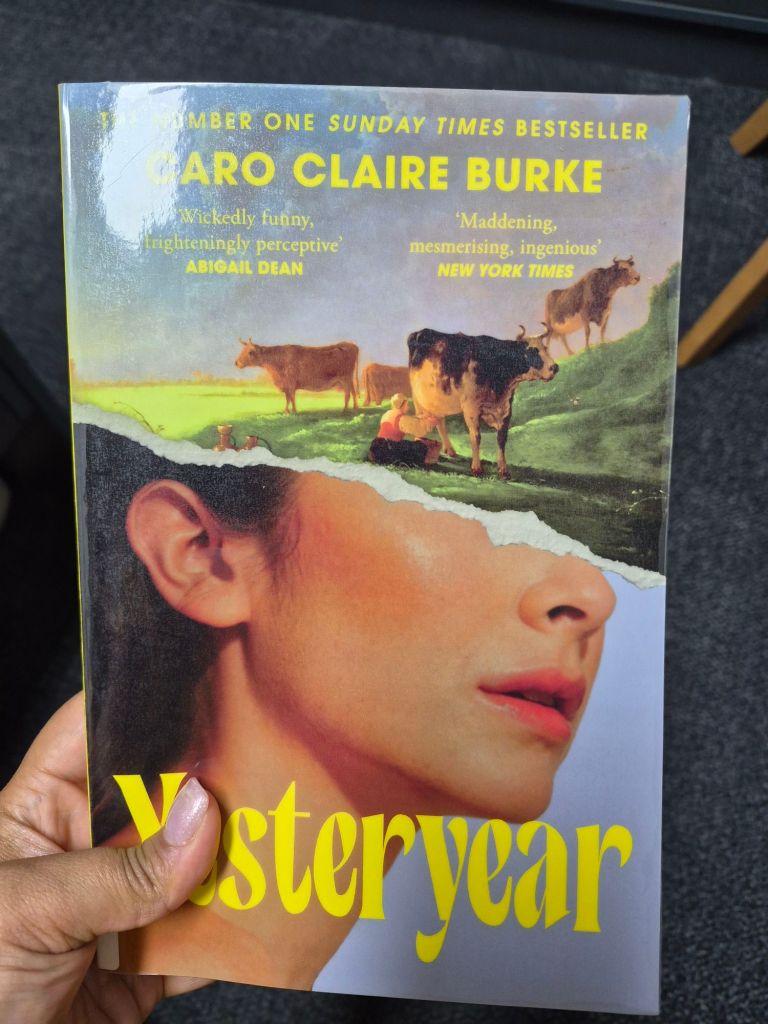
The reality is rather different. Nattie lives on a farm owned not by her, but by her trust-fund husband. The property is tied up entirely in his name through his wealthy father. Her carefully curated social media image conceals pesticides stored in the shed and kitchenware that falls well short of the wholesome aesthetic she promotes. She romanticises a lifestyle that exists largely because of privilege while dismissing anyone, especially the angry women, as she calls those that choose to live differently. Burke deftly skewers the contradictions at the heart of influencer culture. Nattie profits from selling an image rather than a reality, and the novel exposes how easily social media can transform performance into perceived authenticity.
However, the plot suddenly twists when Nattie seems to be suddenly transported back into the real yesteryear pioneer times. Suddenly, the traditional lifestyle she has spent years glamourising ceases to be content and becomes reality. There are no labour-saving devices, no social media sponsorships, and no carefully staged photographs. The work is relentless, exhausting, and often dangerous. More importantly, Nattie is faced with what “traditional values” actually meant for many pioneer women. She does not own property. She cannot vote. She has little legal protection if her husband becomes violent. Her reproductive choices are not her own. The freedoms and protections she has enjoyed in the modern world, while simultaneously criticising why women even need them, disappear overnight for her. There is another plot twist… but I will leave it for you to find. I had to re-read the last few chapters three times to fully absorb it!!
What makes Burke’s Yesteryear so effective is that it refuses to offer an easy caricature. Instead, it asks readers to confront the gulf between romanticised nostalgia and historical reality. The novel challenges the fantasy promoted by some tradwife influencers: that a return to an earlier era would somehow solve modern problems. Burke reminds us that while the past may appear charming through a filtered Instagram reel, it was often profoundly unequal, particularly for women.
Infuriating and surprisingly thought-provoking, Yesteryear is both an entertaining time-slip novel and a sharp critique of influencer culture. It left me frustrated with its protagonist, the trad wife movement, influencers in general, but also wrathful that so many women today lack equal rights. This book clearly captures the delusion that so many right wing people advocate fo4. Yesteryear is a clever and timely reminder that nostalgia is often easiest to sell to people who have never had to live it.

