Literacy is influenced by social, cultural and technological change and the information revolution has increased the modes of communication available for children, teenagers and adults alike. (Anstey & Bull, 2006, p.24). As technology evolves, social and cultural practices need to adapt to this new paradigm.
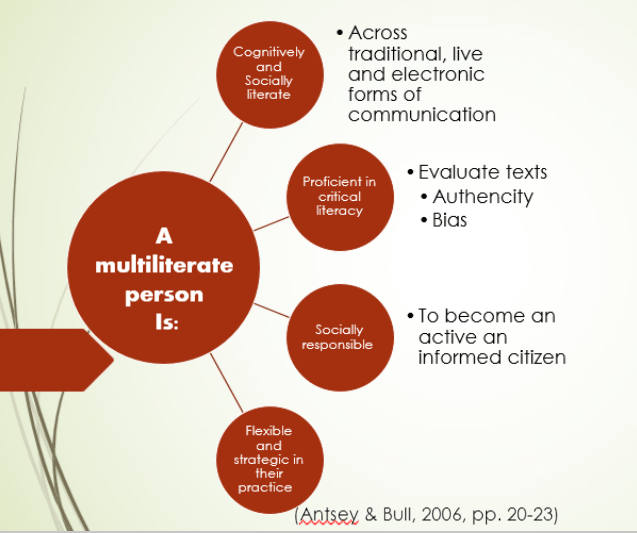
To be an active and informed citizen individuals need to be multiliterate. This means a person needs to be confident in a range of literacies, across a variety of modes and able to translate those skills across all sectors of their life (Anstey & Bull, 2006, pp. 19-22). In order to have mastery with these multiple literacies, individuals need to be able to adapt their practices to suit the whichever context is available (Anstey & Bull, 2006, p.20).
Anstey & Bull (2006) have summarised the skills of a multiliterate person:
As the diagram above shows, a person’s ability to be multiliterate (ML) is also multifaceted. A ML person is able to determine the context of work and then instinctively switch to the literacy that best suits that mode of communication, for example, reading an email to watching a TikTok video, to listening to an audiobook. This flexibility is essential in modern society and requires the reader, or text user, to be able to alternate between different forms of text that may present in daily life.
What does this mean for pedagogical practice?
The notion of text has evolved significantly over the past few decades. I have mentioned this shift in a previous blog post about literature in digital environments. Therefore, a shift in text types means there needs to be a shift in literacy based pedagogical practices (Anstey & Bull, 2006). Remember literacy is influenced by social, cultural and technological change (Anstey & Bull, 2006)!
Hepple, Sockhill, Tan & Akford (2014) point out that since language and literacy exist within the ACARA’s multiliteracy framework, there is firm mandate to include multimodal texts within educational practice. Anstey & Bull (2006) concur, and believe that pedagogy to promote multiliteracy needs to address the changing nature of texts, that literature is learned in a social context and critical literacy is essential for informed action.
Within classroom practice Anstey & Bull (2006) argues the importance of balancing the variety of genres and formats for teaching and learning purposes. Whereas Hepple, Sockhill, Tan & Akford (2014) believe that long term exploration of texts across the curriculum using text exemplars and features, as well as the explicit teaching of semiotics and critical thinking are better suited to student learning.
Anstey & Bull (2006) emphasis the fact that literacy identity is pivotal to multiliteracy (p. 36). As literate practices are linked to social and cultural development, literacy identity is the combination of experiences from both the real world and the school world (Anstey & Bull, 2006). By being aware of their own literacy identity, a person consciously understands their own abilities to decode a set of resources and their faculty for critical literacy (Anstey & Bull, 2006). Hepple, Sockhill, Tan & Akford (2014) point out that the best results for teaching multiliteracies occur when it is taught using active learning and a student centred approach (p.220).
Critical literacy is a tenet of multiliteracy (Anstey & Bull, 2006, p.37). This is based upon the fact that students are exposed to a variety of texts from all contexts of life including, education, employment, social and recreation. But not all texts hold equal authority. Accuracy and validity are not guaranteed, and students need to learn to be able to differentiate between reliable resources and false information, especially on the internet. By exposing students to a range of texts from a trusted adult like a teacher or teacher librarian, through literary learning or via book bento boxes and book trailers, they are given opportunities to develop their critical and multimodal literacy with the hope of translating those skills to life outside the classroom (Anstey & Bull, 2006, p.38).
The name intrigued me immediately. I began to imagine miniature books presented artistically in a bamboo box. Then I remembered how un-artistic I am and the most creative experience I have had lately is using blue eyeliner instead of the stock standard black. Then I began to get hungry.
But I digress. Here is a Book Bento Box I prepared earlier using physical items.
Cover reproduced with permission from Kokoda: Teen edition by Peter FitzSimons, Hachette Australia, 2016.
Book bento boxes (BBB) is a multimodal and interactive reader response strategy to literature that promotes visual literacy, critical thinking and multiliteracy (Bales & Saint-John, 2020; Anstey & Bull, 2005). According to Bales (2018), BBB are adaptable and can be used at the beginning of a novel study to predict the events, in the middle to explain critical features or themes, or at the end of a unit of work to show understanding and comprehension. Most commonly used within the English curriculum, BBB can be successfully adapted to use across other disciplines for teaching and inquiry learning (Bales & Saint-John, 2020).
The concept underpinning book bento boxes is straightforward. Common household items or images are artistically arranged and used as points of reference for significant themes or events within the text (Bales & Saint-John, 2020). Their simplicity and scope for differentiation makes BBB an excellent strategy for capturing understanding in a formal or informal setting (Bales, 2018).
Far different from traditional book reports, BBB provides an alternative and creative method for promoting discourse (Anstey & Bull, 2006, p. 22). It allows the student to engage with the text and respond in a manner that utilises their own knowledge bank and best suits their abilities, as each reader’s comprehension of the text will differ to their peers due to the disparity in views, perspectives and mental acuity (Derewianka, 2015).
We have acknowledged that discourse is important for improving student understanding and success and the traditional method for discourse has been literature circles and book reports. I have previously discussed this in other blog posts, for example The books we read aloud are the ones that resonate the most so I will leave it here. BBB are an ideal reader response strategy for high school classrooms as they can be easily differentiated for diverse learners and promote multimodal literacy.
Here is a Book Bento Box I prepared using digital images (all with CC 4.0 or 2.0).
BBB can range from simple posters, to interactive digital images with embedded links for videos and external websites (Bales, 2018). They can be created individually or in collaborative learning groups, for teaching and learning as well as for assessment purposes.
Pre tech days of the old school poster.
Remember the poster presentation from days before Powerpoint? In the world before Powerpoint and mobile devices, students would create posters using cardboard, paper, coloured pens and magazine collages. This BBB option is still available for young children, or older students with minimal access to devices and software. In most Australian secondary schools, many students have access to mobile devices such as laptops or smartphones, so they are able to create digital images with or without embedded interactive features. By including annotations or a rationale with their work, the reader is able to justify the inclusion of their supporting items and thus illustrate their knowledge and understanding of the text (Bales & Saint-John, 2020).
The process to create a book bento box is quite simple and more detail instructions are here:
Select a text.
Select items or images that correspond to themes or events in the text.
Arrange the items as artistically as possible.
Take a photo.
Edit the photo either using Powerpoint or your camera filters.
Upload the image to Thinglink or you can keep using Powerpoint or Prezi or a poster.
Add the interactive features (if desired).
Add annotations or rationale (if desired).
Share to learning management systems and emails (if desired).
So why is there a need to implement BBB into teaching and learning? Why change things up?
To put it simply, the reading paradigm has changed and therefore pedagogy must also change to support students in this new world (Mangen, Walgermo & Bronnick, 2013). As mentioned earlier, there are sufficient pedagogical reasons to use book bento boxes in teaching and learning. Firstly, exposure to a variety of good quality texts embedded across the curriculum has been proven to extend ICT capabilities, intensify engagement, improve cognition, boost emotional development and increase recall. By using this reader response strategy, students are increasing their visual literacy, critical thinking and consequently multiliteracy capabilities. It is also a whole lot of fun!!
Derewianka, B. (2015). The contribution of genre theory to literacy education in Australia. In J. Turbill, G. Barton & C. Brock (Eds.), Teaching Writing in Today’s Classrooms: Looking back to looking forward (pp. 69-86). Norwood, Australia: Australian Literary Educators’ Association. Retrieved fromhttps://ro.uow.edu.au/cgi/viewcontent.cgi?article=2620&context=sspapers
Change is inevitable and society has seen great changes to the way it functions. The current technology revolution has changed the way people earn, communicate, work, live, study and recreate. According to Vygotsky’s socio-cultural theory, reading and learning work symbiotically together with strong influences from language and technology (Hashim & VongKulluksn, 2018). Therefore by this theory, changes in technology resonates how learning, language and literacy manifests in communities. This is evident in the way the definition of literacy has expanded. Previously the term ‘literate’ was used to describe individuals who were able to read and write. But the current definition includes the skills and knowledge required to access, use, understand and express ideas, thoughts and feelings, across multiple modalities, and in all contexts of life (ACARA, 2014). The broadening of the definition is directly related to the evolving nature of technology and its impact upon the way literature and books are read, comprehended and evaluated (Sargeant, 2015; Jabr, 2015).
The concept of the book changes with every technology revolution and corresponding societal change. From prehistoric stone tablets, to Ancient Egyptian papyrus and Roman vellum scrolls, to the innovative Gutenberg printing press, books have evolved with technology, and at each transformation, the reading paradigm changes (Mangen, Walgermo & Bronnick, 2013). The modern definition of a book can include the traditional paper form, as well as electronic versions that can be read on devices such as mobile phones, tablets and laptops along with audiobooks, online books, and other digital products such as applications and websites (Springen, 2010). This emergence of these new digital texts require additional skills and strategies in order for the reader to comprehend the narrative (Jabr, 2015; Mangen et al., 2013; Sekeres & Watson, 2011). As part of evidence based practice, secondary school teachers are encouraged to adapt their pedagogical practices to address these technological and societal changes to ensure that their students possess the relevant skills and strategies to become active participants in society.
Reading has often been characterised as the product of an individual’s ability to decode and comprehend the text and is viewed as a fundamental human skill (Moore & Cahill, 2016, p.4). Engagement in reading is linked to improved student learning and long term academic success (Moore & Cahill, 2016; Hashim & VongKulluksn, 2018). Unfortunately many teenagers and young adults are reluctant to read and this reluctance can impact their education as well as their social capital and identity formation (Moore & Cahill, 2016). Many education departments across the world have increased funding for technology in schools to boost literacy and reading rates in an effort to halt declining literacy (Keen, 2016). In turn, educators seek to identify pedagogical practices that will increase student motivation for reading and in turn, improve overall literacy.
Technology has been often cited for its ability to improve educational outcomes due to its engaging format. Morris & Cahill (2016) has determined that technology has a stronger preference in secondary compared to primary aged students. Since motivation to read and cognitive experiences when reading works via a positive feedback mechanism, it makes sense that digital literature should lead to increased reading rates and improved literacy (Hashim & VongKulluksn, 2018). Furthermore, Taylor (2018) suggests that the complex nature of digital storytelling is suitable for teenagers as they are familiar with using devices and are comfortable switching between screens and print.
Technology in literature, also known as digital literature, encompasses ebooks, audiobooks, interactive media and mobile applications. Each of these technologies, delivers narratives in their own individual way and requires a variety of skills and strategies for decoding and comprehension. Many teachers and teacher librarians are tasked with identifying technology based literature in an effort to increase engagement and improve educational outcomes.
Sargeant (2015) defines an ebook as the static digitised version of a print text with its familiar features of virtual pages, book gutters and page turning animation. Access to ebooks can occur both onsite and offsite as they can be retrieved and delivered digitally to mobile devices with embedded features (Hashim & VongKulluksn, 2018). Examples include Kindle application, where ebooks purchased from Amazon can be accessed through, or BorrowBox and Wheelers, that allow for borrowing of titles and are often affiliated with public and school libraries. Some ebooks for older readers have various levels of interactivity, such as hyperlinks and in built media are commonly found in secondary expository or information texts such as text books (Sargeant, 2015). Their increased popularity with older readers is due to portability and ability to retain text anonymity (Dickenson, 2014). But ebooks that are designed for younger and less literate readers have lower levels of interactivity and contain more skeuomorphic features to reduce distraction from the main point (Sargeant, 2015) .
Jeon (2012) promotes the use of ebooks in schools as they support academic instruction, are time efficient as well as provide a dynamic and cost effective way of managing a collection. Ebooks can also be integrated into library management systems and thus are available for to be borrowed by students at any time, including in times of pandemics and forced isolation (Jeon, 2012). These apps are designed to assist readers in retaining anonymity in title choice, as well as allow access to a wide range of reading levels which encourages independent reading and promotes bibliotherapy (Hashim & VongKulluksn, 2018).
Audiobooks are increasing in popularity with readers from all generations (Moore & Cahill, 2016). The most prevalent use of audiobooks in schools are, students with low literacy and learning difficulties as well as second language learners (Moore & Cahill, 2016, p.5). Hiebert, as cited in Moore & Cahill (2016) argued that language and the fundamentals of narratives can be conveyed through auditory processes, as language-comprehension system in the brain permits text engagement and comprehension (p.3-4). Other benefits to the implementation of audiobooks in teaching and learning processes include, improving vocabulary, promoting oral language, as well as strengthening links between oral and written literacies (Moore & Cahill, 2016, p.4). Audiobooks can be easily accessed on personal devices and offer the same level of anonymity as achieved by ebooks. Anonymity is very important in secondary schools, particularly for students with low literacy who need to access ‘different’ texts (Dickenson, 2014).
Whilst there are many different reasons why students struggle to read, the most common reasons in secondary schools include, insufficient vocabulary, incorrect decoding and a lack of fluency (Moore & Cahill, 2016, p.5). Access to audiobooks allows students who struggle with the aforementioned inadequacies to engage with the text and develop their reading accuracy as well as potentially improving any behavioural management that arises from disengagement and disenfranchisement (Moore & Cahill, 2016, p.6). Audiobooks address these needs and therefore it is possible to surmise that this technology is able to provide the reader the same rich experience that is afforded by print text.
Interactive media (IM) has exploded in recent years and this is impacting teaching and learning (Cullen, 2015). Some examples of interactive media include digital books, online books, book applications and websites. Lamb & Johnson (2010) argue that IM causes readers to shift from being passive receivers to active participants. This is because IM is able to engage students in the content via multiple entry points and therefore encourages learning through experience and experimentation (Lamb & Johnson, 2010; Cullen, 2015). IM narratives are able to tell dual stories, as well as bring the images to life whilst providing a brilliant way to connect emerging technologies to the curriculum (Cullen, 2015; Taylor, 2018).
One example of IM are book applications (apps). Book apps are software programs that are designed to engage students by delivering high levels of interactive media rich content (Sargeant, 2015). They integrate multiple modes of communication so that the text and visuals are fused to create a story that requires the reader to transform into a user by their interaction in the narrative with a touch screen (Sargeant, 2015). This process of action and outcome is based upon gamification principles already present in the rewards based system currently practiced across most school systems. Gamification uses extrinsic motivation in learning and teaching practice. But Briggs (2016) cautions the use of gamification in assessment. The reason for this caution is that the motivation to succeed arises from the low personal stakes the reader has with the text, as well as the elusive but reachable goals.
IM has the capacity to cater to the needs of a varied classroom because of a student’s ability to work at an individual pace and the multiple entry points allows for differentiation. There is also a possibility for educators to use IM to create scenarios, as a mechanism to introduce students to new units of work, or introduce assessment pieces in an engaging format (Lamb & Johnson, 2010). Cullen (2015) believes that application led learning bolsters motivation and engagement in students, which is essential for improved learning experiences and positive outcomes.
There are valid contraindications to the use of technology in educational settings. Studies have shown comprehension is lower in narratives and expository texts when a device is used (Jeon, 2012; Mangen et al., 2013). Jeon (2012) believes that within some forms of technology, the complex nature and formatting of the text causes too great a cognitive load on students and thus it negatively affects comprehension. Hashim & VongKulluksn (2018) concur and point out that students often become distracted in their attempt to multitask on devices, which leads to decreased metacognitive regulation and reduces text completion.
The format of text is also important for comprehension. Digital literature in all forms have lower comprehension rates in comparison to traditional texts (Jeon, 2012; Mangen et al., 2013). One of the other main reasons for this unfavourable comparison is visual ergonomics. Visual ergonomics, such as lowered spatial stability, leads to a negative mental representation of the text (Mangen et al., 2013, p.66). Good readers have a high mental recall of information positioning in text. Consequently, limited mental representation restricts recall and makes it harder for students to construct new banks of knowledge from individual pieces of information. One suggestion to combat this limitation and to promote a more equitable approach in classrooms is to limit digital reading to short extracts only, and it to be of low stakes value rather than summative assessment (Mangen et al., 2013, p.66).
I obviously have not taken my own advice and have written an epic instead of a synopsis!
Hashim & VongKulluksn (2018) suggests that whilst e-readers provide context and analysis, it lacks the social factor that discussion groups and literature circles provide. There is also an implication that educators fail to treat e-readers like they treat print texts, and therefore provide less scaffolding to students leading to lower comprehension rates. This failure could be due to a lack of personal knowledge to the functionality of e-readers, or simply that teachers are not physically able to see how much of the text the student has engaged with and thus forget to offer assistance (Hashim & VongKulluksn, 2018). Therefore, in the interests of equity, it is important that ebooks are scaffolded in the same way as a print books because, as students gain mastery in their reading, scaffolding can be adjusted to help their progress from a low to a higher mental function (Hashim & VongKulluksn, 2018).
There are other obstacles to using ebooks in educational settings. Primarily, students are not motivated to use e-readers for learning. This could be due to the fact that e-readers are no longer considered a novelty, that devices themselves are commonplace, and lastly, that traditional texts actually provide greater enjoyment than digital literature (Hashim & VongKulluksn, 2018). Ebooks have also been known to cause eye irritation which in turn reduces surface legibility, and increases eye strain and mental fatigue (Jeon, 2012). These physical demands lead to an increased error rate and reduces overall comprehension, which in turn leads to a lower perception of ereaders and ebooks (Jeon, 2012). Other than diminishing comprehension, ebooks can also be seen as tedious in comparison to other entertainment found on devices (Jeon, 2012). Though there is some suggestion that digital natives are resistant to these issues as they are more familiar with technology (Jeon, 2012).
Some educators are reluctant to provide audiobooks to their students in lieu of print texts as they can be viewed as ‘cheating’. But Dahl (2016) disagrees with and finds that audiobooks provide the same learning experience as reading after a certain level of literacy has been reached. This is based upon the theory that the decoding specific to reading becomes instinctive after a certain point in literacy is achieved (Dahl, 2016). The reasoning is that ‘reading comprehension’ is similar to ‘auditory comprehension’ and that echoic memory is comparable to the visual system of eye regression, though the concept of ‘flipping back’ is a bit more problematic in an audiobook (Dahl, 2016).
The current predominate argument surrounding school is that digital media will engage reluctant readers and therefore improve learning outcomes (Springen, 2010; Cullen, 2015). But some educators argue that these alternative texts lack equity as they are limited to students and schools with digital access and financial security (Sekeres & Watson, 2011). Sekeres & Watson (2011) even go further to suggest that educators need to be aware that children are often targeted as consumers in their own right and therefore teachers need to be circumspect when they select digital literature that it actually leads to learning and not just entertainment.
From a school collection perspective there are significant issues with ebooks and audiobooks, namely access and cost (O’Connell, Bates & Mitchell, 2015). This is due to the fact that both ebooks and audiobooks require a personal device such as a mobile phone or tablet and many younger students do not have that level of access. They also require a financial contribution and or a library membership, which again can be limiting for younger students to practice their digital literacy skills. One suggestion to address the rising cost of digital literature is to promote public library memberships in schools. Students who have library memberships at school, local and state libraries, have access to a wide range of texts in both print and digital formats. Some larger institutions also offer electronic access to databases and periodicals which is very useful for secondary students. This reduces the cost to the individual and school systems without limiting access to information.
Licencing and leasing are problematic when it comes to digital literature. Physical books are bought by the library, require no device to use, and are useful till the book gets lost, deselected or falls into disrepair. Ebooks in comparison, are either downloaded (purchased), or borrowed and both require a device and the internet to be used. These devices, such as iPods, ereaders, laptops and tablets can be quite expensive for school libraries and students to purchase and maintain (Gray, 2017). Additionally, if a school library chooses to use a platform such as Borrowbox or Wheelers as their access point for ebooks and audiobooks, they are limited by that publisher’s collection as to what titles meet the developmental needs of the students and curriculum requirements (Gray, 2017). Teacher librarians need to be cautious when selecting platforms for digital literature that they are not limiting their readers to resources based upon publishing contracts and nepotism. Furthermore, the school may not own ‘loaned titles’ and may have to pay a leasing or access fee on a yearly basis. So whilst there seems to be great flexibility, especially with regards to remote access, there can be some stringent financial restraints for schools when it comes to building a robust ebook and audiobook collection.
O’Connell, Bates & Mitchell (2015) suggest that the goal of school libraries is to adapt to the digital needs of the student cohort, which means that the reading culture has to be addressed as well as ensuring a divergence of media is available. Therefore, teacher librarians and school library collections are tasked with ensuring students are given ample access to the different forms of media for teaching and learning across the curriculum as well as for recreational purposes. This means access to both traditional and digital forms of literature. But promotion of wide reading programs and access to emerging literature trends needs to be buttressed by pedagogical practices that support reading and comprehension across the various domains.
The question for teachers, teacher librarians and other educators is that will these new media forms benefit the teaching and learning practices in classrooms, and more specifically, secondary classrooms? It is clearly evident that the information revolution has changed the way society is functioning. Therefore it is important that students gain the skills and knowledge to succeed in this modern world. From the evidence provided, secondary students are more receptive to digital literature because of its engaging format, portability and text anonymity. But many lack the reading and comprehension skills to fully understand the nature of the text and therefore are at a literacy disadvantage. Educators need to recall the importance of culture and tools in Vygotsky’s theory of learning and provide access to a range of literature across the various forms of media. The reading paradigm has changed and teachers must change their teaching and learning to suit this new world.
Gray, M. (2017). Ebooks: To subscribe or not to subscribe? Connections, 101. Retrieved from scis.data.com/connections/issue-101/ebooks-to-subscribe-or-not-to-subscribe
Jeon, H. (2012). A comparison of the influence of electronic books and paper books on reading comprehension, eye fatigue, and perception. The Electronic Library, 30(3), 390-408. doi: 10.1108/02640471211241663
Moore, J., & Cahill, M. (2016). Audiobooks; Legitimate ‘reading’ material for adolescents? Research Journal of the American Association of School Librarians. Retrieved from www.ala.org/aasl/slr/volume19/moore-cah
O’Connell, J., Bales, J., Mitchell, P. (2015). [R]Evolution in reading cultures: 2020 vision for school libraries. The Australian Library Journal, 63(3), 194-208. DOI: 10.1080/00049670.2015.1048043
I fell in love for the first time with a boy named James Winthrop Frayne II. I was 11 years old and madly in love. He was 16 years old, tall and very smart, with red hair, green eyes and a slightly crooked smile.
Unfortunately for me, James or Jim, as I lovingly referred to him, was a character in my favourite book series “Trixie Belden”. In fact, my love for Jim Frayne was so embedded into my mind that I ended up marrying another lovely redhead (he says honey-blond) who also happened to have James in his name. And whilst I was falling in love with Jim Frayne…
I fell in love with reading books.
Now when I say I love books, I say this as an adult who reads on a daily basis.
I have never spent a day in my life as far as I can remember without reading or food. In fact reading and eating are interwoven rather closely in my life. I have eaten my way through many books and I have read my way through many meals. Even now as a mother of three, dinner table conversations are still second place to a book. So for me, books are a need, like food and water. I indulge that need with classics and new authors; old favourites and popular series. But series fiction holds a dear spot in my heart. As a child, series fiction gave me Jim and Trixie, Harry and Hermoine, Frank and Joe, Nancy and Bess, Laura Ingalls, Anne Shirley, Lucy, Pollyanna, Heidi, George and Timmy, Darryl and Sally. As an adult series fiction brought me Doc Scarpetta, Tempe Brennan, Ayla of no people, Falco, Jamie and Claire plus many others into my life. Whilst I have loved the classics and other stand alone titles, series fiction brought me the greatest joy.
{silence} {crickets} {crashing cups of tea and chairs} {my career as a future TL fading into the sunset}
Yes, as an adult who is also a fledgling teacher librarian, I am voicing out loud my deep and ardent affection for serial stories. Now, once everyone has picked themselves off the floor and righted their tea cups; I will explain my thoughts.
I acknowledge that series fiction, whether for adults or children, has often been regarded as literary rubbish. Often viewed as the ‘Mills & Boon’ of literature, series fiction is derided for its repetitive structure, predictive plot and lack of character development (Westfahl, 2018). Some would even argue that its presence on bookshelves is a betrayal of literary values (Westfahl, 2018). But these people are snobs! Books do not always have to be among the lexicons of literature. Books, especially fiction books, should be able to satisfy cognitive, emotional and the developmental needs of the reader and series fiction definitely addresses the emotional needs of both fledging and proficient readers.
But before I elaborate deeply on how series fiction changed my life; I would like to clarify a few technical issues. There are three main types of series fiction. Firstly, there is the progressive series; where a longer narrative is broken down into shorter novels and the sequence of titles is important to the reader and storyline (Wooldridge, 2015). Then there are the successive series, where the plot repeats itself continuously and lastly, the accidental variety where the author reluctantly writes prequels and sequels to comfort the crazies.
Rowling’s Harry Potter, Marsden’s Tomorrow when the war began, Montgomery’s Anne of Green Gables and Wilder’s Little house books are some examples of progressive series. These book concatenations had a definite end which saw the characters grow and develop along with the reader. I was one of those readers that grew up with Ellie and Harry. I devoured John Marsden’s series in a matter of months. My poor high school teacher librarian was continuously pestered to get the rest of the series once I got hold of the first one. Poor man! Lucky for him, by the time I discovered Harry, I had a job and a library membership! I was 13 when the first HP book was released and as Harry grew up, so did I. Harry, Hermoine and Ron were more than just book characters, for me they were friends.
Successive series examples include the famous Diary of a wimpy kid, Nancy Drew, Hardy Boys, Trixie Belden, Babysitters club, Animorphs, Famous Five, Secret Seven, and Bobbsey Twins. These series have a foreseeable story patterns with comforting characters and obvious plots (Wooldridge, 2015). Whilst these books may seem formulaic (they are!), it is their predictability that makes them popular. Series fiction offers children constancy and security in a world full of upheaval (Wooldridge, 2015). Children develop a sense of trust, an affection with the character and possibly even a relationship with the author (Wooldridge, 2015). So while they themselves grow up through the tumultuous years of puberty, series fiction with its predictability offers an escape, a playdate with an old friend.
I developed this type of relationship with Enid Blyton after being introduced to the Famous Five. The sheer joy received from reading that series led me to trust her writing style and with it I discovered Secret Seven, 5 find outers and it, Mallory Towers, Twins at St Claire’s, Wishing Chair, Enchanted Tree, Amelia Jane and so many more. For an awkward immigrant kid with poor social skills, these books allowed me to escape to places where magic and friendship abounded. My daughter is also a big Blyton fan. Every time she picks up a book authored by Blyton, I know that she will most likely gain the same level of emotional satisfaction that I did and so develop her love of reading. There is also a great deal of enjoyment to share with her the books of my childhood.
The last main type of series fiction is the accidental variety. These are books that the author only planned on one, and then somehow their popularity has meant sequels and prequels were soon requested by adoring fans. George M Martin’s Game of Thrones is such a series, spawning an TV run that lasted several years and ended before the last book has even been published. Diana Gabaldan’s Outlander series is currently stalled at the near publication of its 9th book and only time will tell if the tenth book will ever eventuate (especially since the first book was published almost 20 years ago!). Other accidental series include Baum’s Wizard of Oz, Norton’s The Borrowers and P. L. Traver’s Mary Poppins. Because these series were accidental and not planned, their storylines do not always make sense and can appear a bit jerky at times. Sometimes they abruptly end if the author or readers lose interest.
Series fiction has been around for a long time. As much as some literary snobs would hate to admit, there are some current classics that used to be serials. Dicken’s Pickwick Papers and another seven of his other titles as well as Doyle’s Sherlock Holmes started off as series but then were condensed into a novel several reprints later (McGill-Franzen & Ward, 2018). Even further back to the folklore stories such as mythical twelve tasks of Hercules; the thousand and one stories of Scherazade and adventures of the Round table are varieties of series fiction. So to all those literary snobs that believe series fiction are rubbish… well… pffft to you.
If you think about it from a practical viewpoint it makes sense if you have a recipe that works to use it! Edward Strathmeyer had such a recipe back in the boom days of series fiction. He planned outlines of books and then organised cheap ghost writers to write the stories, and oh boy… did it work! The whole Trixie Belden, Nancy Drew and Hardy Boys production is based upon this magical recipe (Westfahl, 2018). The recipe had some key ingredients. Characters are kept the same age; have the same small town holistic upbringing; go on amazing adventures, travel the world but always come home safely to a loving family. These books allowed children and teens (mainly aimed at Caucausian middle class Americans) an avenue of escape from their groundhog day lives. As these book characters all suffered from perennial Peter Pan syndrome, they have never lost their appeal even in its trillionth reprint nearly ninety years after the first copy (Finnian, 2013). I will mention here that whilst racial demographics and family structure has evolved significantly since the first Stratemeyer book was published in 1927, their popularity has not changed. The plot pattern remains the same but the settings and dilemmas have evolved with the times. Obviously the recipe still works!
So what is the benefit of series fiction? Besides emotional satisfaction, series fiction allows the reader to build their literacy skills. McGill-Franzen & Ward (2018) believes that the predictable plots assist in developing word recognition which in turn boosts vocabulary and reading confidence. The formulaic story pattern allows the reader to easily identify any explicit reading conventions present. This expanded vocabulary and confidence then allows the reader to successfully use their increased literacy skills in other areas.
Series fiction makes it simple for readers to identify titles they are willing to read because they identify with the author. Reluctant readers are more likely to pick a book they are familiar with by the same author; than a title by a new author. They are also more likely to try other titles by that author because of the relationship that was previously established. A great example is John Flanagan, author of the fabulous Ranger’s apprentice series. Teens who enjoy that series often move onto the Royal Ranger series as well as Brotherband because they trust the author. The same can be said for Rick Riordan and the plethora of books he has published.
The impact of series fiction is clear. Children and teens who read more books end up being more adults who read. Remember, committed adult readers were hooked onto reading as children by series fiction (McGill-Franzen & Ward, 2018). And whilst reading of insightful novels that provokes critical thinking complements a wide reading program, it cannot replace it. Pushing the classics onto children and teens before they are ready is unlikely to work. But offering them an opportunity to connect with an author or a series they can engage with may put them onto the pathway towards literature. After all, children do age out of one series and into another (McGill-Franzen & Ward, 2018). They grow from Blyton’s Magic Faraway tree to Rodda’s Rowan of Rin, to Rowling’s Harry Potter to Marsden’s Tomorrow when the war began to Davis’ Falco, Cornwall’s Scarpetta and Reichs’ Bones and Hume’s Arthur and Merlin series and eventually they reach the classics. Why do I know that? Cos I did just that.
I fell in love with reading as a child. I have stayed in love with reading as an adult. Are you in love with reading? If so, when did it happen?
Woolridge, T. (2015). Series fiction and Sallly Rippin’s Billie B Brown series: The ‘Most important continuous reading children do on their own’. mETAphor, 3, 30-35. Retrieved from https://www.englishteacher.com.au/
Colin Firth as Mr Fitzwilliam Darcy in 1995 BBC’s Pride and prejudice TV series. Courtesy of Jane Austen Centre, Bath. http://www.janeausten.co.uk
Not the Austen version of Mr Darcy, but Colin Firth version in the BBC mini-series of Pride and prejudice. His smouldering eyes, broad shoulders and clipped accent was enough to make this girl blush and we all know I am too brown to blush!
With that started the greatest love affair I’ve ever had.
I INHALED the TV series, read the book, devoured any adaptation,version and variation I could find. I looked for sequels, hunted for parodies and searched for spin offs. I realised that my infatuation had gone beyond just the Austen version. I watched and read anything that remotely was associated with this book including ‘Bridget Jones’ Diary’ and the Bollywood adaptation of ‘Bride and Prejudice”.
But this new subject of mine made me ponder how the various versions and adaptations would be organised. Then I came across an acronym – FRBR that boggled my mind.
FRBR – Functional requirements of bibliographic records is a conceptual model of thinking about resources that are similar (Hider, 2018). The model seeks to separate resources on different levels depending on their relationship to the original version. As a theoretical model rather than a standard, FRBR forces the cataloger to identify the line in which a new work differs enough from its original form.
In perfect truth, this whole concept was so puzzling to me at first. I struggled to understand how the pieces all connected together. Then whilst on my winter break I started to read another adaptation of ‘Pride and Prejudice’ but from Mr Fitzwilliam Darcy’s point of view. I thought that if I placed all the versions in a table, I would maybe understand it all a bit better.
IT WORKED!
Equivalent
Derivative
Descriptive
Original
Same work
Catalogued as new work
Original
Variations or Versions
Adaptations
Change of Genre
Reviews, criticisms, evaluations, commentaries
Pride and Prejudice by Jane Austen, 1813.
Pride and Prejudice by Jane Austen, Arawa Edition, 2016
Oxford University Press,
Pride and Prejudice by Jane Austen
Penguin English Library, UK Edition, ebook
Pride and Prejudice and Zombies by Seth Grahame Smith and Jane Austen
Emoji pride & prejudice by Katherine Furman, Chuck Gonzales and Jane Austen
Darcy swipes left by Courtney Carbone and Jane Austen
Pride and Prejudice, BBC TV mini series 1995
Pride and Prejudice, film, 2005
Death comes to Pemberley by P.D. James
The Independence of Mary Bennett
By Colleen McCollough
Bride and Prejudice, film, 2004
Bridget Jones Diary, film, 2001
A study guide for Jane Austen’s Pride and Prejudice by Cengage Learning Gale, 2017.
Pride and Prejudice SparkNotes Literature Guide by SparkNotes, 2014.
It made sense to me, that line between original work and versions be organised under the original author’s name but adaptations, parodies and commentaries need to be catalogued with citation to the creator that did the ‘new work’. But this is where tagging comes in use. Cataloging needs to be precise and organised so that the source can be easily identified and found. Tagging/Subject headings, when indexed, allows the user to search for similar items even though the author and or titles may vary. For example, on the right side of this webpage, you can see the tags that are linked to various blogs on this site. The tag allows the user to search up all related posts to that tag. It is less specific than a title and or author search in finding a resource.
I broke down three resources further to illustrate how the metadata varies between them. You can see that the tags “women in England – fiction”as well as some others would be useful in finding Austen adaptations.
Title
Pride and Prejudice
Emoji pride & prejudice: Epic tales told in tiny texts
England social life and customs – 19th century – fiction
Women in England – fiction
Austen, jane – adaptations
Austen, jane – parodies
Women in england – fiction
Brothers and sisters – fiction
Social classes – fiction
Family relations – fiction
England social life and customs – 19th century – fiction
Austen, Jane – adaptations
Austen, jane – parodies
Women in england – fiction
Brothers and sisters – fiction
Social classes – fiction
Family relations – fiction
E-books,
England -social life and customs – 19th century – fiction
This whole exercise has been very useful for me to understand this task and subject. It also has helped me find some other versions of Mr Darcy. I am not yet quite up to the 50 shades of Fitzwilliam Darcy, but I am definitely getting closer!
Hider, P. (2018). Information resource description: Creating and managing metadata (2nd ed.). London: Facet.
Digital literacy was only recently implemented with the year 7’s. Last year I ran a few HASS classes with the then Yr 7’s and realised that they were absolutely incapable of doing very simple tasks such as saving documents, referencing with more than URLs, uploading documents and even using MS word. I was flabbergasted. So I set up a formative assessment task with a rubric to see what the students were capable of doing and then present that information to the AP for teaching and learning. I used the general capabilities continuum, specifically the ICT and CCT components; and used the stages of the continuum as benchmarks to assess the students. The task showed me that nearly ⅔ of the year 7 students from last year were unable to do very simple tasks and were averaging at a year 4 level. Their information literacy was minimal!! The ramifications of this information were immense. How were these students going to progress through high school and complete their educational tasks sufficiently if their baseline was so low? How were they going to be active and informed citizens? How did these students get this way after being mostly at BYOD schools? And, how did we miss this?
Most of the teachers assumed a basic level of digital literacy and citizenship due to the ‘digital native’ tag. After all, these students were adept at using youtube, playing music, taking photos and using Snapchat! There are also expert at hiding their screens when teachers are nearby, and consummate at switching screens when caught out!
The upshot of my assessment of last years Yr 7s is that there is active interest in embedding ICT and the GC within the curriculum. I am in the process of re-writing the Year 7, 8 and 11 RE units of work to make sure that ICT and CCT are appropriately addressed and assessed. As there is no explicit curriculum for RE, I have free range to make it skills based and use inquiry to teach the content. The only problem I am having is with some of the teachers that are disagreeing with my approach. Luckily I have permanency and am willing to take the risk.
Has the school in which you work (or know best) developed an information literacy policy?
My school is currently in the process of implementing an information literacy policy. My colleague is writing it in collaboration with the AP of teaching and learning. The plan is to align information literacies with the general capabilities continuum and then coordinate them to the year levels. The theory is that once we have the framework we are going to use it to implement the various aspects of across the stages and curriculum.
We are using a few of ANU policies as an end point for our framework. Ideally we would like our students to be at this level by the end of year 12 so we thought if that is the goal then we can use the ‘backwards by design’ process and stage the levels backwards according to year levels. I am using the framework that my colleague is writing as a basis for my work with RE.
These are the policies we are using to structure our framework on;
Information literacy is still currently a disorganised program. Whilst some teachers implement aspects of it in their teaching and learning, there is no whole school approach to informational literacy. In addition, there is limited true inquiry within our school. Granted there are a plethora of ‘research’ assignments that bore both students and teachers. But real, true inquiry projects are missing. This is primarily due to teachers citing overcrowded curriculum and lack of time. But here in the ACT, there is such a large range of flexibility allowed with the national curriculum. There is no need for so much explicit content instruction and rigid assessment tasks. Unfortunately, there is a strong cohort of teachers that persist in repeating the same teaching and learning activities that were taught from two decades ago. The only difference is that students now present their tasks on MS Word and or a powerpoint. But by the same token, we have other teachers that inspire students to do their best within the parameters they have thrust upon them.
There are many challenges to teachers implementing guided inquiry lessons into their teaching and learning. They include among others; a misunderstanding of what inquiry learning is; inability to implement their own teaching activities; inability to collaborate with colleagues, lack of time and fear.
The first reason is that teachers (not teacher librarians who know better!) often confuse guided inquiry learning which is deep in knowledge, rich in skills and meaningful to the student, with a superficial regurgitation of facts that accompany a traditional research task (Maniotes & Kuhlthau, 2014). Students are exasperated, teachers are frustrated, yet the loop of insanity continues from kindergarten to year 12. Maniotes & Kuhlthau (2014) says STOP this insanity!
Freedom to implement authentic teaching and learning practices is often hampered by the hierarchy within schools. Whilst many teachers are given the flexibility to plan their own lessons and thus choose their pedagogical practices, they are often bound by the school and departmental parameters in regards to timelines and assessment (Templeton, 2019). This is very evident in high schools where there are department heads and year level coordinators that manage assessments and their timelines for historic reasons, often completely unknown to anyone in this century. These obstinate teachers are unwilling to adapt and or modify their teaching practice with the advent of an information society. The adage, “but we’ve always done it this way”is a common theme (Templeton, 2019 & Maniotes & Kuhlthau, 2014). These parameters translate to an inability to structure longer guided inquiry units of work as teaching hours are crammed with explicit content instruction aimed at superficial tests and mindless research tasks that no one wants to do and even fewer want to mark.
Lack of collaboration is often blamed for ineffective teaching practices by both teachers and teacher librarians. These intransigent educators are reluctant to participate in collaborative practice and balk at co-creating teaching and learning activities (Ezard, 2019). Often these stalwarts of inflexibility are also the ones that struggle to hand over the reins of learning to the students and or willing to practice team teaching. This loss of controlling the learning is often translated as loss of control of a class, which is a complete contraindication of what a guided inquiry unit is. A vibrant class that is engaging with learning task is going to be noisy as noise usually is entwined with social discourse. It does not mean that the students are disrespectful, nor does it mean that there is disharmony. Learning is a social construct and students learn better when engaging with their peers (Kools & Stoll, 2016). Teacher librarians need to understand that the resistance to guided inquiry is often due to the unwillingness of collaborative practice and not themselves as individuals (Ezard, 2019).
As mentioned previously time is an issue in schools. Teachers lack the time to collaborate with their peers to co-create inquiry tasks, and they often also lack time to allow actually put a guided inquiry into practice. But what teachers often forget is that guided inquiry does not have to be a long unit of work that ends in a presentation. Guided inquiry can be as long as a term or as short as a week. Ideally, the practice does require time to build and teach skills, but the flexibility of the framework allows the teacher to guide the lesson as much as the students require. The true point of a guided inquiry task is to TEACH the skills, not the content. Learning of these skills is a cumulative effect that requires constant practice across all classes and year levels.
The last reason that inhibits the implementation of guided inquiry is fear. Fear of the unknown; fear of rebelling against the system; fear of unemployment due to the previous rebellious behaviour; fear of losing control of a class; fear of failing to meet expectations; fear of not achieving learning outcomes; fear of trying something new; fear of failing.
References
Ezard, T., (2019) Leading the Buzz in your school. ASLA 50th Conference. Canberra
Kools, M. and Stoll L. (2016), “What Makes a School a Learning Organisation?”, OECD Education Working Papers. No. 137, OECD Publishing, Paris. http://dx.doi.org/10.1787/5jlwm62b3bvh-en
Maniotes, L.K, Kuhlthau, C. (2014) Making the shift. Knowledge Quest. 43(2) 8-17
Templeton, T., (2019) Rantings of an emerging teacher librarian. I lost my mind 3 children ago. Retrieved from … lost weblink.
How might the TL help the school move towards integrated information literacy instruction?
The change in societal expectations of students has meant that students need to have strong fluency in information literacy and the inclusion of inquiry learning within the curriculum was the ACARA’s response to this change. Information literacy is cumulative and needs to be embedded across the curriculum and year levels. Unfortunately, information literacy is not integrated into the curriculum, but rather aspects of it can be found within some subjects and their inquiry strands. This disjointed learning means that the skills that inquiry promotes are taught in a haphazard manner instead of being practiced in sequential and regular intervals. Information literacy is cumulative and thus requires it to be embedded across the KLAs and year levels rather than in ad hoc stand alone units (Lupton, 2014). Therefore, IL needs to be part of the content, structure and sequence of learning.
Fitzgerald & Garrison (2017) reinforce that consistency is important and a school wide focus is important. The central position of the library within a school allows a teacher librarian to have an holistic view of the school’s teaching and learning. This holistic vision means that a TL is able to liaise and collaborate with their colleagues to implement a framework for inquiry learning within the school so that those essential skills can be practiced at regular intervals (Kuhlthau et al., 2015). This framework, once designed by the TL, can be then adapted by the classroom teacher and or TL to suit the needs of the subject and or year level. As the keeper of the framework, the TL is also able to differentiate the scaffolding to suit the learning needs of the students in anticipation of the unit of work.
What challenges lie in the way of such instruction?
The biggest challenge for the implementation of inquiry units is time, or the lack of time. The curriculum is already very crowded and with the prevalence of standardised testing and the emphasis on traditional assessments, there is insufficient time to properly run inquiry units at regular intervals. Additionally, whilst inquiry units are popular in primary schools and in lower secondary, it is deemed less rigorous in senior years. This is a fallacy, but old habits often die hard. The other challenges for inquiry units are lack of collaboration within the teaching staff and reluctance for students to work in collaborative groups. As mentioned in other posts, many teachers struggle to work collaboratively with their colleagues for numerous reasons. Teacher librarians are often excluded from curriculum planning and assessment design due to the presence of subject silos within schools. This inability to collaborate often leads to poorly designed and implemented guided inquiry units that fail to engage students and provide lacklustre results. This inability for teachers to collaborate effectively is then often transferred to their reluctance to let students to work in similar groupings. Inquiry units are best done collaboratively as learning is enhanced when based within social constructs. These groups are often called inquiry circles or focus groups. Unfortunately some teachers are reluctant to have their students working in groups as they differ from the traditional classroom setting and upset their preferred teaching style.
How teacher librarians and teachers might encourage students to transfer information literacy skills and practices from one subject to another?
The library is often a neutral zone and utilised by all subject areas. Therefore, students are able to view the TL as the ‘inquiry teacher’ regardless of the subject that the task is for. This means that it is plausible that students would be able to transfer their skills in inquiry learning from one subject to another simply because the teacher teaching the subject has not changed. Additionally, the TL is already aware of the learning needs of the students and thus can scaffold them appropriately. This scaffolding can be tailored individually to allow all students to participate to varying degrees. Fitzgerald & Garrison (2017) point out that reflection within an inquiry unit forces students to contemplate their learning and ruminate on the processes they used to achieve their goal. This reflection helps students determine their strengths and weaknesses for future tasks and thus be more conscious of their learning. This cognisance of learning is an essential part of the process and can be used as feedback as well as determining the zone of proximal development (Fitzgerald & Garrison, 2017).
Appropriate for History, English, Drama, Visual Art, RE and Mathematics subject areas.
Appropriate for students who identify as Indigenous people across Stages 4 & 5.
Citation 1
Various Authors (2011) Yarning strong guided reading series. Oxford University Press, Australia.
Format
Licencing
Owned/Subscribed
Mixed formats print/audio/images.
Copyrighted for person and educational use but not for distribution.
Owned.
Description
This is a set of novels, graphic novels, anthologies and a teacher kit that covers issues such as identity, family, law and country. The anthologies include poems, images as well as a teaching kit.
The box set is aimed at Indigenous students as they would identify with the storylines and characters and thus be more likely to engage with it. The language is colloquial and could be considered a Hi-Lo series for older readers. Since many Indigenous teens have lower literacy than their non Indigenous peers, it is important to have books that cater to their ability and interest (AIHW, 2017)
The resources allows for development of a subtle and covert knowledge and understanding of indigenous peoples. Authenticity and perspective has been maintained as all stories have been compiled by Indigenous authors and anthologies led by tribal elders.
Citation 2
Pascoe, B., (2018) Little Red Yellow Black Book. 4th Edition. Aboriginal Studies Press. Australia
Format /Licensing
Book = owned and with copyright attached.
Description
This book has been written from an Indigenous perspective and thus assists with encouraging appreciation and reconciliation between both non Indigenous and Indigenous Australians. It makes strong connections to the concept of Country and culture. The stories within, cover a range of socio-political issues and this edition also will challenge stereotypes and educate the reader as to the contributions made by ATSI peoples in past and present times.
SC
1a, 1b, 1c, 2a, 2c, 3a, 3b, 4a,
SA
Better Reading blog
Evaluation and use
TR and/or RECREATIONAL reading TS: 1.4 & 2.4
OI: 1, 4, 5, 6, 7, 8,9
This book is excellent at initiating educators to Indigenous culture and histories especially those who have had limited exposure to Australian and Indigenous culture such as overseas born staff and students. There is an accompanying website listed in the book with additional materials. It is aimed at adults as a teaching resource, but can be read recreationally by both staff and senior students.
Citation 3
Manning, N., (1994) Close to the bone. Currency press. Australia
Format/licencing
Class set currently in collection. No production permissions purchased.
Description
This play is about the forced removal of a young Aboriginal child from her family and the reawakening of her Indigenous identity twenty years later. An excellent story about the importance of identity and kinship ties.
This play, whilst dated, can be used as a culmination for National Sorry Day or similar units of work. The themes may be distressing for younger students, so class discussion is essential. The play uses common language that resonates with the reader. It can be analysed from an Australian perspective and it can be performed to a groups as informative drama or as a dramatic reading. Good for kinesthetic learners.
Downloading/editing/embedding with citation permitted
Description
This eBook is embedded with videos showcasing interviews with various stakeholders detailing the political and social events that eventuated at the Rudd Apology in 2008 and the ongoing process of Reconciliation.
This resource is heavy in learning outcomes, capabilities and ATSI CPP. The multimodality will support teaching and learning in discrete lessons and as part of NAIDOC week and National Sorry Day.
The resources are appropriate for a school setting and are of mixed literacy ability and an inclusive school. The main downside of this digi-book is that it does not belong to the school and there is no guarantee of its continuance.
This report offers insight to the scant schooling, systemic abuse and trauma that affected several generations of Aboriginals, and offers understanding to the current gap in education and health outcomes between Indigenous and non-Indigenous people. There are very confronting stories of physical and sexual abuse within. It also elucidates the loss of culture, tradition and language.
This report has a narrow use in a school setting. It is NOT to be disseminated to the students but rather excerpts used in specific teaching and learning practices. Teacher discretion required. For example, to provide ‘voices’ for a yarning circle as a classroom exercise which would highlight the importance of oral traditions for Indigenous peoples and thus in turn, the significance of mother tongue. Or as stimulus for class discussion and debating targeting CCP and CCT.
As this video is short it can easily be used to introduce this topic to elicit discussion. The video is aimed at upper primary, and its interactive aspect has low level Bloom’s questioning so can be used as an activity for students with learning needs. The theme of reconciliation would be useful in an RE context too.
This interactive graph gives snapshots of information of Australian history major events such as the Mabo decision and the Apology. It is easy to use, multi user ability and has good graphics.
This website is strong on digital literacy due to the depth and layers present. The embedding of videos, images and hyperlinks work seamlessly to inform the view of events significant to Indigenous and non-Indigenous history. This tool would be great to use across the History KLA but also for the ATSI CCP in identifying key dates. Additionally, data can be searched for by date, event and decade. Whilst the language used is stage appropriate, digitally illiterate students will need guidance due to the multi-layering of information.
This movie is about three girls, removed from their family in WA based on legislative assimilative policy and sent to a mission to train as domestic workers, from which they escaped and followed the infamous fence home.
This interactive movie is rated for 13+ and whilst appropriate for Stage 4 students, it can be used in both History as a social viewpoint or in English (without interactive) from a technical language perspective. The video, with embedded questions would be a great choice for homework and the resulting critical and analytical collaborative discussion held in class. The book is also in the collection already.
This summary commentary summarises the ATSI statistics for Australia on population, population growth, age structure, state and region prevalence as well as additional documents about birth and death rates. As this resource is free, the narrowness of its applicability is accepted.
This document and accompanying materials are ideal for statistical analysis activities. The students could analyse the raw data and account for variances as well as question the disparity. The resource would also supplement HASS/Geography as it would provide evidence for discussion/analysis.
Stage 4 will need scaffolding which licencing permits, whereas Stage 5 could criticise and evaluate the raw data. It would also provide good material for test papers or as an extension supplement for advanced students in all KLAs. Bloom’s Taxonomy of Questioning can be used in its varying formats with this resource.
An example would be the age structure breakdown analysis –
Indigenous lifespan graph has no bell curve graphically – Identify reasons why and justify with evidence.
Citation 10
Songlines – Tracking the Seven Sisters Exhibit. (2018). Canberra: National Museum of Australia.
Format
Touring exhibition by the NMA
Description
This is an excursion/incursion which will lead attendees on a journey through the Dreaming stories via art, multimedia and integrated displays.
The exhibit will be exemplify the importance of Country, kinship and oral traditions to attendees and thus the ramification of the stolen generation had on communities then and now. It will challenge both students and teachers in their perceptions of the ancient culture. The oral traditions during the exhibit use powerful imagery and evocative language to complement the paintings and thus force the viewer to engage deeply with the subject matter.
Educators can use this multidisciplinary exhibit as stimulus, a unit of work itself or culmination for a unit of work. The supporting text resource will provide background to the exhibit and guide the educator in understanding the imagery present within the artefacts. Whilst this excursion is expensive, the multidisciplinary nature and CCP coverage makes it valuable.
It is evident that literacy is an important skill for navigating life’s journey. From a rudimentary age, reading and writing are methods in which people, including children learn to communicate their thoughts and ideas. Naturally, oral communication is the first skill a child learns. Why? Well from personal experience and basic understanding of anthropology (I like the TV show Bones) …. I have learned that children are all masters of oral literacy. Well, all my children were adept at saying “NO!” before they were toilet trained. But aside from that unnecessary anecdotal story, literacy is more than just being able to read and write.
ACARA has clearly defined literacy as “Literacy involves students listening to, reading, viewing, speaking, writing and creating oral, print, visual and digital texts, and using and modifying language for different purposes in a range of contexts”. Literacy is no longer just the domains of text. It is a domain of skills.
In previous years, information literacy was sometimes known as information skills and or digital literacy. But that shortened the scope of the term to just the mechanics of it rather than including associated behaviours and attitudes.
Some could argue that information literacy is restricted to the domain of academia and that the average person has no need of it. Well after the debacle of yesterday’s election I can clearly say that the information literacy is sadly missing in Australian adults.
Information literate individuals would realise that 70% of popular Australian media is owned by the same organisation that funds one of the political parties.
Information literate individuals would also realise when there is bias
Information literate individuals would realise that there is misinformation and how to identify it.
But we don’t live in an information literate world. Information literacy is a life skill that everyone needs. Otherwise, we doom ourselves, our nation and our future outcomes.
#note – I have very strong political leanings and I am not apologising for them.













 Learning through the Library