On Wednesday 27 May, Luna Roo the Kangaroo Baller by Adam Jackson and Adrian Lough, illustrated by Jake A. Minton, was read simultaneously in libraries, schools, early learning settings and homes across the country, uniting communities in a shared reading experience. National Simultaneous Storytime once again brought the joy of shared reading to life across Australia, delighting young readers nationwide. As one of the most anticipated literacy events on the calendar, NSS continues to highlight the powerful role that stories play in fostering connection, imagination and a lifelong love of reading.
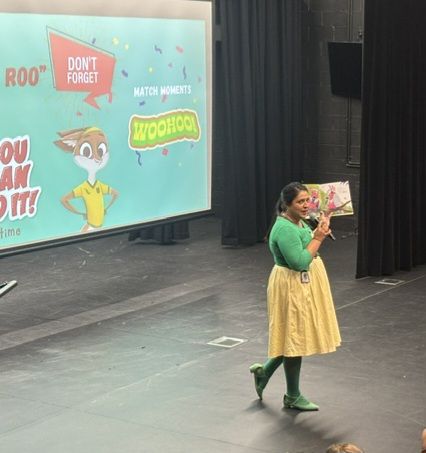
Here at the library, we were excited to support this year’s celebration as our primary students came together to share in the reading of Luna Roo the Kangaroo Baller. Students were active participants throughout, enthusiastically calling out “You can do it!” each time Luna Roo’s name was mentioned and cheering a joyful “Woohoo!” during key match moments. This collective energy created a vibrant and engaging reading experience that truly captured the spirit of National Simultaneous Storytime.
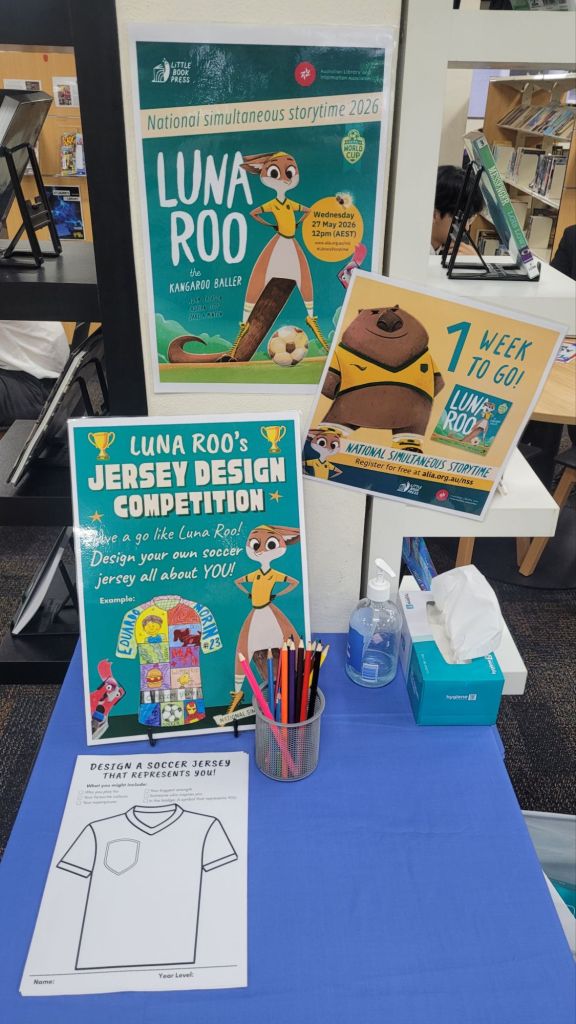
Following the story, our Year 5 and 6 students took part in a creative and engaging activity, designing their own football jerseys inspired by Luna Roo’s passion for the game. This hands on experience provided a fun and meaningful way for students to connect with the text, express their creativity and celebrate the excitement and teamwork at the heart of the story. The library also supported NSS with themed bookmarks and a wonderful display of soccer reads, offering plenty of options for our budding fans to continue their reading beyond the event.
Events such as NSS not only promote literacy but also affirm the importance of storytelling as a communal act, one that brings people together and nurtures empathy, identity and belonging. We hope that our students thoroughly enjoyed meeting Luna Roo and that the accompanying activities enhanced their experience of this heartwarming and energetic story. National Simultaneous Storytime remains a powerful reminder that when we read together, we grow together.
Last week I had the privilege of presenting at the National Education Summit here in Brisbane, sharing a body of work that has evolved over the past five years, three schools and two states. What began in 2021 as a response to disrupted learning during Covid lockdowns has since developed into a sustained, evidence informed approach to vocabulary instruction, grounded in collaboration, inquiry and the role of the teacher librarian.
In the early stages of this work, my fellow teacher librarians and I were grappling with a shared challenge. Students were returning to classrooms with uneven access to the curriculum, and many lacked the language needed to engage meaningfully with content. We began asking a simple but powerful question. How do we support students to connect with learning at their point of access? The answer, we found, lay in vocabulary.
Vocabulary is more than word knowledge. It is the foundation for deeper thinking, richer comprehension and academic success across all learning areas. Drawing on Vygotsky’s understanding of learning as a social process, this work has always prioritised scaffolded, collaborative learning experiences where language is explicitly taught, modelled and applied. Halliday’s theory of language as a social semiotic further reinforced the importance of teaching students how language works within different disciplines, enabling them to access and produce increasingly complex texts.
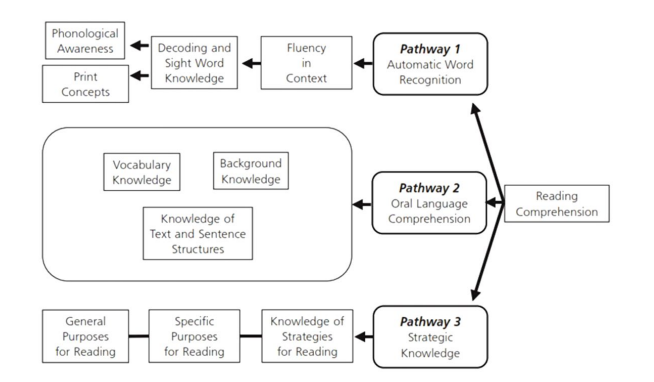
Central to my approach is the belief that vocabulary must be taught explicitly before students are asked to engage in close reading or complex content. This thinking is informed by the cognitive reading model of Stahl & McKenna, as well as Scarborough’s Reading Rope, both of which highlight the interdependence of language comprehension and word knowledge in skilled reading. When students do not understand key terms, comprehension falters. When they do, learning accelerates.
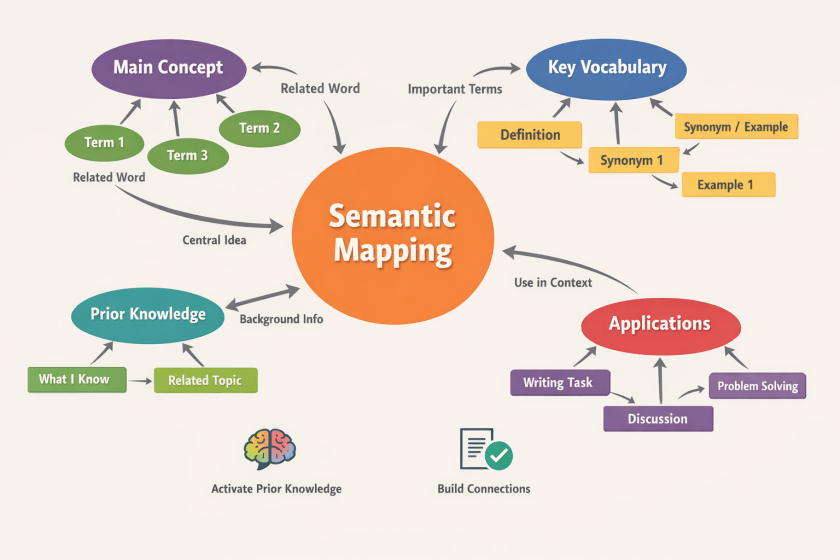
From here, explicit strategies such as the semantic mapping and the Frayer Model are used to connect schemas and deepen understanding. This is especially effective for terms that students commonly misunderstand or struggle to define, which is often the case in scientific contexts. By unpacking definitions, characteristics, examples and non examples, students build a more nuanced and transferable understanding of key concepts.
Throughout this process, resource based learning has been essential. The library is not simply a place where resources are housed, but a dynamic space where literacy and learning are designed in partnership with teachers. As a teacher librarian, I have worked closely with colleagues to co plan units that embed vocabulary instruction within inquiry based learning. Together, we create literacy rich environments where students engage with ideas, language and content in meaningful ways.
What has been most powerful is seeing the cumulative impact of this work. When vocabulary is positioned as a cornerstone of learning, students become more confident readers, more precise thinkers and more capable communicators. They are better equipped to navigate complex texts, engage in disciplinary thinking and articulate their understanding.
Presenting at the Summit this year was an opportunity to reflect on this journey and to share practical, adaptable strategies with other educators. It also reinforced the critical role that teacher librarians play in leading literacy across the curriculum. Through curation, collaboration and intentional teaching, libraries can drive approaches that ensure all students have access to the language of learning.
This work continues to evolve, but the core principle remains unchanged. If we want students to think deeply and learn effectively, we must first give them the words.
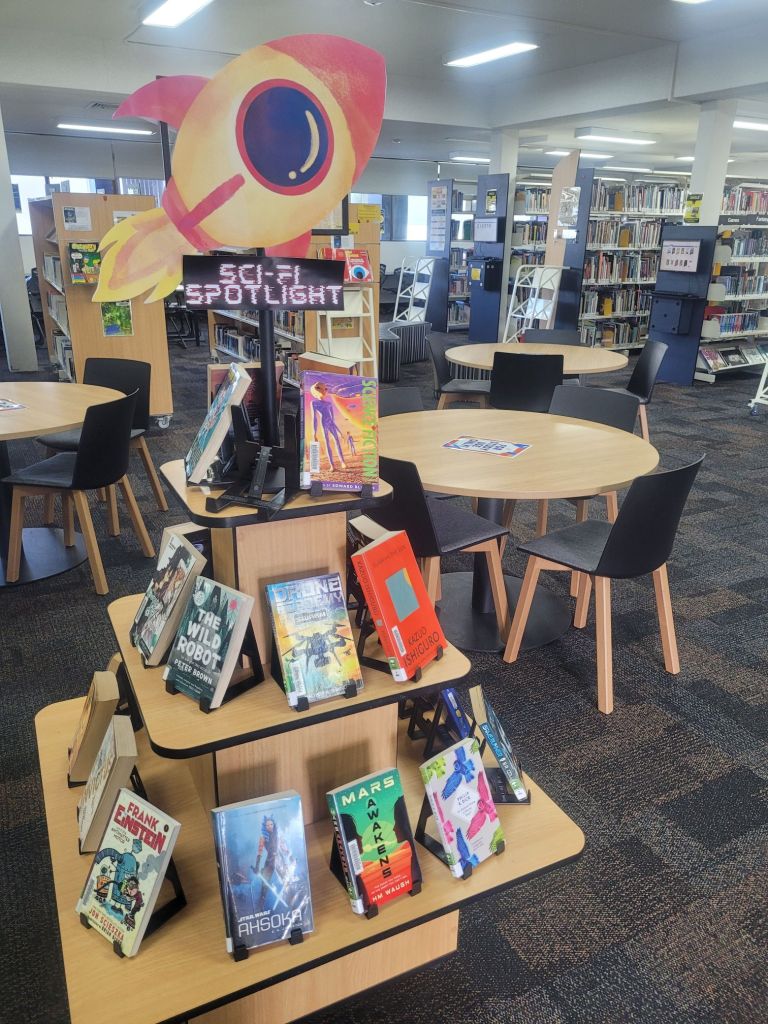
As a teacher librarian, my work is grounded in a simple but firm belief: literacy and literature must remain at the centre of learning. That does not mean avoiding complexity. It means choosing texts and genres that allow students to encounter complexity in ways that are humane, accessible and developmentally appropriate. Science fiction, often misunderstood as niche or escapist, is one of the most effective literary tools we have to do exactly that.
Science fiction offers students a way to think without feeling interrogated. It creates space for ideas to be explored rather than defended. When students encounter ethical dilemmas, social questions or scientific possibilities through story, the focus shifts from right answers to thoughtful engagement. The speculative distance of science fiction allows students to examine power, responsibility, identity and change without the pressure of personal disclosure or immediate real‑world positioning. This is not avoidance, it is scaffolding.
From a literacy perspective, science fiction is particularly powerful for vocabulary development. Scientific, technical and abstract concepts are embedded within narrative, image and character rather than presented as isolated definitions to be memorised. Students meet words repeatedly, across contexts, wrapped in story. This kind of exposure builds depth of understanding, not just surface recognition. It is vocabulary acquisition without confrontation, learning without the spike of anxiety that can come with academic language when it is taught in isolation.
Narratives such as novels and picture books sit at the heart of this work, especially when introducing complex ideas. No one is afraid of a story! Narratives disarm resistance, invite curiosity and slow the reading process in productive ways. A well‑chosen science fiction narrative can introduce abstract ideas such as time, artificial intelligence, environmental collapse or ethical choice without signalling to students that something “difficult” is coming. In particular, science fiction picture books promote the use of imager to carry meaning alongside words, allowing students to construct understanding through multiple pathways. This multimodal entry point is particularly powerful for reluctant readers, EALD students and those who have not yet built confidence as academic learners.
Science fiction has always played a role in shaping how societies imagine the future. Long before deep‑sea exploration or space travel became reality, writers were exploring these possibilities through fiction. That imaginative work mattered. It still does. When students read science fiction, they are not just consuming stories about the future, they are learning how to think about possibility, consequence and change. They practise asking “what if” and “what next?”, questions that sit at the core of critical literacy.
In the library, science fiction becomes a bridge between disciplines. It allows science, ethics, language and social understanding to sit alongside one another rather than compete for space. This aligns deeply with socio‑cultural theories of learning that emphasise language, context and dialogue as central to meaning‑making. Stories give students a shared reference point from which rich conversation can grow. They provide a common text that supports talk, questioning and interpretation, all essential elements of strong literacy practice.
Importantly, science fiction asks students to rethink social dilemmas rather than simply react to them. By following characters through imagined futures, students can explore moral uncertainty, empathise with perspectives unlike their own and consider the long‑term impact of human decisions. This builds ethical imagination alongside analytical skill. It teaches students that thinking deeply is more valuable than answering quickly.
For me, promoting science fiction is not about chasing trends or genre enthusiasm. It is about literacy leadership. It is about selecting texts that honour imagination while strengthening language, that support curiosity without sacrificing rigour. Science fiction does not sit on the edges of serious reading. In a literacy‑led library, it belongs at the centre.
And sometimes, the most powerful way to begin that journey is with a story.
Diyora, S., & Abduramanova, D. (2024). The role of science fiction in enhancing critical thinking and ethical imagination in education. ASEAN Journal of Science and Engineering Education, 4(3), 211–216. https://doi.org/10.17509/ajsee.v4i3.82480
Halliday, M. A. K., & Hasan, R. (1989). Language, context, and text: Aspects of language in a social-semiotic perspective (2nd ed.). Oxford: Oxford University Press.
Vygotsky, L. S. (1978). Mind in society: The development of higher psychological processes. Harvard University Press.
School libraries occupy a unique position within the educational ecosystem. They sit at the intersection of learning, literacy and community, and are one of the few spaces within a school capable of meaningfully engaging students, teachers and families alike. A recent Primary Parent–Son Book Club, held in the library and deliberately designed as a shared reading experience, provided a valuable opportunity to reflect on the role school libraries can play in fostering sustained family engagement in learning.
Research strongly supports the importance of parental involvement in children’s literacy development. While early childhood reading practices are often emphasised, evidence suggests that shared reading continues to have a significant impact well into the primary and secondary years. An article published in The Conversation synthesises international research demonstrating that when parents continue to read with their children after they have become independent readers, students show stronger reading comprehension, higher levels of engagement and more positive attitudes towards reading. The social dimension of shared reading, including discussion, questioning and the modelling of reading behaviours, is consistently identified as a critical factor in these outcomes.
More recent research further reinforces this connection between family engagement and reading success. Hu, Zhuo and Guo’s 2025 study published in Children and Youth Services Review examined the relationship between parental involvement and adolescents’ reading performance. Their findings indicate that parental engagement remains a significant predictor of reading achievement, even as reading increasingly occurs in digital and multimodal contexts. Importantly, the study highlights that meaningful involvement extends beyond direct instruction to include shared experiences, conversations about texts and visible valuing of reading within the home environment.
Parent–child book clubs hosted through the school library offer a practical and research aligned way to translate these findings into everyday practice. In this case, families met informally in the library, shared pizza and engaged in guided discussion around common texts. The term’s focus was historical fiction centred on World War II, with text choices designed to support Year 5 and 6 reading levels while also inviting deeper discussion around themes of loyalty, resilience and survival. Three text options were offered to families to allow for choice and differentiation, while maintaining a shared conceptual focus across the group.
Morris Gleitzman’s Once was selected as one core text due to its accessibility, emotional resonance and status as the first novel in a well established and popular series for young readers. Titles by Katrina Nannestad were also chosen, particularly for her sophisticated yet accessible use of language, syntax and narrative imagery, which strongly support comprehension, vocabulary development and cognitive engagement. A third option offered greater flexibility, with some families selecting narrative non fiction biographies and others choosing popular fiction titles connected to the historical context. Wherever possible, Australian authors were prioritised, reflecting a deliberate commitment to celebrating Australian voices and ensuring students encounter texts that reflect national perspectives and storytelling traditions.
From a library perspective, initiatives such as parent–child book clubs serve multiple strategic purposes. They position the library as a welcoming and inclusive space, reinforce families as active partners in learning and create authentic opportunities for shared literacy practices that extend beyond the classroom. They also provide a tangible means of embedding research informed practice into school wide literacy approaches, demonstrating how libraries can move from advocacy to action.
Engaging families through the school library strengthens relationships, builds a shared language around reading and reinforces the understanding that literacy development is a collective responsibility. As school libraries continue to advocate for their central role in whole school literacy, family focused initiatives such as book clubs offer clear, evidence based examples of how libraries can connect learning, community and research in meaningful and sustainable ways.
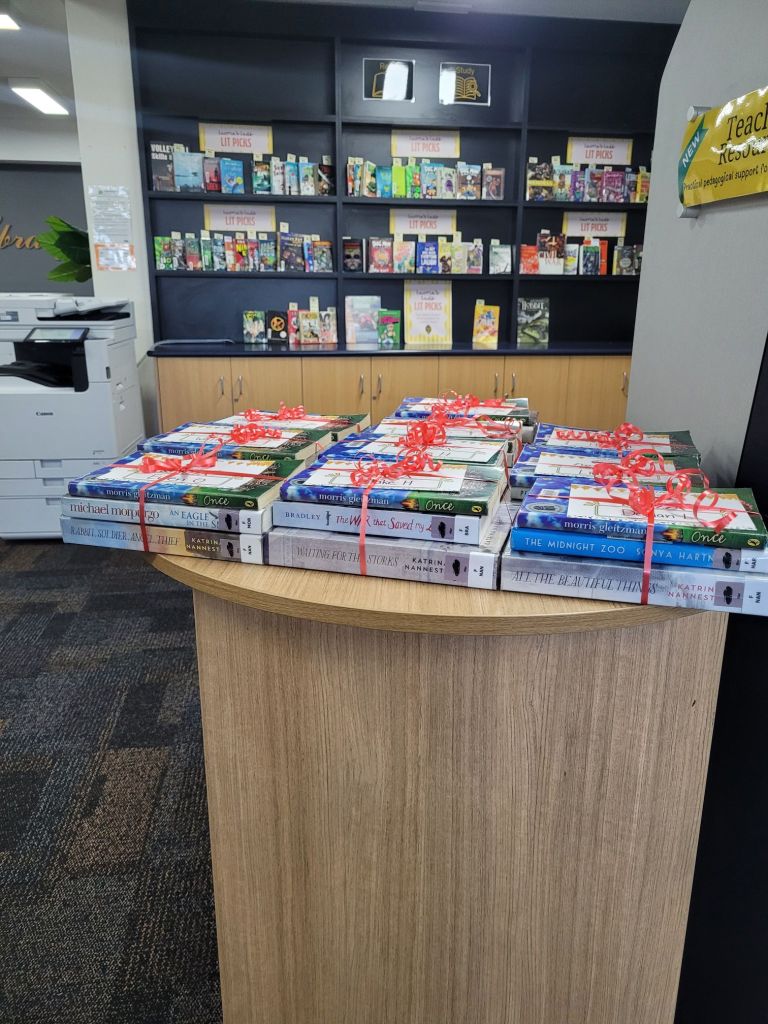
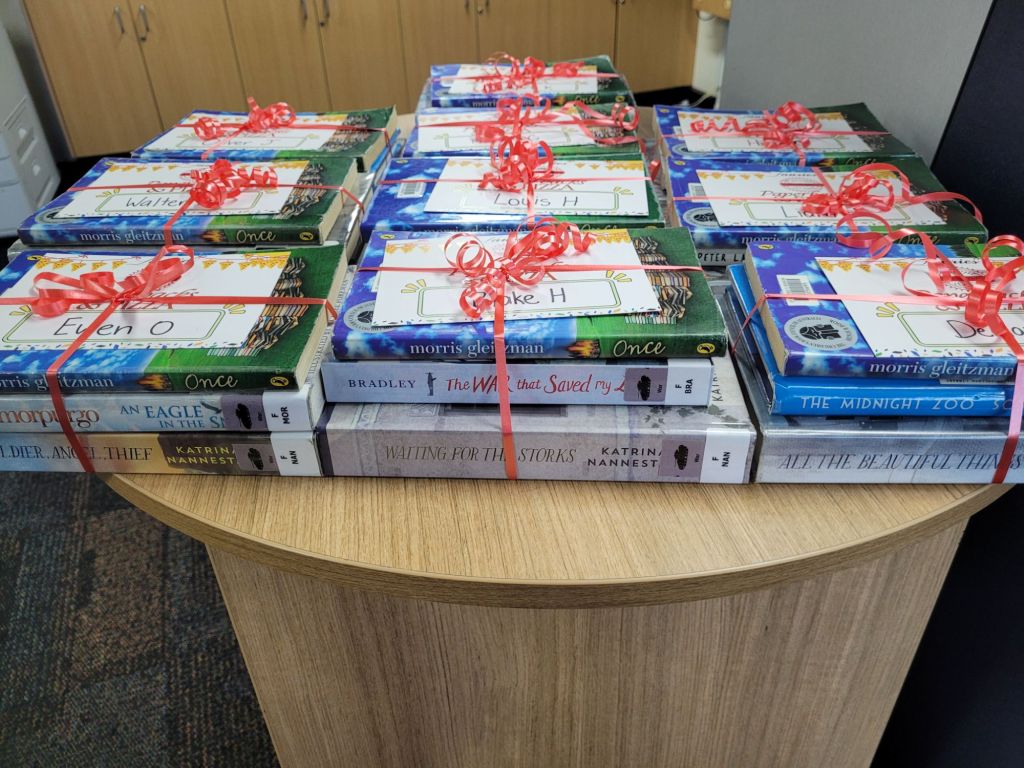
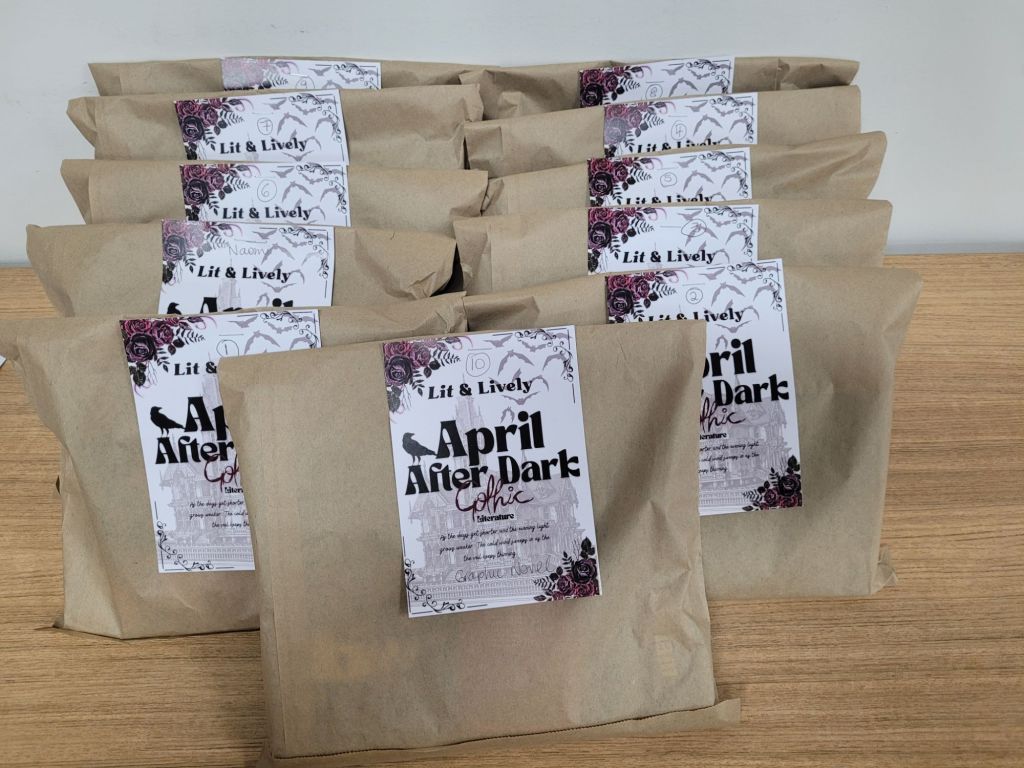
Lit & Lively, the school’s staff book club, is embracing the shadows this month with a gothic themed gathering titled April After Dark. This month’s meeting is centred around gothic literature, inviting staff to explore darker moods, mysterious settings, and stories that linger long after the final page. The format is welcoming and flexible. Staff read one shared text together, giving everyone a common starting point for discussion, before branching out into a range of gothic titles from the library collection. Each participant received a carefully prepared book pack, lovingly packed with the novels, a tea bag, and a chocolate biscuit, turning the reading experience into a small but meaningful indulgence during the autumn break.
April After Dark has also been a practical and creative way of using class sets that usually sit out of season. By repurposing these texts for staff reading, the library is reintroducing overlooked titles and highlighting how versatile the collection can be. Many participants have discovered books and genres they might never have explored without a themed invitation. It also reflects an important part of the Teacher Librarian role, which is not only to support students, but to guide and encourage staff in their own reading journeys and engagement with literature.
Through Lit & Lively, staff are gaining a deeper understanding of the breadth and depth of the school’s collection and reinforces the library as more than a curriculum support space. It is a place for curiosity, enjoyment, and reading for pleasure, modelling the reading culture we encourage in students.
There is also a strong wellbeing element. Reading for pleasure can act as a form of bibliotherapy, offering comfort, escape, and emotional renewal. Teachers often have little opportunity to read during the term, and the autumn break provides a rare pause to do so. Finally, Lit & Lively celebrates the social side of reading. Book clubs create space for conversation, shared reflection, and connection, reminding us that reading is often richest when it is shared.
As April grows darker, April After Dark reminds us that reading together can be restorative, enriching, and deeply human. Lit & Lively continues to affirm that teachers deserve time to read, reflect, and reconnect too.
Reading is widely recognised as a critical skill for young people, supporting the development of strong cognition, mental health and empathy. A growing body of research consistently shows that recreational reading in particular is linked with academic achievement, improved emotional regulation and more nuanced interpersonal understanding. Building a culture of reading, therefore, is not a peripheral task for schools. It lies at the heart of nurturing thoughtful, resilient and socially capable young people.
Yet despite these well established benefits, many children and teenagers do not naturally turn to teachers or teacher librarians for book recommendations (Merga, 2012). To be blunt, young people do not necessarily see adults as cool. Recommendations from teachers, no matter how well intentioned, may lack what adolescents consider to be genuine social credibility. The street cred factor is real, and it is powerful.
Further evidence comes from the work of Dr Margaret Merga, a well respected Australian researcher in literacy and reading engagement. In a mixed methods program examining the influence of social attitudes on reading behaviours, Merga (2012) noted that “perceived friends’ attitudes can have a more significant influence on boys than girls, [therefore] making books socially acceptable for boys should be a priority for educators.” This underscores the idea that book talk among peers is not merely casual chit chat. It is a mechanism of social permission. When books gain traction within a peer group, they gain legitimacy and ethos (Merga, 2012; Merga 2014).
Australia Reads similarly emphasises the importance of social engagement in building sustainable reading habits. Its principles highlight that young people need “positive social reading experiences” and opportunities to “recommend, discuss and share books and other texts in ways that are personally enjoyable and relevant”. In other words, reading thrives when it is relational.
At Lauries, we see these principles in action every day. While staff recommendations certainly have their place, it is peer driven reading culture that most reliably sparks curiosity, especially among reluctant readers. This is why we actively encourage students to reflect on and review the books they read. Their voices matter. Their opinions shape the reading landscape for others. The broader research base supports this emphasis on social recommendation and discussion as a driver of voluntary reading.
A visible expression of this culture is our wall of Lauries Lads Lit Picks. This growing collection showcases books that our students have personally endorsed. We often see reluctant readers wandering over, flicking through the displayed reviews until they discover a familiar name. That moment of recognition is powerful. When a friend or respected peer has enjoyed a book, the barrier to entry drops dramatically. The book becomes not just a text but a shared experience waiting to happen. The pattern aligns with evidence that peer attitudes and friend recommendations play an outsized role in adolescent book choice.
Cultivating a socially rich reading environment therefore requires more than simply providing access to books. It involves elevating student voice, valuing peer influence and creating spaces where reading is openly shared, discussed and celebrated. The evidence is unequivocal. When young people are given opportunities to recommend books to one another, their engagement deepens and their confidence as readers grows. Reading becomes woven not only into their academic lives but into their friendships, identities and everyday conversations.
By continuing to champion peer driven discovery, we support our students not only to read more but to read with curiosity, connection and purpose. That is a foundation that benefits them far beyond the walls of the library
Rutherford, L., Singleton, A., Reddan, B., Johanson, K., & Dezuanni, M. (2024). Discovering a Good Read: Exploring Book Discovery and Reading for Pleasure Among Australian Teens. Deakin University. https://eprints.qut.edu.au/247629/[eprints.qut.edu.au]
History is often presented as a clean line of dates and deeds, with women’s voices muted or missing. Yet when I read historical fiction, I hear those voices rise. It is in the imagined conversations, the textured inner lives and the careful stitching of research to narrative that women like Eleanor of Aquitaine step out from the margins and take their rightful place at the centre of the story. Historical fiction does not replace the archive. It complements it. It gives shape to the silences and lets Her story speak.
Eleanor of Aquitaine has captivated me for years. She was queen of France, then queen of England, duchess in her own right, patron of culture and mother to kings. Even through the writings of men who often judged powerful women harshly, she still appears intelligent, beautiful, strong of will and frequently labelled as wilful. That tension between what the record says and what it leaves unsaid is exactly where historical fiction does its best work. Through fiction, we can inhabit the rooms where the clerks did not sit, hear the words no chronicler bothered to write, and feel the force of a woman who shaped her world.
Because I am fascinated by Eleanor, I have read widely across authors who approach her life from different angles over my last summer holidays. Each one balances fact and imagination to reveal a fuller portrait. In their hands, Eleanor becomes more than a figure on a timeline. She becomes a person, with agency, complexity and heart. Reading these books has reminded me again and again that history is not only his story. It is also her story, and it deserves to be heard.
Why Historical Fiction Lets Her Story Speak
Historical fiction gives us the space to ask human questions that sources do not answer. What did courage feel like to a woman whose decisions could alter a dynasty. How did she manage loyalty and love in a world that traded both for advantage. What language did she use for her ambitions, her fears and her hopes. Novelists use careful research and responsible imagination to explore these questions. They do not invent the past. They interpret it with empathy, so that readers can understand lives very different from our own.
For women, this matters deeply. The written record often reflects the priorities of men who held the pen. Fiction can step into the gaps and consider the private sphere where much of women’s labour and influence took place. It can restore friendships, mentorships, rivalries and choices that formal chronicles overlook. Reading such stories changes how we see the past. It prompts us to look again at the sources, to notice what was omitted and to seek out voices that were ignored.
This is why I keep returning to Eleanor of Aquitaine through fiction as well as history. Each book adds texture to the tapestry. Each author brings a new hue to the same thread. Together they create a portrait that feels whole. In listening to these imagined yet carefully grounded voices, we are not abandoning truth. We are widening it. We are acknowledging that history is a chorus, and that Her story deserves to sing just as clearly.
Her life reminds us that the past belongs to all of us. Reading and sharing these novels is one way to make sure that our understanding of history includes the women who shaped it. His story has been told for a long time. It is time for Her story to be heard alongside it, fully and without apology.
So if you would like to know a bit about Her-Story, here are some of the amazing authors who wrote about Eleanor:
Books by Elizabeth Chadwick featuring Eleanor of Aquitaine The Summer Queen The Winter Crown The Autumn Throne
Books by Jean Plaidy featuring Eleanor of Aquitaine The Courts of Love Eleanor of Aquitaine: The Young Queen Eleanor of Aquitaine: The Rebel Queen
Books by Sharon Penman featuring Eleanor of Aquitaine When Christ and His Saints Slept Time and Chance Devil’s Brood Lionheart A King’s Ransom
Books by Alison Weir featuring Eleanor of Aquitaine Eleanor of Aquitaine: By the Wrath of God, Queen of England (non fiction) Captive Queen (fiction)
Language and learning are inextricably linked because the latter is hard to achieve without knowledge of the former. Language consists of words used in a structural and conventional way which is the principal method or system of communication communities use to engage with each other and the world (Britannica, 2026; Winch et al., 2020, p. 12). Language can be spoken, written or gestural and its effective use is a fundamental principle underlying a person’s ability to actively engage with their society. Therefore, by this definition and in conjunction with the cognitive model of reading, learning, and literacy by extension, can only occur if a person is competent in using language in its different fields, tenors and modes (Winch et al., 2020, p. 13). The role of the teacher librarian and the library in literacy development is to support language, literacy and learning across the curriculum through the broadening and deepening of student vocabulary by improving semantic understanding of key vocabulary and building background knowledge with quality resources.
Winch et al., (2020) point out that language is an identifiable way for cultures to share meaning with each other and to achieve a common purpose and as such is influenced by context. One subset of language influenced in this way is vocabulary because it is the knowledge of words that exist in a particular language or subject and or the total volume of words known by a particular person (Cambridge, 2026). Therefore it can be inferred that a person’s breadth and depth of vocabulary knowledge is based upon their experience and exposure to a variety of texts (Winch et al., 2020; Lewis & Strong, 2021, p5). A person that reads or is exposed to a wide range of vocabulary through various genres will be highly receptive to new terminology. However, that does not translate into an expressive capacity unless they are able to practice it sufficiently.
Vocabulary can also be perceived to be a bridge between the written and spoken modalities because readers need to be efficacious in their ability to predict and build mental images from the text (Winch et al., 2020, p. 20). This perception is consistent with the constructivist approach to reading because text comprehension is the result of a reader’s ability to combine what is known, with what is presented in the text in order to arrive at new knowledge and understanding (Graves et al., 2019; Winch et al., 2020, p.91; Spence & Mitra, 2023). Competent readers have the additional advantage when it comes to informational texts because they are able to determine the genre and purpose of a text by making predictions based on their knowledge of text structure and the language or vocabulary within the text.
McKenna & Stahl, 2009 – Cognitive Model of Reading.
The cognitive model of reading is centred on a reader’s ability to comprehend language because vocabulary acts like a conduit between the working and long term memory impacting ability to effectively comprehend a text (Graves et al., 2019; McKenna & Stahl, 2009; Winch et al., 2020, p82; Spence & Mitra, 2023). A person with a high vocabulary is more likely to have increased success in reading comprehension because their capacity to understand and connect to the text is greater than someone with a limited vocabulary (Winch et al., 2020, p21). This in turn fuels their ability and capacity to read more, further increasing their capacity. This efficacy, as Lewis & Strong (2021) point out, confirms the commonly known Matthews effect as students learn 15% of new words in contextual reading and that they need greater than twelve encounters with a particular term or phrase to even think of including it into their knowledge schemas. However, even confident readers may be confronted when exposed to factual or informative texts because of the leap in cognition required as each discipline will have their own structure, grammar and specialised vocabulary (Spence & Mitra, 2023). This means both experienced and inexperienced readers will require explicit instruction in semantic knowledge to effectively decode and encode text of increasing complexity (Winch et al., 2020, p.110; Lewis & Strong, 2021, p.7).
Year 9 Science – Semantic mapping
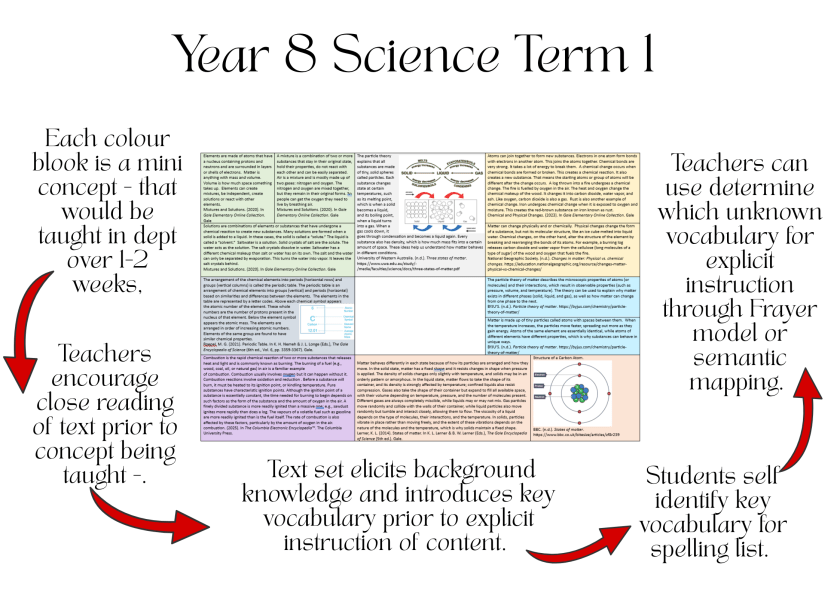
Reading comprehension skills can be supported across the curriculum by increasing a student’s semantic knowledge and background understanding of a topic prior to close reading (Lewis & Strong, 2021). Several pedagogical practices including semantic mapping of tier three vocabulary, the use of text sets to bolster background knowledge as well as explicit modelling of reading strategies can be used effectively to improve reading comprehension and build student capacity (Lewis & Strong, 2021; Spence & Mitra, 2023) However, caution must be used when deciding what text to use in teaching and learning because the use of text can be a limiting factor if infantile resources are used as it limits student capability and capacity (Winch et al., 2020, p114, Lewis & Strong, 2021, pg. 10). Spence & Mitra (2023) point out that it is preferable to scaffold students to complex texts than to provide resources that are age and stage inappropriate.
Text sets are an effective pedagogical strategy to improve vocabulary in a classroom because they encourage students to interact with a wide range of quality, genre specific texts throughout a unit of work. These text sets were specifically curated to improve vocabulary and by extension, reading comprehension. Students were able to engage with short extracts of text that have been appropriately levelled prior to the unit commencing and then were able to re-engage with this text intermittently through the term. This ‘dipping’ in and out of the content allowed students to activate their prior knowledge as well as exposed them to tier two and three terminologies at smaller and more regular intervals. This intermittent exposure is ideal for spaced retrieval practice as teachers are able to regularly gauge the level of background knowledge and understanding the students already have on the topic and as well check for understanding. Furthermore, these vocabulary text sets can be effectively used as text exemplars because they can be formatted to meet the disciplinary genre requirements.
The teacher librarian and library play pivotal roles in supporting language, literacy and learning across the curriculum. Firstly, teacher librarians are well placed to source texts that build semantic and background knowledge. They are able to create and curate text sets, lib-guides, reading lists and book boxes that meet the language and literacy needs of the students. Text sets can be very effectively used to build background knowledge and can be used across classrooms, cohorts and units of work. They can be paper or digitally based; extracts of texts or whole articles; picture books, novels or biographies. They can also be used to explicitly teach vocabulary in discipline specific genres. Teacher librarians can also use their central role in the school to replicate reading strategies across the curriculum, sharing similarly structured resources through various faculties or disciples for a more concerted and systemic approach to literacy and learning. Lastly, teacher librarians are the curators of their collection, and their role is essential to ensure that high quality literature and resources continue to be available to staff and students.
Graves, M. F., Elmore, J., & Fitzgerald, J. (2019). The vocabulary of core reading programs. The Elementary School Journal, 119(3), 386–416. https://doi.org/10.1086/701653
Hiebert, E. H. (2020). The core vocabulary: The foundation of proficient comprehension. The Reading Teacher, 73(6), 757–768.
Lewis, W. E., & Strong, J. Z. (2021). Literacy instruction with disciplinary texts: Strategies for grades 6–12. Guilford Publications. New York
McKenna, M. C., & Stahl, S. A. (2009). Assessment for reading instruction (2nd ed.). Guildford Press
Mitra, A., & Spence, L. (2023). Educational neuroscience for literacy teachers: Research‑backed methods and practices for effective reading instruction. Routledge. New York.
Winch, G., et al. (2020). Literacy: Reading, writing and children’s literature. Oxford University Press. Docklands, Australia.
A term in the life of a teacher librarian is never a simple, steady journey. It rises and falls in energy and pace, shifting between calm stretches, intense bursts of activity and a mid term crescendo that only those who have stood behind a circulation desk during second break truly understand. Teacher librarians do not just follow the rhythm of the school term. We breathe it, support it and often hold it together with a blend of planning, flexibility and a genuine love of learning.
The beginning of the term often appears calm on the surface, but behind the scenes it is a hive of thoughtful planning and collaboration. This early period is spent mapping out programs, updating units, preparing resources and scheduling literacy and information literacy lessons across the curriculum. It is the time for meetings with teachers who bring new ideas for research tasks, nurturing fledging literacy programs or supporting disciplinary literacy through explicit vocabulary instruction. These conversations help shape the curriculum support that will run throughout the term and ensure that every lesson and library experience has purpose and structure. It is also the time for deeper discussions with Heads of Curriculum to align expectations, strengthen research skill development and embed digital and information literacy meaningfully across year levels. The work may be quiet, but it forms the foundation for everything that follows.
By the time the middle of the term arrives, the calm has vanished completely. The library becomes a vibrant and sometimes chaotic hub of constant movement. Students flood through the doors needing books, recommendations or support with upcoming assessments. Borrowing sessions become lively and energetic as classes arrive with armfuls of returns and requests. This is also the busiest teaching period of the term, when the carefully prepared information literacy sessions come to life. Research skills, digital literacy, source evaluation, referencing, note taking and inquiry support all happen at a rapid pace. Teacher librarian roles expand and overlap as we teach back to back lessons, guide students through tasks, troubleshoot technology and support teachers in real time as units unfold.
Amid the flurry, collaboration continues in more practical and immediate ways. Teachers pop in needing quick resources, task sheets are updated on the go and reading groups or book clubs meet regularly. Displays evolve to match what is happening across the school and the flow of students keeps the space buzzing. Moments of humour, curiosity and connection appear constantly, whether it is a student searching for a book they can remember only by its colour or one who is unsure whether reading ten pages a night officially qualifies them as a reader. It is busy and demanding, but it is also the most rewarding time of the term.
As assessment deadlines pass and the term moves into its later weeks, the pace softens again. Students return to the library in search of quiet corners for study, calm spaces for reading or simply a break from the noise of the school day. This slower period allows time to catch up on the larger ongoing projects that were temporarily buried beneath the mid-term rush. There is even the rare moment where a cup of chai stays warm long enough to be enjoyed.
By the final couple of weeks, the library takes on a different kind of energy. Lost books mysteriously reappear from lockers and school bags when billing invoices get sent home. Teachers arrive with last minute requests for resources or holiday reading suggestions. Then there is my own teaching practice, my own classes I have to teach, assess and report on.
Despite the peaks, troughs and everything in between, there is a satisfying sense of purpose in the ebb and flow of library life. Teacher librarians witness students discover stories that inspire them, questions that challenge them and skills that will carry them far beyond the classroom. These moments make every busy break, every full borrowing session and every packed week of information literacy worth it.
This week we celebrate Queensland School Library Week and this year’s theme, School Libraries Light the Way, perfectly captures what our library aims to do every day. School libraries illuminate pathways to learning, belonging, curiosity and joy. They guide students in reading, research, creativity and personal growth while promoting equity and inclusivity for every learner.
Here is how our library is commenced lighting the way in the first few weeks of 2026.
Lighting the Way for Reading, Research and Recreation
Book Clubs in Full Swing: Our book clubs for primary and secondary students have been meeting since Week 2 and the enthusiasm has been wonderful to see. These groups give students opportunities to read for pleasure, discuss ideas and connect with other readers across the school.
Sharing New Books: We continue to promote new books to staff and students. Whether it is a fresh fantasy adventure, a gripping nonfiction title or the newest young adult novel, we work hard to help every reader find something they will enjoy.
Supporting Teacher Professional Learning: We are also lighting the way for staff by ensuring our digital access to teacher journals is current, reliable and easy to use. We share these resources across school networks so that teachers can stay informed, inspired and connected to current practice.
Library Lessons for Years 5 to 8: Our library lessons support student interest and reading engagement. These sessions are planned to build student efficacy in navigating their own reading journey.
Information Literacy for Years 7 and 8: I collaborated with classroom teachers to deliver information literacy instruction that is authentic and practical. Students are learning to locate information, evaluate sources and use material ethically, which helps prepare them for success in school and beyond.
Lighting the Way for Equity and Inclusivity
Lunar New Year Activities: From this week we will offer Lunar New Year activities during language classes and at lunchtime. These activities build cultural understanding and celebrate the rich diversity of our school community so that every student feels valued and represented.
The Happy Book Dragon: Our library is also home to its resident happy book dragon (aka ME) who lives and breathes book trivia and reading joy. Sometimes lighting the way simply means sharing enthusiasm and creating a space where curiosity thrives.
Lighting the way together
Queensland School Library Week is a reminder of the powerful role a school library plays in the life of a community. From nurturing readers to supporting staff and celebrating cultural diversity, our library is proud to be a guiding light in our school.
Here is to a bright and book filled week and to the many ways libraries continue to light the way every day.