An expression that is almost universally known by both adults and children alike. The mere mention of this phrase is enough to perk my offspring’s heads and ears like meerkats on high alert. Like most children, my three girls love story time in all its forms. In their eyes (and ears) it is irrelevant how the story originates. Depending on my mood and their persuasive power; the mode and delivery of the story will vary. Sometimes it is a retelling of an old favourite or a re-read of a treasured classic; other times it is the most recent offering from a library; and occasionally, it is a spuriously invented pudding-headed story to bring silly smiles to little faces.
Cornett (2014) theorised that stories and storytelling developed from a need of the ancient peoples to understand their world. Stories are how cultural traditions and practices were passed down the generations and it is still the most common method in which communities celebrate and immortalise important events. After all, most families have embarrassing stories that get retold at every family gathering and eventually they become familial folklore. The Indigenous peoples of Australia have a rich history of oral traditions and as such, much of their cultural histories are embodied and immortalised in storytelling. But even for societies that no longer possess such a strong emphasis on oral traditions, storytelling is still the most basic and simple way we learn about language, our identity and the society we live in (Ross Johnston, 2014; Cornett, 2014).
So what makes a story so special?
Besides being a vector of traditions, stories and storytelling play key roles in language acquisition in children as stories expand their vocabulary repertoire (Cornett, 2014). Infants and toddlers do absorb nuances of language from their daily life from conversation but reading stories increases the variety of words available. This means that when exposed to literature as adolescents there is already a familiarity with language, which improves comprehension and fluency.
Besides language acquisition, stories also assist with identity formation (Ross Johnston, 2014). To put it simply, stories often contain didactic language that belongs to a particular sub section of society and thus stories can connect individuals together in society and or inform others of another society. A great example of this is Mem Fox’s ‘Possum magic’ with its inclusion of terms such as vegemite, pavlova and lamingtons. Australian children resonate with this story as the language used within is familiar to them and they can connect to the familiar animal characters. Whereas children from other countries could find this language both exotic and a novelty. Similarly, Rod Clement’s ‘Olga the Brolga’ brings together Australian fauna with its fabulous illustrations and rhyming text. Children who are exposed to stories like this discover local vocabulary and in turn unearth aspects of their own country and culture.
Stories are more than just words in a book. Stories reflect societal norms and allows children to gain information about the world they live in. They expand the mind, broaden values, teach empathy and show us what another viewpoint is. Most of all, stories teach us to reflect on who we are as individuals and what we can become. For all these reasons, stories and storytelling are indispensable to adults and children alike.
REFERENCES. Cornet, C. E. (2014). Integrating the literary arts throughout the curriculum. In Creating meaning through literature and the arts: arts integration for Classroom teachers (5th ed,) (pp144-193) USA
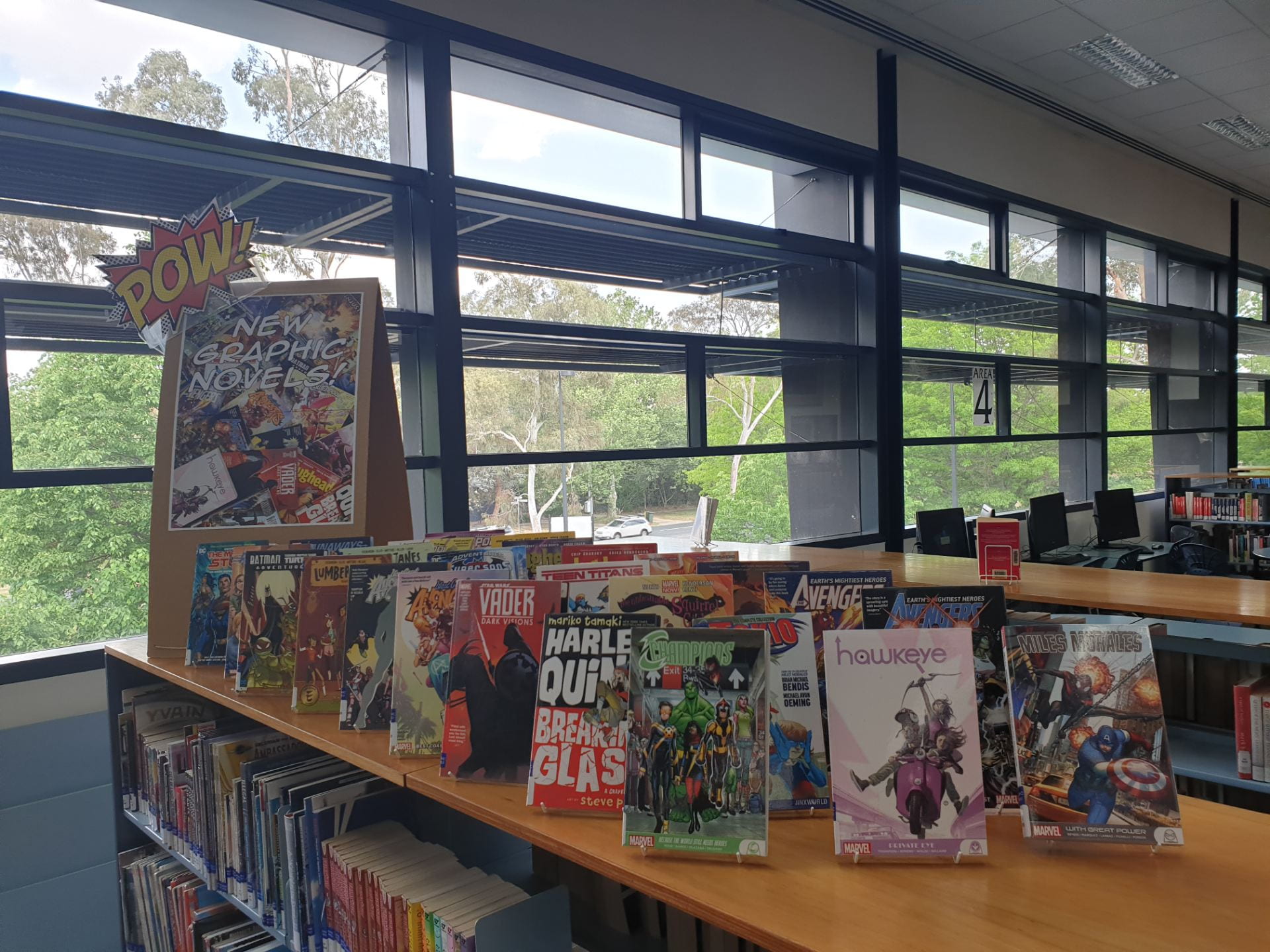
My school library has recently acquired a variety of graphic novels, ranging from classics such as Harper Lee’s, “To Kill a Mockingbird” to swashbuckling tales of pirates, and fantastical stories of superheroes from the Avengers franchise. There are multiple reasons behind the acquisition of these resources; tacking reluctant readers engagement with reading, boosting traditional and multimodal literacy and addressing the needs of the curriculum.
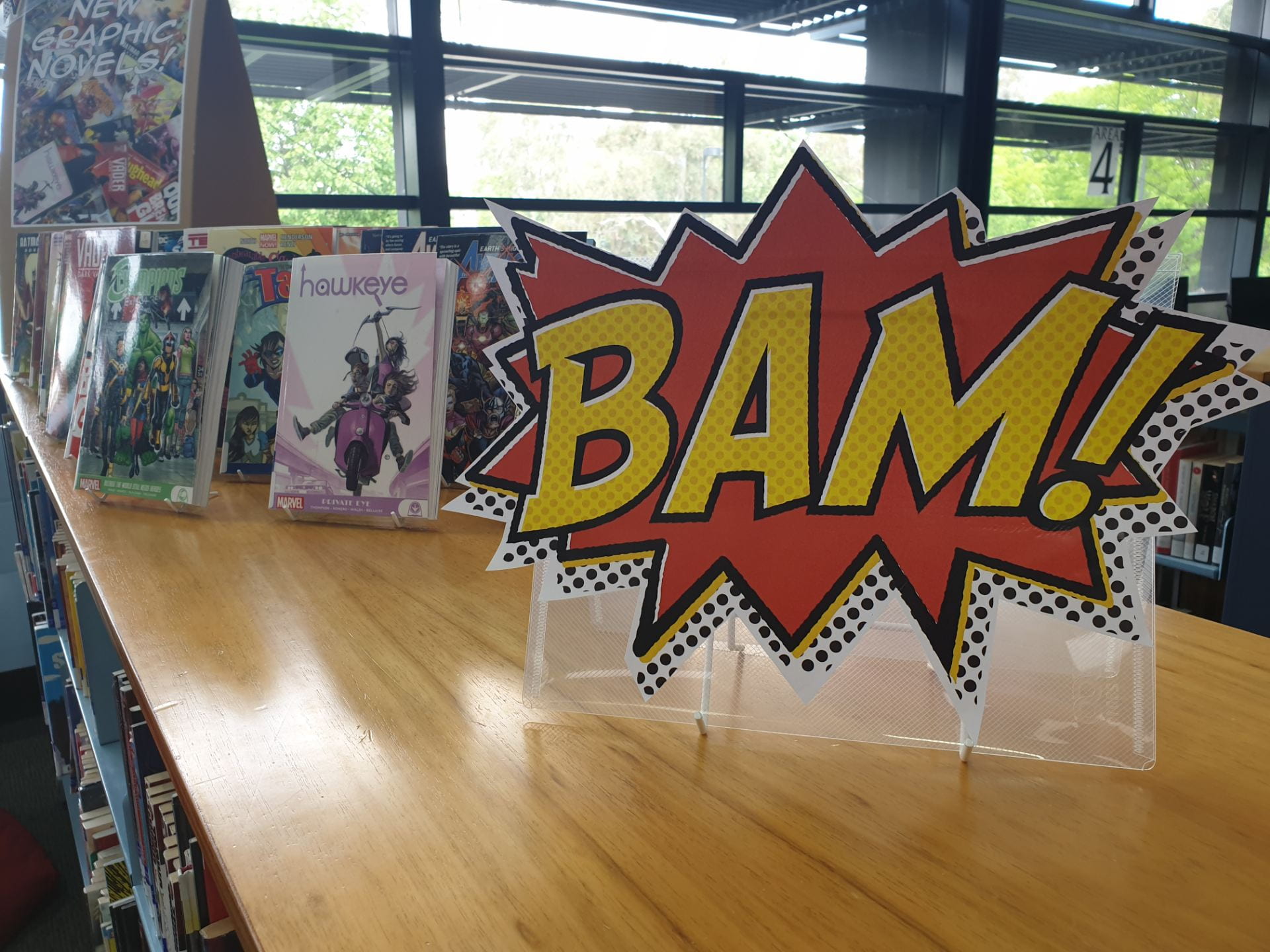
BAM! Literacy and fun- TOGETHER!
Graphic novels have widespread appeal across generations. From adolescent reluctant readers to highly literate adult geeks, graphic novels can inspire a cult following. I can only chuckle when I reminisce about Sheldon Cooper and his obsession with comics in the popular TV series “Big Bang Theory”. The popularity seems to stem from the presence of popular genres such as Manga, funny and superhero comics and their use of contemporary characters (Crowley, 2015; Hughes et al., 2011). The Marvel and DC comic series in particular, have reached new zeniths in popularity due to the recent plethora of movies being released this decade.
Literacy teachers common use graphic novels as a method of engaging students who are reluctant readers boosting literacy. As mentioned in earlier blog posts, reluctant readers often struggle to engage with traditional texts for a multitude of reasons, most commonly, low literacy. Aliteracy or illiteracy, can preclude students from comprehending large text paragraphs (Crowley, 2015). Graphic novels with their text juxtapositioned with pictures format allows students to use visual stimuli to assist with decoding text (Cook & Kirchoff, 2017). The drawings create a tangible image for the reader allowing them to be captivated more easily by the narrative within. This engagement can often influence students with low literacy to become more prolific with their reading, which has a direct correlation to increased literacy and overall academic achievement. Due to their popularity and narrative style, graphic novels epitomise the adage, ‘reading for pleasure’. For schools with wide reading programs, a strong graphic novel investment is highly advised.
There are other benefits to adding graphic novels to a collection. The advent of the information age has demanded a strong requirement for students to be literate across modalities. Graphic novels with their images and text colligated together, confer visual, gestural and spatial elements simultaneously, causing the reader to engage with the material on multiple levels. As mentioned previously, graphic adaptations of class texts and other classics are extremely beneficial in engaging students as it is unfortunate that prescribed texts often seem to lack appeal with the student cohort. A graphic adaptation has the duality of both ENGAGING disinterested students and ASSISTING students with DIVERSE learning needs. By adding graphic novel adaptations of class texts to the collection, a school library is acknowledging the diverse learning needs of their students whilst addressing curriculum requirements mandated by ACARA.
References
Cook, M., & Kirchoff, J. (2017). Teaching multimodal literacy through reading and writing graphic novels. Language and Literacy. Vol. 19 (4). Pp. 76-95
Crowley, J. (2015) Graphic novels in a the school library. The School Library. Vol 63 (3) Pp140-142
Hughes, J., King, A., Perkins, P. & Fuke, V. (2011) Adolescents and the Autographics; Reading and writing coming of age graphic novels. Journal of Adolescent and Adult Literacy. Vol. (54(8). DOI: doi:10.1598/JAAL.54.8.
Academic integrity is often espoused and bandied about across educational institutions, especially in the first few weeks of every scholastic year.
La Trobe university describes it as shared values and behaviour that includes but is not exclusive to honesty, fairness and responsible practices. This concept of honesty in academia is a two way street. Educational institutions such as schools and universities are obliged to award credit and acknowledge honestly conducted work. Students are responsible for ensuring that their work meets the required standards mandated (LaTrobe, 2019). The onus of practices that promote academic honesty need to be equally addressed by students, staff, executive and organisations. It is not simply the role of a student to avoid plagiarism, but also the role of education to provide them with the skills and knowledge to do so. Additionally, society needs to realise that academic integrity does not start and finish with plagiarism. Plagiarism is just an aspect of authentic academia. Other practices include the creation of assessment tasks that limit the risk of dishonest practices and organisations to adequately address infringements in their policies with appropriate levels of censure that are age and stage appropriate. The role of teacher librarian is multifaceted when it comes to academic integrity. Due to their dynamic position, a TL is able to address academic honesty from a student and classroom teacher (CT) lens and from a department and school perspective.
Academic honesty starts with the classroom teacher. If teachers continuously utilise reputable sources in their teaching and learning, as well as consistently reference them correctly; then they are modeling good practice. Students (and teachers) need to be aware that academic honesty is not just for assessment tasks. Its for all tasks. Like all skills, good research behavioural practices such as using databases, encyclopaedias and journal articles are essential in formulating evidence based assertions. Using disreputable sources does not bode well for your postulations. W. Edwards Deming was quoted in Forbes (2016) that “without data you’re just a person with an opinion”. My experience as a scientist holds me in good authority in championing this point. In the fields of science and mathematics, opinions hold little value. It is the data from rigorously run experiments that define our thinking process. Poorly run experiments with inconclusive data have no value; as do opinions with no justification and evidence. Opinions are fine when limited to coffee preferences but not in academics.
The other aspect of academic integrity within the TL’s and or CT’s realms, is the explicit teaching of information literacy. Information literacy is defined by the ability to find, seek, use and create information and traditionally the domain of TL area of expertise (Kuhthau et al, 2012). IL needs to be taught and then subsequently assessed in order for students to reach proficiency (Jacobson et al. 2018; Qayyum & Smith, 2018, p257; McGrew et al. 2018). It is not passively acquired by the act of completing a research task – but rather, these skills need to be integrated into daily practice to boost competency (Kong, 2014). Part of these practices include the direct instruction of correct referencing techniques. As mentioned before, plagiarism is AN aspect of academic honesty, it is not the entirety.
Whilst it teaching information literacy and the finer points of referencing is essential, it is important to note that the assessment task itself can be a liability to honest practice. Introducing mandatory evidence of progress, drafts and log books are other useful methods in ensuring authenticity of work. Assessment tasks that are repeated at yearly intervals for indefinite periods of time are also very problematic. This is due to the fact that its simplistic to assume that students do not try to seek aid from older siblings and or cousins. Having a maximum time frame of 2 years allowed for a particular task reduces the likelihood of younger relatives plagiarising from older siblings. Another point to note is that nuances of language in assessment task construction can reduce the likelihood of plagiarism. Requesting students to analyse, justify and relate to their community requires higher order thinking skills and is harder to successfully pass off as own work due to the nature of the questions. TL can be of great assistance to teachers in the construction of assessment tasks. Ezard (2019) pointed out that co-creation and collective capacity is the fundamental basis of true collaborative practice (cited in Templeton, 2019). Collaboration between departments and the library can result in a positive sharing of expertise and knowledge resulting in tasks that elicit deep understanding and truly engage the student.
Departmental heads and school administrators have the last word on academic honesty in a school situation. The school policies are the framework in which the academic integrity of the staff and students is based upon. Therefore it is up to the executives to ensure the policies are current with contemporary practices which includes the rapid evolution of technology and the challenges that it brings. They are also responsible to clearly define what constitutes minor, moderate and major infringements and their appropriate consequences. Staff need to realise that a major infringement in middle school is not the same as a major infringement in senior school. A suggestion would be construct a hierarchy of violations that is clearly distributed to students and teachers. This transparency reduces the likelihood of students citing ignorance in their defence. An example of such a hierarchy from ANU, Canberra and Andrews University in Michigan are available for your perusal.
Much has been said so far about how teaching staff can do to promote academic honesty. But in all honesty, students need to also be aware of their role in this dual relationship. Students need to follow the referencing guidelines set by their institution. Whether it be APA, Harvard or MLA citation styles, students need to conform. They also need to refrain from reusing earlier work and badging it as new work. Many students feel that this cannot be plagiarism as its their own material. But what they are unaware of is that they can reference previous works. The most common ways in which students are academically dishonest is collusion and unequal group work. Collusion as Monash University (2019) points out is the “unauthorised collaboration on assessable work with other people”. Frequently unauthorised partners include parents, older siblings, tutors and friends. It is dishonest to present the collaborative efforts of multiple people off as individual work. Group work is a minefield where academic honesty is concerned. It is very common for one or two people in a group to carry the team. This unequal distribution of work is often due to a participant’s absenteeism and or disinterest. Unfortunately, there is no suggestion I can offer as I have been guilty of doing too much in past group assessments in order to pass/complete a task. In my opinion, (no facts), I believe that group tasks should not be used for summative assessments tasks due the inequitable nature of collaborative groups.
Academic honesty is not just for students to follow when submitting their assignments. Rather it is a mindset, a code of conduct, developed during schooling years and manifested in adulthood. As a code of conduct, infringements of this nature need to be treated similarly to infringements of other conduct related behaviour. Simply assigning punitive measures is not conducive to learning and reducing future occurrences. Instead, it is more productive to create a situation in which academic integrity is the norm and best practice for both students and teachers. Academic honesty is more than just plagiarism. Its is the authenticity of your work and the extension of self.
References
Ezard, T., (2019) Leading the Buzz in your school. ASLA 50th Conference. Canberra
Jacobsen, R., Halvorsen, A., Frasier, A., Schmitt, A., Crocco, M., and Segall, A. (2018). Thinking deeply, thinking emotionally; how high school students make sense of evidence. Theory & Research in Social Education. 46, 232-276. DOI 10.1080/00933104.2018.1425170
Kuhlthau, C., Maniotes, L. & Caspari, A. (2012). Guided inquiry design: A framework for inquiry in your school. Libraries Unlimited. USA.
Kong, S. (2014). Developing information literacy and critical thinking skills through domain knowledge learning in digital classrooms: An experience of practicing flipped classroom strategy. Computers & Education. 78, pp.160-173, DOI: https://doi.org/10.1016/j.compedu.2014.05.009
McGrew, S., Breakstone, J., Ortega, T., Smith, M., and Wineburg, S. (2018). Can students evaluate online sources? Learning from assessments of civic online reasoning. Theory & Research in Social Education. 46, 165-193, DOI 10.1080/00933104.2017.1416320
Qayyum, M., & Smith, David. (2018). Changing research behaviours of university students with progression through a course. Journal of the Australian Library and Information Association. 67: 3 pp256-277 DOI: 10.1080/24750158.2018.1502243
They capture your imagination with words and imagery.
Similar to a siren singing her tune, an author draws the reader in with stories of heroes, villains, mysteries and magic. There are several writers that come to mind when one thinks about perspicacity at understanding a developing mind. Enid Blyton comes to my thoughts immediately, as it was her books of Faraway trees, Wishing Chairs, Mallory Towers and the adventurous children that beguiled and transformed me into a certifiable bookworm. Other authors with these same mystical powers include Emily Rodda, A A Milne, Dr Seuss, C. S Lewis, Beatrix Potter, E.B White, Lewis Carrol, Eric Carle, Rick Riordan, J K Rowling and of course, Roald Dahl.
Dahl’s popularity has enthralled generations of children with his fantastical tales. Even 30 years after the publication of perspicacious Matilda, the lure is still strong according to Kelly (2019) who recently published an article in the Sunday Times just short of the author’s birthdate. Dahl’s books have inspired generations of children to read. His stories of redemption and resilience appeal to both children and adults. I found it particularly interesting that the books often seem to be narrated by the child protagonist. By doing so, Dahl places the reader in the central position and thus immediately engages their interest. The books often place the child in the role of an underdog and their eventual vanquishment of the bigger and older (usually an adult) enemy gives great satisfaction. Darby (2016) believes that this narrative style is appealing to children as it makes them feel like “someone is in their court”.
Some people assert that Dahl’s books are macabre and filled with violence, racial slurs, misogyny and vindictive behaviour. Anderson (2016) argues that the books caused great disturbance among adult readers when they first started being published in the late 60’s. Stories where witches turn children into mice, people are fed worms and or eaten by giants, and let us not forget principals that swing cute girls by their hair like a discus and push children into nail studded cupboards.
In fact, “James and the Giant Peach has been lambasted for its racism, profanity and sexual innuendo” Anderson (2016) states.
It appears Dahl was provoking everyone, as he offended numerous demographics in equal measure. But I am starting to believe that the provocation is what lured children to read and re-read his books. It was just that little bit naughty and disgusting. Just enough to make children feel superior and more wise than the character, but not too much as to disengage the reader. Arguably this is probably what explains Dahl’s longevity as an author. Nice clean stories such as Wilder’s Little House series has its staunch clientele but it does lacks the Dahl’s drawcard in that the majority of children do not identify with these characters. Kole (2018) suggests that it is when the reader can draw upon their own experience with the subject matter that engagement with the text occurs. This could be contended similar for L M Montgomery’s Anne or White’s Charlotte’s Web. All extremely well written and received books, but not as far reaching as Dahl. Whilst their stories do have points of personal travail, they simply are not dark enough.
This need for darkness is important for children’s literature
as Anderson (2016) and Kole (2018) further elucidate. One can only think of the popularity of the Grimm fairy tales, Rowling’s Harry Potter, Collins ’Hunger Games and Meyer’s Twilight to realise that the desire for grim has not changed in centuries. The adage about literature reflecting life is the underlying support for this need for fear and fright in children’s books. Stories of children overcoming great difficulty has the ability to build great resilience and empathy in the reader.
We are all aware of how reading builds empathy. Readers identify with the characters in the story and thus the feelings from one are juxtaposition-ed on the other . But reading fictitious stories of giants, witches and wizards, whilst unrealistic, also gives children an important cathartic release according to Bettelheim (2010). Rochelle (1977) whilst dated, firmly believes that adults and children both require fantastical literature to interweave the complex strains of good and evil in humanity. Fantastical tales give children innate strength to overcome hurdles life throws at them, no matter how bizarre it is (Kole, 2018). Children are aware that these stories are unreal in the fantastical sense but the situation that the characters are facing are very real indeed (Rochelle, 1977). Wakefield (2014) agrees and points out that fairy tales are there to protect rather than terrify, as the protagonist is forced to seek inner strength to overcome the villain. The stories illustrate that these situations can be overcome, and in that, give hope and possibly a way out.
Fantastical tales are more than just entertainment. In their own way, they give children (and adults) the ability to fight demons in both the real world and in their dreams. After all, the lives of children are not always filled with rainbows and unicorns. Many children live in shadows. Reading stories such as Dahl’s encourage children (and adults) to go past their grim quagmire and find their inner strength.
So this Roald Dahl day on September 13, read a fantastical story… and at the same time, gain some humanity.
Rochelle, L. (1977). The search for meaning through fantasy. The English Journal. Vol. 66, No. 7, pp 54-55. Retrieved from https://www.jstor.org/stable/814365
Wakefield, M. (2014). Why scary fairy stories are the best. The Spectator.
Break out boxes are a fabulous activity that engage and excite students of all ages. These boxes mirror how an escape room works in that students puzzle their way through to find the code that will unlock the box and obtain their prize!
These boxes were amazing all throughout book week!! My fabulous colleague Jordan is a whiz at creating activities that stimulate the brain, evoke critical thinking, creativity, collaboration and communication. Using the Critical and creative thinking continuum from the General capabilities, the puzzles were selected to address the various strands at the appropriate stage for each class. Our students were thoroughly engaged in the pursuit of a grand prize. TBH, the grand prizes were lollies as that was what the budget permitted.
The boxes were such a hit that we have been clamoured with requests to repeat them with other classes. The 2IC of RE has asked the boxes be available for Year 8 RE to sum up their World Religions unit at the end of next term as well as 7 RE for their unit on ‘Gospels, Parables and Miracles’. 9 History wants it for exam preparation in two weeks. 10 English want it next week to reinvigorate the flagging interest in ‘Lord of the flies’ that I have previously grumbled about. We even managed to get an elusive science class requesting it – 11 Biology is going to trial one to introduce the next unit of work.
So what does this mean for us as a TL?
Besides embedding the Gen Caps into the teaching and learning, breakout boxes draw in the skeptical teachers by breaking down barriers. We all know there are teachers in every school that have strong aversions to libraries and teacher librarians. There are ones that are not sure of what a TL can contribute to the classroom, and others that avoid the library like its a contagious disease. Some are not even sure why we are there at all!
We have found that breakout boxes are so captivating that its plainly obvious how it can work in the classroom teacher’s favour. But this indulgence comes at a cost… They need to book a TL to do this activity either in the library or their classroom. And maybe then they will see, we aren’t all that scary. And then… maybe then, they will come back, to borrow books, request teaching spaces and most importantly, collaborate together in planning units of work.
Maybe then they will understand what we do, and who we are.
Now who is feeling smug?
(my HOD… this whole concept wasnt my idea, but as my HOD and colleagues are not going to blog about it. I might as well)
Two words that can excite little kid hearts, big teacher hearts and terrify parents who have to organise costumes for their kids’s parades. These are also two words that hold little excitement for those teen hearts.
Why?
Oh please, ask me why?
Never mind I will just tell you.
It may come as no great surprise to you – but teens don’t read…
Well they do not read as much as they used to and they certainly do not read the variety and depth of texts that their parents and grandparents read. To put it mildly, many teens do not read for recreational purposes. A modern teen is overwhelmed by the variety of recreational activities they could choose from including the persistent lure of technology and glitzy apps, which as we all know, hold far more appeal than stodgy texts. For a bibliophile like me and an emerging Teacher librarian, this dilemma has coined a phrase known as ‘reluctant readers’ which means people, both adults and children that do not read for pleasure.
Why does this occur? We are all aware of how important literacy and reading are in primary school. Students have readers that come home weekly and library visits as a class. Parents are constantly bombarded to read to their children by advocates from both the health and educational faculties. Reading is fun! Schools run literacy activities that boost skills as well as point out the pleasure in reading, such as the CBCA book week. Within this week, teachers and other educational providers seek to promote books and the love of reading to children of all ages. It is thrilling to see little children so excited by costumes and parades. Their faces light up when they hold up their favourite book against their outfit with happy eyes and grins to match. Primary schools across the country go through great lengths to set up parades. Teachers get dressed up in elaborate costumes and there is a general feeling of goodwill and happiness to all. But when does this joy with reading decline?
The answer sadly is high school.
The same attitude for recreational reading does not translate into the latter years of schooling. High school students are not encouraged to find pleasure in reading. There are multiple reasons for this decline. Arguably the primary reason is that teenagers are often plagued by compulsory texts that hold little appeal for them. Texts that have endured generations of disengaged students. I know from my own memory of high school two decades ago, and the apathy that quickly follows William Golding’s “Lord of the Flies”. But yet the text’s presence in the curriculum continues. Yes, I agree that it has valuable social commentary. But I am sure that there are more engaging texts exist- “Hunger Games” by Suzanne Collins is plausibly a good replacement for Goldings dry and dismal story. But forcing students to read books that they have no interest in only elicits anger and disgust for the text and its taint spreads to even the activity of reading.
Douglas (2013) prescribes that an ability to read for pleasure as a teen is an indication of an ability to thrive in social environments. He goes on to explain that children that derive intrinsic pleasure and joy from reading are also the ones who end up being life-long learners. This could simply be because those that find that inherent motivation to read are also the ones that have that immanent drive to succeed. Or it could be that those, even when cajoled, bribed and begged to read, with no innate motivation, are guided into the habit of reading, which over time could develop into something that brings great joy’ as Marie Kondo is often quoted. Either way, the importance of reading is no longer just an educational issue but rather a social issue
Elphaba, 2018
Douglas (2013) elucidates that the demise of recreational reading in teens is based upon gender, attitude and societal expectations. I can only tell you how many times I have rolled my eyes backwards when I hear parents and occasionally some teachers excuse reluctant readers with the banal phrase ‘boys will be boys’. In some circumstances, my eyes have rolled back so hard they have gotten stuck against the back of my head! But I digress!! This gender based preference for reading is societal in origin rather than biological as Wong (2018) points out, “the brain is a unisex organ”. But first world nations such as Britain, US and UK, the disparity in reading statistics between boys and girls is no longer just a fable, a myth. It is a disturbing statistic that affects half our student body. This inability to read translates to less dexterity in processing words, less sophistication in communication, and a consistent decline in educational outcomes. On the note of societal disparity – in developing countries, the gender gap is primarily based upon unequal access to education.
Queen of Hearts – 2018
The other problem lies in that once a student is considered to be a competent reader in upper primary school, the focus changes from ‘learning to read’ to ‘read to learn’. Ill informed parents believe that their children can now read and after years of being forced to read “Where is the green sheep” (by Mem Fox), (#mylife!), they dance their way from having to read to their children. I must include myself with this charge. I too stopped reading to my eldest once she could read and have had only re-started after seeing the research. my Netflix time can wait a little longer.
Malificient – 2018
As educators and as teacher librarians, we need to make reading FUN for our high school students. We need to remind them of when a book character could make you laugh, cry and fall in love. We need to show them how reading books is not just about school work and assignments, but rather reading can be the quickest escape from it all.
Cruella 2018
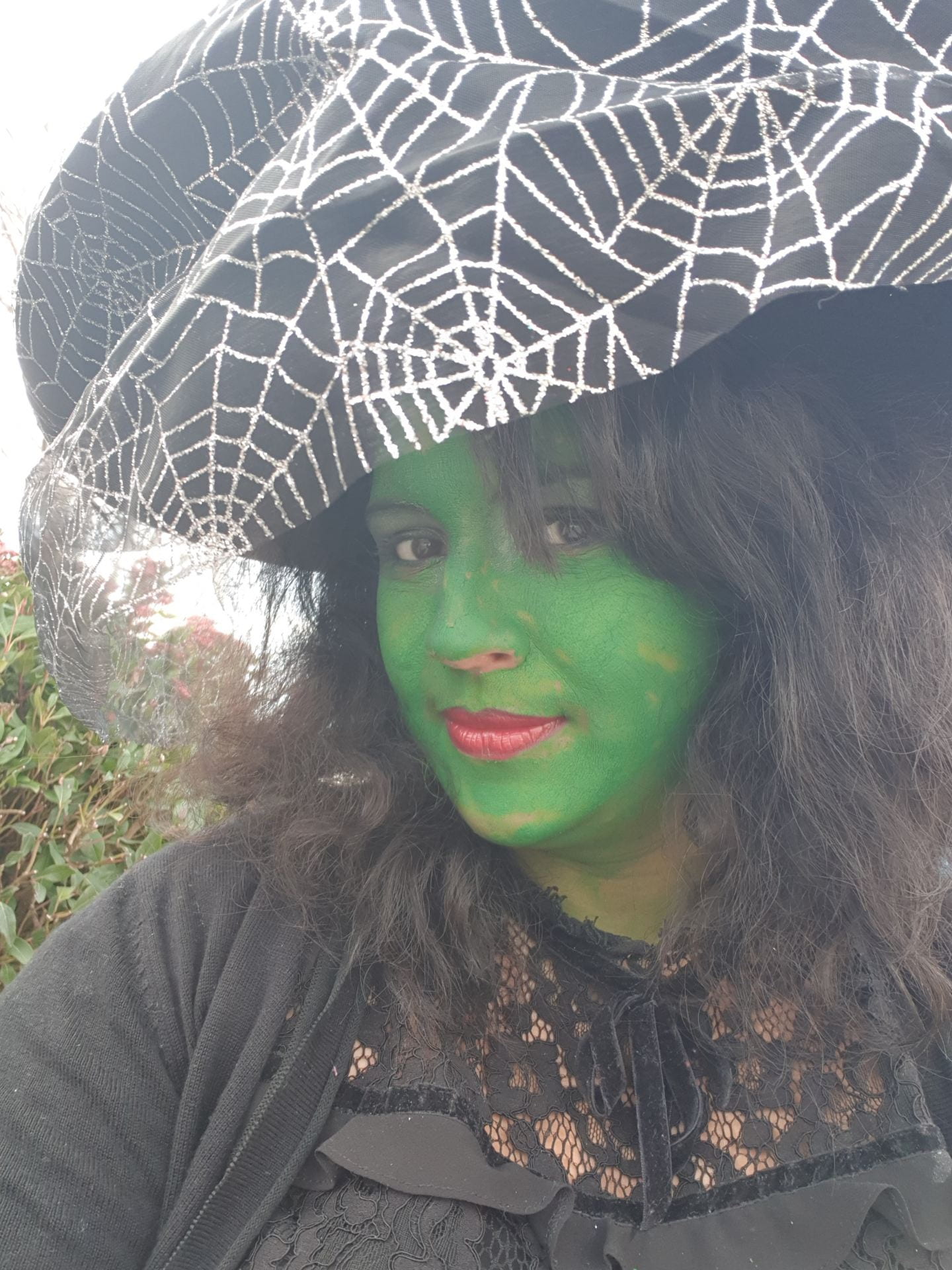
I am going all out for book week this year. I am going to make a complete idjit of myself and show my students that reading is FUN! That reading books you are interested in brings great joy! Most of all, I am going to show my colleagues that recreational reading is still important for teenagers. And I am going to show them that whilst looking FABULOUS!
I just read a fabulous article on Facebook that was shared by another TL about how much choice matters in recreational reading. Korbey in her Edutopia article “The reading wars; choice vs canon” presents various perspectives to this scholastic issue.
The problem lies in that if students are forced to read particular texts, then there can naturally be a resentment towards the task, the book and the activity of reading. But if a student only ever reads what they want to read then their minds will never be broadened by wider concepts and or cognition stretched. Korbey goes on to elaborate that leaving all texts to student choice poses challenges. The obvious challenge is that students are less able to ascertain which reading material is best suited to their abilities. They often return to old childhood favourites rather than allow their reading material to grow with them.
But what is the happy medium? In this article Korbey talks about teacher lead explicit instruction and the impact it is having on students. The answer seems elusive.
One idea is for teachers to select a general theme and or moral objective and then find books that address that theme in a variety of genres and text types. This way student choice is addressed as well as the need to expand and challenge their growing minds.
This is a definite change in direction but I do think that George Orwell can work with Suzanne Collins; Mark Zusack with John Boyne and Jackie French. But that also calls on English teachers to be brave and well supported by their colleagues.
Getting the word about Book week out. We have asked the kids to bring in food that has a book theme. They will be judged and then prizes awarded before selling them to raise money for the Pajama Foundation. We had a lovely student bring in some a few days early to drum up support. So far we have had 40 students agree to bring in something delectable for next week.
I am not sure about you but I found both those books dull, dry and depressing as a teen; and I will say they have not improved with age!
Our graduate English teachers were struggling with the rampant disengagement with those two novels. The indifference was causing the teachers great distress as they were concerned how the students were going to submit their essay assessment task if they would not engage with the book. More experienced teachers were able to forge through the disengagement but our newest recruits were finding teaching the text challenging.
It then occurred to me that memorial boxes could be the answer!
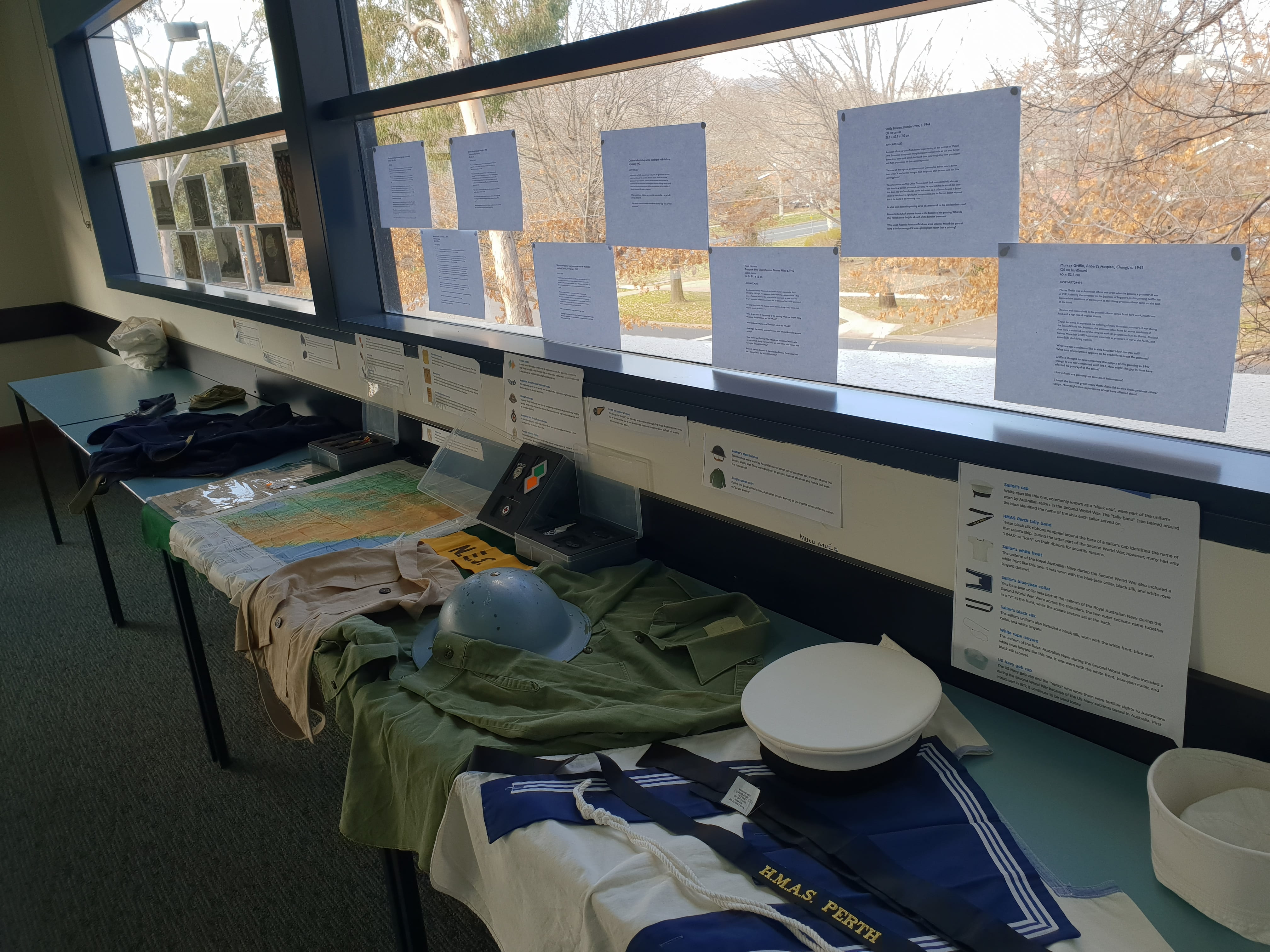
WW2 Memorial Box set up
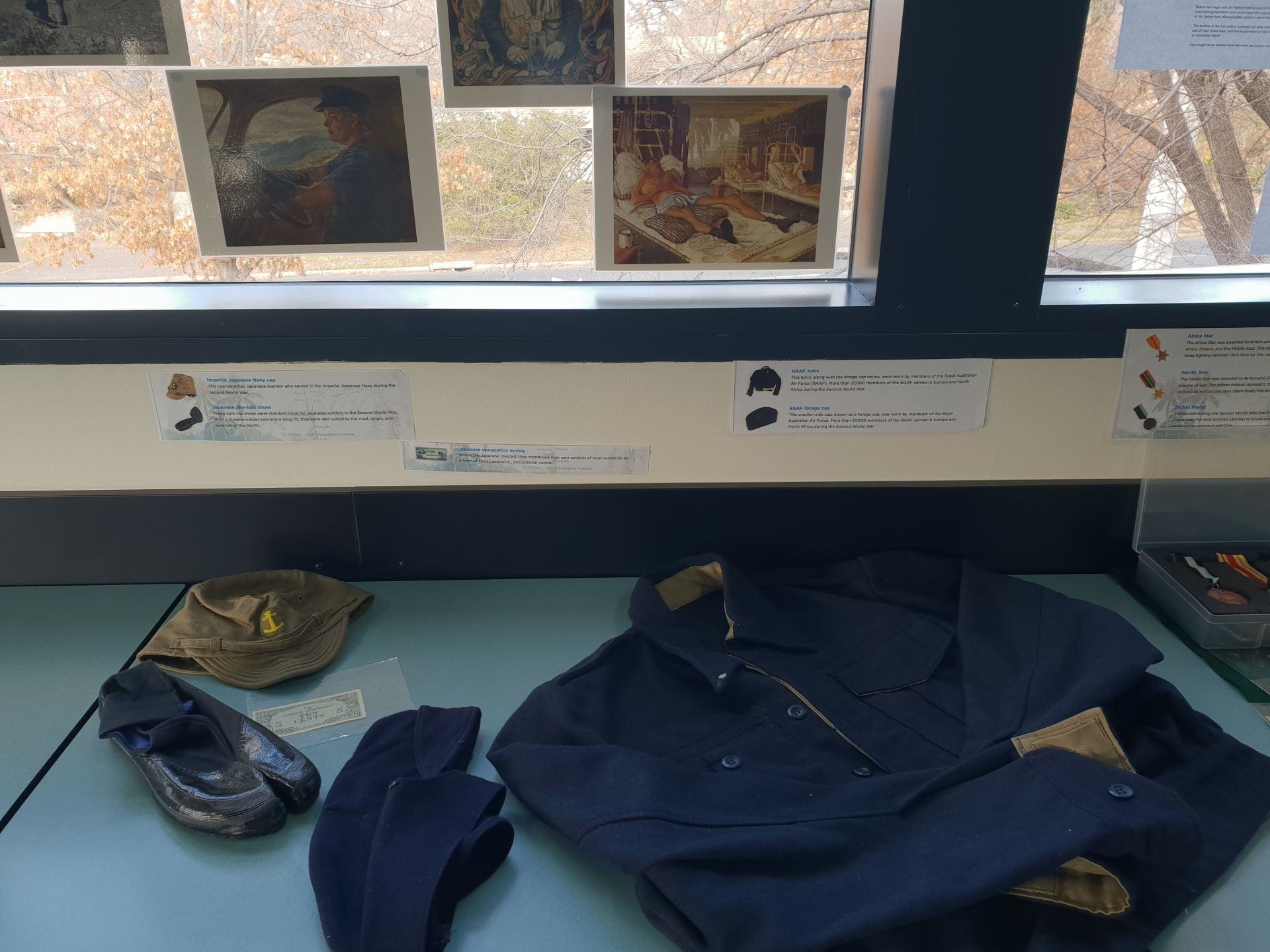
I had discovered that the Australian War Memorial had a whole host of educational resources available for loan to schools in the form of memorial boxes. These boxes contain genuine artifacts from various military events in Australian history. I had requested a box for our 10 History classes earlier this semester as a ‘hook’ factor to engage and elicit interest at the commencement of their World War 2 unit.
Artifacts from the memorial box
My cognitive connection between our great English dilemma and the memorial box was very much delayed! It wasn’t until I was unpacking the resources in our library seminar room that it occurred to me that the same artifacts that were engaging our Year 10 history students could also stimulate our year 7 and 10 English students.
I had an epiphany of sorts!
I was so happy my HOD agreed with my madcap proposal about using the memorial box as a stimulus for English. The scheme was simple. The students would come to our ‘library museum’ and view the various artifacts displayed within. Then in pairs, the students would interview each other to create a podcast with an accompanying transcript. A very clever English teacher quickly whipped up a worksheet and then, just like that… our immersive experience had begun.
Pictures and Memorabilia
Now I would love to tell you it was all a huge success, but I would be lying.
The memorial boxes were a great triumph with our 10 History students but success was variable with our English classes. This lackluster response could be attributed to the inadequate time for the students to complete the activity. The classes that visited the library twice had more success than ones that came just once.
What we did discover was that students were stirred out of the apathetic stance towards the books because they began to understand the context surrounding it. The memorial box activity connected the students to the mileu of the books and engaged them in the character’s turmoil. As the worksheets were collected at the end of the session, the teachers were able to use those responses to formatively assess student literacy and other learning goals.
The in class essays are all occurring this week for year 7 and next week for year 10. I would be very intrigued to know if the memorial boxes assisted in increasing student engagement with the books and the outcome of the assessments. I would also like to analyse the results of the English classes that declined to attend our library museum and compare them to the classes that did come. If there is a significant difference, then I would have sufficient evidence to run this activity for more teachers and students.
Colin Firth as Mr Fitzwilliam Darcy in 1995 BBC’s Pride and prejudice TV series. Courtesy of Jane Austen Centre, Bath. http://www.janeausten.co.uk
Not the Austen version of Mr Darcy, but Colin Firth version in the BBC mini-series of Pride and prejudice. His smouldering eyes, broad shoulders and clipped accent was enough to make this girl blush and we all know I am too brown to blush!
With that started the greatest love affair I’ve ever had.
I INHALED the TV series, read the book, devoured any adaptation,version and variation I could find. I looked for sequels, hunted for parodies and searched for spin offs. I realised that my infatuation had gone beyond just the Austen version. I watched and read anything that remotely was associated with this book including ‘Bridget Jones’ Diary’ and the Bollywood adaptation of ‘Bride and Prejudice”.
But this new subject of mine made me ponder how the various versions and adaptations would be organised. Then I came across an acronym – FRBR that boggled my mind.
FRBR – Functional requirements of bibliographic records is a conceptual model of thinking about resources that are similar (Hider, 2018). The model seeks to separate resources on different levels depending on their relationship to the original version. As a theoretical model rather than a standard, FRBR forces the cataloger to identify the line in which a new work differs enough from its original form.
In perfect truth, this whole concept was so puzzling to me at first. I struggled to understand how the pieces all connected together. Then whilst on my winter break I started to read another adaptation of ‘Pride and Prejudice’ but from Mr Fitzwilliam Darcy’s point of view. I thought that if I placed all the versions in a table, I would maybe understand it all a bit better.
IT WORKED!
Equivalent
Derivative
Descriptive
Original
Same work
Catalogued as new work
Original
Variations or Versions
Adaptations
Change of Genre
Reviews, criticisms, evaluations, commentaries
Pride and Prejudice by Jane Austen, 1813.
Pride and Prejudice by Jane Austen, Arawa Edition, 2016
Oxford University Press,
Pride and Prejudice by Jane Austen
Penguin English Library, UK Edition, ebook
Pride and Prejudice and Zombies by Seth Grahame Smith and Jane Austen
Emoji pride & prejudice by Katherine Furman, Chuck Gonzales and Jane Austen
Darcy swipes left by Courtney Carbone and Jane Austen
Pride and Prejudice, BBC TV mini series 1995
Pride and Prejudice, film, 2005
Death comes to Pemberley by P.D. James
The Independence of Mary Bennett
By Colleen McCollough
Bride and Prejudice, film, 2004
Bridget Jones Diary, film, 2001
A study guide for Jane Austen’s Pride and Prejudice by Cengage Learning Gale, 2017.
Pride and Prejudice SparkNotes Literature Guide by SparkNotes, 2014.
It made sense to me, that line between original work and versions be organised under the original author’s name but adaptations, parodies and commentaries need to be catalogued with citation to the creator that did the ‘new work’. But this is where tagging comes in use. Cataloging needs to be precise and organised so that the source can be easily identified and found. Tagging/Subject headings, when indexed, allows the user to search for similar items even though the author and or titles may vary. For example, on the right side of this webpage, you can see the tags that are linked to various blogs on this site. The tag allows the user to search up all related posts to that tag. It is less specific than a title and or author search in finding a resource.
I broke down three resources further to illustrate how the metadata varies between them. You can see that the tags “women in England – fiction”as well as some others would be useful in finding Austen adaptations.
Title
Pride and Prejudice
Emoji pride & prejudice: Epic tales told in tiny texts
England social life and customs – 19th century – fiction
Women in England – fiction
Austen, jane – adaptations
Austen, jane – parodies
Women in england – fiction
Brothers and sisters – fiction
Social classes – fiction
Family relations – fiction
England social life and customs – 19th century – fiction
Austen, Jane – adaptations
Austen, jane – parodies
Women in england – fiction
Brothers and sisters – fiction
Social classes – fiction
Family relations – fiction
E-books,
England -social life and customs – 19th century – fiction
This whole exercise has been very useful for me to understand this task and subject. It also has helped me find some other versions of Mr Darcy. I am not yet quite up to the 50 shades of Fitzwilliam Darcy, but I am definitely getting closer!
Hider, P. (2018). Information resource description: Creating and managing metadata (2nd ed.). London: Facet.

 Ramdlon / PixabayA











 Learning through the Library