Disciplinary Literacy is rarely discussed in schools, and this can lead to a significant impact to learning outcomes. The skills required to read a text in Chemistry are very different than the ones required in Literature. However, most schools pigeonhole literacy into the purview of the English Department.
Shanahan & Shanahan (2012) advocate for the explicit instruction of disciplinary literacy across middle and high school classrooms. This approach clearly acknowledges the importance it is the have the ability to ‘create, communicate and use knowledge’ appropriately within each discipline.
Change is inevitable and society has seen great changes to the way it functions. The current technology revolution has changed the way people earn, communicate, work, live, study and recreate. According to Vygotsky’s socio-cultural theory, reading and learning work symbiotically together with strong influences from language and technology (Hashim & VongKulluksn, 2018). Therefore by this theory, changes in technology resonates how learning, language and literacy manifests in communities. This is evident in the way the definition of literacy has expanded. Previously the term ‘literate’ was used to describe individuals who were able to read and write. But the current definition includes the skills and knowledge required to access, use, understand and express ideas, thoughts and feelings, across multiple modalities, and in all contexts of life (ACARA, 2014). The broadening of the definition is directly related to the evolving nature of technology and its impact upon the way literature and books are read, comprehended and evaluated (Sargeant, 2015; Jabr, 2015).
The concept of the book changes with every technology revolution and corresponding societal change. From prehistoric stone tablets, to Ancient Egyptian papyrus and Roman vellum scrolls, to the innovative Gutenberg printing press, books have evolved with technology, and at each transformation, the reading paradigm changes (Mangen, Walgermo & Bronnick, 2013). The modern definition of a book can include the traditional paper form, as well as electronic versions that can be read on devices such as mobile phones, tablets and laptops along with audiobooks, online books, and other digital products such as applications and websites (Springen, 2010). This emergence of these new digital texts require additional skills and strategies in order for the reader to comprehend the narrative (Jabr, 2015; Mangen et al., 2013; Sekeres & Watson, 2011). As part of evidence based practice, secondary school teachers are encouraged to adapt their pedagogical practices to address these technological and societal changes to ensure that their students possess the relevant skills and strategies to become active participants in society.
Reading has often been characterised as the product of an individual’s ability to decode and comprehend the text and is viewed as a fundamental human skill (Moore & Cahill, 2016, p.4). Engagement in reading is linked to improved student learning and long term academic success (Moore & Cahill, 2016; Hashim & VongKulluksn, 2018). Unfortunately many teenagers and young adults are reluctant to read and this reluctance can impact their education as well as their social capital and identity formation (Moore & Cahill, 2016). Many education departments across the world have increased funding for technology in schools to boost literacy and reading rates in an effort to halt declining literacy (Keen, 2016). In turn, educators seek to identify pedagogical practices that will increase student motivation for reading and in turn, improve overall literacy.
Technology has been often cited for its ability to improve educational outcomes due to its engaging format. Morris & Cahill (2016) has determined that technology has a stronger preference in secondary compared to primary aged students. Since motivation to read and cognitive experiences when reading works via a positive feedback mechanism, it makes sense that digital literature should lead to increased reading rates and improved literacy (Hashim & VongKulluksn, 2018). Furthermore, Taylor (2018) suggests that the complex nature of digital storytelling is suitable for teenagers as they are familiar with using devices and are comfortable switching between screens and print.
Technology in literature, also known as digital literature, encompasses ebooks, audiobooks, interactive media and mobile applications. Each of these technologies, delivers narratives in their own individual way and requires a variety of skills and strategies for decoding and comprehension. Many teachers and teacher librarians are tasked with identifying technology based literature in an effort to increase engagement and improve educational outcomes.
Sargeant (2015) defines an ebook as the static digitised version of a print text with its familiar features of virtual pages, book gutters and page turning animation. Access to ebooks can occur both onsite and offsite as they can be retrieved and delivered digitally to mobile devices with embedded features (Hashim & VongKulluksn, 2018). Examples include Kindle application, where ebooks purchased from Amazon can be accessed through, or BorrowBox and Wheelers, that allow for borrowing of titles and are often affiliated with public and school libraries. Some ebooks for older readers have various levels of interactivity, such as hyperlinks and in built media are commonly found in secondary expository or information texts such as text books (Sargeant, 2015). Their increased popularity with older readers is due to portability and ability to retain text anonymity (Dickenson, 2014). But ebooks that are designed for younger and less literate readers have lower levels of interactivity and contain more skeuomorphic features to reduce distraction from the main point (Sargeant, 2015) .
Jeon (2012) promotes the use of ebooks in schools as they support academic instruction, are time efficient as well as provide a dynamic and cost effective way of managing a collection. Ebooks can also be integrated into library management systems and thus are available for to be borrowed by students at any time, including in times of pandemics and forced isolation (Jeon, 2012). These apps are designed to assist readers in retaining anonymity in title choice, as well as allow access to a wide range of reading levels which encourages independent reading and promotes bibliotherapy (Hashim & VongKulluksn, 2018).
Audiobooks are increasing in popularity with readers from all generations (Moore & Cahill, 2016). The most prevalent use of audiobooks in schools are, students with low literacy and learning difficulties as well as second language learners (Moore & Cahill, 2016, p.5). Hiebert, as cited in Moore & Cahill (2016) argued that language and the fundamentals of narratives can be conveyed through auditory processes, as language-comprehension system in the brain permits text engagement and comprehension (p.3-4). Other benefits to the implementation of audiobooks in teaching and learning processes include, improving vocabulary, promoting oral language, as well as strengthening links between oral and written literacies (Moore & Cahill, 2016, p.4). Audiobooks can be easily accessed on personal devices and offer the same level of anonymity as achieved by ebooks. Anonymity is very important in secondary schools, particularly for students with low literacy who need to access ‘different’ texts (Dickenson, 2014).
Whilst there are many different reasons why students struggle to read, the most common reasons in secondary schools include, insufficient vocabulary, incorrect decoding and a lack of fluency (Moore & Cahill, 2016, p.5). Access to audiobooks allows students who struggle with the aforementioned inadequacies to engage with the text and develop their reading accuracy as well as potentially improving any behavioural management that arises from disengagement and disenfranchisement (Moore & Cahill, 2016, p.6). Audiobooks address these needs and therefore it is possible to surmise that this technology is able to provide the reader the same rich experience that is afforded by print text.
Interactive media (IM) has exploded in recent years and this is impacting teaching and learning (Cullen, 2015). Some examples of interactive media include digital books, online books, book applications and websites. Lamb & Johnson (2010) argue that IM causes readers to shift from being passive receivers to active participants. This is because IM is able to engage students in the content via multiple entry points and therefore encourages learning through experience and experimentation (Lamb & Johnson, 2010; Cullen, 2015). IM narratives are able to tell dual stories, as well as bring the images to life whilst providing a brilliant way to connect emerging technologies to the curriculum (Cullen, 2015; Taylor, 2018).
One example of IM are book applications (apps). Book apps are software programs that are designed to engage students by delivering high levels of interactive media rich content (Sargeant, 2015). They integrate multiple modes of communication so that the text and visuals are fused to create a story that requires the reader to transform into a user by their interaction in the narrative with a touch screen (Sargeant, 2015). This process of action and outcome is based upon gamification principles already present in the rewards based system currently practiced across most school systems. Gamification uses extrinsic motivation in learning and teaching practice. But Briggs (2016) cautions the use of gamification in assessment. The reason for this caution is that the motivation to succeed arises from the low personal stakes the reader has with the text, as well as the elusive but reachable goals.
IM has the capacity to cater to the needs of a varied classroom because of a student’s ability to work at an individual pace and the multiple entry points allows for differentiation. There is also a possibility for educators to use IM to create scenarios, as a mechanism to introduce students to new units of work, or introduce assessment pieces in an engaging format (Lamb & Johnson, 2010). Cullen (2015) believes that application led learning bolsters motivation and engagement in students, which is essential for improved learning experiences and positive outcomes.
There are valid contraindications to the use of technology in educational settings. Studies have shown comprehension is lower in narratives and expository texts when a device is used (Jeon, 2012; Mangen et al., 2013). Jeon (2012) believes that within some forms of technology, the complex nature and formatting of the text causes too great a cognitive load on students and thus it negatively affects comprehension. Hashim & VongKulluksn (2018) concur and point out that students often become distracted in their attempt to multitask on devices, which leads to decreased metacognitive regulation and reduces text completion.
The format of text is also important for comprehension. Digital literature in all forms have lower comprehension rates in comparison to traditional texts (Jeon, 2012; Mangen et al., 2013). One of the other main reasons for this unfavourable comparison is visual ergonomics. Visual ergonomics, such as lowered spatial stability, leads to a negative mental representation of the text (Mangen et al., 2013, p.66). Good readers have a high mental recall of information positioning in text. Consequently, limited mental representation restricts recall and makes it harder for students to construct new banks of knowledge from individual pieces of information. One suggestion to combat this limitation and to promote a more equitable approach in classrooms is to limit digital reading to short extracts only, and it to be of low stakes value rather than summative assessment (Mangen et al., 2013, p.66).
I obviously have not taken my own advice and have written an epic instead of a synopsis!
Hashim & VongKulluksn (2018) suggests that whilst e-readers provide context and analysis, it lacks the social factor that discussion groups and literature circles provide. There is also an implication that educators fail to treat e-readers like they treat print texts, and therefore provide less scaffolding to students leading to lower comprehension rates. This failure could be due to a lack of personal knowledge to the functionality of e-readers, or simply that teachers are not physically able to see how much of the text the student has engaged with and thus forget to offer assistance (Hashim & VongKulluksn, 2018). Therefore, in the interests of equity, it is important that ebooks are scaffolded in the same way as a print books because, as students gain mastery in their reading, scaffolding can be adjusted to help their progress from a low to a higher mental function (Hashim & VongKulluksn, 2018).
There are other obstacles to using ebooks in educational settings. Primarily, students are not motivated to use e-readers for learning. This could be due to the fact that e-readers are no longer considered a novelty, that devices themselves are commonplace, and lastly, that traditional texts actually provide greater enjoyment than digital literature (Hashim & VongKulluksn, 2018). Ebooks have also been known to cause eye irritation which in turn reduces surface legibility, and increases eye strain and mental fatigue (Jeon, 2012). These physical demands lead to an increased error rate and reduces overall comprehension, which in turn leads to a lower perception of ereaders and ebooks (Jeon, 2012). Other than diminishing comprehension, ebooks can also be seen as tedious in comparison to other entertainment found on devices (Jeon, 2012). Though there is some suggestion that digital natives are resistant to these issues as they are more familiar with technology (Jeon, 2012).
Some educators are reluctant to provide audiobooks to their students in lieu of print texts as they can be viewed as ‘cheating’. But Dahl (2016) disagrees with and finds that audiobooks provide the same learning experience as reading after a certain level of literacy has been reached. This is based upon the theory that the decoding specific to reading becomes instinctive after a certain point in literacy is achieved (Dahl, 2016). The reasoning is that ‘reading comprehension’ is similar to ‘auditory comprehension’ and that echoic memory is comparable to the visual system of eye regression, though the concept of ‘flipping back’ is a bit more problematic in an audiobook (Dahl, 2016).
The current predominate argument surrounding school is that digital media will engage reluctant readers and therefore improve learning outcomes (Springen, 2010; Cullen, 2015). But some educators argue that these alternative texts lack equity as they are limited to students and schools with digital access and financial security (Sekeres & Watson, 2011). Sekeres & Watson (2011) even go further to suggest that educators need to be aware that children are often targeted as consumers in their own right and therefore teachers need to be circumspect when they select digital literature that it actually leads to learning and not just entertainment.
From a school collection perspective there are significant issues with ebooks and audiobooks, namely access and cost (O’Connell, Bates & Mitchell, 2015). This is due to the fact that both ebooks and audiobooks require a personal device such as a mobile phone or tablet and many younger students do not have that level of access. They also require a financial contribution and or a library membership, which again can be limiting for younger students to practice their digital literacy skills. One suggestion to address the rising cost of digital literature is to promote public library memberships in schools. Students who have library memberships at school, local and state libraries, have access to a wide range of texts in both print and digital formats. Some larger institutions also offer electronic access to databases and periodicals which is very useful for secondary students. This reduces the cost to the individual and school systems without limiting access to information.
Licencing and leasing are problematic when it comes to digital literature. Physical books are bought by the library, require no device to use, and are useful till the book gets lost, deselected or falls into disrepair. Ebooks in comparison, are either downloaded (purchased), or borrowed and both require a device and the internet to be used. These devices, such as iPods, ereaders, laptops and tablets can be quite expensive for school libraries and students to purchase and maintain (Gray, 2017). Additionally, if a school library chooses to use a platform such as Borrowbox or Wheelers as their access point for ebooks and audiobooks, they are limited by that publisher’s collection as to what titles meet the developmental needs of the students and curriculum requirements (Gray, 2017). Teacher librarians need to be cautious when selecting platforms for digital literature that they are not limiting their readers to resources based upon publishing contracts and nepotism. Furthermore, the school may not own ‘loaned titles’ and may have to pay a leasing or access fee on a yearly basis. So whilst there seems to be great flexibility, especially with regards to remote access, there can be some stringent financial restraints for schools when it comes to building a robust ebook and audiobook collection.
O’Connell, Bates & Mitchell (2015) suggest that the goal of school libraries is to adapt to the digital needs of the student cohort, which means that the reading culture has to be addressed as well as ensuring a divergence of media is available. Therefore, teacher librarians and school library collections are tasked with ensuring students are given ample access to the different forms of media for teaching and learning across the curriculum as well as for recreational purposes. This means access to both traditional and digital forms of literature. But promotion of wide reading programs and access to emerging literature trends needs to be buttressed by pedagogical practices that support reading and comprehension across the various domains.
The question for teachers, teacher librarians and other educators is that will these new media forms benefit the teaching and learning practices in classrooms, and more specifically, secondary classrooms? It is clearly evident that the information revolution has changed the way society is functioning. Therefore it is important that students gain the skills and knowledge to succeed in this modern world. From the evidence provided, secondary students are more receptive to digital literature because of its engaging format, portability and text anonymity. But many lack the reading and comprehension skills to fully understand the nature of the text and therefore are at a literacy disadvantage. Educators need to recall the importance of culture and tools in Vygotsky’s theory of learning and provide access to a range of literature across the various forms of media. The reading paradigm has changed and teachers must change their teaching and learning to suit this new world.
Gray, M. (2017). Ebooks: To subscribe or not to subscribe? Connections, 101. Retrieved from scis.data.com/connections/issue-101/ebooks-to-subscribe-or-not-to-subscribe
Jeon, H. (2012). A comparison of the influence of electronic books and paper books on reading comprehension, eye fatigue, and perception. The Electronic Library, 30(3), 390-408. doi: 10.1108/02640471211241663
Moore, J., & Cahill, M. (2016). Audiobooks; Legitimate ‘reading’ material for adolescents? Research Journal of the American Association of School Librarians. Retrieved from www.ala.org/aasl/slr/volume19/moore-cah
O’Connell, J., Bales, J., Mitchell, P. (2015). [R]Evolution in reading cultures: 2020 vision for school libraries. The Australian Library Journal, 63(3), 194-208. DOI: 10.1080/00049670.2015.1048043
In days gone by, graphic novels were regarded little more than entertainment for children and young adults. They were regarded as shallow and of no value as literature. I have previously discussed the popularity of graphic novels in my school library, but I have not expounded upon their value to the collection as a source of literature.
A good graphic novel as described by Gonzales (2016) is a literary text in a comic strip format. It should have the same literary features of a prose novel, such as an overarching theme, depth of plot, character development, as well as the standard literary devices of any other piece of literature (Gonzales, 2016). But the added strength of graphic novels is the illustrations. These illustrations support the storyline and seek to enhance the plot for the reader by providing context and additional visual clues.
ACARA (n.d.a) defines a text as a conveyance of communication. It does not discriminate if the text is written, spoken or multi-modal in nature, but rather emphasises the importance in its ability to transmit information. Therefore, as per ACARA (n.d.a), it is perfectly reasonable for graphic novels to be used as part of curriculum literature as well as part of general wide reading. The multi-modal format of graphic novels is suitable for both fiction and non fiction subject matter, and engages students across year levels and contributes to the development of various literacies and higher order thinking skills.
The format of graphic novels strongly promotes literacy; which includes but is not limited to language and visual development as well as critical and cultural literacy (Laycock, 2019). As ACARA (n.d.b) illustrates, the literacy continuum allows for active teaching of graphic novels in the visual knowledge element as well as the comprehension of text elements. These elements clearly indicate that the focus of literature is no longer restricted to prose in print; but that the concept of text has greatly evolved.
Graphic novels have several features that lend itself to teaching and learning practice. Firstly, the transition that is needed between frames makes it necessary for the reader to predict the next action (Botzakis, 2018). This prediction requires the student to utilise higher order thinking skills before they can arrive at that point, using the contextual information present in the imagery. The context of a graphic novel has multiple uses in an educational setting. Besides assisting low literacy and ESL students improving their ability to decode; discordance between images and text can also be used to provoke spirited discussions and analysis (Botzakis, 2018). Lamentably, most students fail to understand such nuances intuitively, therefore explicit pedagogical practice is required to equip students with the necessary skills (Laycock, 2019). Lastly, graphic novels have visual permanence (Botzakis, 2018). This visual permanence means that the reader is able to set their own reading pace and allows for re-reading and further clarification.
In recent years, many classical texts have been reprinted as graphic novels due to their popularity. Complex texts such as Homer’s “Iliad” and Harper Lee’s “To kill a mockingbird” adaptations allow the reader to engage with class texts in a format that they can access more easily. Even popular titles such as “Anne Frank’s Diary” and “Wrinkle in Time”have proven more competitive in a graphic format than the traditional text version with high school students. Laycock (2019) points out that graphic novels increase the literacy alphabet in poor readers as well as offer an additional method in which content can be delivered. The evidence does indicate that as a format, graphic novels have great potential in a classroom setting.
Unfortunately many teachers falter when challenged to use graphic novels in their teaching practice. This is due to a lack of confidence with this format. Authority in explicitly teaching literacy using graphic novels requires the teacher to be familiar with a variety of graphic texts (Gonzales, 2016). Gonzales (2016) suggests that knowledge in film techniques would be useful in analysing the illustrations, as they use frames, colours, angles and word bubbles to convey the covert message; in comparison to the the text, which speaks the overt message. Comprehension is further enhanced by clear teaching of artistic elements such as line, shade, colour, form and depth. Some graphic novels aid comprehension further by the inclusion of character mapping which aids in memory recall (Botzakis, 2018).
The largest benefit to the inclusion of graphic novels in a high school library collection is that reading graphic novels tends to lead to an increased satisfaction with reading, which in turn leads to increased wide reading (Gonzales, 2016; Laycock, 2019). Graphic novels also give poor and reluctant readers a sense of accomplishment due to the increased decoding assistance from the visual clues (Botzakis, 2018).
Regrettably many parents and teachers still believe that graphic novels are unsuitable for classrooms and wide reading due to ingrained prejudices and their own distant memories (Gonzales, 2016; Laycock, 2019). There is an assumption that vintage comics are in the same league as a modern graphic novel. But this thesis would be incorrect. Comics are to graphic novels as Mills & Boon are to traditional literature (Botzakis, 2018). It would be a great miscalculation to designate all graphic novels as entertainment, when one can clearly see their practicality in the classroom and links to the curriculum. Another point to consider is that there is a disconnect between what students want to read and what the curriculum dictates they have to read. This dichotomy cripples literacy development. When school literacy programs prefer only monomodal texts, it creates pedagogical tension for teachers. Adding graphic novels to class literature shifts the voice in the classroom from teacher to the student which leads to higher student engagement.
Graphic novels sales are trending across the literary world. The first graphic novel to win a Pulitzer Prize was “Maus” by Spiegelman in 1992, followed by Aydin’s “March” series that won the National Book Award in 2016. Traditionally favoured with the tween and teen males, graphic novels have become increasingly popular with teenage girls (Gonzales, 2016; Botzakis, 2018). This popularity has led to a sharp increase in the occurrence of female protagonists within this genre (Gonzales, 2016). One could argue that graphic novels are indeed texts of the 21st century as they engage the reader on multiple levels, promoting multiple literacies in a multi-modal world.
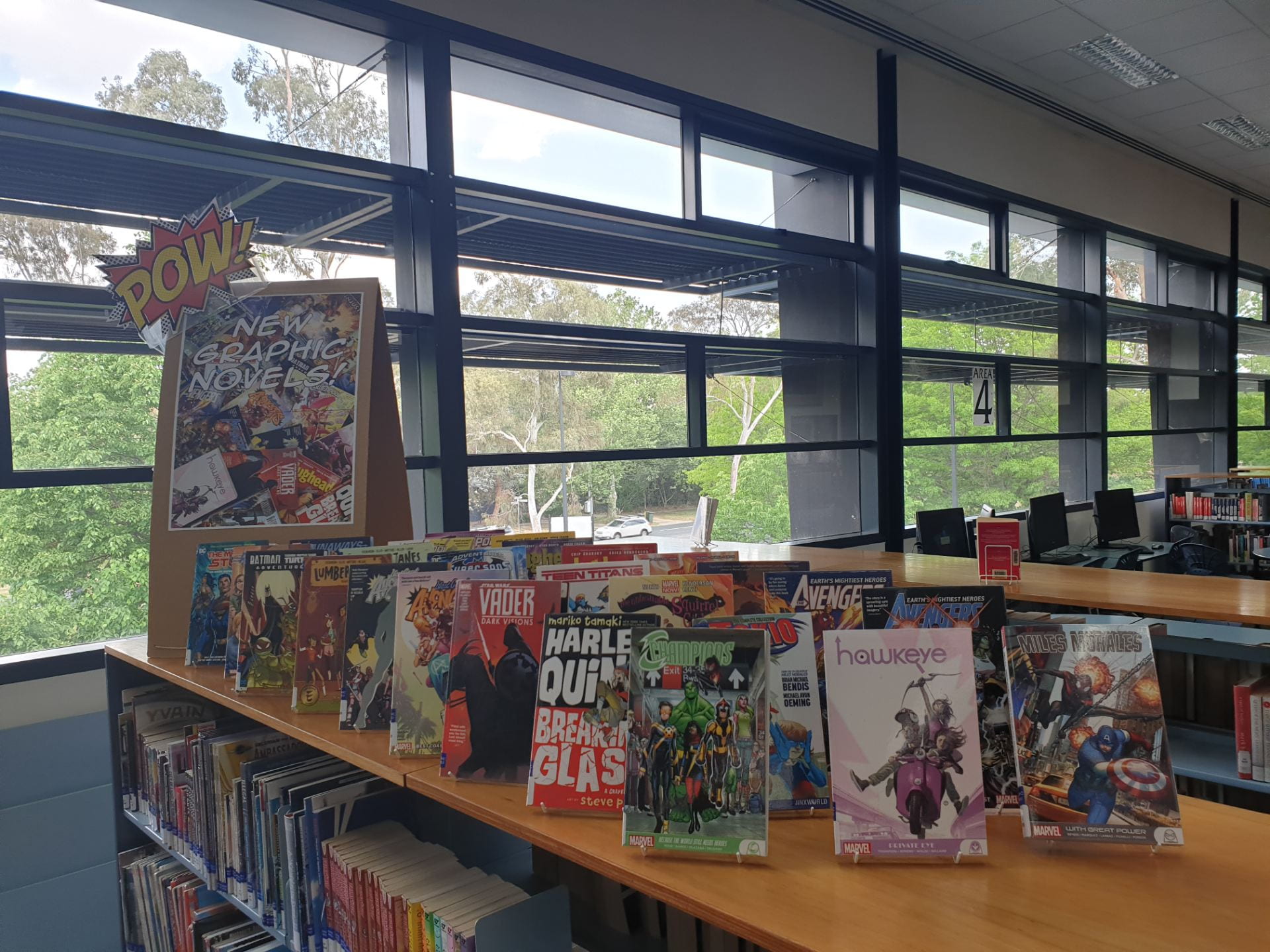
My school library has recently acquired a variety of graphic novels, ranging from classics such as Harper Lee’s, “To Kill a Mockingbird” to swashbuckling tales of pirates, and fantastical stories of superheroes from the Avengers franchise. There are multiple reasons behind the acquisition of these resources; tacking reluctant readers engagement with reading, boosting traditional and multimodal literacy and addressing the needs of the curriculum.
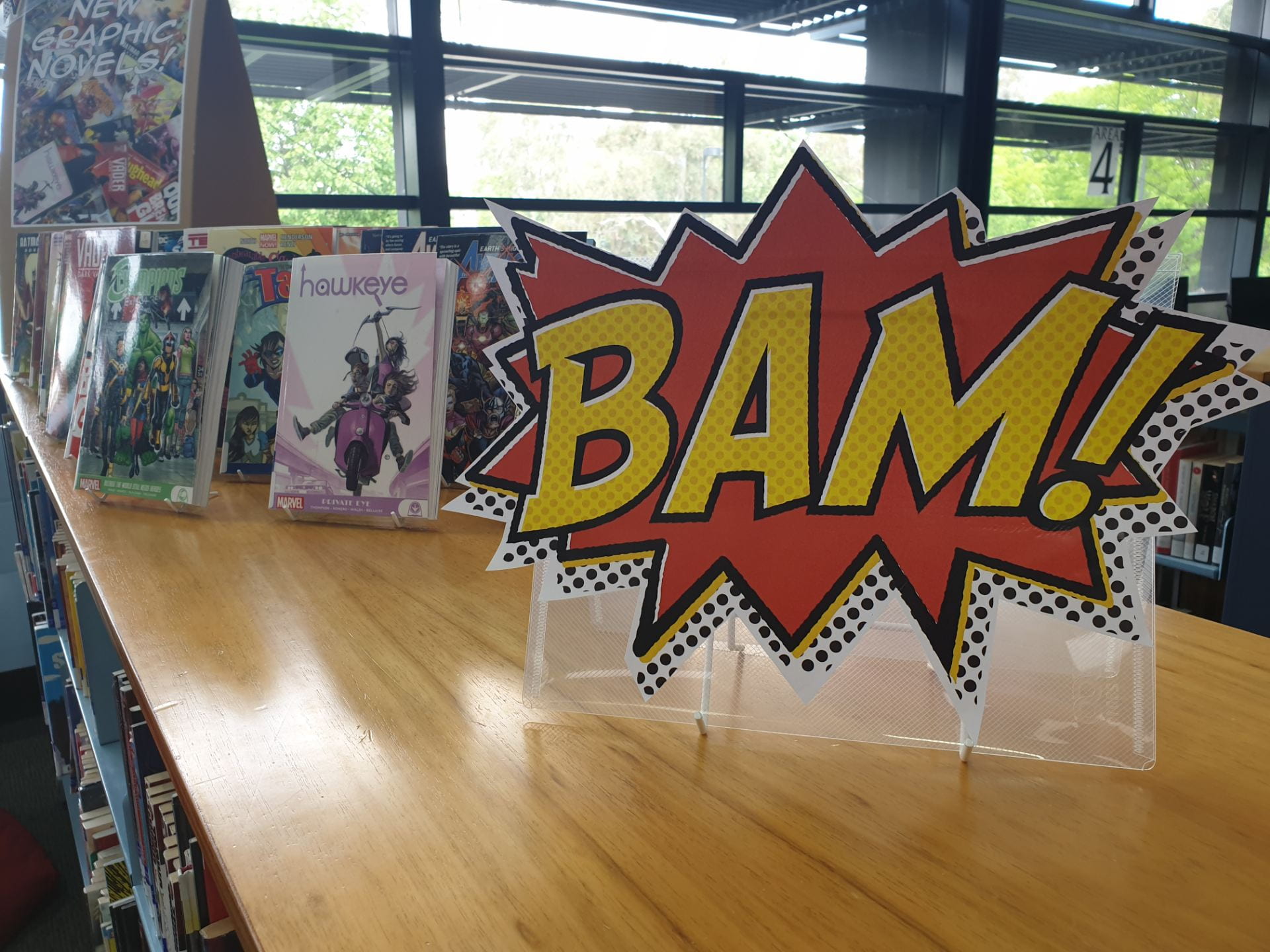
BAM! Literacy and fun- TOGETHER!
Graphic novels have widespread appeal across generations. From adolescent reluctant readers to highly literate adult geeks, graphic novels can inspire a cult following. I can only chuckle when I reminisce about Sheldon Cooper and his obsession with comics in the popular TV series “Big Bang Theory”. The popularity seems to stem from the presence of popular genres such as Manga, funny and superhero comics and their use of contemporary characters (Crowley, 2015; Hughes et al., 2011). The Marvel and DC comic series in particular, have reached new zeniths in popularity due to the recent plethora of movies being released this decade.
Literacy teachers common use graphic novels as a method of engaging students who are reluctant readers boosting literacy. As mentioned in earlier blog posts, reluctant readers often struggle to engage with traditional texts for a multitude of reasons, most commonly, low literacy. Aliteracy or illiteracy, can preclude students from comprehending large text paragraphs (Crowley, 2015). Graphic novels with their text juxtapositioned with pictures format allows students to use visual stimuli to assist with decoding text (Cook & Kirchoff, 2017). The drawings create a tangible image for the reader allowing them to be captivated more easily by the narrative within. This engagement can often influence students with low literacy to become more prolific with their reading, which has a direct correlation to increased literacy and overall academic achievement. Due to their popularity and narrative style, graphic novels epitomise the adage, ‘reading for pleasure’. For schools with wide reading programs, a strong graphic novel investment is highly advised.
There are other benefits to adding graphic novels to a collection. The advent of the information age has demanded a strong requirement for students to be literate across modalities. Graphic novels with their images and text colligated together, confer visual, gestural and spatial elements simultaneously, causing the reader to engage with the material on multiple levels. As mentioned previously, graphic adaptations of class texts and other classics are extremely beneficial in engaging students as it is unfortunate that prescribed texts often seem to lack appeal with the student cohort. A graphic adaptation has the duality of both ENGAGING disinterested students and ASSISTING students with DIVERSE learning needs. By adding graphic novel adaptations of class texts to the collection, a school library is acknowledging the diverse learning needs of their students whilst addressing curriculum requirements mandated by ACARA.
References
Cook, M., & Kirchoff, J. (2017). Teaching multimodal literacy through reading and writing graphic novels. Language and Literacy. Vol. 19 (4). Pp. 76-95
Crowley, J. (2015) Graphic novels in a the school library. The School Library. Vol 63 (3) Pp140-142
Hughes, J., King, A., Perkins, P. & Fuke, V. (2011) Adolescents and the Autographics; Reading and writing coming of age graphic novels. Journal of Adolescent and Adult Literacy. Vol. (54(8). DOI: doi:10.1598/JAAL.54.8.
For many people the language they use is indicative of their nationality, culture and geographical placement. Language, especially a mother language, has the ability to motivate the individual to raise their strongest voice.
My life is a linguistic soap opera. Born in Mumbai, India, I completed the majority of my schooling in Brisbane before living sporadically along the eastern seaboard of Australia. Currently based in Canberra, I am a Mumbaikar by birth to Goan parents that never lived in Goa. By this convuluted history, I should possess the linguistic arsenal of Konkani, Marati, Hindi and English from my childhood years; and be reasonably fluent in Yugara, from my time spent in Brisbane and be commencing to learn Ngunnawal, the language of Canberra.
But no. Sadly I am only fluent in English, accented as it can be and possess a smattering of inappropriate words in a few other languages. Think more like a sailor and less like a teacher, if you get my drift!
I am also sure that I am not the only emigrant with this linguistic dilemma with a dismal knowledge of my native tongue. As new citizens, my parents so keen on assimilation that they discarded all linguistic connections to the motherland to ensure we settled in as quickly as possible.
Unfortunately, this discarding of language has lead to feelings of inadequacy as an adult. Besides feeling like a ‘fake’, the saddest aspect of my own inadequacies of language is that I cannot teach my children their heritage. This death of language diversity can be attributed to numerous reasons, with emigration as mine. Other reasons include, political persecution, globalisation and civil war (Strochlic, 2018). In Australia alone, over 100 Aboriginal languages have disappeared since Philipsy and his ruffian filled boats docked in Sydney (Strochlic, 2018). You don’t have to try too hard to imagine why… do you?
Strochlic (2018) reminds us all that over 200 languages have become extinct since the end of WW2, with every fortnight another language dying a silent death. It is predicted that by the end of this century, another 90% will disappear. This loss is tragedy for current and future generations.
But all is not lost. Modern Hebrew, made a dramatic reappearance in the 18th century. Conversational Hebrew had all but disappeared in the 4th Century and was revived in the late 18th. As aspects of the language were preserved in copies of the Torah and Talmund across the world, the words and phrases within could then be extrapolated to frame conversational Hebrew (Bensadoun, 2015).
Another memorable reincarnation are the Egyptian hieroglyphs, which were decoded using the famous Rosetta stone. This stone was paramount in aiding academics in understanding the amazing wonders of that ancient empire. The stone helped construe the pictorial script into ancient Greek, which could then be further translated into modern day English (British Museum, 2017).
But what about languages with no written component? What will happen to those mother tongues? The speed in which languages disappear is heightened when they are only exist in an oral form as there is no documentation to ensure preservation. Communities with distinctive languages will become extinct and this death is a blot on society.
What can we do about it?
Well, there are several groups around the world that are seeking to preserve rare dialects and languages using wikis. These groups use available technology to record, store and transfer these conversations for preservation purposes. Noone (2015), additionally advocates the use of technology as a preservation tool to document and record languages for future generations. Other ICT tools such as Skype or Facetime, can be used by people to converse with greater ease even if separated by large distances. Language, like all other skills, becomes rusty with lack of use and regression is quite common when unused for extended periods. By using these tools, people all over the world can converse and practice their skills.
As teacher librarians, we can assist students and teachers access these audible resources. Libraries are no longer just archives for the storing of information. Instead, they are centres of ‘resourcing’ information. The same technology that permits us to document and preserve these languages also enables us to access and share them.
The State Library of Queensland has an impressive collation of Indigenous language resources on their webpage. They are working towards preserving and documenting the various dialects of the region and are drawing these word lists from their range of historical texts within the collection (SLQ, 2019b). I like the word lists. It is a simple way for me to learn some common use terms for myself and then share them with my children. SLQ also has another challenge on their portal called the ‘ Say G’day in an Aboriginal or Torres Strait Islander Language’. As 2019 is UNESCO’s Year of Indigenous Language, SLQ is challenging Queenslanders to use an Indigenous language to greet their mates in an effort to help raise awareness and promote Indigenous cultural awareness.
SLQ (2019) Languages of Queensland – including the Torres Strait
This sentiment is shared by this years NAIDOC’s them of “Voice, Treaty, Truth” as it places great emphasis on the importance of giving voice to the Aboriginal and Torres Strait Islander people of Australia. But as indigenous languages fade into the history pages, the voices that speak these languages are then also muted. There cannot be a treaty if voices are not heard. For voices to be heard and understood, we must understand that Australia is more than just English.
NAIDOC 2019 – Voices need to be heard
Whilst I do regret my inadequacy of mother tongue, I also regret not learning the language of land in which I stand on. It never crossed my mind to learn the local Indigenous dialect. That in itself is something I need to resolve as I forge my way through this M. Ed.
So I leave you with these greetings as I acknowledge that the language heritage and knowledge reside with the traditional owners, elders and custodians of the various nations. So from me to you,
I’ve always taken my kids to the library. My eldest first visited when she was six days old. I was a new nursing mum and desperate for reading materials to keep me entertained through those numerous breastfeeds. Throughout her infancy we visited different libraries on rotation. Some had great books. Others had great coffee nearby. Some had social groups that I was interested in. Either way the local library was where I felt relaxed and welcome.
Fast forward to mothering toddlers and then preschoolers, the library was where we did ‘Rhyme time’, ‘toddler time’, and ‘storytime’. Each session was eagerly awaited by mother and enjoyed whoheartedly by child and then, children.
Now as a mum of three, my library visits are less regulated mainly cos life is busy. But I do believe that my children are thriving, because of their lifetime access to books.
Local libraries are more than just a warehouse of books. They are an escape from the mundane, a breath of fresh air, and most importantly, a welcoming space.
So I dare you. Go to a local library. Take the kids and watch the magic happen.
Reading is a vital skill for learning at school and success in later life. There is multitudes of research to show that an early exposure to books has a direct correlation to literacy success. This success during formative schooling years often translates to ameliorated schooling outcomes in primary and high school, increased self esteem and overall positive well being. Unfortunately, substandard literacy skills often convert to poor education outcomes, decreased earnings and lower health outcomes. Thus it seems fairly obvious that literacy needs to be the forefront of the education system to ensure that our young citizens have the best chance at a successful and happy future.
But the statistics are dreadful. ABS (2013) reports that over 40% of Australian adults lack sufficient literacy skills to cope with daily life. This is astounding! For a first world nation this is unacceptable. How does this even happen in Australia?
Softlink (2011) research indicates that literacy levels are proportional to the presence of a school library and a qualified teacher librarian. This is further corroborated by UNESCO (2016), that libraries are the keystone in which literacy is built and promoted upon. By this token, it seems plausible that all educational facilities have a library and librarian.
Australian correctional centres have embraced this life long learning challenges by mandating that all prisons, jails, correctional facilities and detention centres have a library on site (ALIA, 2015). These libraries serve three main causes, to provide information for personal development; to improve educational outcomes and for recreational purposes (ALIA, 2015). Bevan (1984) takes the point further to ensure that detainees are encouraged to read and to have access to the library.
What a marvelous thing this is? I wish our children had the same access.
Yes, it is true. All inmates of correctional centres have the right to access a library which is run by a qualified librarian. Yet in Tasmania less than 50% of schools have a teacher librarian. Victoria has seen the numbers of qualified teacher librarians drop significantly over the past decade (Better Beginnings, n.d.). Well meaning but unqualified teachers and or assistants are resourcing the library and implementing literacy goals for our students, and it is not working out.
Once again, society bemoans the inadequacies of our children in their reading and writing without actually thinking as to the cause of it. Blame is flung eagerly at social media, inattentive parents, flying pigs and the like. But the real reason why our children’s literacy levels are deteriorating is because the information expert is absent from the school context.
The 2011 House of Representatives inquiry into schools and their libraries detailed the importance that teacher librarians bring to schools and their community. UNESCO (2016) Institute for Lifelong Learning published a policy dictating how libraries support lifelong literacy. Even the Bevan (1984) Institute of Criminology has mandated that prisoners get access to a library and books in order to improve well being and increase their chance of re-entering society.
Why can’t we give our children the same chance as we give the incarcerated?
Peschers, G (2011) Books Open Worlds for People Behind Bars: Library Services in Prison as Exemplified by the Münster Prison Library, Germany’s “Library of the Year 2007”. Library Trends 59:3 pp520-543













 Learning through the Library