Sundays, Libraries, and the Quiet Crisis in Reading

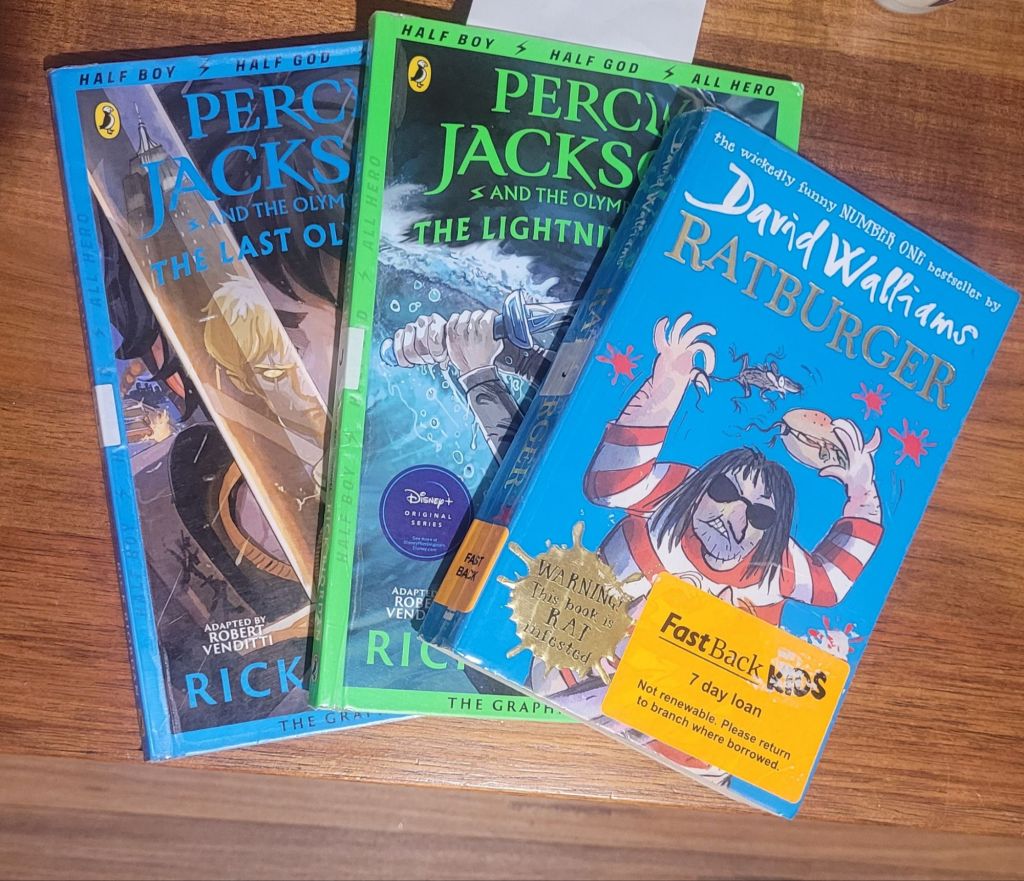
The 10 year old child’s haul.

On Sundays, our family has a rhythm. We go to church in the morning, then its off to our local library. The kids scatter to their favourite corners, borrowing books and settling in to read whatever strikes their fancy. The only rule is, that for every book that is a re-read, there must be one you have not read before.

This week’s book haul – mine.

Whilst my children scurry to their favourite genres, I grab a coffee and wander the shelves, letting my eyes land on whatever catches my eye. My husband always chuckles at this part. “You work in a library,” he says, amused. He’s right, of course. I do. But I work in a boys’ school library, and let’s just say the collection doesn’t quite float my boat. We then settle down for 30-45min of quiet reading together, but all on individual journeys.

Cook, S. (2025, November 5). It will take more than the new Children’s Booker Prize to arrest the dramatic decline in reading enjoyment. The Conversation. https://theconversation.com/it-will-take-more-than-the-new-childrens-booker-prize-to-arrest-the-dramatic-decline-in-reading-enjoyment-268777

There’s something different about being in a space where reading is chosen, not assigned. Where stories are picked for pleasure, not performance. That contrast has been sitting with me lately, especially after reading Loh et al.’s 2025 report on the decline in volitional reading and a recent piece in The Conversation about the new Children’s Booker Prize. Both paint a sobering picture: young people are reading less, and they’re enjoying it even less than that.

Loh, C. E. et al. (2025) The Decline in Volitional
Reading: Evidence-Informed Ways Forward.
National Institute of Education, Nanyang
Technological University, Singapore.

Loh’s recommendations to improve literacy success.

  • agency
  • access to literature
  • time in daily routines
  • reflection and connection
  • social interaction
  • developing a positive reading identity

What struck me most in Loh’s report was what wasn’t there. None of the key principles mention curriculum reform. None suggest that testing is the answer. Instead, the focus is on joy, choice, and connection. Reading for pleasure is framed not as a luxury, but as a necessity. It’s a stronger predictor of reading attainment than socioeconomic status. That’s huge. It means that if we want to close literacy gaps, we need to open up space for enjoyment.

In my school library, I see the tension. Boys who associate reading with assignments, comprehension questions, and accelerated reader points. Not with curiosity or escape. Not with laughter or awe. And I wonder: what would happen if we let go of the scaffolds and trusted them to choose? The Conversation article makes a similar point. Awards like the Children’s Booker are lovely, but they won’t shift the culture on their own. What we need is a reimagining of reading in schools. Less about outcomes, more about experience. Less about control, more about trust.

Furthermore, parents need to remember that they are their children’s first educators. Is reading and literacy your household value? One of the key findings in Loh’s research is that children need access to literature and to see it modelled by the adults around them. Do parents take their kids to the library? Do they read in front of their children? Or do they presume that schools will take care of it? Do they even ask their children how often they visit the school library? These questions matter. Because when reading is visible and valued at home, it becomes part of a child’s identity, not just a school subject.

So here’s my quiet Sunday reflection: maybe the best thing we can do as educators is to make room and provide time. Room for stories that speak to our students. Room for browsing, for borrowing, for reading without a worksheet attached. Room for libraries that float their boats and time to lie back and float away.

Because when reading becomes a choice again, it becomes a joy again. And that’s where the magic lives.

To go digital or hardcopy, that is the question …

I’ve just returned from a wedding overseas. It was a beautiful celebration, and between the flights and lounges, I had time to catch up on some reading. Normally, I’d pack a couple of paperbacks, but this time, I decided to travel light and for the first time,  go digital only.

This was not a lightly made decision! Before I left, I logged into eWheelers through my school account and downloaded a few titles I’d been meaning to read and others for my children. I also used BorrowBox via my Brisbane City Council library membership. I accessed both platforms on my phone, which made it incredibly easy to dip in and out of books whenever I had a spare moment. One of the great things about eWheelers is that it works across multiple devices, so whether you’re on a tablet, laptop, or mobile, your library is always within reach. It can also be read offline, as can books on Borrowbox which makes it perfect for when WiFi is not available.

Pool side reads

Ebooks are brilliant for travel. They offer the flexibility to read whatever you fancy without the bulk. It’s quick, convenient, and surprisingly satisfying to flick through pages with just a tap. For students, ebooks and or audiobooks, are becoming an increasingly valuable library resource. Many prefer them because they’re easy to access, allow for tech engagement, and offer features that physical books simply can’t.

Digital reading platforms often include options to change font sizes, switch to dyslexia-friendly fonts, or even translate texts into different languages. This makes eBooks especially helpful for students with vision impairments, learning differences, or those studying in multilingual environments. It’s a more inclusive way to read, and it’s reshaping how libraries support diverse learning needs.

And let’s be honest, eBooks also preserve a bit of anonymity. I’ll admit, I indulged in a cheeky bit of romantasy and adult fiction on the plane, the kind of titles that might raise eyebrows if I were carrying the physical copy around in public or completely mortify my children next to me! For young people, this privacy is gold. It allows them to explore genres they might be embarrassed to share with peers, especially when it comes to romance or identity-focused narratives.

This ties into a broader issue: many teens feel pressure to conform to social norms, especially around gender expectations. Ebooks offer teens a quiet refuge—a way to read without the gaze of others. For students navigating the delicate terrain of romance, identity, or emotionally expressive stories, this privacy matters. These genres, often unfairly stigmatised among peers, can feel too vulnerable to carry in plain sight. Smith and Wilhelm (2002) observed that boys, in particular, are more inclined to engage with emotionally rich narratives when the fear of judgement is lifted. In this way, digital reading becomes more than convenience, it becomes a gentle permission to explore, reflect, and connect with stories that might otherwise remain untouched.

eBooks also allow for customisation, changing fonts, adjusting layouts, and even switching languages, which makes reading more accessible and less intimidating for students with dyslexia, vision impairments, or those learning English as an additional language. For teens navigating identity, peer pressure, and personal growth, digital reading can be a quiet revolution, one page at a time.

That said, I do miss the tactile joy of a real book. The smell of the pages, the feel of the spine, and the quiet ritual of turning each leaf offer a kind of bibliotherapy that digital formats can’t replicate. There’s something grounding about physically interacting with a book that screens just don’t deliver. This feeling is evident from what the research tells us and what my experience has been as a teacher librarian in high schools because teenagers still express a strong preference for physical books despite the popularity of digital reading platforms. This inclination is often tied to the sensory and emotional experience that printed books provide such as the feel of the pages, the smell of the paper, and the visual satisfaction of seeing progress through a tangible object. Young readers, in particular, report screen fatigue and eye strain from prolonged digital use, making physical books a welcome reprieve from their tech-saturated lives (World Economic Forum, 2023). Additionally, cultural trends like #BookTok have reignited enthusiasm for printed books, with teens embracing the aesthetic and social aspects of owning and sharing physical copies (Literary Hub, 2023). Research also shows that teens retain information better and concentrate more effectively when reading print, especially in academic settings (ResearchGate, 2024). These findings suggest that while ebooks offer convenience and accessibility, physical books continue to hold a meaningful place in teen reading habits.

Still, for this trip, convenience won. And who knows, maybe next time I’ll sneak a paperback in for old time’s sake.

references

Australia Reads. (2024). 7 ways to support Australian teens in reading for pleasure. https://australiareads.org.au/news/7-ways-support-teen-reading

Literary Hub. (2023, March 14). In a surprise to no one, Gen Z prefers printed books over e-books. https://lithub.com/in-a-surprise-to-no-one-gen-z-prefers-printed-books-over-e-books/

ResearchGate. (2024). A comparative analysis of the student preferences for digital and physical books in library usage. https://www.researchgate.net/publication/385616029_A_Comparative_Analysis_of_the_Student_Preferences_for_Digital_and_Physical_Books_in_Library_Usage

Queensland Department of Education. (2024). Impact of eBooks: Exploring student health, learning and implications. https://education.qld.gov.au/about/reporting-data-research/research/Documents/impact-ebooks-report.pdf

Smith, M. W., & Wilhelm, J. D. (2002). Reading don’t fix no Chevys: Literacy in the lives of young men. Heinemann.

University of Edinburgh. (2024). Supporting teenagers’ reading enjoyment and engagement: A guide for teachers and librarians. https://blogs.ed.ac.uk/literacylab

World Economic Forum. (2023, March 13). Gen Zers are bookworms but say they’re shunning e-books because of eye strain, digital detoxing and their love for libraries. https://www.weforum.org/stories/2023/03/gen-zers-are-bookworms-but-say-theyre-shunning-e-books-because-of-eye-strain-digital-detoxing-and-their-love-for-libraries

Graphic Organisers in Inquiry Learning – Facilitating the critical thinking process.

Graphic Organisers in Inquiry Learning – Facilitating the critical thinking process.

Figure 1. (ACARA, 2016) Critical and Creative Thinking. 

The ability to pose a question is clearly detailed in ACARA (2016) General Capabilities – Critical and Creative Thinking as a stimulus to learning.   Students are challenged to create a rigorous question that can be challenged, examined and analysed to provide useful information for the investigator to draw a conclusion (Rattan, Anand & Rantan, 2019; Werder, 2016; Aslam & Emmanuel, 2010).  Werder (2016) in particular argues that inquiry questions need to contain specific disciplinary languages and parameters that define the depth and breadth of the learning experience.  Unfortunately, many of the questions constructed by students fall short of this standard because they struggle in developing inquiry questions that are sufficiently open-ended for further investigation, yet within the parameters of their task.  This quagmire led to the discussion of using a graphic organiser to scaffold the students into forming an appropriate inquiry question.

Figure 1 – ACARA (2016) Critical and creative thinking continuum. 

Theory of Graphic Organisers – Framework for critical thinking. 

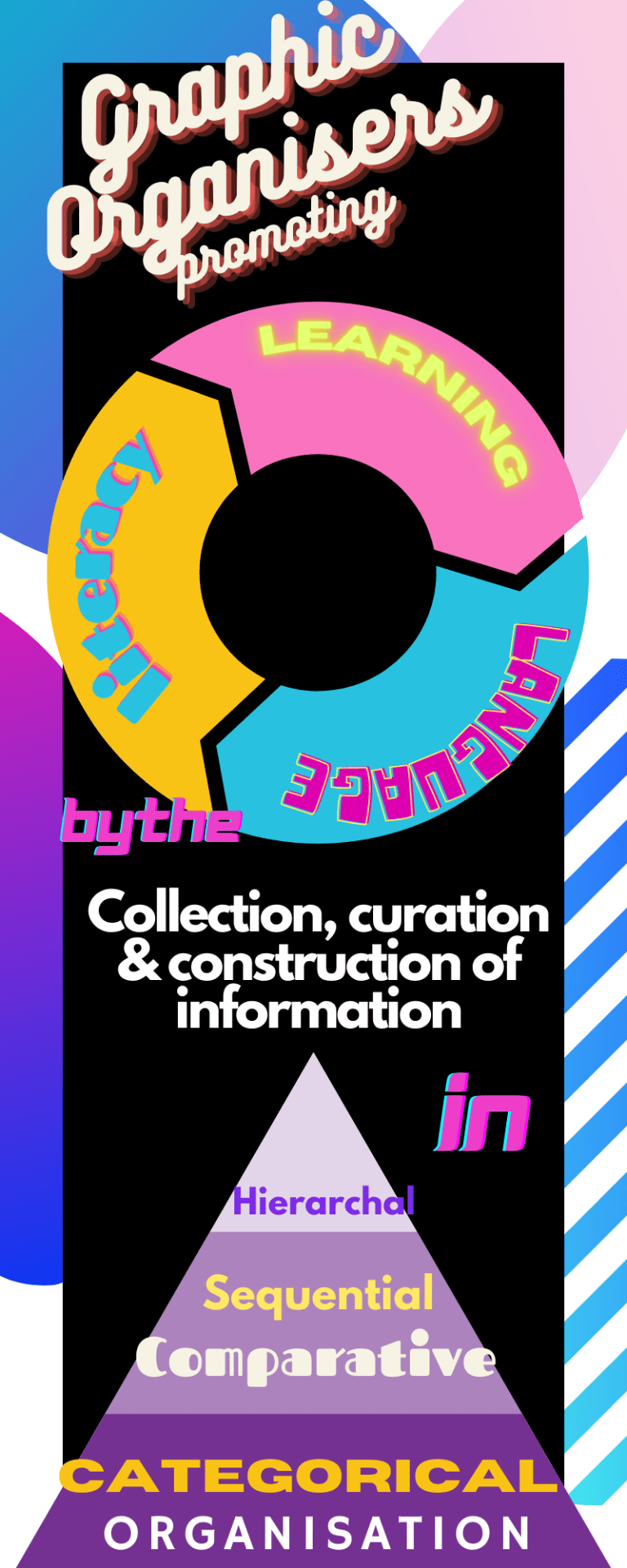
Language, literacy and learning are greatly improved when graphic organisers are used as they allow for the collection, curation and construction of information in categorical, comparative, sequential or hierarchical organisation (Ilter, 2016, p.42; Lusk, 2014, p.12).  Graphic organisers are a constructivist approach to learning because the chart encourages students to write as a method of constructing their knowledge, and can be used to introduce a topic, activate prior knowledge, curate information, connect ideas and concepts, as well as visually present information and assess student understanding (Cox, 2020; Lusk, 2014).  They are effective across all year levels, curriculum areas, as well as in educational, personal or professional spheres of life as their efficacy lies in their structure (Cox, 2020).  Graphic organisers are diverse and can range from maps, diagrams, tables, and charts, with venn diagrams, concept maps, tables and T-charts are the most frequently used in classroom settings (Cox, 2020).   

 Graphic organisers allow for the holistic understanding of a topic by allowing challenging concepts to be displayed in a meaningful manner (Lusk, 2014, p.11).  Students are able to visually see the breadth and depth of their learning and this can be particularly useful for scaffolding more challenging concepts or to assist low ability students.  This visual organisation is especially important for disciplinary literacy development, accumulation of knowledge and the comprehension of challenging concepts (Werder, 2016, p.2; Ilter, 2016, p.42). 

Science Learning Outcomes:

Science as Human Endeavour

  1. Solutions to contemporary issues that are found using science and technology (ACSHE135)​
  2. People use science understanding and skills in their occupations and these have influenced development in areas of human activity (ACSHE136)​

​Science Inquiry: ​

  • Identify questions and problems that can be investigated scientifically and make predictions based on scientific knowledge (ACSIS139)


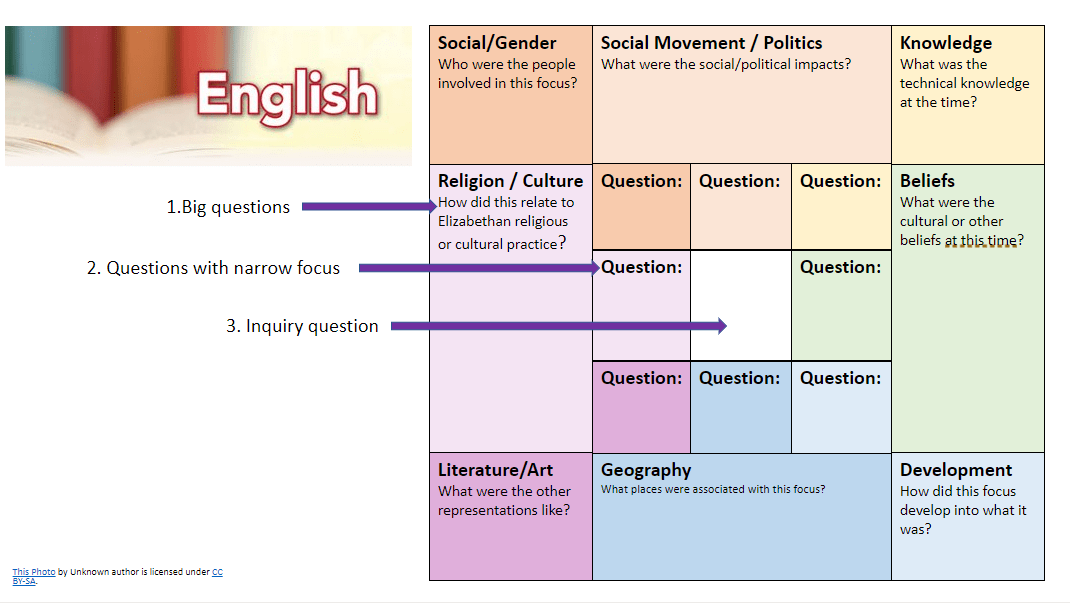
The year 8 guided inquiry unit was constructed collaboratively between the Science team leader RW and the Teacher librarian.  The goal was to scaffold the students into creating inquiry questions that were of a high standard within the defined boundaries of the task.  The Teacher Librarian conceived the idea of using a graphic organiser, and then worked collaboratively with the Science Team Leader to frame and integrate the questions within the chart.  The end result was a chart that used a layer of questions to build connections between prior knowledge and new information; before narrowing down to identifying relevant disciplinary literacy which is then used to formulate the scientific inquiry question.  As many of the science teachers were unfamiliar with the GID process, a joint decision was made by the Teacher librarian and the Science team leader that certain sections of the inquiry would be team taught by the classroom teacher and a teacher librarian.  The entire year 8 science cohort of ten classes utilised the library for five consecutive lessons each.  This collaborative practice supported both the teacher in their practice and the student in their learning. 

English Learning Outcomes:

  1. Explore the ways that literary texts drawn from different historical, social and cultural contexts may reflect or challenge the values of individuals and groups (ACELT1626)​
  2. Recognise and explain differing viewpoints about the world, cultures, individual people and concerns represented in texts (ACELT1807)​
  3. Interpret and analyse language choices, including dialogue and imagery in short stories, literary essays and plays (ACELT1767)

The success of the Science modified lotus chart inspired the English team leader CB to create a similar one but instead of using a single layer of questioning, CB decided the students needed to funnel down from a broad focus to a narrow focus before coming to their inquiry question.  This meant that students were asked to look deeper into the various perspectives of Shakespeare’s World and then pose a series of questions before arriving at their main inquiry question.  At this point the students were familiar with the concept of inquiry learning but there was still some uncertainty from the classroom teachers.  Therefore, the English team leader CB suggested that the classes be brought to the library so that they could be supported by the teacher librarians.  Unfortunately, there was less uptake from the English department in comparison to the science team, and this meant only a few teachers were willing to work collaboratively in a flexible learning space.  

For both the Year 8 inquiry tasks, the modified lotus chart was integrated into the learning journal and included questions of varying cognitive levels to scaffold learning, promote metacognition, elicit writing for meaning, and facilitate the formulation of a robust inquiry question (Tofade, Elsner & Haines, 2013).   Most students received the standard chart and questions,  but those with additional needs were offered supplementary cognitive scaffolding, and highly adept students were given the opportunity to create their questions for a self-directed approach (Lusk, 2014, p.12).   The integration of questioning increased the success of the inquiry task as it promoted metacognition, differentiated the learning, minimised accidental sedge ways, developed disciplinary vocabulary and allowed students to stay within the learning goal parameters.  Another advantage is that the questions within the chart were task, rather than subject specific, which meant that students were able to engage in learning based on their own interests rather than predetermined topics (Werder, 2016).

Evaluating the impact of the graphic organiser on the learning process

SCIENCE INQUIRY TASK –  

The student’s ability to create a question that was specific, yet with enough depth to allow for an open-ended investigation was assessed both informally and formally.  Initially, the question was informally assessed by the classroom teacher and teacher librarian for its suitability before the students could proceed to the next step in their inquiry task.  In most circumstances, the question that was too broad and or too difficult for students to investigate successfully in their limited time frame.  This meant that students were asked to go back and use the questions to extend their thinking processes and narrow down their investigation parameters.  They also had to clearly illustrate their cognitive process through their modified lotus graphic organiser as part of their formal and summative assessment of learning identified within the task rubric.  Anecdotal evidence from classroom teachers suggests that students seemed more prepared, and their questions were of a higher quality in comparison to previous years where there was no graphic organiser used.   

ENGLISH INQUIRY TASK –   

The English inquiry question was also informally assessed by the classroom teacher and the teacher librarian to their suitability during class time.  Like the science inquiry task, students used the modified lotus to formulate a question that was narrow enough to be completed within the time frame, but yet open-ended enough to investigate.  The main difference between the two inquiry tasks was that the English chart requested students use two levels of questioning to develop their inquiry question.  This proved to be more problematic than requesting disciplinary literacy from the middle layer, as students often needed guidance to understand that they were supposed to narrow into specifics at that point.   This confusion was exacerbated by the fact the English task immediately followed the science inquiry but the change in lotus chart format caused some teacher and student anxiety.  In similar circumstances to the Science inquiry, the questions formulated by the students were of a higher quality than when the modified lotus graphic organiser was not included.   

 Reflection of learning process

The inclusion of a modified lotus chart with an embedded line of questioning was a crucial factor in the student’s ability to formulate a suitable inquiry question because it allowed for the clear visualisation of parameters, alternative perspectives and integrated essential disciplinary literacy.   It enabled students to effectively plan their investigations, identify gaps in their own reasoning, organise their thinking process and reflect upon their learning.  The chart also mitigated teacher anxiety about unaddressed learning outcomes and unexpectedly promoted low stakes writing.   

Many classroom teachers were concerned that a student centred inquiry task would lead to tangent investigations and lost learning outcomes.  However, the modified lotus diagram allowed teachers to guide their student’s learning by using the questions to lead the students directly to the desired learning outcomes and the formulation of an appropriate question and investigation.  Anecdotal evidence showed that previously reluctant teachers were satisfied with this process and were amenable to using a modified lotus for future inquiry investigations.  

One of the unexpected advantages that the modified lotus diagram provided was the students were able to engage in low stakes writing.  Werder (2016) points out that writing in schools is often a high stakes activity as students are often required to know the information prior to being questioned in settings, such as within exams and assignments.  Cunningham (2019) elaborates upon this and calls it ‘writing to show learning’ but points out that rarely do students get to engage in ‘writing to learn’ (p.76).  This means that students are seldom given opportunities to engage in writing that allows them to promote critical thinking, build content knowledge and make meaning in environments that are context rich, and situational  without the pressure of assessment (Cunningham, 2019, p.79).  This can be particularly an issue in high schools where students are less likely to participate in free writing.  Therefore by integrating a modified lotus graphic organiser into an inquiry task, teachers are encouraging to develop their cognitive strength by connecting concepts, making meaning and creating new knowledge (Cunningham, 2019; Werder, 2016, p. 2).

Conclusion

The inclusion of a modified lotus diagram with an embedded line of questioning was very beneficial to both the faculty staff members and the students.  It increased the quality of inquiry questions because the graphic organiser allowed the students to develop an understanding of the topic, which then led to a creation of a question that can be challenged, examined and investigated more deeply.  The format of the diagram also ensured that the students developed disciplinary literacy and addressed the learning outcomes as required.   Interestingly, the unexpected outcome of low stakes writing proved to be very beneficial to the learning process and as such, future graphic organisers will be constructed to provide ample writing space.  

References: 

ACARA. (2016). F –10 Curriculum – Science Curriculum. Educational Services Australia.  https://www.australiancurriculum.edu.au/f-10-curriculum/science/ 

ACARA. (2016). Critical and creative thinking continuum. F-10 Curriculum – General Capabilities. Educational Services Australia.  https://australiancurriculum.edu.au/media/1072/general-capabilities-creative-and-critical-thinking-learning-continuum.pdf 

Andrini, V.S. (2016). The effectiveness of inquiry learning method to enhance student’s learning outcome: A theoretical and empirical review.  Journal of Education and Practice 7(3). https://files.eric.ed.gov/fulltext/EJ1089825.pdf 

Aslam, S., & Emmanuel, P. (2010). Formulating a researchable question: A critical step for facilitating good clinical research. Indian journal of sexually transmitted diseases and AIDS, 31(1), 47–50. https://www.ncbi.nlm.nih.gov/pmc/articles/PMC3140151/ 

Brookhart, S. (2013). Chapter 1 – What are rubrics and why are they important. In  How to Create and Use Rubrics for Formative Assessment and Grading. ASCD. http://www.ascd.org/publications/books/112001/chapters/What-Are-Rubrics-and-Why-Are-They-Important%C2%A2.aspx

Cox, J. (September 16, 2020). What is a graphic organiser and how to use it effectively. TeacherHub.com [Blog]. https://www.teachhub.com/classroom-management/2020/09/what-is-a-graphic-organizer-and-how-to-use-it-effectively/ 

Cunningham, E. (2019). Teaching invention: Leveraging the power of low stakes writing. The Journal of Writing Teacher Education 6(1). 76-87. https://scholarworks.wmich.edu/cgi/viewcontent.cgi?article=1180&context=wte

Ilter, I. (2016). The power of graphic organisers: Effects on students’ word learning and achievement emotions in social studies. Australian Journal of Teacher Education 41(1), p42-64.  

Kilickaya, F. (2019). Review of studies on graphic organisers and language learner performance. APACALL Newsletter 23. https://files.eric.ed.gov/fulltext/ED602371.pdf 

Lusk, K. (2014). Teaching High School Students Scientific Concepts Using Graphic Organizers. Theses, Dissertations and Capstones. 895. https://mds.marshall.edu/etd/895 

Maniotes, L., & Kuhlthau, C. (2014) Making the shift. Knowledge Quest. 43(2) 8-17. https://eric.ed.gov/?id=EJ1045936

Maxwell, S. (2008). Using rubrics to support graded assessment in a competency based Environment.  National Centre for Vocational Education Research. Commonwealth of Australia – Department of Education, Employment and Workplace Relations. https://www.ncver.edu.au/__data/assets/file/0012/3900/2236.pdf 

NSW Department of Education. (2021). Strategies for student self assessment. Teaching and Learning – Professional Learning. Retrieved from https://education.nsw.gov.au/teaching-and-learning/professional-learning/teacher-quality-and-accreditation/strong-start-great-teachers/refining-practice/peer-and-self-assessment-for-students/strategies-for-student-self-assessment 

Quigley, C., Marshall, J., Deaton, C.C.M., Cook, M.P., & Padilla, M. (2011).  Challenges to inquiry teaching and suggestion for how to meet them.  Science Education (20) 1; p55-61. Retrieved from https://files.eric.ed.gov/fulltext/EJ940939.pdf 

 Ratan, S. K., Anand, T., & Ratan, J. (2019). Formulation of Research Question – Stepwise Approach. Journal of Indian Association of Pediatric Surgeons, 24(1), 15–20. https://doi.org/10.4103/jiaps.JIAPS_76_18 

Southen Cross University. (2020). Using rubrics in student assessment. Teaching and Learning. https://www.scu.edu.au/media/scueduau/staff/teaching-and-learning/using_rubrics_in_student_assessment.pdf 

State Library of Victoria. (2021). Generating questions – lotus diagram.  ERGO – Research Resources. Retrieved from http://ergo.slv.vic.gov.au/teachers/generating-questions-lotus-diagram 

Stone, E. (2014).  Guiding students to develop an understanding of scientific inquiry: A science skills approach to instruction and assessment. CBE Life Science Education 13 (1): pp90-101.   https://www.ncbi.nlm.nih.gov/pmc/articles/PMC3940468/ 

Tofade, T., Elsner, J., & Haines, S. T. (2013). Best practice strategies for effective use of questions as a teaching tool. American journal of pharmaceutical education, 77(7), 155. https://doi.org/10.5688/ajpe777155 

Vale R. D. (2013). The value of asking questions. Molecular biology of the cell, 24(6), 680–682. https://doi.org/10.1091/mbc.E12-09-0660.  Retrieved from https://www.ncbi.nlm.nih.gov/pmc/articles/PMC3596240/ 

Werder, C. (2016). Chapter 10 – Writing as inquiry, writing as thinking. The Research Process: Strategies for undergraduate students. 10. Retrieved from https://cedar.wwu.edu/cgi/viewcontent.cgi?referer=http://www.jurn.org/&httpsredir=1&article=1009&context=research_process 

Wilson, N.S., & Smetana, L. (2011). Questioning as thinking: a metacognitive framework to improve comprehension of expository text. Literacy 45(2). UKLA.  

Zion, M., & Mendelovici, R. (2012). Moving from structured to open inquiry: Challenges and limits. Science Education International 23(4): p383-399.  International Council of Associations for Science Education. Retrieved from https://files.eric.ed.gov/fulltext/EJ1001631.pdf 


Cooperative and collaboration in the library.

johnhain / Pixabay


We recently hosted the Year 9 Mathematics cohort for a few lessons over this past term.  Traditionally, the Information Centre rarely hosts Mathematics classes, but a recently graduate Mathematics teacher wanted a more collaborative approach to learning.  He devised a series of lessons that were aimed at developing the student’s skills in geometry through collaborative learning groups but needed additional bodies and space to ensure it ran effectively.  By using the library and its flexible learning spaces to run these collaborative learning sessions, the students were able to gain assistance from their peers, their own teachers and the teacher librarians.  This mean that there was more specific support available for facilitating the learning, which led to an overall improvement in student outcomes.  From a teacher librarian perspective, these sessions were a wonderful way to develop student learning through collaboration and cooperation, and a fantastic outcome for all.   

Classes come to the Information Centre from across the school to access the library for resources, the flexible learning spaces, as well as gain assistance from the teacher librarians.  This assistance may be in the form of information seeking, but the fact is that the primary focus of any teacher librarian is to facilitate the teaching and learning of their school community (ALIA & ASLA, 2004).  Research from over thirty different studies across the world has indicated that the presence of qualified teacher librarians has a strong positive correlation to improved learning outcomes (Hughes, 2013).  This access can occur in a variety of ways but most often occurs in the form of team teaching with the classroom teacher, explicit instruction, targeted assistance with inquiry learning, as well as informal and formal research support, essay writing workshopsthe implementation of literacy and numeracy strategies, and various other teaching and learning programs.  This breath of access means that the teacher librarians themselves can be considered a resource to improve student learning because they enable students and teachers to use the library and all its resources to its fullest potential (ALIA & ASLA, 2016).   

School libraries are more than just book repositories, but rather they are dynamic spaces where information can be accessed, and knowledge constructed for a range of purposes.  The reality is that time spent into the library in the pursuit of knowledge often leads to improved efficiency and efficacy because of the qualified teacher librarians that support student learning.   

 References. 

ALIA & ASLA. (2004). Standards of professional excellence for teacher librarians. Australian School Library Association. https://read.alia.org.au/alia-asla-standards-professional-excellence-teacher-librarians 

ALIA, & ASLA. (2016). Statement on Teacher Librarians in Australia. Australian School Library Association. https://asla.org.au/resources/Documents/Website%20Documents/Policies/policy_tls_in_australia.pdf 

Hughes, H. (2013). School libraries and teacher librarians: evidence of their contribution ot student literacy and learning. Curriculum & Leadership Journal 11(12).   http://www.curriculum.edu.au/leader/school_libraries_and_tls,36453.html?issueID=12777 

Leading from the middle – Teacher Librarian as a Middle Leader at School.


Leading from the Middle. 

FelixMittermeier / Pixabay

Strong educational leadership has been clearly linked to a positive learning culture and increased student outcomes as effective leaders have a strong vision, are able to lead by example, manage their resources in a flexible manner and are able to develop strong collaborative teams (Leithwood, Harris & Hopkins, 2020; Yeith et al, 2019, p. 452). But whilst there are numerous types of leadership styles, research has indicated that distributed leadership (DL) has the greatest influence on students and their learning outcomes (Leithwood, Harris & Hopkins, 2020, p. 12; Bartlett, 2014, p.1).  DL advocates for the distribution of leadership roles within the school community based on expertise rather than a formal position of power, and as such is fundamentally based upon positive and collaborative interactions between colleagues and teams (Leithwood, Harris & Hopkins, 2020, p. 13-14.  It is these interactions and team development that leads to the promotion of middle school leaders and the development of teacher librarians as leaders of information literacy, innovative pedagogy and educational technology.  

Middle school leaders (MSL) are an important aspect of educational environments as their position of responsibility operates between senior leadership and teaching staff (De Nobile, 2018).  They are often responsible for mentoring new teachers, leading a team, a project or a faculty, as well as managing the traditional aspects of classroom teaching  (Lipscombe et al., 2020, p. 408-411; De Nobile, 2018, p.398).   Unlike principals whose leadership role is based upon actions,  MSL’s responsibility  is often linked to maintenance of resources, professional development, school improvement plans and thus their role is dependent on interactions with others and on their individual context (De Nobile, 2018, p.398; Lipscombe et al., 2020, p. 408-409).  

In primary schools, MSL are often team leaders or year level coordinators, whereas in secondary schools, they manifest as faculty heads and or leaders of wellbeing (Lipscombe et al., 2020, p. 408).  As experienced teachers, MSL are able to combine classroom teaching with leadership positions, and therefore are well placed to make a direct and positive impact upon the teaching and learning (Lipscombe et al., 2020, p.407-408).   Whilst the context may differ, MSL operate on behalf of the school leadership team as they are often required to interpret the agenda of senior management as well as expected to develop and staff towards the principal’s shared vision (De Nobile, 2018, p. 400).  

The efficacy of MSL is dependent on several clear parameters.  The variability of the role and range of possible contexts means that there is no distinct career pathway or associated professional development.  Therefore, in order to be effective, these emerging leaders require clearly established responsibilities, explicit support from the principal, a positive learning culture, expertise in their field and a framework for professional development, so that they can successfully meet the expectations of their school community (De Nobile, 2018, p. 401; Lipscombe et al., 2020, p.407).  Due to the lack of a formal career pathway, Lipscombe et al., (2020) advocates  AITSL’s Australian Professional Standard for Principals as a framework for informing current practice as well as providing direction for future MSL professional development (p. 412).  This framework is useful because there is little structure for leadership development within the professional standards for teachers (Lipscombe et al., 2020, p.412).  Unfortunately not all MSL have clearly defined expectations, or adequate sufficient support from the principal, and this can severely impact their ability to effect change within the school especially when it comes to innovations in pedagogy (De Nobile, 2018, p.401; Lipscombe et al., 2020, p.419). This inability can impact the MSL’s capacity for job satisfaction and can lead to increased attrition rates (Stroud, 2017). 

The main purpose of MSL is to improve and innovate pedagogical practices and positively impact learning outcomes (Lipscombe et al., 2020, p.417).  By these parameters, teacher librarians (TL) are ideally suited to the task based upon their Masters of Education, as well as the significant overlap between their role in the school and the requirements of MSL.  Unlike ATSIL’s Highly Accomplished and Lead Teacher which is focused on using classroom teacher’s expertise to develop professional practice in others, teacher librarians are required by their professional standards to demonstrate leadership within school communities, have thorough knowledge of the curriculum and actively promote collaborative learning (AITSL, 2019, p.3; ALIA & ASLA, 2004; Lipscombe et al., 2020, p.412).  Additionally, from a school hierarchy perspective, most TLs are classified as coordinators or as faculty heads,  and therefore their position within a school is literally in the ‘middle’.   TLs are able to  lead from the middle by supporting their colleagues with their expertise, promoting collaborative teaching and learning as well as modelling good pedagogical practices (ALIA & ASLA, 2004). 

The reality is that even though teacher librarians have a great capacity for leadership, their ability to fulfill that role to the best of their ability requires adequate time, support and structure (Johnston, 2015).  Time is the most desired resource as TL do require adequate time to balance the roles of managing an information agency, along with the developing informational literacy as well as sufficient time to plan strategically for future educational trends (Lipscombe et al., 2020, p.412).  Unfortunately many TLs are restricted in their ability to strategically plan, co-plan and collaborate with their colleagues due to significant teaching loads, lack of support from the principal and insufficient authority.  

Middle school leaders have a great capacity to improve student learning  by sharing their expertise, promoting professional development and collaborative learning as well as by modelling best practice pedagogy.  Teacher librarians make ideal middle school leaders because of their human and social capital.  They are academically qualified, have the necessary professional knowledge, extensive curriculum understanding and collaborative approach to education.  As such their ability to significantly improve learning outcomes is immense provided they are supported by their principal, a positive learning culture and sufficient time to do their role properly.  


References:

AITSL. (2014). Australian professional standard for principals and the leadership profiles. Education Services Australia. 

https://www.aitsl.edu.au/docs/default-source/national-policy-framework/australian-professional-standard-for-principals.pdf?sfvrsn=c07eff3c_6

AITSL. (2019). Certification of Highly Accomplished and Lead Teachers in Australia. National Policy Framework https://www.aitsl.edu.au/docs/default-source/national-policy-framework/certification-of-highly-accomplished-and-lead-teachers.pdf?sfvrsn=227fff3c_8

ALIA & ASLA. (2004). Standards of professional excellence for teacher librarians. Australian School Library Association. https://read.alia.org.au/alia-asla-standards-professional-excellence-teacher-librarians

Bartlett, J. (2014). The power deep in Org Chart: Leading from the middle. Library Leadership & Management 28 (4). https://journals.tdl.org/llm/index.php/llm/article/view/7091/6307

De Nobile, J. (2018). Towards a theoretical model of middle leadership in schools. School Leadership & Management 38 (4). pp 395-416, DOI: 10.1080/13632434.2017.1411902

Gurr, D. (2019). School middle leaders in Australia, Chile and Singapore.  School Leadership & Management, 39:3-4, p278-296, DOI: 10.1080/13632434.2018.1512485 

Leithwood, K., Harris, A., & Hopkins, D. (2020). Seven strong claims about successful school leadership revisited, School Leadership & Management, 40 (1), 5-22, DOI: 10.1080/13632434.2019.1596077

Lipscombe, K. Grice, C. Tindall-Ford, S., & DeNobile, J. (2020). Middle leading in Australian schools: professional standards, positions, and professional development. School Leadership & Management 40 (5) pp.406-424. DOI: 10.1080/13632434.2020.1731685

Johnston, M. (2015). Distributed leadership theory for investigating teacher librarian leadership. School Libraries Worldwide 21 (2). doi: 10.14265.21.2.003

Stroud, G. (2017). Why do teachers leave? ABC News – Opinion. https://www.abc.net.au/news/2017-02-04/why-do-teachers-leave/8234054

Yeigh, T., Lynch, D., Turner, D., Provost, S., Smith, R., & Willis, R. (2019).  School leadership and school improvement: an examination of school readiness factors. School Leadership & Management, 39:5, pp434-456, DOI: 10.1080/13632434.2018.1505718

#IWD2021

#ChooseToChallenge
 

IWD2021’s theme of #ChooseToChallenge is a call for a more inclusive society by challenging outdated ideologies.  This theme suggests that we as individuals can quietly watch gender bias, discrimination and equality occur around us, or we can call it out.  Our role in the Information Centre and as teacher librarians is to call out the gender bias in literature.   

Literature is a reflection of society because the storylines, characterisations and language of the time are captured by the author (Zanfabro, 2015).   This is why Austen’s Elizabeth Bennett, Bronte’s Jane Eyre, Mitchell’s Scarlett O’Hara, Collins’ Katniss Evergreen, and Dahl’s Matilda Wormwood are so memorable.  They were the rebels of their time and as such inspired other women to challenge prevailing standards and rebel against societal expectations of femininity.  Literature has a great capacity to inspire, provoke and challenge the reader, but the presence of strong female protagonists is not the norm.    A recent study of books published indicates that less than 30% of fiction texts have a strong female character (Green, 2018).   The primary theory for this disparity is that males don’t like reading books with female protagonists, whereas females are less discriminatory about their reading material.  Therefore, it is safer for publishers to print books that feature male protagonists as they have a wider appeal (Rebel Girls, 2017).   

Gender bias in literature and publishing has ramifications.  Strong female characters are excellent role models for both sexes (Green, 2018).  Female protagonists in fiction texts normalise physically and cognitively strong women, point out that it is ok for females to have a leadership role and mostly, that strong women do not mean boys are weak (Green, 2018).  Interestingly whilst strong female protagonists are found in varying forms of literature in many differing capacities, they are rarely captured as leaders, unless based upon a historical figure or a biography (Green, 2018).   

Our role in the Information Centre and as teacher librarians is to curate literature that portrays strong female and male role models. We are continuously seeking to ensure our collection reflects the educational, emotional, cognitive and developmental needs of our school community… And that includes making sure our girls and boys get to read a range of texts about strong women.   

We #ChooseToChallenge gender stereotypes in literature. 

References:  

Green, S. (2018). Do we need strong female characters? The Irish Times. Retrieved from https://www.irishtimes.com/culture/books/do-we-need-strong-female-characters-1.3513651 

Magras, D. (2019). Feminist AF: Hearing Their Voices: Supporting Female Empowerment in Middle Grade Fiction for Tweens and Teens. School Library Journal.    

Rebel Girls. (2017). The ugly truth about children’s books [Video].  Retrieved from http://rebelgirls.co/ugly_truth 

Zanfabro, G. (2017). Gender matters: What is at stake in dealing with children’s literature? TRANS- Revue de Litterature Générale et Comparée 21. DOI : https://doi.org/10.4000/trans.1440 


Transformational leadership


There are many different types of leadership styles and their suitability is dependent on the organisation and the type of outcomes desired.  Schools and other learning institutions that have learning as their focus, require leaders to ensure learning outcomes are maximised for all individuals.  In response to the information revolution and the digital age, MCEETYA (2009) has highlighted the necessary skill set required by young people to succeed in the twenty-first century.  No longer just focused primarily on just knowledge acquisition, the modern world requires students to have critical and creative thinking skills, digital and multimodal literacy as well as competent personal and social capabilities.  This transformation of educational outcomes requires a leadership style that is able to inspire change.  That style of leadership is defined as transformational leadership.  

geralt / Pixabay

There is a significant body of research indicating the efficacy of transformational leadership in modern educational institutions.  Anderson (2017) describes this style as being characterised by a leader (principal) who guides their subordinates towards a shared vision and executes that change with a team.  Transformational principals are able to envision the trajectory of their school towards the goals set by the Melbourne Declaration, and are able to motivate their colleagues to build successful teams and achieve that vision within the desired time frame (MCEETYA, 2009; Mindtools, 2016). 

geralt / Pixabay

Transformational leadership promotes team building and opportunities for professional growth.  This style encourages the development of leadership skills in others (Ingram, 2019).  A principal who demonstrates this style of leadership recognises the importance of relationships between teachers and the need to develop teacher leaders (Longwell-McKean, 2012).  They recognise the importance of building collaborative relationships and promoting professional growth to enable teachers to become leaders, and instruments of change within their teams and departments (Longwell-McKean, 2012, p. 24).  Transformational principals nurture collaborative practices and professional practice in others, and as such collectively increase the level of transformation within the organisation (Longwell-McKean, 2012, p. 25).  

REFERENCES:

Anderson, Matthew (2017) “Transformational Leadership in Education: A Review of Existing Literature,” International Social Science Review 93: 1. Retrieved from https://digitalcommons.northgeorgia.edu/issr/vol93/iss1/4

Longwell -McKean, P.C. (2012). Restructuring Leadership for 21st Century Schools: How Transformational Leadership and Trust Cultivate Teacher Leadership.  UC San Diego. Retrieved from https://escholarship.org/uc/item/6746s4p9

MCEETYA (2009) Melbourne Declaration on Educational Goals for Young Australians. Curriculum Corporation. Australia. Retrieved from http://www.curriculum.edu.au/verve/_resources/national_declaration_on_the_educational_goals_for_young_australians.pdf

MindTools. (2016). Core leadership theories. https://www.mindtools.com/pages/article/leadership-theories.htm