Crossing Generational Trauma- Wild Swans and Fly Wild Swans.

Women, Memory and Exile: A School Library Reflection

Adding Fly Wild Swans to our school library felt like a natural continuation of a legacy. Wild Swans has long stood as a canonical piece of literature, a book that captures the struggles of three generations of women against the backdrop of China’s political upheavals. In her second publication Fly Wild Swans, Jung Chang turns her gaze inward, reflecting on the cost of telling that story and the way truth can estrange a writer from her homeland. It is a pensive work that reminds us how women across centuries have shouldered familial and societal expectations, carrying memory and resilience even when nations would rather forget.
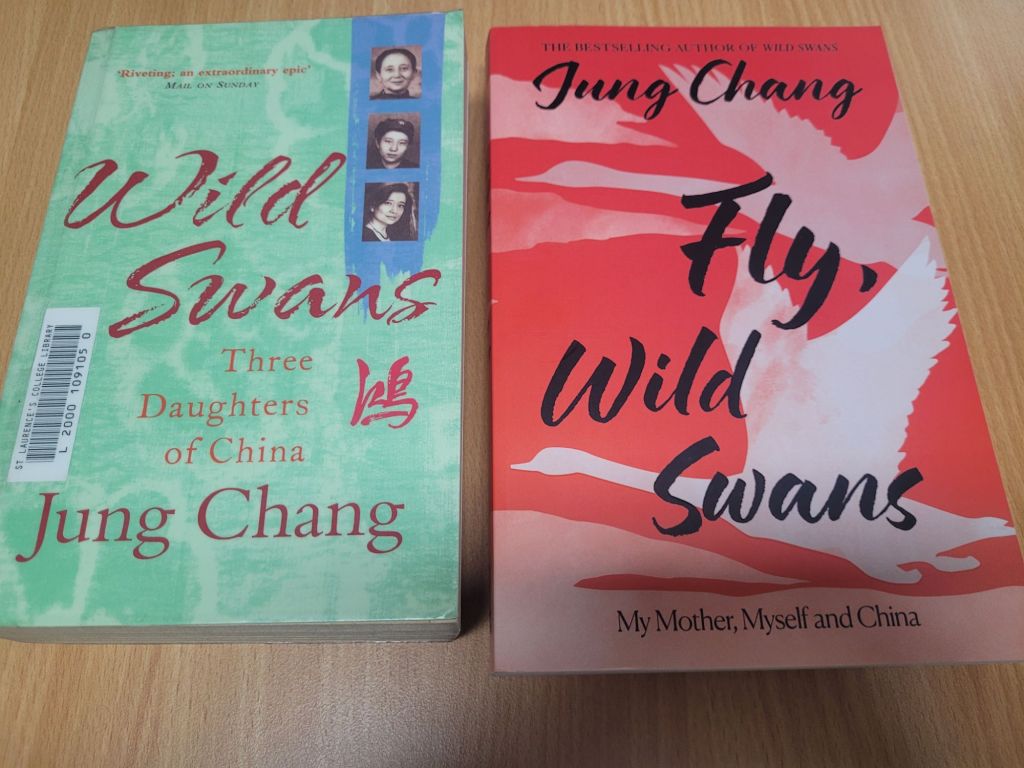
Jung Chang and her canons of literature

For students, these books are more than history. They are lessons in courage, in the power of memory and in the resilience of women who endured both familial duty and political oppression. Wild Swans explores the tension between tradition and rapid government‑driven progress. What was presented as modernisation often meant the destruction of customs and the breaking of family bonds as the Cultural Revolution tore families apart and demanded loyalty at the expense of tradition. Her story gave voice to three generations of women living through the upheavals of Mao’s China and this new work is written not only of her mother and her homeland, but of the burden of truth itself, and the cost of bearing witness when a nation would rather forget.

Fly Wild Swans reveals the aftermath of telling that truth, showing how a writer can be celebrated abroad yet silenced at home. Jung Chang turns her gaze inward, reflecting on the cost of telling that story and the way truth can estrange a writer from her homeland. Unlike Wild Swans, which focused on her mother and grandmother, this new work is more personal. It explores how writing Wild Swans changed her life, both opening doors in the West and closing them in China. There is a deep melancholy in her reflections on being unable to freely return to her birthplace. The success of Wild Swans brought her recognition abroad but estrangement at home. This tension between belonging and exclusion mirrors the broader story of women in history, who have often been celebrated for their endurance yet denied the freedom to define themselves.

I chose to buy Fly Wild Swans for my school library because it is a book that students should encounter, not only for its historical insight but also for its profound exploration of resilience, identity and the role of women in shaping and surviving history. Adding Fly Wild Swans to our collection ensures that the conversation continues, allowing readers to see how the legacy of truth‑telling reverberates across generations.

By placing both works on our shelves, we invite students to consider how politics, family and identity intersect, and how women across centuries have borne the burden of expectation while still finding ways to endure. These books remind us that literature is not static. It evolves, it questions and it carries forward the weight of generations.

#IWD2021

#ChooseToChallenge
 

IWD2021’s theme of #ChooseToChallenge is a call for a more inclusive society by challenging outdated ideologies.  This theme suggests that we as individuals can quietly watch gender bias, discrimination and equality occur around us, or we can call it out.  Our role in the Information Centre and as teacher librarians is to call out the gender bias in literature.   

Literature is a reflection of society because the storylines, characterisations and language of the time are captured by the author (Zanfabro, 2015).   This is why Austen’s Elizabeth Bennett, Bronte’s Jane Eyre, Mitchell’s Scarlett O’Hara, Collins’ Katniss Evergreen, and Dahl’s Matilda Wormwood are so memorable.  They were the rebels of their time and as such inspired other women to challenge prevailing standards and rebel against societal expectations of femininity.  Literature has a great capacity to inspire, provoke and challenge the reader, but the presence of strong female protagonists is not the norm.    A recent study of books published indicates that less than 30% of fiction texts have a strong female character (Green, 2018).   The primary theory for this disparity is that males don’t like reading books with female protagonists, whereas females are less discriminatory about their reading material.  Therefore, it is safer for publishers to print books that feature male protagonists as they have a wider appeal (Rebel Girls, 2017).   

Gender bias in literature and publishing has ramifications.  Strong female characters are excellent role models for both sexes (Green, 2018).  Female protagonists in fiction texts normalise physically and cognitively strong women, point out that it is ok for females to have a leadership role and mostly, that strong women do not mean boys are weak (Green, 2018).  Interestingly whilst strong female protagonists are found in varying forms of literature in many differing capacities, they are rarely captured as leaders, unless based upon a historical figure or a biography (Green, 2018).   

Our role in the Information Centre and as teacher librarians is to curate literature that portrays strong female and male role models. We are continuously seeking to ensure our collection reflects the educational, emotional, cognitive and developmental needs of our school community… And that includes making sure our girls and boys get to read a range of texts about strong women.   

We #ChooseToChallenge gender stereotypes in literature. 

References:  

Green, S. (2018). Do we need strong female characters? The Irish Times. Retrieved from https://www.irishtimes.com/culture/books/do-we-need-strong-female-characters-1.3513651 

Magras, D. (2019). Feminist AF: Hearing Their Voices: Supporting Female Empowerment in Middle Grade Fiction for Tweens and Teens. School Library Journal.    

Rebel Girls. (2017). The ugly truth about children’s books [Video].  Retrieved from http://rebelgirls.co/ugly_truth 

Zanfabro, G. (2017). Gender matters: What is at stake in dealing with children’s literature? TRANS- Revue de Litterature Générale et Comparée 21. DOI : https://doi.org/10.4000/trans.1440