Women, Memory and Exile: A School Library Reflection
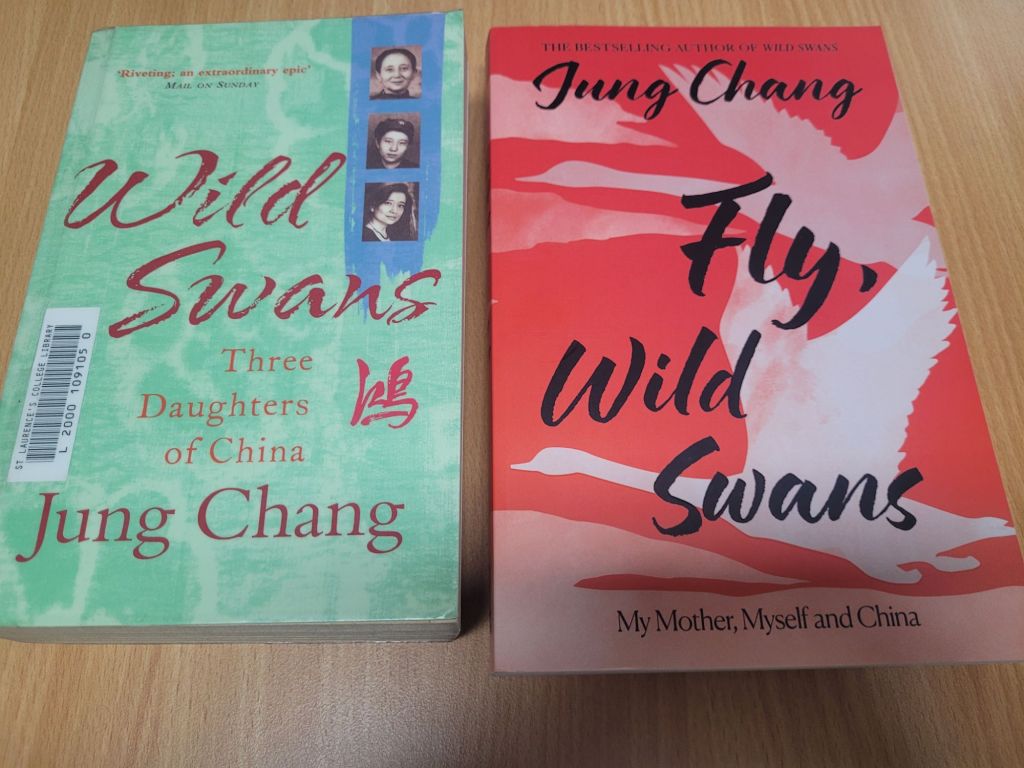
Adding Fly Wild Swans to our school library felt like a natural continuation of a legacy. Wild Swans has long stood as a canonical piece of literature, a book that captures the struggles of three generations of women against the backdrop of China’s political upheavals. In her second publication Fly Wild Swans, Jung Chang turns her gaze inward, reflecting on the cost of telling that story and the way truth can estrange a writer from her homeland. It is a pensive work that reminds us how women across centuries have shouldered familial and societal expectations, carrying memory and resilience even when nations would rather forget.
Jung Chang and her canons of literature
For students, these books are more than history. They are lessons in courage, in the power of memory and in the resilience of women who endured both familial duty and political oppression. Wild Swans explores the tension between tradition and rapid government‑driven progress. What was presented as modernisation often meant the destruction of customs and the breaking of family bonds as the Cultural Revolution tore families apart and demanded loyalty at the expense of tradition. Her story gave voice to three generations of women living through the upheavals of Mao’s China and this new work is written not only of her mother and her homeland, but of the burden of truth itself, and the cost of bearing witness when a nation would rather forget.
Fly Wild Swans reveals the aftermath of telling that truth, showing how a writer can be celebrated abroad yet silenced at home. Jung Chang turns her gaze inward, reflecting on the cost of telling that story and the way truth can estrange a writer from her homeland. Unlike Wild Swans, which focused on her mother and grandmother, this new work is more personal. It explores how writing Wild Swans changed her life, both opening doors in the West and closing them in China. There is a deep melancholy in her reflections on being unable to freely return to her birthplace. The success of Wild Swans brought her recognition abroad but estrangement at home. This tension between belonging and exclusion mirrors the broader story of women in history, who have often been celebrated for their endurance yet denied the freedom to define themselves.
I chose to buy Fly Wild Swans for my school library because it is a book that students should encounter, not only for its historical insight but also for its profound exploration of resilience, identity and the role of women in shaping and surviving history. Adding Fly Wild Swans to our collection ensures that the conversation continues, allowing readers to see how the legacy of truth‑telling reverberates across generations.
By placing both works on our shelves, we invite students to consider how politics, family and identity intersect, and how women across centuries have borne the burden of expectation while still finding ways to endure. These books remind us that literature is not static. It evolves, it questions and it carries forward the weight of generations.
At the end of each school day, I wander through the library and notice the gaps and blank spaces. Why? It is because the shelves never lie about the books that are loved the most. These are the ones that stack tall on our return trolleys. To be fair, they are also the ones that leave with another student almost instantly. They are the ones with worn spines, grubby covers and suspicious stains on the pages. Yet all of them tell me a story. They all tell me something about our school community.
Non‑fiction loans follow the interests of the boys themselves, whether it be cars, music, military equipment, or funnily enough… anatomy. These choices show me that curiosity is not confined to the classroom but stretches into the interests, curiousities, passions, and fascinations that shape their lives outside the school grounds.
The sports shelves mimic the seasons almost perfectly. Footy fades as winter ends, and suddenly, cricket biographies and fiction surge forward, especially anything tied to the upcoming Ashes. It is as if the rhythm of the sporting calendar beats through the borrowing habits of our students, reflecting not just their interests but the pulse of the wider culture around them.
The novels tell another kind of story. Fantasy sagas rarely rest long before they are whisked away again, dragons, quests and magical lands offering both escape and courage. Contemporary stories about identity and belonging circulate steadily too, often returned with dog‑eared pages. Those books feel like companions, helping students navigate questions of who they are and where they fit.
Certain authors move faster than most. This year we have seen a sharp update in request for Orwell’s works that seemed to be borrowed by students who want to think critically, because his sharp observations on society still resonating decades later. King’s novels vanish quickly from the shelves too, his blend of horror and humanity appealing to readers who crave both thrills and reflection. Griffiths brings laughter and lightness, his quirky humour and imaginative plots offering relief from the seriousness of school life. Kinney’s books are snapped up by younger readers, his diary‑style storytelling capturing the awkwardness and comedy of growing up. Walliams adds another layer of fun, his playful characters and outrageous scenarios proving irresistible to students who want a quick, joyful read. Bancks, with his Australian voice and relatable themes, connects directly to the local experience, showing students their own world reflected back at them. Heath’s stories move quickly too, often chosen by readers who enjoy adventure and fast‑paced plots. And then there is Rowling. Her magical universe remains evergreen, with titles borrowed again and again by students who want to lose themselves in a world of spells and friendship. Dashner’s dystopian tales race through the library as well, his fast‑moving plots and high stakes gripping readers who love suspense.
And then there are the comfort reads. During exam season, familiar series, lighthearted tales and joke books fly off the shelves, as if students are reaching for something steady and reassuring when stress runs high. When headlines outside the school walls grow louder, books on social issues suddenly become popular, showing me how our community is engaging with the wider world.
Over time, these borrowing trends become a mirror. They reflect curiosity, resilience, joy and sometimes vulnerability. They remind me that the library is not just a place to find information, it is a living record of what matters most to our students at any given moment. Each book borrowed is a quiet signal, a way of saying, this is what I need right now.
Together, these authors form a chorus of voices that shape the identity of our school community. Orwell challenges us to question, King dares us to feel fear and empathy, Griffiths and Kinney make us laugh, Walliams and Heath keep us entertained, Bancks grounds us in our own backyard, Rowling invites us into magic, and Dashner pushes us to imagine futures both thrilling and uncertain. Their collective presence on our shelves is more than entertainment, it is a reflection of the many ways our students seek to learn, to grow and to belong.
And as the year turns, the shelves whisper back, carrying the heartbeat of our community in every borrowed book.
What if you could travel back in time—but only for the duration of a single cup of coffee?
Toshikazu Kawaguchi’s Before the Coffee Gets Cold is a short novel, or novella if you wish to use that term that reminds you about regrets and how they can influence your actions. The novel is about a small, tucked-away Tokyo café where time travel is possible, but with strict rules. You can revisit the past, but you can’t change it. You must sit in a specific seat. And most importantly, you must return before your coffee gets cold. As a teacher and a parent, I am used to drinking cold coffee and how people actually drink warm coffee at work is a mystery to me!
Thank you Julia for the loan
The novel unfolds through four interconnected stories, each exploring themes of love, loss, regret, and reconciliation. The characters—a woman hoping to reconnect with a lover, a sister grieving her sibling, a mother longing for her child—are ordinary people facing emotionally charged moments. Kawaguchi’s writing is simple and understated, allowing the emotional depth of each story to shine through.
Unlike a novel I read recently (will not name names but ole Mate Danny), Kawaguchi uses provoking language and variated sentence structure to evoke emotion in the reader. This book, written with quiet clarity and emotional depth, avoids dramatic flourishes or unnecessary embellishments, instead offering a straightforward, sincere narrative that invites reflection without demanding attention.
If you could revisit a moment, not to change it, but to understand it better—would you?
Books like this remind us that stories have the power to shift our perspective. They can make us pause and reflect on our own choices, relationships, and regrets. Before the Coffee Gets Cold encourages readers to consider how they treat others, how they communicate, and what truly matters in the fleeting moments of everyday life. It’s a quiet nudge to be more present, more thoughtful, and more intentional.
Perfect for readers who enjoy reflective, character-driven stories, Before the Coffee Gets Cold is a gentle reminder that while we can’t rewrite the past, we can reshape how we carry it forward. It’s a book best read slowly, perhaps with a warm drink in hand and a quiet space to think.
They capture your imagination with words and imagery.
Similar to a siren singing her tune, an author draws the reader in with stories of heroes, villains, mysteries and magic. There are several writers that come to mind when one thinks about perspicacity at understanding a developing mind. Enid Blyton comes to my thoughts immediately, as it was her books of Faraway trees, Wishing Chairs, Mallory Towers and the adventurous children that beguiled and transformed me into a certifiable bookworm. Other authors with these same mystical powers include Emily Rodda, A A Milne, Dr Seuss, C. S Lewis, Beatrix Potter, E.B White, Lewis Carrol, Eric Carle, Rick Riordan, J K Rowling and of course, Roald Dahl.
Dahl’s popularity has enthralled generations of children with his fantastical tales. Even 30 years after the publication of perspicacious Matilda, the lure is still strong according to Kelly (2019) who recently published an article in the Sunday Times just short of the author’s birthdate. Dahl’s books have inspired generations of children to read. His stories of redemption and resilience appeal to both children and adults. I found it particularly interesting that the books often seem to be narrated by the child protagonist. By doing so, Dahl places the reader in the central position and thus immediately engages their interest. The books often place the child in the role of an underdog and their eventual vanquishment of the bigger and older (usually an adult) enemy gives great satisfaction. Darby (2016) believes that this narrative style is appealing to children as it makes them feel like “someone is in their court”.
Some people assert that Dahl’s books are macabre and filled with violence, racial slurs, misogyny and vindictive behaviour. Anderson (2016) argues that the books caused great disturbance among adult readers when they first started being published in the late 60’s. Stories where witches turn children into mice, people are fed worms and or eaten by giants, and let us not forget principals that swing cute girls by their hair like a discus and push children into nail studded cupboards.
In fact, “James and the Giant Peach has been lambasted for its racism, profanity and sexual innuendo” Anderson (2016) states.
It appears Dahl was provoking everyone, as he offended numerous demographics in equal measure. But I am starting to believe that the provocation is what lured children to read and re-read his books. It was just that little bit naughty and disgusting. Just enough to make children feel superior and more wise than the character, but not too much as to disengage the reader. Arguably this is probably what explains Dahl’s longevity as an author. Nice clean stories such as Wilder’s Little House series has its staunch clientele but it does lacks the Dahl’s drawcard in that the majority of children do not identify with these characters. Kole (2018) suggests that it is when the reader can draw upon their own experience with the subject matter that engagement with the text occurs. This could be contended similar for L M Montgomery’s Anne or White’s Charlotte’s Web. All extremely well written and received books, but not as far reaching as Dahl. Whilst their stories do have points of personal travail, they simply are not dark enough.
This need for darkness is important for children’s literature
as Anderson (2016) and Kole (2018) further elucidate. One can only think of the popularity of the Grimm fairy tales, Rowling’s Harry Potter, Collins ’Hunger Games and Meyer’s Twilight to realise that the desire for grim has not changed in centuries. The adage about literature reflecting life is the underlying support for this need for fear and fright in children’s books. Stories of children overcoming great difficulty has the ability to build great resilience and empathy in the reader.
We are all aware of how reading builds empathy. Readers identify with the characters in the story and thus the feelings from one are juxtaposition-ed on the other . But reading fictitious stories of giants, witches and wizards, whilst unrealistic, also gives children an important cathartic release according to Bettelheim (2010). Rochelle (1977) whilst dated, firmly believes that adults and children both require fantastical literature to interweave the complex strains of good and evil in humanity. Fantastical tales give children innate strength to overcome hurdles life throws at them, no matter how bizarre it is (Kole, 2018). Children are aware that these stories are unreal in the fantastical sense but the situation that the characters are facing are very real indeed (Rochelle, 1977). Wakefield (2014) agrees and points out that fairy tales are there to protect rather than terrify, as the protagonist is forced to seek inner strength to overcome the villain. The stories illustrate that these situations can be overcome, and in that, give hope and possibly a way out.
Fantastical tales are more than just entertainment. In their own way, they give children (and adults) the ability to fight demons in both the real world and in their dreams. After all, the lives of children are not always filled with rainbows and unicorns. Many children live in shadows. Reading stories such as Dahl’s encourage children (and adults) to go past their grim quagmire and find their inner strength.
So this Roald Dahl day on September 13, read a fantastical story… and at the same time, gain some humanity.
Rochelle, L. (1977). The search for meaning through fantasy. The English Journal. Vol. 66, No. 7, pp 54-55. Retrieved from https://www.jstor.org/stable/814365
Wakefield, M. (2014). Why scary fairy stories are the best. The Spectator.



 Learning through the Library