I went to my old high school’s 40-year celebration two days ago. It was one of those evenings steeped in memory. Faces reappeared from another version of my life and conversations slipped easily back into old rhythms. I found myself reconnecting with past teachers, friends and principals, each interaction quietly reconstructing the person who I had once been.
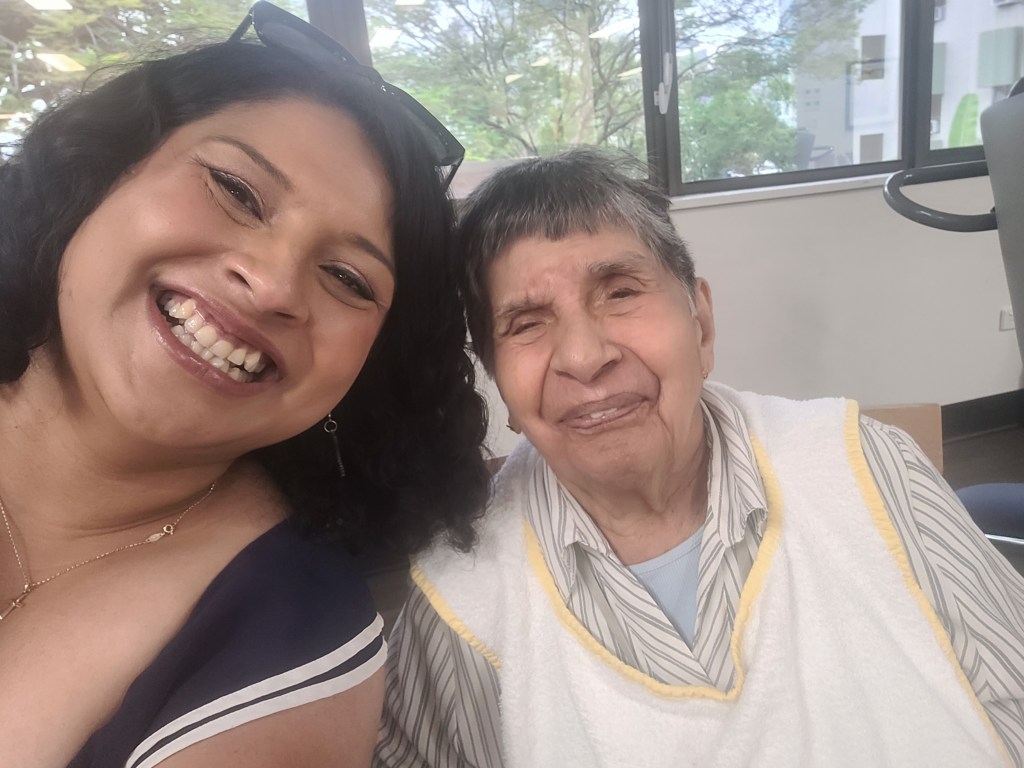
But the moment that stayed with me, the one that carried the most weight, was seeing Mrs P, the Library Technician. I had not seen her since my last day of high school, more than twenty-five years ago. And yet, I recognised her instantly.
There was no hesitation, no uncertainty. It was as if no time had passed at all.
I walked up to her, a little tentatively, and asked if she had been the library technician back in those days. She smiled, said yes, and then paused, really looking at me. There was a flicker of recognition, the slow realisation that this was not just a past student, but someone connected to those shared years in the library.
In that moment, I felt again what I had felt all those years ago. Seen. Remembered. Held, in some quiet way, in the memory of a place that had once held me so carefully. Mrs P, along with Mrs H and our teacher librarian, Mr J, absolutely saved me in high school.
I was an awkward teenager, navigating the usual turbulence of adolescence, but also something more complex. I was trying to make sense of my identity as a migrant. I did not feel like I belonged in Brisbane. I felt out of place, uncertain of the invisible rules that seemed to come so naturally to everyone else. It was a quiet kind of dislocation, one that I carried with me each day through classrooms, corridors and playgrounds.
Except when I was in the library.
The library became my constant. I went there every day, sometimes four times a day. Before school, during breaks, at lunchtime, and after school. On sports days and swimming carnivals, when the noise and exposure felt overwhelming, I would find my way there again. It was not just a place I visited. It was a place I returned to, over and over, because I knew what waited for me.
There was space. There was calm. There was permission to exist without explanation.
What made that space transformative, however, was not simply the books or the quiet. It was the people who held it.
Mrs P. Mrs H. Mr J.
They welcomed me without making it visible. There was no intervention, no spotlight, no need to name what I was struggling to articulate myself. Instead, there were small, consistent acts of care. A smile. A brief conversation. An acceptance of my presence, no matter how often I appeared. They never made me feel like I was there too much. If anything, they made it clear that I was exactly where I was meant to be.
It was through these quiet acts that something began to shift.
I started to feel that I belonged.
Not because I had changed dramatically or suddenly fit the mould of what I thought I should be, but because the library allowed me to exist outside of that mould altogether. It was a space where difference did not need to be negotiated or justified. It was simply accepted.
On my last day of Year 12, Mr J and Mrs P handed me a pile of books. They told me, with a kind of gentle humour, that I was the only student who had borrowed and reborrowed those titles over the past five years. They thought I should take them. That they may as well belong to me.
At the time, I accepted them with gratitude. In hindsight, I understand that what they were giving me was something much larger than a stack of well worn pages. It was an acknowledgement of time, of presence, of connection. It was a way of saying that I had been seen.
Now, I find myself in their position.
As a teacher librarian, I think often about what it means to create a space like that. It is easy to speak about libraries in terms of collections, resources and programming. These are important, necessary components of our work. But they are not, in themselves, what makes a library matter.
What matters is the atmosphere we cultivate. The decisions we make, often unconsciously, about who feels welcome and who does not. The way we respond to the student who lingers a little too long, who comes back again and again, who seems to need the space in a way that goes beyond borrowing a book.
There are always students like I was.
They may not announce themselves. They may not ask for help in ways that are easily recognised. But they are there, at the edges, watching and waiting to see if a space will hold them.
The library can be that space.
Not through grand initiatives, but through consistency. Through noticing. Through the quiet, deliberate choice to welcome a student, not once, but every time they walk through the door.
Increasingly, I also see this through the experience of my own children. I watch them move through their school libraries with a sense of ease that feels both reassuring and deeply familiar. They find corners to read, people to talk to, spaces where they can simply be. There is a confidence in the way they inhabit those spaces that tells me they feel they belong.
It is a subtle thing, belonging. It is rarely declared outright. Instead, it accumulates in moments, in gestures, in the quiet understanding that a place will receive you without question.
Libraries hold the capacity to offer this in a way that few other spaces in a school can.
They are places where students can arrive without needing to explain themselves. Places where identity can be explored, shaped or simply held. Places where someone might come four times a day and never be made to feel like they are too much.
At their best, libraries are not defined by what they contain, but by what they allow.
They allow stillness. They allow curiosity. They allow refuge.
And, for some of us, they allow the slow and steady realisation that we belong.