Language, learning and the power of library.

Language and learning are inextricably linked because the latter is hard to achieve without knowledge of the former. Language consists of words used in a structural and conventional way which is the principal method or system of communication communities use to engage with each other and the world (Britannica, 2026; Winch et al., 2020, p. 12).  Language can be spoken, written or gestural and its effective use is a fundamental principle underlying a person’s ability to actively engage with their society. Therefore, by this definition and in conjunction with the cognitive model of reading, learning, and literacy by extension, can only occur if a person is competent in using language in its different fields, tenors and modes (Winch et al., 2020, p. 13).  The role of the teacher librarian and the library in literacy development is to support language, literacy and learning across the curriculum through the broadening and deepening of student vocabulary by improving semantic understanding of key vocabulary and building background knowledge with quality resources. 

Winch et al., (2020) point out that language is an identifiable way for cultures to share meaning with each other and to achieve a common purpose and as such is influenced by context.  One subset of language influenced in this way is vocabulary because it is the knowledge of words that exist in a particular language or subject and or the total volume of words known by a particular person (Cambridge, 2026).  Therefore it can be inferred that a person’s breadth and depth of vocabulary knowledge is based upon their experience and exposure to a variety of texts (Winch et al., 2020; Lewis & Strong, 2021, p5).  A person that reads or is exposed to a wide range of vocabulary through various genres will be highly receptive to new terminology.  However, that does not translate into an expressive capacity unless they are able to practice it sufficiently. 
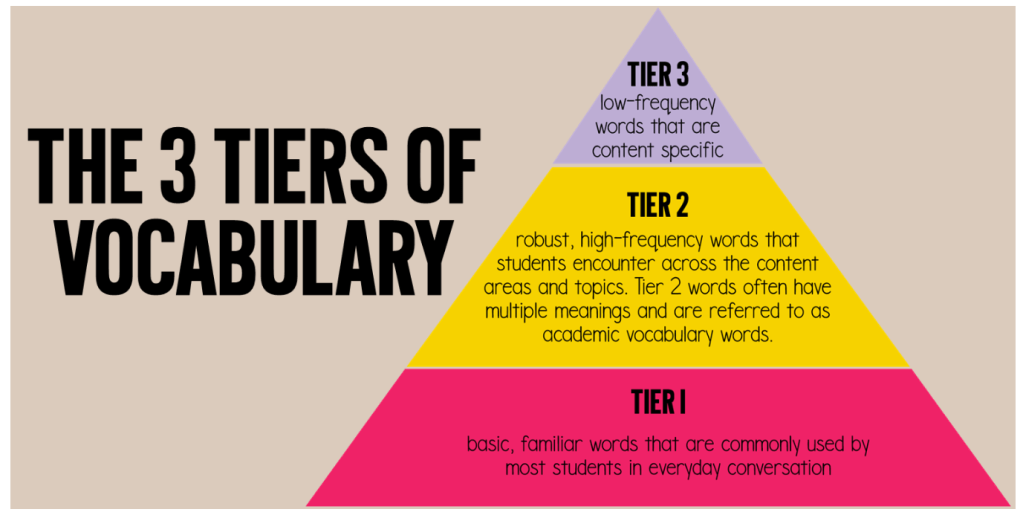
Miss DeCarbo. (2021). The 3 tiers of vocabulary for classroom instruction. https://www.missdecarbo.com/three-tiers-of-vocabulary-instruction/

 Vocabulary can also be perceived to be a bridge between the written and spoken modalities because readers need to be efficacious in their ability to predict and build mental images from the text (Winch et al., 2020, p. 20).  This perception is consistent with the constructivist approach to reading because text comprehension is the result of a reader’s ability to combine what is known, with what is presented in the text in order to arrive at new knowledge and understanding (Graves et al., 2019; Winch et al., 2020, p.91; Spence & Mitra, 2023).  Competent readers have the additional advantage when it comes to informational texts because they are able to determine the genre and purpose of a text by making predictions based on their knowledge of text structure and the language or vocabulary within the text.
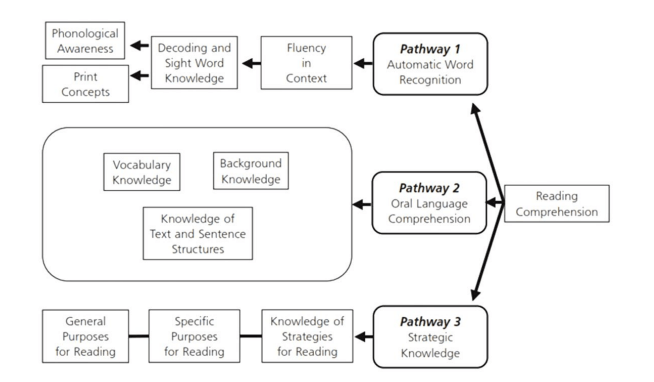
McKenna & Stahl, 2009 – Cognitive Model of Reading.

The cognitive model of reading is centred on a reader’s ability to comprehend language because vocabulary acts like a conduit between the working and long term memory impacting ability to effectively comprehend a text (Graves et al., 2019; McKenna & Stahl, 2009; Winch et al., 2020, p82; Spence & Mitra, 2023).   A person with a high vocabulary is more likely to have increased success in reading comprehension because their capacity to understand and connect to the text is greater than someone with a limited vocabulary (Winch et al., 2020, p21). This in turn fuels their ability and capacity to read more, further increasing their capacity.  This efficacy, as Lewis & Strong (2021) point out, confirms the commonly known Matthews effect as students learn 15% of new words in contextual reading and that they need greater than twelve encounters with a particular term or phrase to even think of including it into their knowledge schemas.   However, even confident readers may be confronted when exposed to factual or informative texts because of the leap in cognition required as each discipline will have their own structure, grammar and specialised vocabulary (Spence & Mitra, 2023).  This means both experienced and inexperienced readers will require explicit instruction in semantic knowledge to effectively decode and encode text of increasing complexity (Winch et al., 2020, p.110; Lewis & Strong, 2021, p.7).  
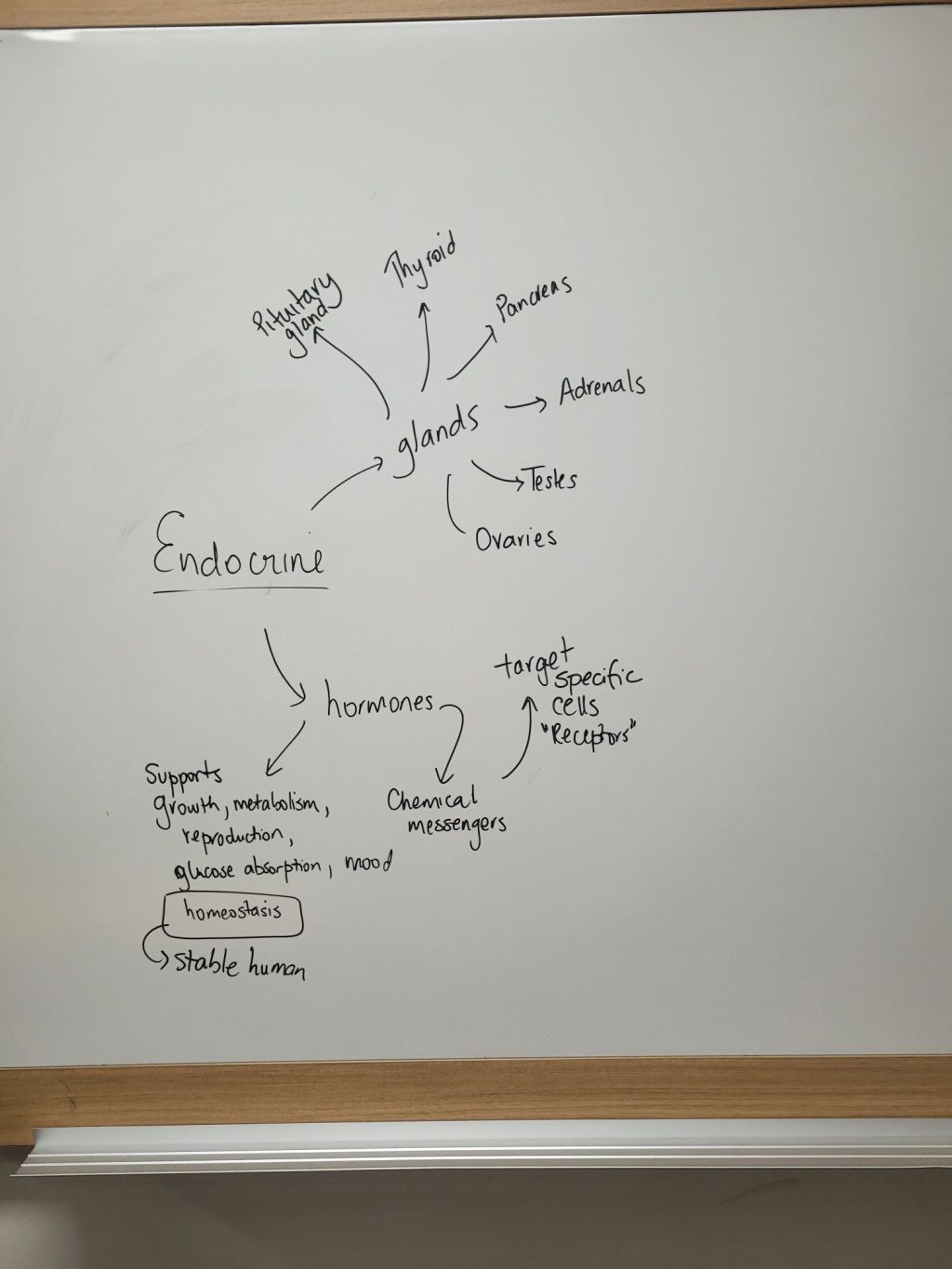
20260205_1315043280922158433381446
Year 9 Science – Semantic mapping

Reading comprehension skills can be supported across the curriculum by increasing a student’s semantic knowledge and background understanding of a topic prior to close reading (Lewis & Strong, 2021). Several pedagogical practices including semantic mapping of tier three vocabulary, the use of text sets to bolster background knowledge as well as explicit modelling of reading strategies can be used effectively to improve reading comprehension and build student capacity (Lewis & Strong, 2021; Spence & Mitra, 2023)  However, caution must be used when deciding what text to use in teaching and learning because the use of text can be a limiting factor if infantile resources are used as it limits student capability and capacity  (Winch et al., 2020, p114, Lewis & Strong, 2021, pg. 10).  Spence & Mitra (2023) point out that it is preferable to scaffold students to complex texts than to provide resources that are age and stage inappropriate.   
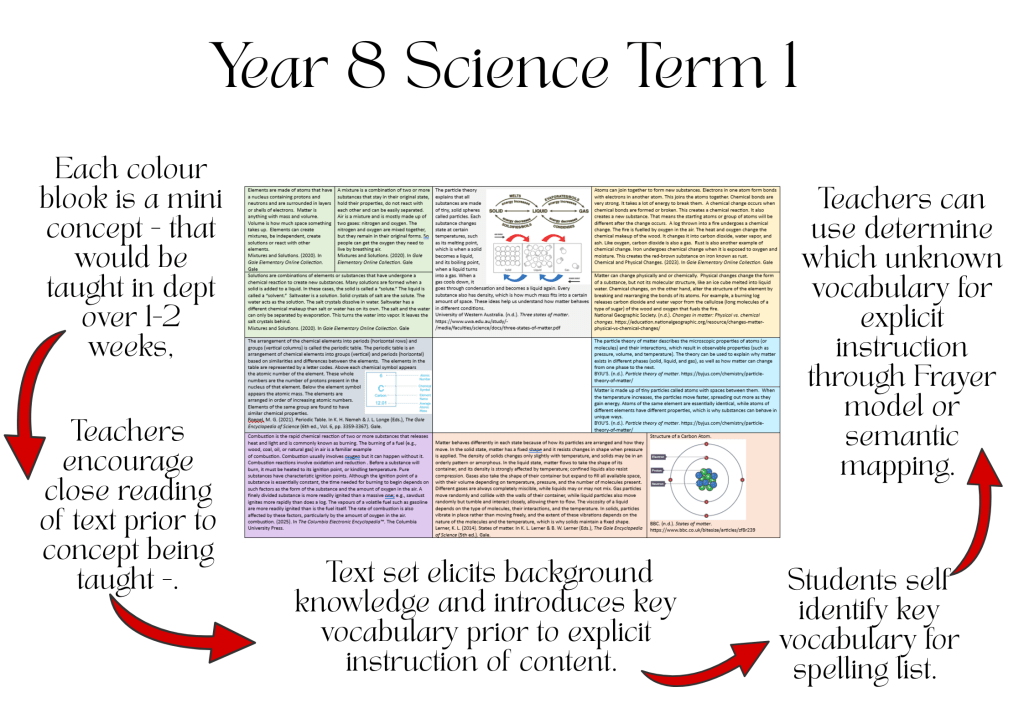
Text sets are an effective pedagogical strategy to improve vocabulary in a classroom because they encourage students to interact with a wide range of quality, genre specific texts throughout a unit of work.  These text sets were specifically curated to improve vocabulary and by extension, reading comprehension. Students were able to engage with short extracts of text that have been appropriately levelled prior to the unit commencing and then were able to re-engage with this text intermittently through the term.  This ‘dipping’ in and out of the content allowed students to activate their prior knowledge as well as exposed them to tier two and three terminologies at smaller and more regular intervals.  This intermittent exposure is ideal for spaced retrieval practice as teachers are able to regularly gauge the level of background knowledge and understanding the students already have on the topic and as well check for understanding.   Furthermore, these vocabulary text sets can be effectively used as text exemplars because they can be formatted to meet the disciplinary genre requirements.  

The teacher librarian and library play pivotal roles in supporting language, literacy and learning across the curriculum. Firstly, teacher librarians are well placed to source texts that build semantic and background knowledge. They are able to create and curate text sets, lib-guides, reading lists and book boxes that meet the language and literacy needs of the students.  Text sets can be very effectively used to build background knowledge and can be used across classrooms, cohorts and units of work. They can be paper or digitally based; extracts of texts or whole articles; picture books, novels or biographies.  They can also be used to explicitly teach vocabulary in discipline specific genres.  Teacher librarians can also use their central role in the school to replicate reading strategies across the curriculum, sharing similarly structured resources through various faculties or disciples for a more concerted and systemic approach to literacy and learning.  Lastly, teacher librarians are the curators of their collection, and their role is essential to ensure that high quality literature and resources continue to be available to staff and students.

References

Cambridge University Press. (n.d.). Vocabulary. In Cambridge Dictionary. Retrieved February 23, 2026, from https://dictionary.cambridge.org/dictionary/english/vocabulary

Encyclopaedia Britannica. (2026, February 6). Language. https://www.britannica.com/topic/language

Graves, M. F., Elmore, J., & Fitzgerald, J. (2019). The vocabulary of core reading programs. The Elementary School Journal, 119(3), 386–416. https://doi.org/10.1086/701653

Hiebert, E. H. (2020). The core vocabulary: The foundation of proficient comprehension. The Reading Teacher, 73(6), 757–768.

Lewis, W. E., & Strong, J. Z. (2021). Literacy instruction with disciplinary texts: Strategies for grades 6–12. Guilford Publications. New York

McKenna, M. C., & Stahl, S. A. (2009). Assessment for reading instruction (2nd ed.). Guildford Press

Mitra, A., & Spence, L. (2023). Educational neuroscience for literacy teachers: Research‑backed methods and practices for effective reading instruction. Routledge. New York.

Winch, G., et al. (2020). Literacy: Reading, writing and children’s literature. Oxford University Press. Docklands, Australia. 
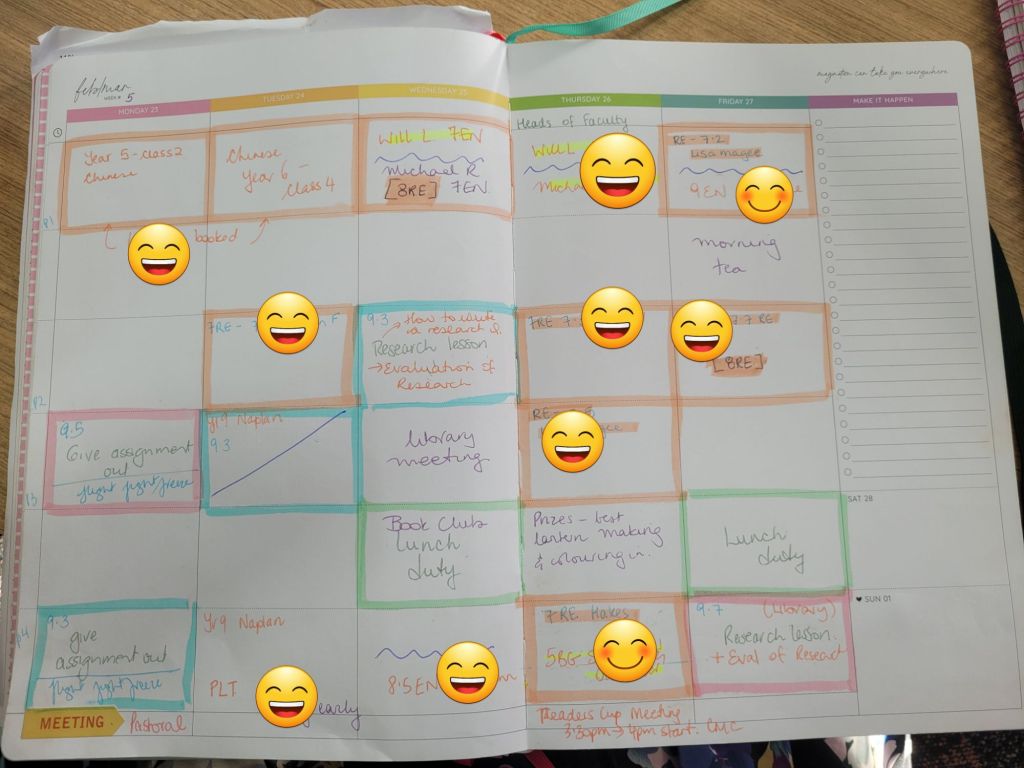
The Peaks and Troughs of a Term.

A term in the life of a teacher librarian is never a simple, steady journey. It rises and falls in energy and pace, shifting between calm stretches, intense bursts of activity and a mid term crescendo that only those who have stood behind a circulation desk during second break truly understand. Teacher librarians do not just follow the rhythm of the school term. We breathe it, support it and often hold it together with a blend of planning, flexibility and a genuine love of learning.

The beginning of the term often appears calm on the surface, but behind the scenes it is a hive of thoughtful planning and collaboration. This early period is spent mapping out programs, updating units, preparing resources and scheduling literacy and information literacy lessons across the curriculum. It is the time for meetings with teachers who bring new ideas for research tasks, nurturing fledging literacy programs or supporting disciplinary literacy through explicit vocabulary instruction. These conversations help shape the curriculum support that will run throughout the term and ensure that every lesson and library experience has purpose and structure. It is also the time for deeper discussions with Heads of Curriculum to align expectations, strengthen research skill development and embed digital and information literacy meaningfully across year levels. The work may be quiet, but it forms the foundation for everything that follows.

By the time the middle of the term arrives, the calm has vanished completely. The library becomes a vibrant and sometimes chaotic hub of constant movement. Students flood through the doors needing books, recommendations or support with upcoming assessments. Borrowing sessions become lively and energetic as classes arrive with armfuls of returns and requests. This is also the busiest teaching period of the term, when the carefully prepared information literacy sessions come to life. Research skills, digital literacy, source evaluation, referencing, note taking and inquiry support all happen at a rapid pace. Teacher librarian roles expand and overlap as we teach back to back lessons, guide students through tasks, troubleshoot technology and support teachers in real time as units unfold.

Amid the flurry, collaboration continues in more practical and immediate ways. Teachers pop in needing quick resources, task sheets are updated on the go and reading groups or book clubs meet regularly. Displays evolve to match what is happening across the school and the flow of students keeps the space buzzing. Moments of humour, curiosity and connection appear constantly, whether it is a student searching for a book they can remember only by its colour or one who is unsure whether reading ten pages a night officially qualifies them as a reader. It is busy and demanding, but it is also the most rewarding time of the term.

As assessment deadlines pass and the term moves into its later weeks, the pace softens again. Students return to the library in search of quiet corners for study, calm spaces for reading or simply a break from the noise of the school day. This slower period allows time to catch up on the larger ongoing projects that were temporarily buried beneath the mid-term rush. There is even the rare moment where a cup of chai stays warm long enough to be enjoyed.

By the final couple of weeks, the library takes on a different kind of energy. Lost books mysteriously reappear from lockers and school bags when billing invoices get sent home. Teachers arrive with last minute requests for resources or holiday reading suggestions. Then there is my own teaching practice, my own classes I have to teach, assess and report on.

Despite the peaks, troughs and everything in between, there is a satisfying sense of purpose in the ebb and flow of library life. Teacher librarians witness students discover stories that inspire them, questions that challenge them and skills that will carry them far beyond the classroom. These moments make every busy break, every full borrowing session and every packed week of information literacy worth it.

Queensland School Library Week 2026

This week we celebrate Queensland School Library Week and this year’s theme, School Libraries Light the Way, perfectly captures what our library aims to do every day. School libraries illuminate pathways to learning, belonging, curiosity and joy. They guide students in reading, research, creativity and personal growth while promoting equity and inclusivity for every learner.

Here is how our library is commenced lighting the way in the first few weeks of 2026.

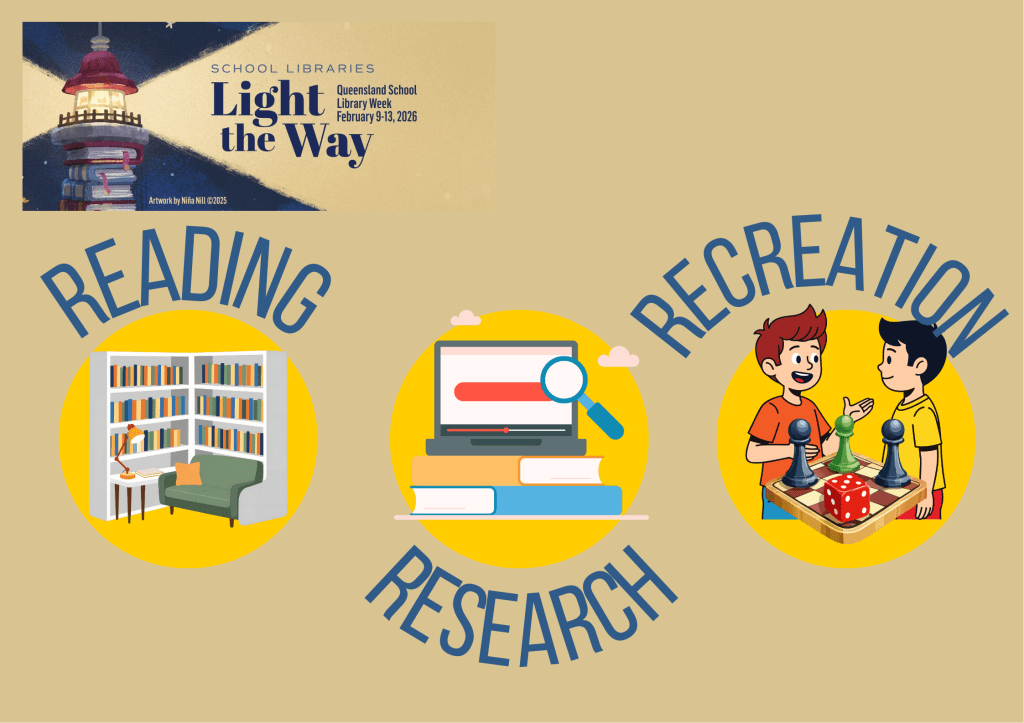
Lighting the Way for Reading, Research and Recreation

Book Clubs in Full Swing: Our book clubs for primary and secondary students have been meeting since Week 2 and the enthusiasm has been wonderful to see. These groups give students opportunities to read for pleasure, discuss ideas and connect with other readers across the school.

Sharing New Books: We continue to promote new books to staff and students. Whether it is a fresh fantasy adventure, a gripping nonfiction title or the newest young adult novel, we work hard to help every reader find something they will enjoy.

Supporting Teacher Professional Learning: We are also lighting the way for staff by ensuring our digital access to teacher journals is current, reliable and easy to use. We share these resources across school networks so that teachers can stay informed, inspired and connected to current practice.

Library Lessons for Years 5 to 8: Our library lessons support student interest and reading engagement. These sessions are planned to build student efficacy in navigating their own reading journey.

Information Literacy for Years 7 and 8: I collaborated with classroom teachers to deliver information literacy instruction that is authentic and practical. Students are learning to locate information, evaluate sources and use material ethically, which helps prepare them for success in school and beyond.

Lighting the Way for Equity and Inclusivity

Lunar New Year Activities: From this week we will offer Lunar New Year activities during language classes and at lunchtime. These activities build cultural understanding and celebrate the rich diversity of our school community so that every student feels valued and represented.

The Happy Book Dragon: Our library is also home to its resident happy book dragon (aka ME) who lives and breathes book trivia and reading joy. Sometimes lighting the way simply means sharing enthusiasm and creating a space where curiosity thrives.

Lighting the way together

Queensland School Library Week is a reminder of the powerful role a school library plays in the life of a community. From nurturing readers to supporting staff and celebrating cultural diversity, our library is proud to be a guiding light in our school.

Here is to a bright and book filled week and to the many ways libraries continue to light the way every day.

School libraries and the beginning of the academic year

The beginning of each academic year presents both opportunity and challenge. It is a time characterised by optimism, renewed energy, and a shared commitment to supporting student learning and wellbeing. However, it is also a period marked by competing priorities, operational demands, and the rapid transition from planning to implementation.

As is often the case, the intensity of Staff Week and the early weeks of Term 1 meant that dedicated time for strategic reflection was limited. I discovered that in between the mandatory tutorials, staff meetings, faculty meetings and wellbeing sessions, I didn’t quite get the time to organise and articulate my own vision for the 2026 academic year. Rather than viewing this as a setback, it has prompted a more deliberate and considered approach to articulating a clear library vision and set of priorities for 2026 — grounded in the school’s strategic direction and responsive to the evolving needs of the community.

As the school’s sole Teacher Librarian, I am tasked with organisation, development and delivery of the school’s library programs and services. This role requires the library to function not simply as a resource hub, but as a key driver of teaching and learning, student engagement, and inclusive practice.

The foundation for any of the school’s library programs and services is the school’s 2024–2026 Strategic Plan, supported by the school’s mission and vision, and further informed by the Edmund Rice Education Australia (EREA) Touchstones, particularly Liberating Education and Inclusive Community. These frameworks provide both direction and accountability, ensuring that library initiatives meaningfully contribute to whole‑school priorities.

Strategic Priority 1: Curriculum and Teaching & Learning Support

The primary purpose of the school library is to support curriculum delivery and enhance student learning outcomes. In alignment with the school’s strategic priorities, the library’s focus in 2026 will be on strengthening practice within the middle years, where targeted intervention and skill development have the greatest long‑term impact. Key curriculum‑aligned priorities include:

  • Strengthening literacy development through collaborative, resource‑based learning approaches across faculties, in particular science and religious education.
  • Designing and implementing a structured information literacy program that explicitly teaches research skills, critical thinking, and ethical information use.
  • Supporting inclusive curriculum delivery by ensuring access to high‑quality resources in a range of formats and modalities to meet the diverse learning needs of students.

Through purposeful collaboration with teaching staff, the library will act as both a partner in curriculum design and a facilitator of inquiry‑based learning experiences.

Strategic Priority 2: Community, Wellbeing, and Culture

While curriculum support remains central, the library also plays a vital role in fostering student wellbeing, belonging, and engagement. A contemporary school library must function as a flexible, inclusive space that supports both academic and social development. In essence, for research, reading and recreation. In 2026, community‑focused priorities include:

  • Maintaining a welcoming and inclusive library environment for staff and students.
  • Strengthening a whole‑school culture of reading, with an emphasis on reading for pleasure and student choice.
  • Collaborating strategically with the Diverse Learning and Pastoral Teams to support students with complex social, emotional, and learning needs.

By intentionally balancing structure with flexibility, the library will continue to support student wellbeing while reinforcing positive engagement with learning.

Strategic Priority 3: Professional Relationships and Capacity Building

The effectiveness of the library is directly linked to the strength of the relationships that underpin its operation. In 2026, a key professional focus will be the continued development of strong, purposeful connections with:

  • Teaching staff
  • Students
  • The wider school community

These relationships are central to successful collaboration, responsive service delivery, and the library’s role as an embedded component of the school’s learning culture.

Now that I have a framework, I can now focus on building programs that meet these goals.

How do you plan your year’s library programs?