Lunchtime in a library can sometimes be overlooked as a quiet or transitional part of the day. In reality, it is one of the most powerful opportunities libraries have to connect with their community. Lunchtime events turn a regular break into a moment of discovery, drawing people into the space, engaging those who may feel unsure or disconnected, and strengthening the library’s role as a welcoming and active hub.
Library events are vital for building a rapport between a school community and their library because participating in a simple activity can lead to conversations. From there, it becomes easier to talk about books, recommend reading, or explain what the library can offer. This is because for many people, a lunchtime event is someone’s first positive and relaxed experience in the library, helping them feel more confident and welcome. The brilliance lies in the fact that lunchtime events naturally attract foot traffic. Students and staff are already moving around, looking for somewhere to go or something to do. Hosting activities during this time removes barriers to participation. There is no need to stay after hours or commit to a long session. People can simply wander in, take part, and head off again because these activities are flexible and easy to join. Not everyone wants a formal workshop or a structured program during their break. Drop in challenges and creative prompts allow people to engage at their own pace, whether they stay for two minutes or twenty.
Heartfelt Haiku and prizes for winning entries.
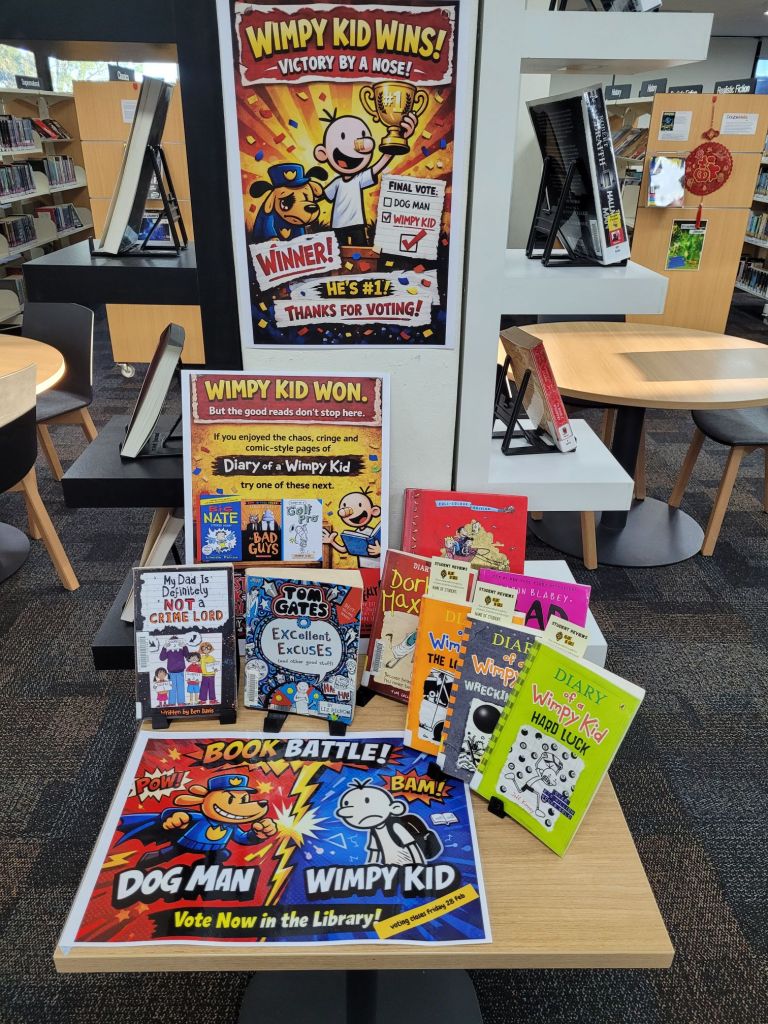
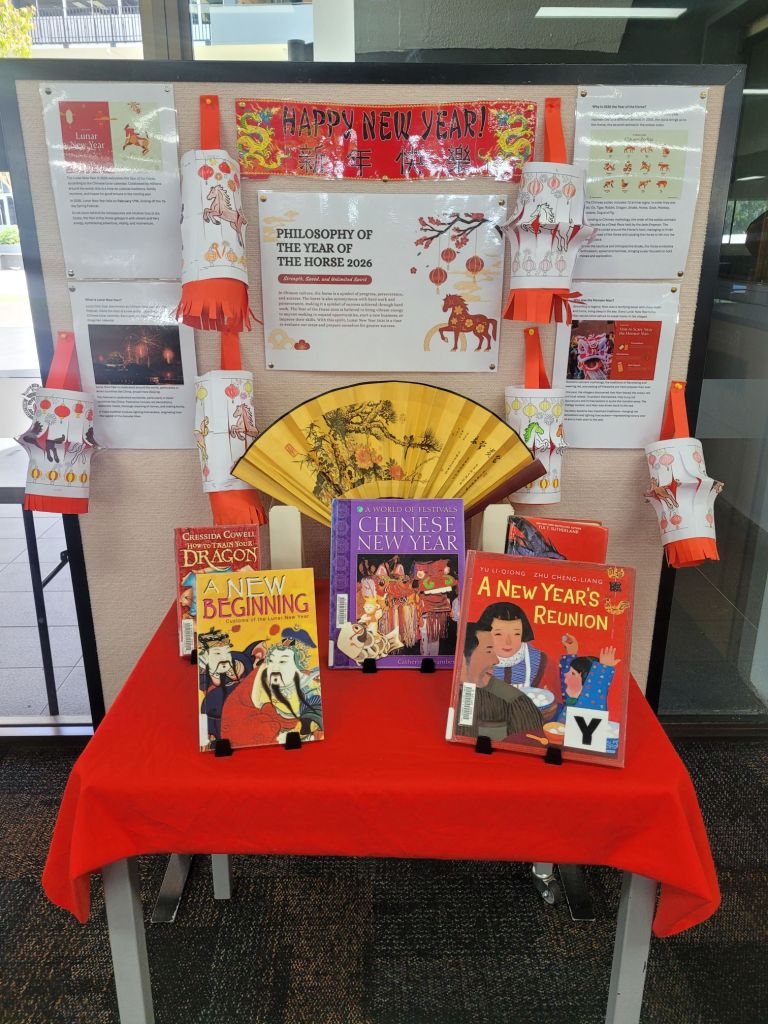
Furthermore, connecting lunchtime challenges to theme days and seasonal events helps keep them fresh and relevant. It gives people a reason to take part right now and adds a sense of fun and anticipation. Over the past few weeks, our library has run challenges such as Heartfelt Haiku for Valentine’s Day and Library Lovers’ Day invited participants to reflect on their love of reading and libraries. Lantern making for Lunar New Year created a hands on way to celebrate culture and tradition. A recent voting challenge between Dog Man and Diary of a Wimpy Kid tapped into popular reading interests and friendly competition. Now, in this past week, the Falling into a Book challenge has encouraged readers to embrace the new season with a new story.
Book Battle: Dogmas V Wimpy Kid
Lunchtime events transform the library into a social and welcoming space. A table set up with a challenge, a craft activity, or a voting station often sparks curiosity. Someone who had no intention of visiting the library may step inside just to see what is happening. Once they do, they are surrounded by books, displays, and friendly faces. Lunchtime events create opportunities for spontaneous engagement that might not happen at any other time of day. They also show that the library values participation in many different forms, not just quiet reading. Afterall, when people participate together, even briefly, they share experiences that build a sense of belonging. Over time, these shared moments help strengthen relationships between library users and staff. The library becomes known not just as a place to borrow books, but as a place where people feel comfortable, included, and valued.
Lunar New Year Display and handmade lanterns.
Lunchtime events quietly demonstrate the broader role of libraries. They show that libraries are dynamic spaces that respond to their communities, encourage creativity, and support wellbeing as well as learning. School libraries that use their lunchtime activities or challenges to build connections and rapport with their communities can turn an ordinary break into a meaningful connection and remind everyone why libraries matter.
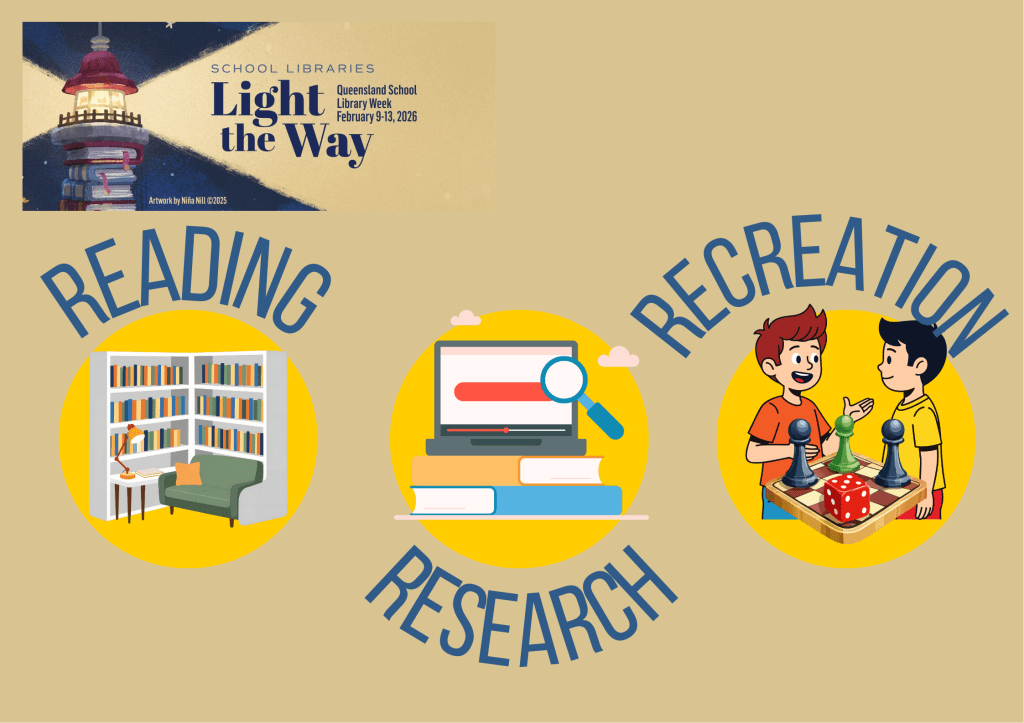
This week we celebrate Queensland School Library Week and this year’s theme, School Libraries Light the Way, perfectly captures what our library aims to do every day. School libraries illuminate pathways to learning, belonging, curiosity and joy. They guide students in reading, research, creativity and personal growth while promoting equity and inclusivity for every learner.
Here is how our library is commenced lighting the way in the first few weeks of 2026.
Lighting the Way for Reading, Research and Recreation
Book Clubs in Full Swing: Our book clubs for primary and secondary students have been meeting since Week 2 and the enthusiasm has been wonderful to see. These groups give students opportunities to read for pleasure, discuss ideas and connect with other readers across the school.
Sharing New Books: We continue to promote new books to staff and students. Whether it is a fresh fantasy adventure, a gripping nonfiction title or the newest young adult novel, we work hard to help every reader find something they will enjoy.
Supporting Teacher Professional Learning: We are also lighting the way for staff by ensuring our digital access to teacher journals is current, reliable and easy to use. We share these resources across school networks so that teachers can stay informed, inspired and connected to current practice.
Library Lessons for Years 5 to 8: Our library lessons support student interest and reading engagement. These sessions are planned to build student efficacy in navigating their own reading journey.
Information Literacy for Years 7 and 8: I collaborated with classroom teachers to deliver information literacy instruction that is authentic and practical. Students are learning to locate information, evaluate sources and use material ethically, which helps prepare them for success in school and beyond.
Lighting the Way for Equity and Inclusivity
Lunar New Year Activities: From this week we will offer Lunar New Year activities during language classes and at lunchtime. These activities build cultural understanding and celebrate the rich diversity of our school community so that every student feels valued and represented.
The Happy Book Dragon: Our library is also home to its resident happy book dragon (aka ME) who lives and breathes book trivia and reading joy. Sometimes lighting the way simply means sharing enthusiasm and creating a space where curiosity thrives.
Lighting the way together
Queensland School Library Week is a reminder of the powerful role a school library plays in the life of a community. From nurturing readers to supporting staff and celebrating cultural diversity, our library is proud to be a guiding light in our school.
Here is to a bright and book filled week and to the many ways libraries continue to light the way every day.
As the scholastic year draws to a close, children and teenagers eagerly anticipate the long summer holidays filled with play, family time and relaxation. While this break is important for wellbeing, research consistently shows that it can also lead to what is known as the summer reading slump. This phenomenon refers to the decline in literacy skills that many children experience during extended school breaks. Studies have found that children can lose up to a month of learning over summer, particularly in reading and spelling, with the effect most pronounced among children from lower socio-economic backgrounds who may have limited access to books and literacy-rich environments (National Library of New Zealand, n.d.).
Evidence from New Zealand highlights the importance of structured literacy teaching in preventing this decline. A study published in the New Zealand Journal of Educational Studies determined that the impact of explicit phonics, phoneme awareness and decoding strategies can embed foundational skills deeply enough to withstand the summer gap (Vosslamber, Walker, Millar-Swan, Motha, & Gillon, 2025). This reinforces the idea that strong classroom instruction can provide a buffer against learning loss.
Alongside structured teaching, regular reading at level is critical. When children engage with texts that match their ability, they reinforce vocabulary, comprehension and decoding skills while building confidence and motivation. Reading at level prevents cognitive decline associated with long breaks from literacy activities. Research also shows that children who participate in summer reading programs are more likely to maintain or improve their literacy skills. Benefits include increased motivation, improved comprehension and stronger connections between home and school learning (Reading Eggs, n.d.).
Governments and councils are aware of the risks posed by summer learning loss, which is why many have invested in free summer reading programs. These initiatives encourage children to keep reading for pleasure and skill development during the holidays. The Brisbane City Council Summer Reading Program, for example, offers fun challenges, rewards and community engagement to keep children motivated throughout the break (Brisbane City Council, n.d.). Programs like these not only support literacy but also foster a love of reading that lasts well beyond the summer months.
At my school, we have taken this one step further by setting up a summer reading challenge for both staff and students in the form of bookmarks. Students were given bookmarks that encouraged them to read a funny book, a book with a hero, a book by an Australian author and a book with an animal character.
Staff were challenged to read a book that made them laugh, one that made them cry, a book that gave hope and one recommended by a friend. This shared challenge not only promotes literacy but also builds a sense of community, with staff and students alike engaging in conversations about their reading choices and discovering new perspectives together.
The summer holidays should be a time of joy, but they do not have to mean a setback in learning. With structured teaching approaches, regular reading at level, community programs that make books accessible and fun, and school-based initiatives like reading challenges, children and adults alike can return to school inspired and ready to thrive. The evidence is clear: consistent engagement with reading is one of the most effective ways to prevent the summer slump and ensure that literacy skills continue to grow.
Suggestions for Teachers and Parents
Encourage children to read daily, even for short periods, with books that match their reading level.
Provide access to a variety of texts, including humorous stories, adventure tales, and culturally relevant works.
Model reading behaviour by sharing your own reading experiences and discussing books together.
Participate in local library programs or community reading initiatives to maintain motivation.
Create family reading routines, such as bedtime stories or shared reading times, to embed literacy into everyday life.
Celebrate reading achievements with small rewards or recognition to sustain enthusiasm.
Vosslamber, A., Walker, J., Millar-Swan, A., Motha, J., & Gillon, G. (2025). The impact of Better Start Literacy Approach teaching on the retention of children’s early literacy skills over the summer holidays. New Zealand Journal of Educational Studies, 60(3), 435–449. https://doi.org/10.1007/s40841-025-00405-2
At the end of each school day, I wander through the library and notice the gaps and blank spaces. Why? It is because the shelves never lie about the books that are loved the most. These are the ones that stack tall on our return trolleys. To be fair, they are also the ones that leave with another student almost instantly. They are the ones with worn spines, grubby covers and suspicious stains on the pages. Yet all of them tell me a story. They all tell me something about our school community.
Non‑fiction loans follow the interests of the boys themselves, whether it be cars, music, military equipment, or funnily enough… anatomy. These choices show me that curiosity is not confined to the classroom but stretches into the interests, curiousities, passions, and fascinations that shape their lives outside the school grounds.
The sports shelves mimic the seasons almost perfectly. Footy fades as winter ends, and suddenly, cricket biographies and fiction surge forward, especially anything tied to the upcoming Ashes. It is as if the rhythm of the sporting calendar beats through the borrowing habits of our students, reflecting not just their interests but the pulse of the wider culture around them.
The novels tell another kind of story. Fantasy sagas rarely rest long before they are whisked away again, dragons, quests and magical lands offering both escape and courage. Contemporary stories about identity and belonging circulate steadily too, often returned with dog‑eared pages. Those books feel like companions, helping students navigate questions of who they are and where they fit.
Certain authors move faster than most. This year we have seen a sharp update in request for Orwell’s works that seemed to be borrowed by students who want to think critically, because his sharp observations on society still resonating decades later. King’s novels vanish quickly from the shelves too, his blend of horror and humanity appealing to readers who crave both thrills and reflection. Griffiths brings laughter and lightness, his quirky humour and imaginative plots offering relief from the seriousness of school life. Kinney’s books are snapped up by younger readers, his diary‑style storytelling capturing the awkwardness and comedy of growing up. Walliams adds another layer of fun, his playful characters and outrageous scenarios proving irresistible to students who want a quick, joyful read. Bancks, with his Australian voice and relatable themes, connects directly to the local experience, showing students their own world reflected back at them. Heath’s stories move quickly too, often chosen by readers who enjoy adventure and fast‑paced plots. And then there is Rowling. Her magical universe remains evergreen, with titles borrowed again and again by students who want to lose themselves in a world of spells and friendship. Dashner’s dystopian tales race through the library as well, his fast‑moving plots and high stakes gripping readers who love suspense.
And then there are the comfort reads. During exam season, familiar series, lighthearted tales and joke books fly off the shelves, as if students are reaching for something steady and reassuring when stress runs high. When headlines outside the school walls grow louder, books on social issues suddenly become popular, showing me how our community is engaging with the wider world.
Over time, these borrowing trends become a mirror. They reflect curiosity, resilience, joy and sometimes vulnerability. They remind me that the library is not just a place to find information, it is a living record of what matters most to our students at any given moment. Each book borrowed is a quiet signal, a way of saying, this is what I need right now.
Together, these authors form a chorus of voices that shape the identity of our school community. Orwell challenges us to question, King dares us to feel fear and empathy, Griffiths and Kinney make us laugh, Walliams and Heath keep us entertained, Bancks grounds us in our own backyard, Rowling invites us into magic, and Dashner pushes us to imagine futures both thrilling and uncertain. Their collective presence on our shelves is more than entertainment, it is a reflection of the many ways our students seek to learn, to grow and to belong.
And as the year turns, the shelves whisper back, carrying the heartbeat of our community in every borrowed book.
Eighteen months ago, a group of misfit boys were introduced to one another in what could only be described as a playdate orchestrated by fate, and a well-meaning informational professional. At first glance, these four boys had little in common. Yet over time, something extraordinary unfolded. They began meeting regularly in the library, and from those gatherings emerged a fully-fledged micronation.
The couch that sparked a nation. As you can see, I have a crown made from paper printed with the Constitution of this micronation.
They appointed ministers: an Archduke, a President, a Minister for Finance who oversees a coffee jar filled with bottle caps, and a Secretary of Defence whose primary qualification is being the tallest. Together, these young men drafted a constitution, designed coinage (featuring my profile, no less), and issued passports and other official documentation. Eventually, I was graciously crowned their Head of State—Her Gracious Imperial Majesty, Empress Trish.
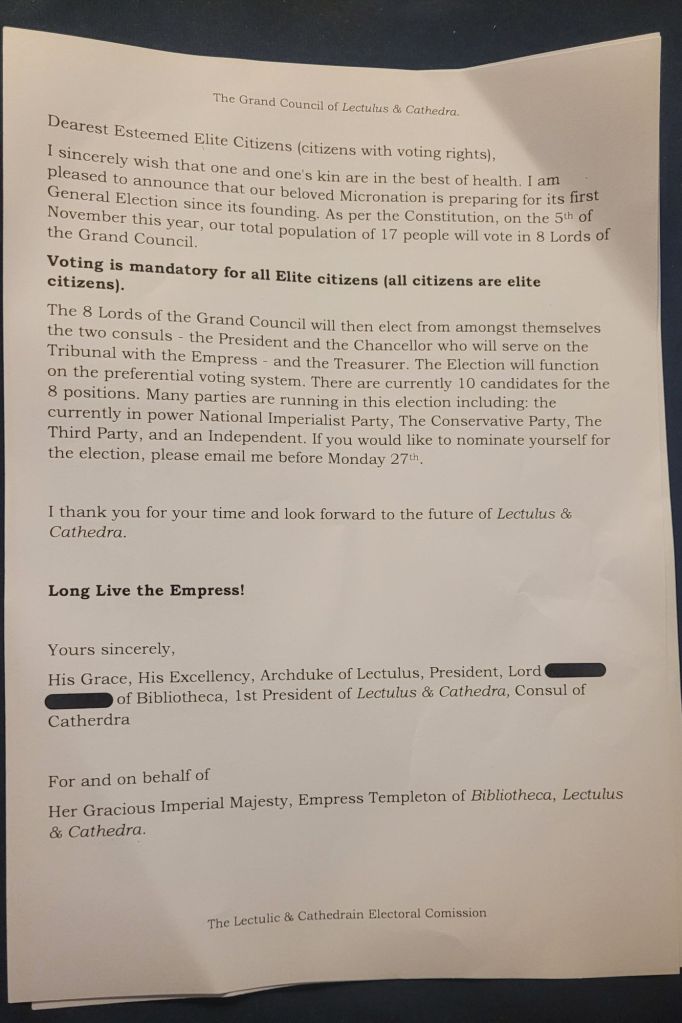
Letter of appeal to voters for the micronation of Lectulus and Cathedra.
Today, this quirky collective has grown to 17 members and is preparing for its first general election on 5 November. What began as a casual connection has evolved into a vibrant community, complete with governance, creativity, and camaraderie—all nurtured within the walls of a school library.
Libraries as Hubs of Wellbeing and Learning
While this story may sound whimsical, it highlights a deeper truth: school libraries are far more than repositories of books. They are sanctuaries of connection, creativity, and wellbeing.
Student wellbeing is increasingly recognised as a priority in Australian schools. Research indicates that poor wellbeing and associated mental health concerns affect between 10–20% of young people (Merga, 2020). In response, the Australian Government launched the “National School Wellbeing Framework” in 2018 to support schools in fostering positive relationships and wellbeing within safe, inclusive, and connected learning communities (Education Council, 2018). Although the framework does not explicitly mention libraries, many of its initiatives can be effectively implemented through a library lens.
School libraries have long served as safe havens for students, offering refuge for a variety of reasons. Merga (2021) notes that contemporary school libraries provide students with a peaceful space to recharge and relax. Similarly, Willis, Hughes, and Bland (2019) affirm that libraries contribute to both physical and emotional wellbeing by enabling vital social connections to flourish.
Merga’s research validates what many educators have long known: school libraries are places where students feel they belong, feel safe, and feel welcome. Some seek sanctuary and solitude; others come to connect and unwind. As school library professionals, our role is to create spaces where young people continue to feel secure—whether they are reading a book, playing a board game or Minecraft, or, as my students do, establishing a micronation on the couch outside my office.
Merga, M. (2020). How can school libraries support student wellbeing? Evidence and implications for further research. Journal of Library Administration, 60(6), 660–673. https://doi.org/10.1080/01930826.2020.1773718
Merga, M. K. (2021). Libraries as wellbeing supportive spaces in contemporary schools. Journal of Library Administration, 61(6), 659–675. https://doi.org/10.1080/01930826.2021.1947056
Willis, J., Hughes, H., & Bland, D. (2019). Students reimagining school libraries as spaces of learning and wellbeing. In J. Franz, H. Hughes, & J. Willis (Eds.), School spaces for student wellbeing and learning: Insights from research and practice (pp. 121–137). Springer. https://eprints.qut.edu.au/126979/
There’s something quietly radical about a group of students gathering to talk about books; in a world of endless scrolls and fleeting attention, the act of sitting together, face to face, page to page, is an act of resistance; it’s also an act of connection. Book clubs are often seen as quaint or optional, but research increasingly shows they are anything but; they are lifelines, especially for boys.
“A space for boys and books is a space for possibility.” — Nichols-Besel et al., 2018
Reading is, by nature, a solitary pursuit; but when we read together, when we discuss, debate, and share, we transform that solitude into community. The National Library of New Zealand (n.d.) emphasizes that social reading increases understanding, introduces diverse perspectives, and fosters authentic engagement; it’s not just about comprehension, it’s about connection. This matters deeply for boys, who often disengage from reading during adolescence. Nichols-Besel, Scharber, O’Brien, and Dillon (2018) found that boys respond positively to book clubs when given access to interest-based reading materials and male role models; their study showed that boys’ engagement and reading outcomes improved significantly in these settings. Similarly, a recent UK study trialed social book clubs across 17 school libraries and found that boys’ reading ages increased by an average of 1 year and 3 months or more than double the expected growth when reading was framed as a social, low-pressure activity (School Library Association, 2025).
“Book clubs create a space where stories become shared experiences, and readers become friends.” — J.N. Polleck (2022)
One of the primary roles of the teacher librarian is to foster a love of reading; this goes beyond managing resources and catalogues, it’s about cultivating curiosity, joy, and lifelong habits. Polleck (2022) argues that youth-led book clubs, especially those facilitated by librarians, are transformative spaces that prioritize student voice, identity, and emotional safety. Book clubs provide opportunities for students to review books, select new titles for the library collection, participate in reading competitions, and model positive reading behaviour for peers; these activities not only build literacy skills but also empower students to take ownership of their reading journey (Cutrer-Párraga & Hall-Kenyon, 2024).
Facilitating book clubs and fostering a love of reading aligns directly with the Australian School Library Association’s (ASLA) Standards of Professional Excellence for Teacher Librarians. Specifically, it reflects the standard that teacher librarians “develop and promote literacy and literature programs that encourage and engage learners” (ASLA, 2004). By creating inclusive, student-led book clubs, supporting reading for pleasure, and modelling positive reading behaviours, teacher librarians demonstrate excellence in both pedagogy and leadership. These practices not only build literacy but also nurture lifelong learning and a strong reading culture within the school community.
For boys, reading can feel like a chore; a subject; a test. But in a book club, it becomes a conversation; a safe space; a place to laugh, question, and be heard. Literacy circles and book clubs allow boys to explore texts in small, student-led groups, which fosters deeper understanding and emotional connection (The Weary Educator, 2024). And yes, food helps; at our school, we’ve learned that no boy can resist a food bribe. Biscuits, humble, crumbly, and beloved, have become our secret weapon; they lure students in, but it’s the stories and the friendships that keep them coming back.
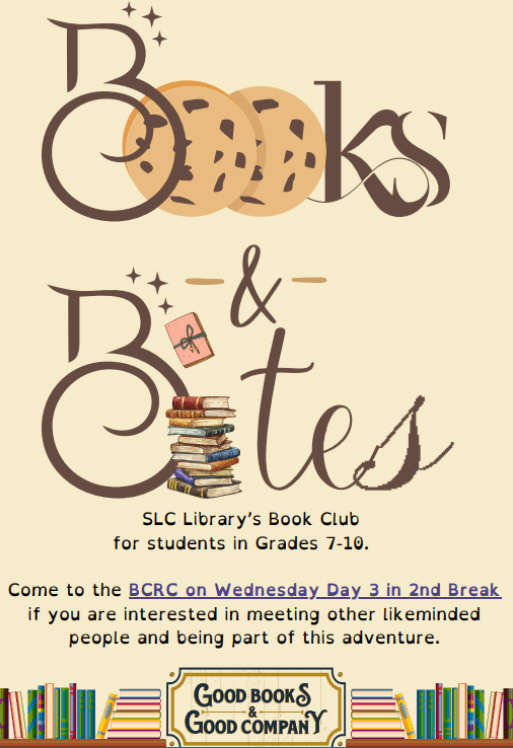
In 2024, our school launched a student book club called Books & Bites for Years 7–9; just six students came. It was small, but it was something. I bribed them with food and with this lure, they came. Now, in 2025, our Years 7–10 club has grown to 28 students; that’s 28 young minds choosing to read, choosing to talk, choosing to belong. Whilst they still come for the biscuits, they stay for the books. Therefore, I felt emboldened with such a strong uptake, and decided to start one for our younger readers. So, this August, we started a primary book club called Lauries Literature Legends. On day one, 15 students turned up. Some came for the biscuits; all stayed for the books. Even more came to the second session… apparently the lure of sitting in the library reading and eating was stronger than playing out in the quad.
Book clubs are not just about literacy; they’re about identity, empathy, and agency. They teach students to listen and to lead; they offer a space where boys can express emotions, challenge ideas, and discover who they are—not just as readers, but as people. In a time when reading is increasingly seen as a subject to learn rather than a joy to experience, book clubs remind us that stories are meant to be shared. So, we’ll keep offering biscuits; we’ll keep making space; because every book club meeting is a quiet revolution, and every student who shows up is part of it.
Today, across the country, we celebrate Australian School Library Day—a moment to shine a light on the heartbeat of our schools: the library.
This year’s theme, All the Literacies, reminds us that school libraries are not just about reading. They’re about empowering students with the full spectrum of literacies needed to thrive in a complex world. As educators, this day invites us to reflect on the transformative role libraries play in our schools and to advocate for the qualified teacher librarians who make these spaces come alive.
More Than Just Books: The Role of School Libraries
Modern school libraries are vibrant, inclusive environments that support curriculum delivery, foster independent learning, and build critical and creative thinking skills (ACT Government, 2022). When led by a qualified teacher librarian, these spaces become central to a school’s teaching and learning culture.Yet in Queensland and beyond, many schools still lack a dedicated library space or a qualified teacher librarian—especially in communities where literacy outcomes are already at risk (Queensland Teachers’ Union [QTU], 2023).
Why qualified Teacher Librarians matter?
Teacher librarians are dual-qualified professionals with expertise in both education and information science.
They:
Collaborate with classroom teachers to support curriculum goals.
Promote reading for pleasure and academic success.
Guide students in navigating digital and print resources.
Create safe, inclusive spaces that support student wellbeing.
Then there is nothing quite like seeing a student fall in love with reading for the first time. That joy is irreplaceable!
Literacy and Wellbeing: A Powerful Connection
Literacy is foundational and not just for academic achievement, but for emotional and social wellbeing. Research shows that reading and writing can significantly support children’s mental health, especially during times of stress (National Literacy Trust, 2020).
This year’s theme, All the Literacies, highlights the many ways libraries support students, from reading and information literacy to digital, cultural, and wellbeing literacy. A well-resourced library is a launchpad for lifelong learning. Emerging frameworks like wellbeing literacy emphasize the importance of teaching students how to communicate about their emotional and mental states (Oades, Robinson, Green, & Spence, 2021).
The Reading Crisis.
Merga (2017) has revealed a troubling trend: while many adolescents possess basic literacy skills, they are increasingly disengaged from reading for pleasure which is known as aliteracy. Between 2017 and 2021, the percentage of Australians who read books at least once a year dropped from 92% to 75% (Merga, 2022). This decline has serious implications for literacy development, academic performance, and future opportunities. Merga’s findings also underscore the vital role of teacher librarians in reversing this trend. By fostering reading habits and building relationships with students, they help bridge the gap between ability and motivation.
Australian School Library Day – A call to action.
Australian School Library Day was created to celebrate the incredible work of school library staff and to raise awareness of the essential role libraries play in education (Australian Library and Information Association [ALIA], 2025). It’s a day to:
Share appreciation for your library staff.
Showcase student voices and library stories.
Advocate for well-resourced libraries in every school.
If your school doesn’t yet have a qualified teacher librarian or a dedicated library space, today is the perfect time to start the conversation.
After all, every student deserves access to a library that supports all the literacies.
Oades, L. G., Robinson, P., Green, S., & Spence, G. B. (2021). Wellbeing literacy: A capability model for wellbeing science and practice. International Journal of Wellbeing, 11(1), 1–27. https://doi.org/10.5502/ijw.v11i1.727
We recently hosted the Year 9 Mathematics cohort for a few lessons over this past term. Traditionally, the Information Centre rarely hosts Mathematics classes, but a recently graduate Mathematics teacher wanted a more collaborative approach to learning. He devised a series of lessons that were aimed at developing the student’s skills in geometry through collaborative learning groups but needed additional bodies and space to ensure it ran effectively. By using the library and its flexible learning spaces to run these collaborative learning sessions, the students were able to gain assistance from their peers, their own teachers and the teacher librarians. This mean that there was more specific support available for facilitating the learning, which led to an overall improvement in student outcomes. From a teacher librarian perspective, these sessions were a wonderful way to develop student learning through collaboration and cooperation, and a fantastic outcome for all.
Classes come to the Information Centre from across the school to access the library for resources, the flexible learning spaces, as well as gain assistance from the teacher librarians. This assistance may be in the form of information seeking, but the fact is that the primary focus of any teacher librarian is to facilitate the teaching and learning of their school community (ALIA & ASLA, 2004). Research from over thirty different studies across the world has indicated that the presence of qualified teacher librarians has a strong positive correlation to improved learning outcomes (Hughes, 2013). This access can occur in a variety of ways but most often occurs in the form of team teaching with the classroom teacher, explicit instruction, targeted assistance with inquiry learning, as well as informal and formal research support, essay writing workshops, the implementation of literacy and numeracy strategies, and various other teaching and learning programs. This breath of access means that the teacher librarians themselves can be considered a resource to improve student learning because they enable students and teachers to use the library and all its resources to its fullest potential (ALIA & ASLA, 2016).
School libraries are more than just book repositories, but rather they are dynamic spaces where information can be accessed, and knowledge constructed for a range of purposes. The reality is that time spent into the library in the pursuit of knowledge often leads to improved efficiency and efficacy because of the qualified teacher librarians that support student learning.
My journey into literature started very traditionally. Like all members of my generation (after boomer but before Z), I learned to read from first readers to chapter books, series fiction and comic books ( more Jughead than Nimona) and all of them in print. Consequently as an adult, my preference for recreational reading is for print and I do use digital journal articles for educational purposes but that is a matter of expediency rather than inclination. As I have documented my reading journey in previous blog posts so I will not go into that again.
(But you are more than welcome to read about my love of reading/books etc. Try this one when I fell in love with reading, or this one about the importance of storytellng, or this one about childhood favourites)
My personal preferences for text formats have leached into my professional practice. As an early career teacher I always favoured print texts for my classrooms because that was the medium I was confident and comfortable using. I was reluctant to explore and use digital literature because I wanted to conserve my faculties for behaviour management and pedagogical practices. I did not want to add in technology and digital literature to my already overloaded self.
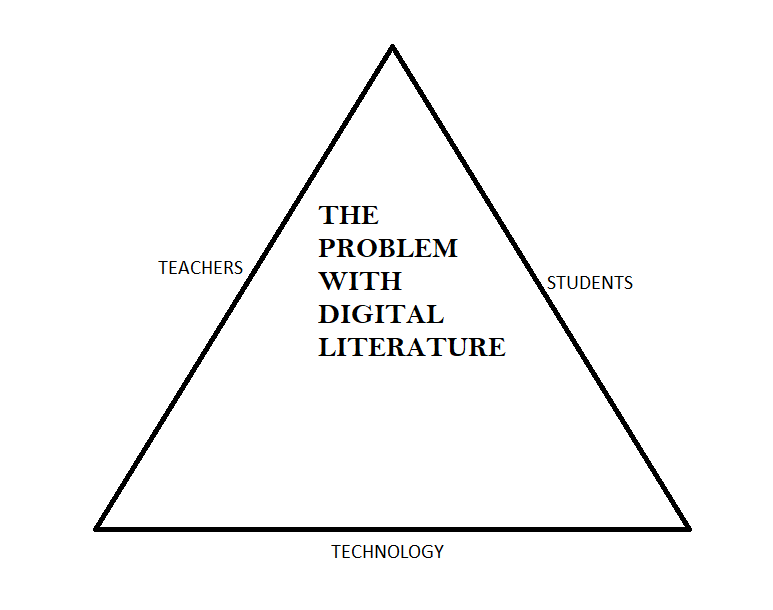
Fast forward two years and my foray into the role of a teacher librarian has forced me to extend my practice into the digital realm. I have learned how to teach information literacy by navigating my way through ebooks, audiobooks and interactive books online. I have downloaded and experimented with book apps, created bento boxes and book trailers. Through this journey of discovery using digital literature and creating digital text, I have come to the conclusion that there are three main concerns when advocating for the inclusion of digital literature in the classroom. These concerns are, students, teachers and the technology itself.
The most commonly cited impediment for the implementation of digital literature into classrooms are the students themselves. I have previously detailed the multitudinal issues relating to reading and comprehension of digital texts in another blog (see here), so I will just give a synopsis now. Besides the usual issues of forgotten, uncharged and missing laptops, many students struggle with reading digital literature because they struggle with visual ergonomics in digital texts. Their inability to locate text leads to reduced comprehension and negative mental representation of the text (Mangen et al., 2013, p.66). This lack of comprehension, combined with poor digital literacy (see this post!) and the fact that many students are easily distracted by games and social media can negatively impact the integration of digital literature in classroom practice.
Teachers themselves are another liability when it comes to the implementation of digital literature in the classroom. Even though AITSL (2017) is very clear in the Teacher Standards that ICT needs to be included in teaching strategies (Std 2.6), and within resources selection (Std. 3.4), there is still a strong reluctance among many teachers to use digital literature meaningfully in their classroom practice. This disinclination to use digital literature could be due to a myriad of reasons as Hyndman (2018) explains in this article. One very pertinent reason is that many teachers feel pressured to suddenly become digital experts as they often assume they need to be the expert so as to instruct and assist students in their learning (Hyndman, 2018). Hyndman (2018) goes on further to say that these feelings of anxiety can exacerbate in schools with BYOD programs as the large variability in student device capability can cause increased technology anxiety. But there is no expectation that teachers be experts in understanding the complexities of individual devices nor in how the digital literature was created, only that they use them in their teaching practice (AITSL, 2017; ACARA, 2014).
The last crucial variable is the literature itself. Digital literature comes in many formats and ranges from scanned books on a website, ebooks, enhanced ebooks, linear narratives, hypertext nonlinear narratives and mobile applications for tablets and smartphones. Each of these literature formats may use different technology, require competency in different literacies and consequently need specific pedagogies for instruction. The combination of these new formats and technologies can be overwhelming for many teachers. Unfortunately, professional development for teachers regarding ICT and digital literature is often ad hoc and lack specific focus, which can inhibit the integration of these technologies into classrooms (Howard & Thompson, 2016).
When you view these issues, it seems evident that the best way to improve the breadth and variety of digital literature in classrooms, is to explicitly motivate, introduce, and teach educators about the various formats and their applicability to classroom practice (Korthagen, 2017; Hyndman, 2018). As teachers we have little control over student’s device selection and swiss cheese memories. But we can have control over our own learning and behaviour.
There are a myriad of learning courses available for teacher education, and teachers are encouraged to extend their professional development. This explicit instruction targeting ICT and digital literacies would be assumed to automatically lead to a cognitive change in teachers, which in turn would correlate to improved integration of digital literature in classroom practice. (Korthagen, 2017, p.390). But this assumption of correlation following a cognitive change is a fallacy as behavioural change requires more than just improved cognition, it requires motivation and affect too (Korthagen, 2017, p. 389-390)!
Therefore it seems foolhardy of ATSIL (2017) and ACARA (2014) to mandate the integration of technologies and multimodal literature into classroom practice without accounting for the requirements of behavioural change (Korthagen, 2017, p. 389-390). Simply dictating teachers to increase digital literature into classroom practice will not succeed in altering their behaviour, as this level of change requires cognition, affect AND motivation (Korthagen, 2017, p.390). Affect not only has an impact on teacher behaviour but also on student motivation. Teachers who are frustrated and disinclined with using digital literature are not going to translate the value of that format to their students. Whereas teachers who gain pleasure from using ICT are more enthusiastic about it, and this has a positive effect on their motivation too. Intrinsic motivation in teaching comes from teachers having a sense of autonomy, competence and relatedness in their profession (Korthagen, 2017, p.391). A teacher that has learned about digital literature, through formal professional developments or informal social learning is more likely to implement those new practices if they are enthused about it and that they can apply this knowledge in a manner of their choice.
So it appears the best way for a teacher librarian to introduce and promote digital literature in schools is to:
Run training sessions for teaching staff and support staff about various digital literature formats and how they meet specific learning outcomes.
Share your ideas, enthusiasm and motivation about digital literature, model, talk, blog and boast about how it works for your classroom, and most of all, be positive and laugh about it – After all, happiness and a smile are way more infectious than COVID-19.
Mantei, J., Kipscombe, K., & Kervin, L. (2018). Literature in a digital environment (Ch. 13). In L. McDonald (Ed.), A literature companion for teachers. Marrickville, NSW: Primary English Teaching Association Australia (PETAA)
Walsh, M. (2013). Literature in a digital environment (Ch. 13). In L. McDonald (Ed.), A literature companion for teachers. Marrickville, NSW: Primary English Teaching Association Australia (PETAA).
More ways in which AR can be applied in a school dynamic.
6. NUMERACY
Numeracy skills can be enhanced using AR. Wu et al. (2013) suggest that students can learn geometry, trigonometry, spatial relationships and collaborative problem based learning by using AR to supplement their learning. Technologies such as the combination of TinkerLamp and Kaleidoscope are popular in Europe and can be used to explore symmetries and congruence. Whereas the mobile application – AR Measure kit is useful in measuring distances, trajectories, angles, height and estimating volume (Cuendet, Bonnard, Do-Lenh & Dillenbourg, 2013).
7. SUPPORT LITERARY ARTS
Hannah et al. (2019) cited several methods in which AR can support the literary arts curriculum. Students are able to create or visit real or fictional sites using the digital interfaces such as Merge cube, so that connections between the content and the real world can be made. For example, Shakespeare comes alive with a tour of Verona, Japanese medieval history can be taught by analysing the structure of Kokura Castle, and students can investigate the structure of a steam engine, all with a single mobile app, a smartphone or tablet and a Merge cube.
8. VISUAL ARTS
A very interesting use of AR is the ability to access and engage in an authentic exploration of real objects in an artificial space (Wu et al. 2013). Many art galleries and museums around the world already have embedded AR to allow users access to additional information about the display, for example, some places use QR codes to inform the user of additional information about the artist or exhibit (Coates, 2020). From a classroom perspective, students can support their own creative pieces by embedding their rationale using Thinglink,Padletor Metaverse, and use QR codes on their paintings, sculptures, photographs or collages to link it to their rationale (Zak, 2014) .
9. LOCATION BASED LEARNING
Wu et al., (2013) suggests that location based learning, such as field trips and excursions, can be augmented by the use of AR. As previously mentioned, many museums, galleries and other institutions have already adopted the use of AR in their spaces (Coates, 2020; Townsdin & Whitmer, 2017). Some of them use the technology to provide additional information to the user about the collection, whereas other places use AR in their maps or tours (Townsdin & Whitmer, 2017). By including relevant information within the augmented space, it encourages more authentic learning, which in turn improves student engagement and learning outcomes (Wu et al., 2013).
Emerging technologies have also been adopted by some council reserves and state national parks as a means to inform users about local flora and fauna. Visitors are able to use their devices and their inbuilt GPS systems to access pertinent information about the site they are accessing (Townsdin & Whitmer, 2017). Some sites also offer remote access and this can be very useful for excursion preparation or for revision purposes. Remote access would also be of great assistance when students are unable to attend excursions or field trips due to illness or pandemics.
10. ASSISTING STUDENTS WITH DIVERSE LEARNING NEEDS
Technology has often been cited as an effective intervention method for students with autism spectrum disorder (ASD) and educators seek methods in which to meet cognitive, behavioural and developmental needs (Sahin, Keshav, Salisbury & Vahabzadeh, 2018). Digital methods are often favoured for ASD students, as they tend to have a preference for electronic media due to their predilection as visual learners (Mahayuddin & Mamat, 2019, p.2176-2177). Additionally AR offers them an environment that supports the tangible manipulation of abstract ideals, as well as a visual image of the learning content, and standardised and predictable outcomes as routine and predictability is very important to students with ASD (Mahayuddin & Mamat, 2019, p.2176-2177; Sahin et al., 2018, p.1).
AR and VR are also able to assist ASD students in developing their socio-emotional skills. This technology allows students to experience the world and its environmental hazards as well as engage and interact with their peers in a socially controlled environment (Sahin et al., 2018, p.2; Riva, Banos, Botella, Mantovani & Gaggioli; 2016). Whilst tablets and smartphones can be used, Sahin et al. (2018) suggests the use of SmartGlasses as they can be preloaded with social and behavioural coaching software. Another benefit is that AR experiences can be tailored and adapted to suit student’s diverse needs, which is important as many experience high levels of anxiety when there is disruption to their learning plan.










 Learning through the Library