Celebrating Australian School Library Day: Why Every School Needs a Library and a Qualified Teacher Librarian

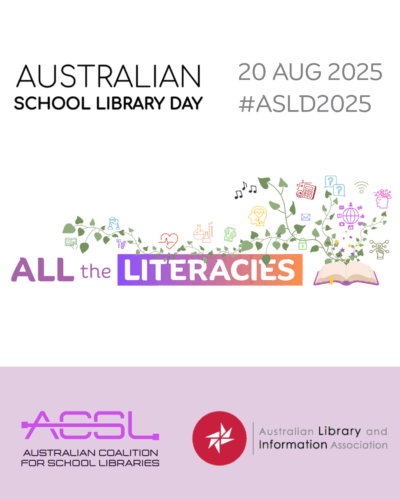
Today, across the country, we celebrate Australian School Library Day—a moment to shine a light on the heartbeat of our schools: the library.

This year’s theme, All the Literacies, reminds us that school libraries are not just about reading. They’re about empowering students with the full spectrum of literacies needed to thrive in a complex world. As educators, this day invites us to reflect on the transformative role libraries play in our schools and to advocate for the qualified teacher librarians who make these spaces come alive.

More Than Just Books: The Role of School Libraries

Modern school libraries are vibrant, inclusive environments that support curriculum delivery, foster independent learning, and build critical and creative thinking skills (ACT Government, 2022). When led by a qualified teacher librarian, these spaces become central to a school’s teaching and learning culture.Yet in Queensland and beyond, many schools still lack a dedicated library space or a qualified teacher librarian—especially in communities where literacy outcomes are already at risk (Queensland Teachers’ Union [QTU], 2023).

Why qualified Teacher Librarians matter?

Teacher librarians are dual-qualified professionals with expertise in both education and information science.

They:

  • Collaborate with classroom teachers to support curriculum goals.
  • Promote reading for pleasure and academic success.
  • Guide students in navigating digital and print resources.
  • Create safe, inclusive spaces that support student wellbeing.

Then there is nothing quite like seeing a student fall in love with reading for the first time. That joy is irreplaceable!

Literacy and Wellbeing: A Powerful Connection

Literacy is foundational and not just for academic achievement, but for emotional and social wellbeing. Research shows that reading and writing can significantly support children’s mental health, especially during times of stress (National Literacy Trust, 2020).

This year’s theme, All the Literacies, highlights the many ways libraries support students, from reading and information literacy to digital, cultural, and wellbeing literacy. A well-resourced library is a launchpad for lifelong learning. Emerging frameworks like wellbeing literacy emphasize the importance of teaching students how to communicate about their emotional and mental states (Oades, Robinson, Green, & Spence, 2021).

The Reading Crisis.

Merga (2017) has revealed a troubling trend: while many adolescents possess basic literacy skills, they are increasingly disengaged from reading for pleasure which is known as aliteracy. Between 2017 and 2021, the percentage of Australians who read books at least once a year dropped from 92% to 75% (Merga, 2022). This decline has serious implications for literacy development, academic performance, and future opportunities. Merga’s findings also underscore the vital role of teacher librarians in reversing this trend. By fostering reading habits and building relationships with students, they help bridge the gap between ability and motivation.

Australian School Library Day – A call to action.

Australian School Library Day was created to celebrate the incredible work of school library staff and to raise awareness of the essential role libraries play in education (Australian Library and Information Association [ALIA], 2025). It’s a day to:

Share appreciation for your library staff.

Showcase student voices and library stories.

Advocate for well-resourced libraries in every school.

If your school doesn’t yet have a qualified teacher librarian or a dedicated library space, today is the perfect time to start the conversation.

After all, every student deserves access to a library that supports all the literacies.

References

Merga, M. K. (2022). Reading engagement in Australian adolescents: Beyond ability. Springer.National Literacy Trust. (2020). Children and young people’s reading in 2020 before and during lockdown. https://literacytrust.org.uk/research-services/research-reports/children-and-young-peoples-reading-2020-before-and-during-lockdown/

Oades, L. G., Robinson, P., Green, S., & Spence, G. B. (2021). Wellbeing literacy: A capability model for wellbeing science and practice. International Journal of Wellbeing, 11(1), 1–27. https://doi.org/10.5502/ijw.v11i1.727

Queensland Teachers’ Union. (2023, May 5). Do you have a qualified teacher-librarian in your school library? Queensland Teachers’ Journal, 128(3), 22. https://www.qtu.asn.au/journal/queensland-teachers-journal-vol-128-2023/queensland-teachers-journal-vol-128-no-3/do-you-have-qualified-teacher-librarian-your-school-library

Beyond the Bookshelf: Why Diverse Stories Belong in Every School Library

In every corner of a school library, stories wait to be discovered. Stories that open minds, build empathy, and reflect the rich tapestry of human experience. But what happens when those stories are missing? When shelves lack the voices of different cultures, identities, and lived experiences?

As an educator and lifelong reader, I’ve come to believe that diverse books aren’t just nice to have in a collection. But rather, that they’re essential. They shape how students see themselves and others, and they help build inclusive communities where every child feels seen and valued.

Representation Matters

Research consistently shows that representation in literature has a profound impact on students’ self-esteem, academic engagement, and social development. When children see characters who look like them, speak their language, or share their cultural background, they feel validated. And when they read about lives different from their own, they develop empathy and understanding.

  • A study by the Cooperative Children’s Book Center found that in 2022, only 33% of children’s books featured characters from diverse backgrounds.
  • According to the Australian Institute for Teaching and School Leadership, inclusive education improves student outcomes and fosters respect among peers.
  • The “Windows, Mirrors, and Sliding Glass Doors” framework by Dr. Rudine Sims Bishop emphasizes how books can reflect our own lives, offer insight into others’, and invite us into new worlds.

Growing up as a teen in Australia, I rarely saw characters in books who looked like me or came from my cultural background. It wasn’t until university that I encountered authors who spoke to my experience, and it was transformative. That moment of recognition made me realize how powerful literature can be in shaping identity and belonging.

One of the most vivid memories I have of feeling truly represented was during a recent trip to Mumbai. I walked into a bookstore and saw the latest issue of India Vogue. I was drawn to it because the cover featured models who looked like me, wore traditional fabrics with pride, and radiated a beauty that felt familiar. I stood there, overwhelmed. For the first time, I saw my heritage celebrated in a way that was bold, glamorous, and unapologetically authentic. That moment reminded me how powerful visibility can be, not just in fashion, but in every form of storytelling.

Now, as a teacher, I’m committed to curating a library space that reflects the diversity of our world. I’ve seen firsthand how students light up when they find a book that resonates with them. As one Year 9 student told me earlier this year when I handed him The White Tiger by Arvind Adiga, “This book feels like it was written for me.” That’s the magic we should strive for.

🏫 What should Teacher Librarians do?

To ensure every student has access to diverse stories, Teacher Librarians and schools must:

  • Regularly audit their library collections for representation across race, gender, ability, and culture.
  • Partner with local communities and authors to source authentic voices.
  • Provide professional development for educators on inclusive literature.
  • Encourage student-led book clubs and reading initiatives that celebrate diversity.

💬 Final Thoughts

Diverse books aren’t just about ticking boxes, they’re about opening hearts and minds. They help students navigate the world with compassion, curiosity, and confidence. When we fill our shelves with stories that reflect the full spectrum of human experience, we send a powerful message: You belong here. Your story matters.

Let’s go beyond the bookshelf—and make every library a gateway to understanding.

Schools as learning organisations.


The leadership and management of a school is heavily dependent on the organisation’s structure and learning culture. 

Small businesses, large corporations and government agencies tend to have an organisational structure that is easily identifiable.  However, schools and other learning institutions rarely adhere to a single framework and are often a medley of theories and are also heavily influenced by external political, social and economic factors.  This variance in organisational framework and external influences can affect the way schools are managed and overall success achieved. 

mohamed_hassan / Pixabay


Buijs (2005) argues that the way education and teaching is viewed has a direct influence on teaching practices.  Consequently, if education and learning institutions are to be viewed as centres of learning, then the focus of that organisation should be based upon pedagogical practices and the achievement of learning outcomes.  Kools & Stoll (2016) elaborate upon this idea further by suggesting that schools are knowledge based organisations with community as a central focus.  This is because learning and learning outcomes are exponentially  increased when students are emotionally supported in the presence of strong relationships.  Consequently the definition of schools as knowledge based learning organisations is more suitable as there is a shared focus on good pedagogical practice, student welfare and a strong emphasis on meaningful relationships.  This means schools will have different organisational needs and require a very different leadership style.  It is also important to remember that schools are not businesses and cannot be run for a profit from an ethical or moral point of view (Kools & Stoll, 2016).  

The reality is that most local schools are part of larger organisations, such as education departments or charters, and or have strong links to religious affliliations.  This means that as part of larger conglomerates, they are not an independent organisation but are at the behest of the policies and procedures of the parent.  This acknowledgement of a parent organisation confirms the presence of machine theory, which can make some schools inefficient and rigid because they are unable to meet the local community due to the largely bureaucratic nature of the overarching organisation.  This can be fairly common in education department schools that have to follow a central path instead of meeting the needs of their local community. 

Besides the presence of the overarching machine theory, most individual schools are aligned along the classic management format with a clearly defined hierarchy of authority emanating from the principalship down to heads of faculty, team leaders and then classroom teachers (Kokemuller, 2017).  This structure is generally very stable as there are distinct channels of communication and in most circumstances staff are compliant  as this system is often replicated across schools and sectors (Kokemuller, 2017). 

Interestingly, few schools adhere to the professional organisational theory even though the teachers are considered to be highly educated and thus should have volition of their professional practice.  This difference could be due to the difference in how teachers view their own organisation and the way the organisation views teachers.  Classroom teachers view their profession as a student centred and have learning outcomes at the focus of their practice. But as schools are often viewed as public property, the actions and decisions made by school leaders are often influenced by the politics and society.  The presence of national curriculums, state syllabi, standardised testing and performance reviews limit the professional autonomy of practice teachers truly have.  These decisions, such as standardised testing, are often used to measure the efficacy of teachers and schools rather than determining and then resolving inequity between students (Berry, 2018).   It also puts into focus the trust and level of professional courtesy extended to teachers themselves by the governing authority and the greater community.


What influences a school’s decision making?

Whilst schools place a system of caring as its focus is beneficial to students, there are some negatives for teachers.  Kools & Stool (2017) argue that using vision and purpose to bind workers to an organisation is not always in the worker’s best interests as it puts the organisation’s vision above the needs of the employee.  Consistently putting the needs of the organisation above the worker can quickly lead to employee dissatisfaction, reduction in morale and increased attrition rates.  This is glaringly obvious when considering the high attrition of teaching staff  due to disillusionment and a lack of support (Stroud, 2017).  Currently, it is touted that over half of people who hold a teaching degree do not currently work in education and almost a fifth of new graduates do not even register as teachers upon completion of their degree (Stroud, 2017).  These statistics do not bode well for schools as learning organisations in the long term.  Schools are learning organisations and should be focused on the needs of their learning community and the relationships that support that learning for staff and students. 

The unfortunate truth is that the education sector is at the behest of public funds and as such are dependent on governmental policies as well as societal expectations.  This means that till there is a consensus about what the actual focus is of schools and other educational institutions, there will continue to be uncertainty about its outcomes, and for the people that work within the system.

The OECD’s report about schools being a learning organisation acknowledges that student learning needs to be the focus of educational institutions (OECD, 2016).  It points out that as a learning organisation, schools need to have the flexibility to adapt quickly to changing circumstances, as well as having the internal frameworks to embrace emerging technologies and innovative practice (OECD, 2016).  It is evidently clear that for students to receive the necessary skills and knowledge required for the 21st century, schools need to have a shared and collaborative approach to learning.  As such, there is a clear need for schools to have a shared vision, a positive culture of learning, support professional development and collaboration, and be able to exchange information freely with the external environment (OECD, 2016, p.1). This type of organisation values its staff members as professionals, and places importance in building those valuable relationships.

Schools are indeed organisations that promote learning and need to have a strong focus on their learning community which includes staff and students.  Unfortunately, education sectors are at the behest of public funds and as such are dependent on governmental policies as well as societal expectations.  This means that till there is a consensus about what the actual focus is of schools and other educational institutions, there will continue to be uncertainty about its outcomes, and the people that embedded within the system.


References:

Buijs, J. (2005). Teaching: Profession or vocation? Catholic  Education:  A  Journal  of  Inquiry  and  Practice, 8; 3. Pp 326-345. Retrieved from https://ejournals.bc.edu/index.php/cej/article/view/590/579

Berry, Y. (March 20, 2018). Time to drop NAPLAN? We shouldn’t treat school like a competition. The Canberra Times. Retrieved from https://www.canberratimes.com.au/story/6021749/time-to-drop-naplan-we-shouldnt-treat-school-like-a-competition/digital-subscription/

Kokemuller, N. (2017). Mintzberg’s five types of organizational structure. Hearst Newspapers: Small business. http://smallbusiness.chron.com/mintzbergs-five-types-organizational-structure-60119.html

Kools, M. and Stoll L. (2016), “What Makes a School a Learning Organisation?”, OECD Education Working Papers, No. 137, OECD Publishing, Paris. http://dx.doi.org/10.1787/5jlwm62b3bvh-en

Laming, M.M. and Horne, M. (2013) Career change teachers: Pragmatic choice or a vocation postponed? Teachers and Teaching: Theory and Practice, 19 (3). pp. 326-343.

OECD. (2016). What makes a school a learning organisation? A guide for policy makers, school leaders and teachers. UNICEF – Office of Research-Innocenti. Retrieved from http://www.oecd.org/education/school/school-learning-organisation.pdf

Stroud, G. (2017). Why do teachers leave? ABC News – Opinion. Retrieved from https://www.abc.net.au/news/2017-02-04/why-do-teachers-leave/8234054