
As a teacher librarian, my work is grounded in a simple but firm belief: literacy and literature must remain at the centre of learning. That does not mean avoiding complexity. It means choosing texts and genres that allow students to encounter complexity in ways that are humane, accessible and developmentally appropriate. Science fiction, often misunderstood as niche or escapist, is one of the most effective literary tools we have to do exactly that.
Science fiction offers students a way to think without feeling interrogated. It creates space for ideas to be explored rather than defended. When students encounter ethical dilemmas, social questions or scientific possibilities through story, the focus shifts from right answers to thoughtful engagement. The speculative distance of science fiction allows students to examine power, responsibility, identity and change without the pressure of personal disclosure or immediate real‑world positioning. This is not avoidance, it is scaffolding.
From a literacy perspective, science fiction is particularly powerful for vocabulary development. Scientific, technical and abstract concepts are embedded within narrative, image and character rather than presented as isolated definitions to be memorised. Students meet words repeatedly, across contexts, wrapped in story. This kind of exposure builds depth of understanding, not just surface recognition. It is vocabulary acquisition without confrontation, learning without the spike of anxiety that can come with academic language when it is taught in isolation.
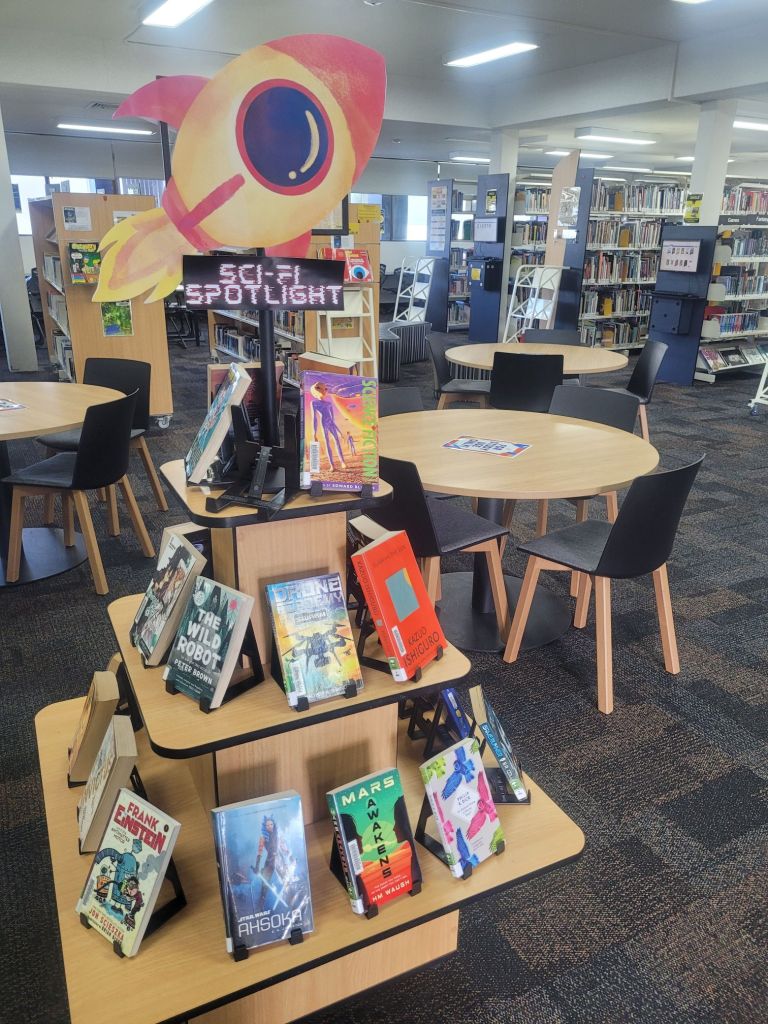
Narratives such as novels and picture books sit at the heart of this work, especially when introducing complex ideas. No one is afraid of a story! Narratives disarm resistance, invite curiosity and slow the reading process in productive ways. A well‑chosen science fiction narrative can introduce abstract ideas such as time, artificial intelligence, environmental collapse or ethical choice without signalling to students that something “difficult” is coming. In particular, science fiction picture books promote the use of imager to carry meaning alongside words, allowing students to construct understanding through multiple pathways. This multimodal entry point is particularly powerful for reluctant readers, EALD students and those who have not yet built confidence as academic learners.
Science fiction has always played a role in shaping how societies imagine the future. Long before deep‑sea exploration or space travel became reality, writers were exploring these possibilities through fiction. That imaginative work mattered. It still does. When students read science fiction, they are not just consuming stories about the future, they are learning how to think about possibility, consequence and change. They practise asking “what if” and “what next?”, questions that sit at the core of critical literacy.
In the library, science fiction becomes a bridge between disciplines. It allows science, ethics, language and social understanding to sit alongside one another rather than compete for space. This aligns deeply with socio‑cultural theories of learning that emphasise language, context and dialogue as central to meaning‑making. Stories give students a shared reference point from which rich conversation can grow. They provide a common text that supports talk, questioning and interpretation, all essential elements of strong literacy practice.
Importantly, science fiction asks students to rethink social dilemmas rather than simply react to them. By following characters through imagined futures, students can explore moral uncertainty, empathise with perspectives unlike their own and consider the long‑term impact of human decisions. This builds ethical imagination alongside analytical skill. It teaches students that thinking deeply is more valuable than answering quickly.
For me, promoting science fiction is not about chasing trends or genre enthusiasm. It is about literacy leadership. It is about selecting texts that honour imagination while strengthening language, that support curiosity without sacrificing rigour. Science fiction does not sit on the edges of serious reading. In a literacy‑led library, it belongs at the centre.
And sometimes, the most powerful way to begin that journey is with a story.
References.
BookTrust. (n.d.). Why children’s science fiction is so important. https://www.booktrust.org.uk/resources/find-resources/why-childrens-science-fiction-is-so-important/
Diyora, S., & Abduramanova, D. (2024). The role of science fiction in enhancing critical thinking and ethical imagination in education. ASEAN Journal of Science and Engineering Education, 4(3), 211–216. https://doi.org/10.17509/ajsee.v4i3.82480
Eason, A. (2024, February 27). The psychological benefits of science fiction. https://adam-eason.com/the-psychological-benefits-of-science-fiction/
Jones, E. (2020, May 24). Sci‑fi and fantasy build mental resiliency in young readers. JSTOR Daily. https://daily.jstor.org/science-fiction-builds-mental-resiliency-young-readers/
Halliday, M. A. K., & Hasan, R. (1989). Language, context, and text: Aspects of language in a social-semiotic perspective (2nd ed.). Oxford: Oxford University Press.
Vygotsky, L. S. (1978). Mind in society: The development of higher psychological processes. Harvard University Press.

