Historical Fiction: Her-stories are as important as His-stories.

History is often presented as a clean line of dates and deeds, with women’s voices muted or missing. Yet when I read historical fiction, I hear those voices rise. It is in the imagined conversations, the textured inner lives and the careful stitching of research to narrative that women like Eleanor of Aquitaine step out from the margins and take their rightful place at the centre of the story. Historical fiction does not replace the archive. It complements it. It gives shape to the silences and lets Her story speak.

Eleanor of Aquitaine has captivated me for years. She was queen of France, then queen of England, duchess in her own right, patron of culture and mother to kings. Even through the writings of men who often judged powerful women harshly, she still appears intelligent, beautiful, strong of will and frequently labelled as wilful. That tension between what the record says and what it leaves unsaid is exactly where historical fiction does its best work. Through fiction, we can inhabit the rooms where the clerks did not sit, hear the words no chronicler bothered to write, and feel the force of a woman who shaped her world.
20260118_2023522374916063472770158

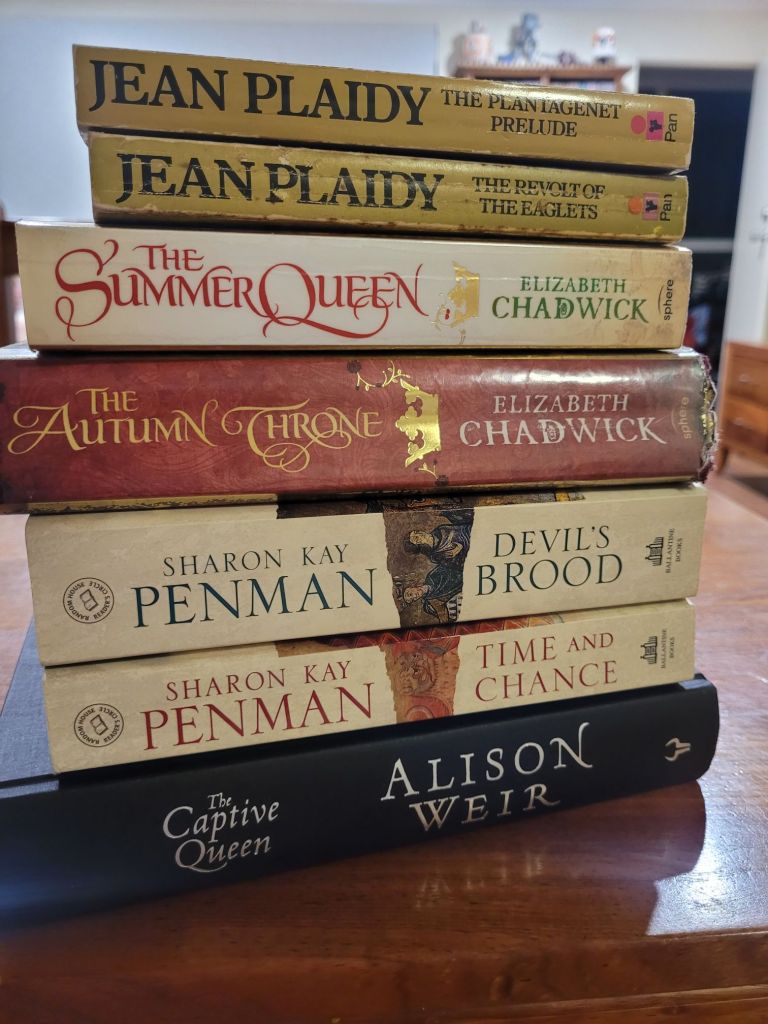
Because I am fascinated by Eleanor, I have read widely across authors who approach her life from different angles over my last summer holidays. Each one balances fact and imagination to reveal a fuller portrait. In their hands, Eleanor becomes more than a figure on a timeline. She becomes a person, with agency, complexity and heart. Reading these books has reminded me again and again that history is not only his story. It is also her story, and it deserves to be heard.

Why Historical Fiction Lets Her Story Speak

Historical fiction gives us the space to ask human questions that sources do not answer. What did courage feel like to a woman whose decisions could alter a dynasty. How did she manage loyalty and love in a world that traded both for advantage. What language did she use for her ambitions, her fears and her hopes. Novelists use careful research and responsible imagination to explore these questions. They do not invent the past. They interpret it with empathy, so that readers can understand lives very different from our own.

For women, this matters deeply. The written record often reflects the priorities of men who held the pen. Fiction can step into the gaps and consider the private sphere where much of women’s labour and influence took place. It can restore friendships, mentorships, rivalries and choices that formal chronicles overlook. Reading such stories changes how we see the past. It prompts us to look again at the sources, to notice what was omitted and to seek out voices that were ignored.

This is why I keep returning to Eleanor of Aquitaine through fiction as well as history. Each book adds texture to the tapestry. Each author brings a new hue to the same thread. Together they create a portrait that feels whole. In listening to these imagined yet carefully grounded voices, we are not abandoning truth. We are widening it. We are acknowledging that history is a chorus, and that Her story deserves to sing just as clearly.

Her life reminds us that the past belongs to all of us. Reading and sharing these novels is one way to make sure that our understanding of history includes the women who shaped it. His story has been told for a long time. It is time for Her story to be heard alongside it, fully and without apology.

So if you would like to know a bit about Her-Story, here are some of the amazing authors who wrote about Eleanor:

Books by Elizabeth Chadwick featuring Eleanor of Aquitaine
The Summer Queen
The Winter Crown
The Autumn Throne

Books by Jean Plaidy featuring Eleanor of Aquitaine
The Courts of Love
Eleanor of Aquitaine: The Young Queen
Eleanor of Aquitaine: The Rebel Queen

Books by Sharon Penman featuring Eleanor of Aquitaine
When Christ and His Saints Slept
Time and Chance
Devil’s Brood
Lionheart
A King’s Ransom

Books by Alison Weir featuring Eleanor of Aquitaine
Eleanor of Aquitaine: By the Wrath of God, Queen of England (non fiction)
Captive Queen (fiction)

Book Review: The King’s Mother

Annie Garthwaite’s The King’s Mother is her second book about an incredible woman, and this sequel is a masterful and emotionally resonant portrait of Cecily Neville, a woman whose strength, ambition, and heartbreak shaped the course of English history. Set against the backdrop of the Wars of the Roses, this novel brings to life a matriarch who was far more than the mother of kings; she was a strategist, a survivor, and a power in her own right.

I was first introduced to Cecily in Sharon Penman’s The Sunne in Splendour, where she stood as a dignified and commanding presence amid the chaos of civil war. Garthwaite’s novel deepens that impression, giving Cecily center stage and allowing her voice to ring out with clarity, courage and conviction. As a daughter of the royal House of Neville, cousin to the Kingmaker and wife to highest ranking Lord of York, Cecily was indeed a lady of influence—but she earned her place in history through grit, determination and sacrifice.

Garthwaite’s storytelling is rich and immersive, capturing the political intrigue and emotional toll of a woman who saw her husband, cousin, and sons die in pursuit of their house’s claim to the throne. Cecily’s love for her children is both her greatest strength and her most painful vulnerability. Her devotion to George, Duke of Clarence, is especially poignant, as his betrayal and eventual death (drowning in a butt of malmsey wine, no less) is rendered with tragic inevitability. Garthwaite doesn’t flinch from the irony or the heartbreak, and neither does Cecily.

What sets The King’s Mother apart is its portrayal of female agency in a world dominated by men. Cecily is no passive observer; she is a political operator, a negotiator, and a woman who understands power and how to wield it. Garthwaite’s prose is elegant and sharp, balancing historical detail with emotional depth. The novel doesn’t just recount events—it explores the cost of ambition, the weight of legacy, and the quiet resilience of a woman who endured more than most.

Cecily Neville emerges as a complex and unforgettable figure, proud, calculating, loyal, and deeply human. Garthwaite gives her the voice she deserves, and in doing so, reclaims a vital piece of history too often overshadowed by the men around her.

Book Review: Cecily

Cecily is a bold and brilliant reimagining of one of the most overlooked power players of the Wars of the Roses, Cecily Neville, Duchess of York. In this incredible novel, Garthwaite resurrects a woman who was relegated to the margins of history and gave her a voice as commanding and complex as the times she lived through.

Kindle edition

History tells us that Cecily must have been a woman of great character. As the wife of a high ranking noble in the English court and a daughter of the house of Neville, Cecily is not merely a noblewoman, she is a strategist, a political operator, and a survivor. In a time where women were relegated to the distaff and the cradle, Cecily held her own among the peers of England and France. I love how Garthwaite has portrayed Cecily. Her use of language and semantics is unapologetically fierce. Cecily is driven, calculating, and deeply loyal to her family’s cause. She is also flawed. Her love for her sons, her only weakness and ultimately will cost her dearly.

The novel spans decades of turmoil, from the fall of her husband Richard, Duke of York, to the rise and reign of her sons Edward IV and Richard III. Through it all, Cecily remains at the heart of the action, not as a passive observer, but as a woman who shapes events from behind the scenes. Garthwaite’s prose is taut and evocative, capturing both the grandeur of court politics and the intimate griefs of a mother watching her family unravel.

What sets Cecily apart is its refusal to romanticise the brutality and heartbreak of medieval motherhood. The heartstrings are definitely pulled when youthink about the number of pregnancy losses, stillbirths and infant losses she experienced. In a time where the childbed was a path paved to the graveyard; Cecily used it to wield power. This is not a tale of damsels and chivalry—it’s a story of power, survival, and the brutal cost of ambition. Garthwaite’s Cecily is a woman of her time, but also ahead of it: she understands the game, and she plays it better than most men around her.

For readers who first met Cecily in Sharon Penman’s The Sunne in Splendour, Garthwaite’s novel offers a deeper, more personal exploration. It’s a fantastic story about a strong woman who lived through unimaginable loss—husband, cousin, sons—all sacrificed for the Yorkist cause. And while her greatest weakness may have been her love for her children, it’s also what makes her so achingly human.

Cecily is historical fiction at its finest: vivid, uncompromising, and utterly absorbing. Garthwaite doesn’t just resurrect a forgotten duchess—she reclaims her legacy.

No surprises that after I read this one, I had to read the sequel.

Book Review – Schindler’s Ark by Thomas Keneally

Book of the Day

Schindler’s Ark by Thomas Keneally was a very dry read.  It was drier than the cheapest plonk at the pub during happy hour.  Now before anyone starts collecting rocks to stone me, I would challenge them to read the book too and then comment.  

I am not denying that the material in the book is powerful.  I definitely acknowledge that the book is filled with names, places and intense facts.  But it is not prose. Upon thinking this further, I recollect the subject of the book and wonder if there is a reason for that.  If the author, in this case Thomas Keneally was aiming for an emotive piece, it would be a character lie. By all accounts, Oskar Schindler was a hard drinking and reckless businessman who cheated on his wife with regularity (Hurvitz & Karesh, 2016).  He destroyed his family business, sought to cheat, lie and swindle his way back into a life of comfort. Quite frankly, by all tokens, this man was an immoral and wasteful character. Then Schindler went on to save almost 1300 Jews from the concentration camps during those dark days in Eastern Europe.  This man, who by the standards of his time, and now; unworthy of attention; put his own life at risk to save others. His actions have been immortalised in a book, a major Spielberg movie production and the term Schindlerjuden or Schindler’s Jews, which is still used to refer to the descendents of those that were saved.   

So when you consider all these facts, the dryness of Keneally’s “Schindler’s Ark” makes sense.  It would be a lie if the book was anything other than prosaic. Instead, its matter of fact manner of describing the main character’s traits ensures that the reader does not view him with rose framed lenses.  The reader is made fully aware of Oskar’s failings as a man and a husband. It is in viewing these failings that Schindler’s true heroism is seen. The plain language allows the reader to envision the fear hiding between the stalwart words.  Conversely, the plain language also allows readers with little imagination to read the book without being overwhelmed.  

“Schindler’s Ark” was a very dry read for someone who is a lover of prose.  As an avid reader of fiction, I found this novel to be more informative than anything else.  I also found it heartbreaking, just like the sadness I feel when the happy hour wine is just awful.  But whilst this book was a struggle for me, it would be ideal for reluctant teens who struggle with engaging with fictitious stories.  The language, style and format of the book resemble information books and thus may satisfy their need for ‘facts’.  But whilst the Guardian review suggests this book as appropriate for 8-12 year old children, I would probably restrict it to students over 14-15 years old.  This would then correlate well with the year 10 HASS’s World War 2 and Holocaust unit especially the ACDSEH025 elaboration.  It would also work well in the Biographies and memoirs unit in Year 10 English.  

 REFERENCES:

Alannahbee, (2013). Schindler’s Ark by Thomas Keneally – review. The Guardian. Retrieved 16th March, 2020 from https://www.theguardian.com/childrens-books-site/2013/sep/25/review-schindler-s-ark-by-thomas-keneally

Axelrod, A. (2013). Schindler, Oskar. In Encyclopedia of World War II, vol. 2. New York: Facts On File. Retrieved March 16, 2020, from online.infobase.com/Auth/Index?aid=19165&itemid=WE53&articleId=265017.

Hurvitz, M. M., & Karesh, S. E. (2016). Schindler, Oskar. In Encyclopedia of Judaism, Second Edition. New York: Facts On File. Retrieved March 16, 2020, from online.infobase.com/Auth/Index?aid=19165&itemid=WE53&articleId=263928.