If you’re looking for books that speak directly to boys—stories packed with action, danger, and emotional grit—Jack Heath is an author who delivers every time. Based in Canberra, Heath has become a standout voice in Australian young adult fiction, known for his fast-paced narratives and male protagonists who face extreme challenges and somehow manage to survive. His books aren’t just entertaining—they’re powerful tools for building resilience, especially in young readers who need to see that courage isn’t about being fearless, but about pushing through fear.
One of Heath’s most popular texts in my school library is the Minutes of Danger series. Each book features ten short stories, each unfolding in real time over ten minutes. Titles like 300 Minutes of Danger, 400 Minutes of Danger, and 500 Minutes of Danger are perfect for reluctant readers, offering bite-sized thrillers that are impossible to put down. The protagonists are often boys who are caught in life-or-death situations. They must rely on quick thinking, bravery, and resourcefulness. These stories are not only gripping but also subtly teach problem-solving and emotional regulation under pressure.
The Liars series takes a different angle, blending tech intrigue with moral complexity. It follows Jarli, a teenage inventor whose lie-detecting app turns him into a target. Across titles like The Truth App, No Survivors, and Armageddon, Jarli navigates a world where truth is dangerous and trust is hard-earned. These books explore ethical dilemmas, the consequences of innovation, and the importance of standing up for what’s right, even when it’s risky. Jarli’s journey is one of growth, resilience, and learning to think critically in a world full of deception.
Then there’s the Money series, featuring Ashley Arthur is based around a teen thief with a conscience. In Money Run and Hit List, Ashley pulls off high-stakes heists while wrestling with questions of morality and loyalty. These books are like Ocean’s Eleven for young readers, combining adrenaline-fueled action with deeper themes about risk, justice, and the blurry line between right and wrong. Ashley’s cleverness and internal compass make him a compelling role model for boys who are learning to navigate complex social dynamics.
“Thrills, Truth, and Tough Choices”
Jack Heath’s literary universe doesn’t stop at young adult fiction—it boldly steps into adult territory with the Timothy Blake series, beginning with Hangman. This marks Heath’s foray into darker, more psychologically complex storytelling, offering older teen readers a bridge into adult fiction. I have recently acquired the series for my school library because these books are perfect for boys who’ve grown up devouring his YA thrillers as they provide a natural progression into more mature narratives. With a protagonist who’s part genius, part monster, and whose moral compass is as twisted as the crimes he solves, the series channels unmistakable Thomas Harris’ Hannibal Lecter vibes, intelligent, disturbing, and impossible to look away from.
For boys’ schools and educators curating their library collections, authors like Jack Heath are essential. His stories don’t just entertain. They shape character. They help boys confront fear, wrestle with ethical decisions, and develop emotional resilience. In a world that often asks boys to be tough without teaching them how to be strong, Heath’s books offer a roadmap. They help boys grow, not just as readers, but as young men learning to navigate complexity, responsibility, and identity.
Jack Heath’s stories are more than just thrill rides. They offer boys a mirror and a map, reflecting their struggles and showing them paths through adversity. His characters don’t have superpowers, but they do have grit, intelligence, and heart. For educators and parents looking to foster resilience in boys, Heath’s books are a goldmine. They prove that strength isn’t just physical, it’s emotional, ethical, and deeply human.
We recently hosted the Year 9 Mathematics cohort for a few lessons over this past term. Traditionally, the Information Centre rarely hosts Mathematics classes, but a recently graduate Mathematics teacher wanted a more collaborative approach to learning. He devised a series of lessons that were aimed at developing the student’s skills in geometry through collaborative learning groups but needed additional bodies and space to ensure it ran effectively. By using the library and its flexible learning spaces to run these collaborative learning sessions, the students were able to gain assistance from their peers, their own teachers and the teacher librarians. This mean that there was more specific support available for facilitating the learning, which led to an overall improvement in student outcomes. From a teacher librarian perspective, these sessions were a wonderful way to develop student learning through collaboration and cooperation, and a fantastic outcome for all.
Classes come to the Information Centre from across the school to access the library for resources, the flexible learning spaces, as well as gain assistance from the teacher librarians. This assistance may be in the form of information seeking, but the fact is that the primary focus of any teacher librarian is to facilitate the teaching and learning of their school community (ALIA & ASLA, 2004). Research from over thirty different studies across the world has indicated that the presence of qualified teacher librarians has a strong positive correlation to improved learning outcomes (Hughes, 2013). This access can occur in a variety of ways but most often occurs in the form of team teaching with the classroom teacher, explicit instruction, targeted assistance with inquiry learning, as well as informal and formal research support, essay writing workshops, the implementation of literacy and numeracy strategies, and various other teaching and learning programs. This breath of access means that the teacher librarians themselves can be considered a resource to improve student learning because they enable students and teachers to use the library and all its resources to its fullest potential (ALIA & ASLA, 2016).
School libraries are more than just book repositories, but rather they are dynamic spaces where information can be accessed, and knowledge constructed for a range of purposes. The reality is that time spent into the library in the pursuit of knowledge often leads to improved efficiency and efficacy because of the qualified teacher librarians that support student learning.
How does a library influence the teaching and learning of a school?
How does a school library, its services and resources contribute to teaching and learning? When I started my course two years ago, my understanding of the capabilities of a library and a teacher librarian was restricted to resourcing the curriculum and providing recreational reading.
Now, five units later, I am starting to become more aware of what a well staffed school library and teacher librarian is capable of.
The above concept map is how I feel my school library contributes to the teaching and learning within the school. I was amazed at how many adaptations I had to make to the original flow chart.
This is my original flow chart of how I thought the library as the information centre contributes to the overall learning outcomes. But flow charts do not show the relationships between areas or how one impacts the other.
For example – The cycle of Pedagogy, curriculum and assessment is continuous and requires regular reviews. For example, pedagogical practice impacts learning outcomes and requires teachers review their practice to ensure best practices is maintained.
But you can’t show those relationships on a flow chart or a hierarchal chart…
Academic integrity is often espoused and bandied about across educational institutions, especially in the first few weeks of every scholastic year.
La Trobe university describes it as shared values and behaviour that includes but is not exclusive to honesty, fairness and responsible practices. This concept of honesty in academia is a two way street. Educational institutions such as schools and universities are obliged to award credit and acknowledge honestly conducted work. Students are responsible for ensuring that their work meets the required standards mandated (LaTrobe, 2019). The onus of practices that promote academic honesty need to be equally addressed by students, staff, executive and organisations. It is not simply the role of a student to avoid plagiarism, but also the role of education to provide them with the skills and knowledge to do so. Additionally, society needs to realise that academic integrity does not start and finish with plagiarism. Plagiarism is just an aspect of authentic academia. Other practices include the creation of assessment tasks that limit the risk of dishonest practices and organisations to adequately address infringements in their policies with appropriate levels of censure that are age and stage appropriate. The role of teacher librarian is multifaceted when it comes to academic integrity. Due to their dynamic position, a TL is able to address academic honesty from a student and classroom teacher (CT) lens and from a department and school perspective.
Academic honesty starts with the classroom teacher. If teachers continuously utilise reputable sources in their teaching and learning, as well as consistently reference them correctly; then they are modeling good practice. Students (and teachers) need to be aware that academic honesty is not just for assessment tasks. Its for all tasks. Like all skills, good research behavioural practices such as using databases, encyclopaedias and journal articles are essential in formulating evidence based assertions. Using disreputable sources does not bode well for your postulations. W. Edwards Deming was quoted in Forbes (2016) that “without data you’re just a person with an opinion”. My experience as a scientist holds me in good authority in championing this point. In the fields of science and mathematics, opinions hold little value. It is the data from rigorously run experiments that define our thinking process. Poorly run experiments with inconclusive data have no value; as do opinions with no justification and evidence. Opinions are fine when limited to coffee preferences but not in academics.
The other aspect of academic integrity within the TL’s and or CT’s realms, is the explicit teaching of information literacy. Information literacy is defined by the ability to find, seek, use and create information and traditionally the domain of TL area of expertise (Kuhthau et al, 2012). IL needs to be taught and then subsequently assessed in order for students to reach proficiency (Jacobson et al. 2018; Qayyum & Smith, 2018, p257; McGrew et al. 2018). It is not passively acquired by the act of completing a research task – but rather, these skills need to be integrated into daily practice to boost competency (Kong, 2014). Part of these practices include the direct instruction of correct referencing techniques. As mentioned before, plagiarism is AN aspect of academic honesty, it is not the entirety.
Whilst it teaching information literacy and the finer points of referencing is essential, it is important to note that the assessment task itself can be a liability to honest practice. Introducing mandatory evidence of progress, drafts and log books are other useful methods in ensuring authenticity of work. Assessment tasks that are repeated at yearly intervals for indefinite periods of time are also very problematic. This is due to the fact that its simplistic to assume that students do not try to seek aid from older siblings and or cousins. Having a maximum time frame of 2 years allowed for a particular task reduces the likelihood of younger relatives plagiarising from older siblings. Another point to note is that nuances of language in assessment task construction can reduce the likelihood of plagiarism. Requesting students to analyse, justify and relate to their community requires higher order thinking skills and is harder to successfully pass off as own work due to the nature of the questions. TL can be of great assistance to teachers in the construction of assessment tasks. Ezard (2019) pointed out that co-creation and collective capacity is the fundamental basis of true collaborative practice (cited in Templeton, 2019). Collaboration between departments and the library can result in a positive sharing of expertise and knowledge resulting in tasks that elicit deep understanding and truly engage the student.
Departmental heads and school administrators have the last word on academic honesty in a school situation. The school policies are the framework in which the academic integrity of the staff and students is based upon. Therefore it is up to the executives to ensure the policies are current with contemporary practices which includes the rapid evolution of technology and the challenges that it brings. They are also responsible to clearly define what constitutes minor, moderate and major infringements and their appropriate consequences. Staff need to realise that a major infringement in middle school is not the same as a major infringement in senior school. A suggestion would be construct a hierarchy of violations that is clearly distributed to students and teachers. This transparency reduces the likelihood of students citing ignorance in their defence. An example of such a hierarchy from ANU, Canberra and Andrews University in Michigan are available for your perusal.
Much has been said so far about how teaching staff can do to promote academic honesty. But in all honesty, students need to also be aware of their role in this dual relationship. Students need to follow the referencing guidelines set by their institution. Whether it be APA, Harvard or MLA citation styles, students need to conform. They also need to refrain from reusing earlier work and badging it as new work. Many students feel that this cannot be plagiarism as its their own material. But what they are unaware of is that they can reference previous works. The most common ways in which students are academically dishonest is collusion and unequal group work. Collusion as Monash University (2019) points out is the “unauthorised collaboration on assessable work with other people”. Frequently unauthorised partners include parents, older siblings, tutors and friends. It is dishonest to present the collaborative efforts of multiple people off as individual work. Group work is a minefield where academic honesty is concerned. It is very common for one or two people in a group to carry the team. This unequal distribution of work is often due to a participant’s absenteeism and or disinterest. Unfortunately, there is no suggestion I can offer as I have been guilty of doing too much in past group assessments in order to pass/complete a task. In my opinion, (no facts), I believe that group tasks should not be used for summative assessments tasks due the inequitable nature of collaborative groups.
Academic honesty is not just for students to follow when submitting their assignments. Rather it is a mindset, a code of conduct, developed during schooling years and manifested in adulthood. As a code of conduct, infringements of this nature need to be treated similarly to infringements of other conduct related behaviour. Simply assigning punitive measures is not conducive to learning and reducing future occurrences. Instead, it is more productive to create a situation in which academic integrity is the norm and best practice for both students and teachers. Academic honesty is more than just plagiarism. Its is the authenticity of your work and the extension of self.
References
Ezard, T., (2019) Leading the Buzz in your school. ASLA 50th Conference. Canberra
Jacobsen, R., Halvorsen, A., Frasier, A., Schmitt, A., Crocco, M., and Segall, A. (2018). Thinking deeply, thinking emotionally; how high school students make sense of evidence. Theory & Research in Social Education. 46, 232-276. DOI 10.1080/00933104.2018.1425170
Kuhlthau, C., Maniotes, L. & Caspari, A. (2012). Guided inquiry design: A framework for inquiry in your school. Libraries Unlimited. USA.
Kong, S. (2014). Developing information literacy and critical thinking skills through domain knowledge learning in digital classrooms: An experience of practicing flipped classroom strategy. Computers & Education. 78, pp.160-173, DOI: https://doi.org/10.1016/j.compedu.2014.05.009
McGrew, S., Breakstone, J., Ortega, T., Smith, M., and Wineburg, S. (2018). Can students evaluate online sources? Learning from assessments of civic online reasoning. Theory & Research in Social Education. 46, 165-193, DOI 10.1080/00933104.2017.1416320
Qayyum, M., & Smith, David. (2018). Changing research behaviours of university students with progression through a course. Journal of the Australian Library and Information Association. 67: 3 pp256-277 DOI: 10.1080/24750158.2018.1502243
I am not sure about you but I found both those books dull, dry and depressing as a teen; and I will say they have not improved with age!
Our graduate English teachers were struggling with the rampant disengagement with those two novels. The indifference was causing the teachers great distress as they were concerned how the students were going to submit their essay assessment task if they would not engage with the book. More experienced teachers were able to forge through the disengagement but our newest recruits were finding teaching the text challenging.
It then occurred to me that memorial boxes could be the answer!
WW2 Memorial Box set up
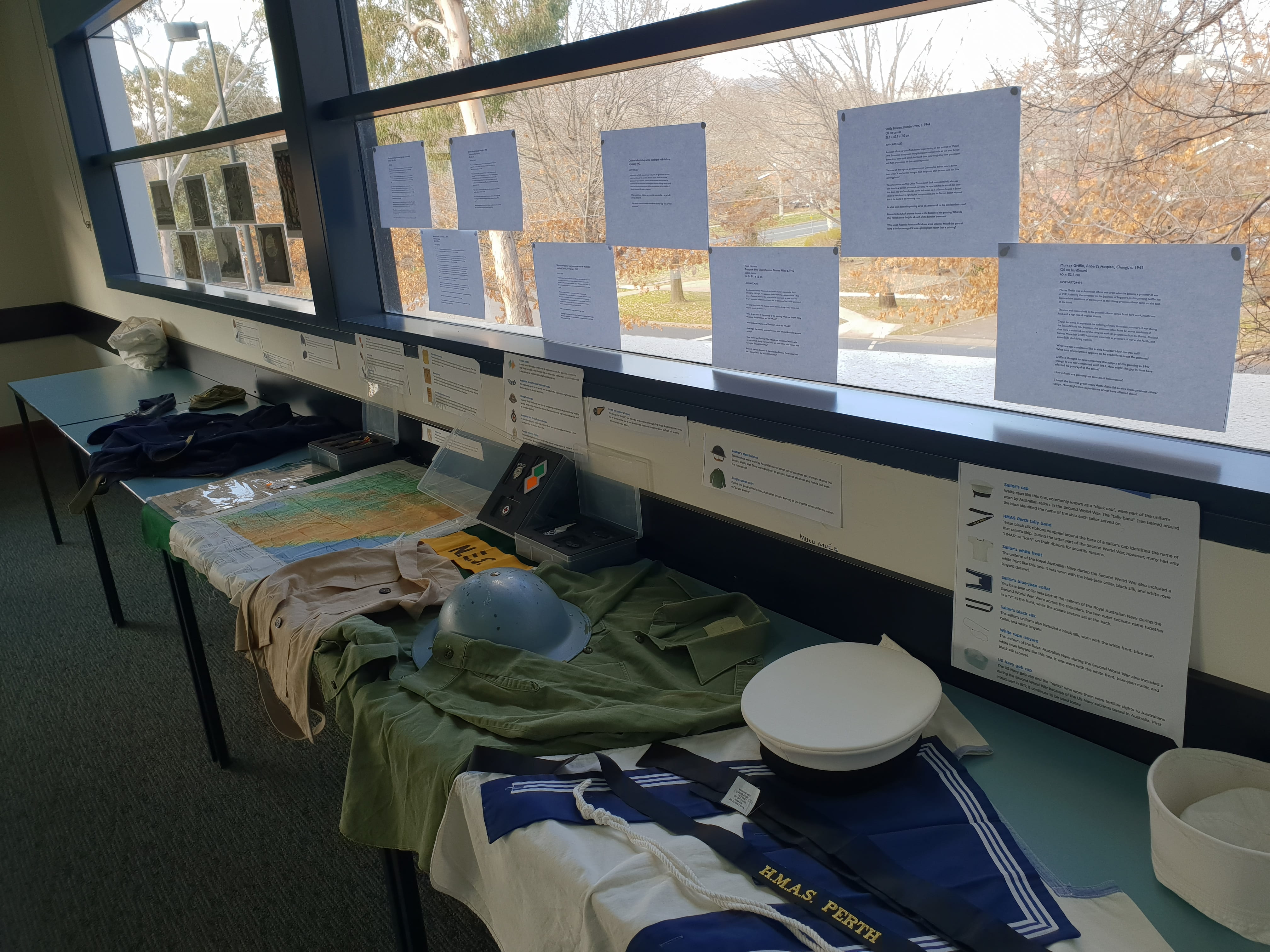
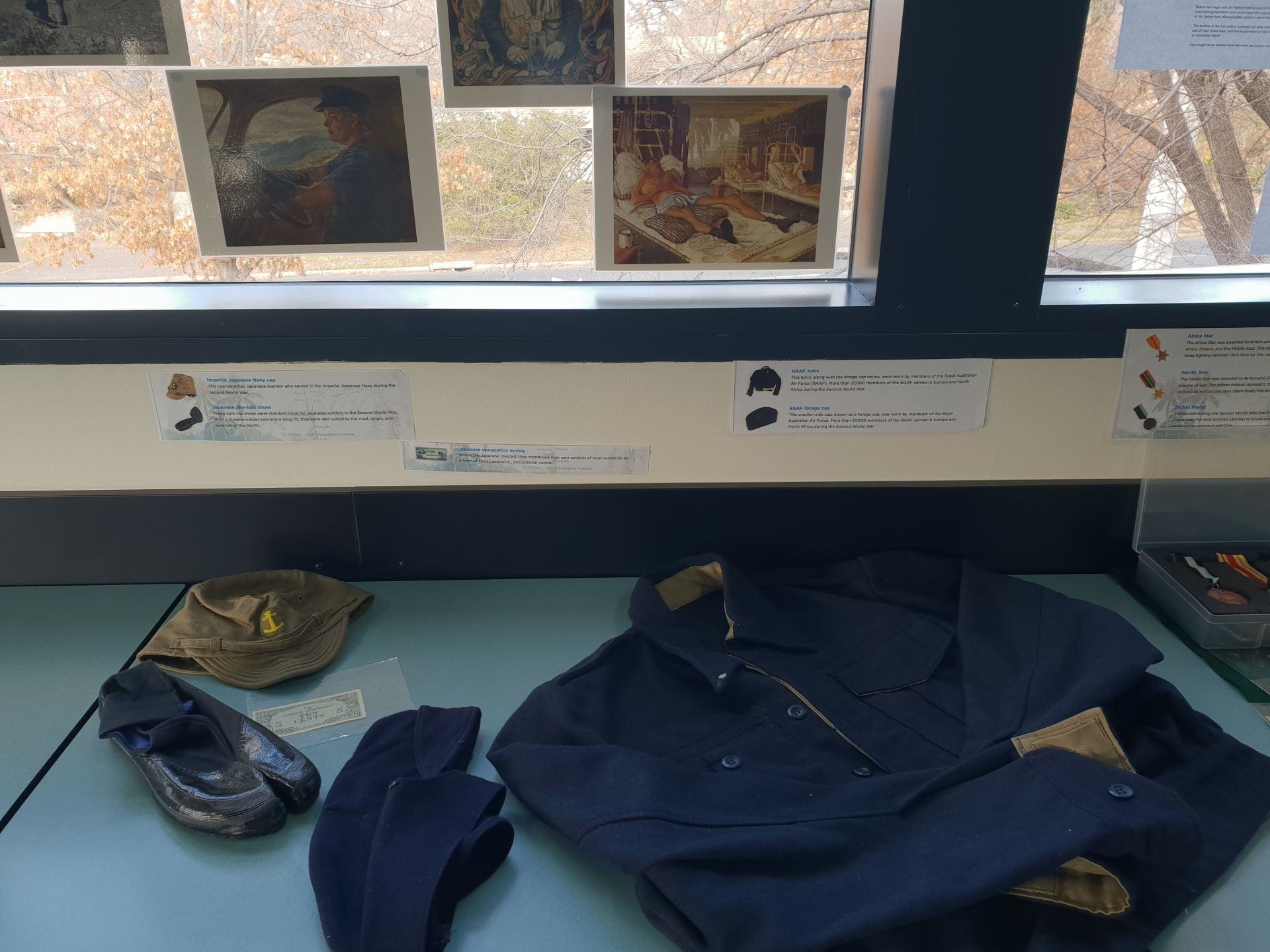
I had discovered that the Australian War Memorial had a whole host of educational resources available for loan to schools in the form of memorial boxes. These boxes contain genuine artifacts from various military events in Australian history. I had requested a box for our 10 History classes earlier this semester as a ‘hook’ factor to engage and elicit interest at the commencement of their World War 2 unit.
Artifacts from the memorial box
My cognitive connection between our great English dilemma and the memorial box was very much delayed! It wasn’t until I was unpacking the resources in our library seminar room that it occurred to me that the same artifacts that were engaging our Year 10 history students could also stimulate our year 7 and 10 English students.
I had an epiphany of sorts!
I was so happy my HOD agreed with my madcap proposal about using the memorial box as a stimulus for English. The scheme was simple. The students would come to our ‘library museum’ and view the various artifacts displayed within. Then in pairs, the students would interview each other to create a podcast with an accompanying transcript. A very clever English teacher quickly whipped up a worksheet and then, just like that… our immersive experience had begun.
Pictures and Memorabilia
Now I would love to tell you it was all a huge success, but I would be lying.
The memorial boxes were a great triumph with our 10 History students but success was variable with our English classes. This lackluster response could be attributed to the inadequate time for the students to complete the activity. The classes that visited the library twice had more success than ones that came just once.
What we did discover was that students were stirred out of the apathetic stance towards the books because they began to understand the context surrounding it. The memorial box activity connected the students to the mileu of the books and engaged them in the character’s turmoil. As the worksheets were collected at the end of the session, the teachers were able to use those responses to formatively assess student literacy and other learning goals.
The in class essays are all occurring this week for year 7 and next week for year 10. I would be very intrigued to know if the memorial boxes assisted in increasing student engagement with the books and the outcome of the assessments. I would also like to analyse the results of the English classes that declined to attend our library museum and compare them to the classes that did come. If there is a significant difference, then I would have sufficient evidence to run this activity for more teachers and students.
It would come as no surprise to any of you that education budgets are constantly being stretched.
The slow erosion of funding has led many schools to debate the value of their resources to determine which ones need to be cut in order to survive fiscally. Unfortunately, school libraries are the department that is being most adversely affected. This adverse effect can be seen either by the absence of a qualified teacher librarian and or the complete absence of a school library. Cook (2018) suggests that libraries are robbed of their funding because they are deemed useless in this internet age. I have spoken previously about the importance of a teacher librarian so this post is not about that. But some schools, overburdened by numbers, convert their library spaces into additional classrooms. When this occurs, most often than not, these schools sometimes set up classroom libraries to combat the loss of a school library.
According to Cook (2018), libraries are essential to a school’s success.
But are classroom libraries the same as having a school library with a qualified teacher librarian? We are all aware that exposure to books is positively correlated to improved literacy (Neuman, n.d.). We are also know that not all households have the same bibliophilic tendencies. This means that there are a proportion of students who are not exposed to books in the home. Neuman (n.d.) elucidates that it is the presence of books in close proximity that correlate directly to increased literacy.
Schools historically are known for exposing young minds to the wonderful world of imagination and literature via the school library. But with no school library, is the alternative a classroom library? But what if the classroom library is poorly executed? By executed, I mean poorly stocked and unable to meet the needs of the students. This can lead to limited student engagement with the classroom materials and if there is no school library, then there is no safety net for these disengaged readers. Implementing an assortment of books in a box is not equivalent to the presence of a qualified professional. After all, teachers are not trained in information management and resourcing, and it seems foolhardy to leave the resource management to at the hands of an already overburdened classroom teacher.
One suggestion is that the classes each have their own classroom library but they are managed by a teacher librarian.
So rather that rather than a random assortment of materials, the books are carefully curated by the teacher librarian to meet the evolving needs of the students. An example of this would be a box of books are rotated in regular intervals and that the reading levels within are appropriately aligned to the needs of the students (Sacks, 2018). But whilst in theory is outstanding, the practicality is far more complicated. Sacks (2018) surmised that consistency and equity are the largest issues with classroom libraries as the titles will vary between classes. The primary problem is that schools would need to almost double their collection for them to adequately service the needs of all their classrooms. This would incur extra costs for the school. There would also be greater difficulty in tracking the books and ensuring that they are maintained.
The downside of having a teacher librarian manage physical classroom collections is that they are then limited in their ability to create, manage and implement information literacy programs.
Lance & Kachel (2018) indicate that the research is clear about the correlation between high quality library programs and increased student achievement. Frierson & Virtue (2013) believe that it library programs that need to be embedded into classroom practice. They go on to illustrate that this improvement is not just for affluent schools but for all schools. In fact, arguably the lack of a school library is discriminatory to students from lower socio-economic backgrounds, that do in desperate fact, require regular access to libraries, their programs and books in order to engage equitably with educational practices.
There are currently teacher librarians in Australia that are creating LibGuides that are specifically relevant to units of work and use the school’s learning management systems to reach their audience.
This method also means that students that are away from school due to ill health or other personal reasons are still able to engage with their learning off site. An example of this would be the class novel study with appropriate supporting materials and related works. So with our Year 7’s currently studying the Jackie French novel “Hitler’s Daughter”, the LibGuide contains the ebook version as well as; study notes, worksheets, supporting extracts from other similar novels such as “Boy in a wooden box” by Jim Boyne, “Book Thief” by Mark Zusack and “Dollmaker of Krakow”by R M Romero. I have also created an online museum with images relating to the book where students can view artefacts and watch short video-clips.
All of this take time. Time that I have because I am not curating classroom library boxes. But if I was not there, or if the position of teacher librarian was not there, then students would not have access to these resources. Yes, there are teachers who do have the time and energy to go beyond the normal to create amazing learning experiences for their students. But with 50% of teachers leaving the profession within 5 years, and nearly ⅓ of employed teachers suffering from a mental illness and or addiction, overburdening them further is foolish.
My closet is a veritable rainbow of pretty dresses, skirts, tops and cardigans. Each item is lovingly washed, ironed and replaced in its place with care. Starting from the right, the dresses start as formal, and work their way to day dresses, before moving on to skirts, tops, cardigans and jumpers. In each subsection they are further organised by colour. At a glance, I can see what I have hanging up and locate an item with ease.
Then my husband comes along to ‘help’. He ‘helps’ by putting away my carefully washed and ironed dresses by shoving them into the wardrobe in whatever spot seems available. Needless to say this causes me mild panic when I cannot find my ‘Florelle’ (orange cotton dress) which should be in between ‘Neroli’ (yellow print dress) and ‘Melody Rose’ (orange print dress). Instead ‘Florelle’ been shoved between ‘Cascade’ and ‘wish upon a star’ (both black and white patterns).
I was horrified. How on earth was I supposed to find my precious dress buried in the wrong spot???
My husband was miffed. Here he is helping me by putting away my clothing all I am doing is complaining.
Apparently my wardrobe organisation is too complicated to understand, and I have too many dresses that look exactly the same.
Now I was miffed. I certainly do not. There are nuances between them and I definitely do not have too many clothes. (note that picture of my wardrobe was from January 2019 and I can honestly say I have added a few (maybe more than a few) to that collection since then.
But I digress.
This blog post is not about my dress acquisition nor my marital disagreements about my wardrobe organisation or Imelda Marcos tendencies.
Instead, this post is a prelude to the subject that I will commence tomorrow morning. ETL 505 will open my mind to how resources are cataloged. I will learn how the records are created and use that information to benefit the users within my community. This knowledge will also help me with giving constructive feedback to metadata specialists as part of my role as a TL.
Last semester in ETL 401 I learned about what the role of a TL encompasses as a whole. In ETL 503 I learned how important it was to correlate the resources within the library to the curriculum. This is simply because the point of a school library is to address the needs of the curriculum. This semester, it appears my learning is aimed more at the librarian aspect of a TL than the teacher component. As an information specialist and information services manager, my role involves ensuring that the collection is easily accessible by the student population using the information management system available.
To sum it up succinctly. I need to learn how a library is organised so that the kiddos can use it successfully.
The point of organisation is to easily find and locate an item when you wish to use it. How it is organised depends on who is doing the work, but the underlying point is ACCESS! If the item cannot be found and used when it is needed, then the system is broken. The resource is underutilised and the monies wasted. In school libraries this is a travesty when budgets are often stretched and funds scant.
Libraries are famous for their organisation.
Neenuvimalkumar – Pre computerised Library management system
Dear ole Mr Dewey revolutionised the information world with his Dewey Decimal System. Known famously as the ultimate in organisation and classification, DDS organises the information within a library into groups and then further divisions for specifics areas (Encyclopaedia Britannica, 2018). Due to its comprehensive and adaptive nature, the system is universally used across the world (OCLC, 2019). A bibliophile in New York city can find a book about Bonnie Prince Charlie in the same location as they would in a suburban library in Melbourne’s suburbs.
But information isn’t so simple in this modern day. Gone are the days where libraries only stocked books and maps. A modern day library will have shelving of books, but will also have access to other formats such as videos, audiobooks, eReaders and images. All of these resources need to be catalogued and organised so that they can be accessed by the user. They also need to be differentiated within the catalogue records so that the user can easily identify that their request for ‘The Odyssey’ includes versions of the epic tale, even if the creator and format differs.
So as the last day of my uni holidays draws to a close I ponder the knowledge I will gain from this subject. I am a bit apprehensive as the assessment tasks are not essays but rather more practically based tasks. I am far better at blathering out epochs than being useful. So this may be a steep learning curve for me. Also, I burnt out a bit last semester so I am just doing the one subject now.
I thought I had exhausted this topic, but then it occurred to me that I have not reflected upon my own understanding of information literacy and how that impacts the role of a Teacher librarian.
…….Eh… What? More words?
Let us review what I have learned this semester… (briefly, I promise!)
Literacy levels are reducing (Lanning & Mallek, 2017).
IL is poorly articulated and not embedded across national curriculum (Farmer, 2014; Lupton, 2014)
…an attempt was made (Bonanno & Fitzgerald, 2014) but it was poorly planned and executed (Why not review my review of Lupton’s review 2014?).
IL needs to be explicitly taught and assessed so that students see its value (Jacobson et al. 2018; Qayyum & Smith, 2018, p257; McGrew et al. 2018)… and please don’t say just do a research task and the skills will be accidentally learned. It won’t (McGrew et al. 2018).
Evidence shows that Inquiry learning improves information literacy (Kuhlthau et al, 2012) as well as boosting…
student motivation and self-regulation (Buchanan et al. 2016).
Curriculum embedding of IL is important (McGrew et al. 2018; Berg, 2018) and
classroom integration of IL boosts IL competency (Kong, 2014)
Lack of IL leads to poor decision making skills and life outcomes (Berg, 2018; Wood, 2017; Kachel, 2016)
The lightbulb moment came about…. NOW!
Donna did phrase it better when that light switched on. BUT I do digress…
Anywhoo… back to the task.
So from the readings and modules in this semester I can deduce:
There is a need for a IL framework in schools.
IL needs to be a planned learning experience
that allows students to build new IL skills upon prior knowledge. (Christy reckons from kindy and I agree!)
Therefore, IL needs to be embedded across the curriculum and year levels,
BASICALLY – Schools and education departments need to have a framework that addresses IL and implement a school-wide approach for the best outcome… on an aside, I find it amusing that P E Island on the Canadian east coast has such a policy. Anne Shirley would have been so proud!!
There are numerous ways that IL can be implemented in schools but for the sake of efficiency and word count, I am going to fast track the the conversation to what matters to TL in schools.
It is based upon extensive research. As a practicing scientist for many years, I am a great believer in basing my practice on research and evidence. GID is considered the GOLD standard, which is AMAZING for my neurotic brain!
GID places equal importance on the cognitive and affective aspects of the ISP. Affect plays a strong role in student (and my) motivation. So by understanding when students are having low affect, guidance and mediation can help them overcome this hurdle successfully
Naturally, there are difficulties in implementing Inquiry learning in schools. The presence of standardised testing, is a big prevention of authentic teaching and learning within schools (… there is an elephant in the room…). And unless ACARA and government bodies realise this, then inquiry learning may always struggle to gain a strong presence in all the KLAs.
Oh look – The elephant’s name is NAPLAN!
So what does this mean for me?
A TL role in schools is no longer just about books, referencing and plagiarism lessons (Lanning & Mallek, 2017). Rather, the role has become more dynamic in nature, much to my surprise.
As you can see, a TL does more for IL than just occasionally teach a class about referencing. Rather, a TL implements a framework that embeds important literacy skills into and across the curriculum. This makes the role of a TL extremely important to students, schools and the wider community.
Buchanan, S., Harlan, M., Bruce, Christine S., and Edwards, Sylvia L. (2016). Inquiry based learning models, information literacy, and student engagement: A literature review. School Libraries Worldwide. 22(2), pp. 23-39.
Garrison, K., and FitzGerald, L. (2016). ‘It’s like stickers in your brain’: Using the guided inquiry process to support lifelong learning skills in an Australian school library. A school library built for the digital age. 45th IASL Annual conference. Japan.
Jacobsen, R., Halvorsen, A., Frasier, A., Schmitt, A., Crocco, M., and Segall, A. (2018). Thinking deeply, thinking emotionally; how high school students make sense of evidence. Theory & Research in Social Education. 46, 232-276. DOI 10.1080/00933104.2018.1425170
Kong, S. (2014). Developing information literacy and critical thinking skills through domain knowledge learning in digital classrooms: An experience of practicing flipped classroom strategy. Computers & Education. 78, pp.160-173, DOI: https://doi.org/10.1016/j.compedu.2014.05.009
Kuhlthau, C., and Maniotes, L. (2010). Building guided inquiry teams for 21st century learners. ZZ School library monthly. Volume 26: 5.
Kuhlthau, C., Maniotes, L. & Caspari, A. (2012). Guided inquiry design: A framework for inquiry in your school. Libraries Unlimited. USA.
Kuhthau, C., Maniotes, L., and Caspari, A. (2015). Guided inquiry: learning in the 21st century. 2nd Edition. Libraries unlimited, USA.
Lanning, S,. and Mallek, J. (2017). Factors influencing information literacy competency of college students. The Journal of Academic Librarianship. 43: 443-450. DOI: 10.10.16/j.acalib.2017.07.005
McGrew, S., Breakstone, J., Ortega, T., Smith, M., and Wineburg, S. (2018). Can students evaluate online sources? Learning from assessments of civic online reasoning. Theory & Research in Social Education. 46, 165-193, DOI 10.1080/00933104.2017.1416320
Qayyum, M., & Smith, David. (2018). Changing research behaviours of university students with progression through a course. Journal of the Australian Library and Information Association. 67: 3 pp256-277 DOI: 10.1080/24750158.2018.1502243
Ricaurte, P. (2016). Pedagogies for the open knowledge society. International Journal of Educational Technology in Higher Education. 13:32 DOI: 10.1186/s41239-016-0033-y
Thomas, J., Barraket, J., Wilson, C., Cook, K., Louie, Y., Holcombe-James, I., Ewing, S., and MacDonald, T. (2018). Measuring Australia’s Digital Divide: The Australian Digital Inclusion Index 2018. RMIT University, Melbourne, DOI: https://doi.org/10.25916/5b594e4475a00
School libraries (SL) are more than books on shelves. To a fledgling teacher librarian (TL), libraries often imagine warehouses, where books awaits death and then reincarnation at Lifeline. The reality is different; collections are not inert. SL are dynamic; they constantly evolve to suit the needs of their community.
Framework = DNA
What makes a SL so dynamic? Well, like any organism, it’s all in the DNA, or for SL, it’s in the Collection Development and Management Policy (CDMP). The CDMP is the DNA of a SL and contains strategic data for growth in today’s splurge and is flexibliity in tomorrow’s freeze. If the DNA of a SL is without clear direction and missing data, then its ability to thrive, or even survive is in jeopardy. Consequently, TL need to be aware of the duality of a CDMP that prepares the collection for today’s needs, and tomorrow’s growth.
Not faint hearted
A school CMDP exists primarily to address the curriculum, the teaching and learning needs of its community as well as provide well-being (IFLA, 2015; ASLA & VCTL, 2018). Therefore, the policy needs to clearly reflect those needs when framing the purpose, selection principles, acquisition and censorship procedures. Along with other maintenance endeavours such as deselection and collection evaluation; all whilst staying within budget, bolstering literacy and well-being. It is not a small task and definitely not for the faint hearted. But then TL are not faint hearted (Templeton, 2019a).
The development and management of a collection involves many facets.
Print or Digital?
Understanding the information evolution and its implications on education and wider society is crucial. TL need to be aware that previous resource acquisition has evolved now into information facilitation paradigm (Kelly, 2015). With publishers rapidly changing their delivery from print to digital formats (Templeton, 2019b), the repercussions on formats and licencing are momentous.
Knowledge of how resources may be packaged for cost efficiency, and evaluatingthat against the value of each of those titles is a challenging task (Templeton, 2019c; Templeton, 2019d. (Module 2 – Online Access)(Module 2 – Bundling together)
Being able to manage collections thriftily is necessary when SL budgets are constantly squeezed (Softlink, 2018; Templeton, 2019e).
Awareness of censorshipand its role in SL (Templeton, 2019g).
Challenging the censors
Linking budget to student population is an effective manner to secure funds that suit the growth/decline of the school community (IFLA, 2015, p.6) versus being dependent on yearly fixed sums.
Besides building a collection, a CDMP contains procedures that maintains its value and its ability to service the needs of their community.
Measuring outputs and outcomes are useful in analysing the effectiveness and efficacy of a collection (Templeton, 2019h).
Being able to link the collection value to qualitative and quantitative data validates the collection and program (Templeton, 2019i). A recent study by Sutton et al., (2017) show that altmetrics are useful in the evaluation of collections. Power (2019) suggests that both qualitative and quantitative methods are used.
Linking educational outcomes to collections as evidence for continuing financial support for resources, especially digital subscriptions, is judicial. Journal subscriptions are very expensive and a TL would need to prove value if there is insufficient evidence to indicate positive outcomes (Jubb et al., 2017). Journal databases, like many other electronic resources, may be economical up front, but often require long term subscription.
Technology is rapidly changing and consequently now, the same information is available in multiple formats. TL need to be aware of this paradigm when committing to subscription resources as it is more than just a commitment for the current cohort of students (Anderson, 2008). It is a financial commitment for future generations.
A strong CDMP ensures that a library collection addresses the needs of their community, and the rewards are high resource outputs and user outcomes. What TLs all over the world do not want are libraries with numerous books that are not utilised or under utilised. Tsundoku is the affliction of purchasing resources that no one uses (Templeton, 2019j).
An unusedcollection is an ineffective collection. It is very hard to justify a collection that has failed to prove their value their community. It is even harder to justify the presence of TL with a collection that is not relevant.
REFERENCES for BLOG
Anderson, R. (2008). Future proofing the library; Strategies for acquisitions, cataloguing and collection development. The Serials Librarian. 55 (4). doi:10.1080/03615260802399908
Jantti, M., and Cox, B. (2013). Measuring the value of library resources and student academic performance through relational datasets. Evidence Based Library and Information Practice. 8 (2), 163-171. {Conference Paper}
Jubb, M., Rowlands, I., and Nicholas, D. (2013). Values of libraries: Relationships between provisions, usage, and research outcomes. Evidence Based Library and Informative Practice. 8(2), 139-152 {Conference Paper}
Kelly, M. (2015). Collection development policies in public libraries in Australia: A qualitative content analysis. Public Library Quarterly. 34, 44-62
Sutton, S., Miles, R., and Konkiel, S., (2017) Is what’s “Trending” whats worth purchasing? Insights from a national study of collection development librarians. The Serials Librarian. Vol 72 (1-4) pp.134-143. DOI 10.1080/0361526X.2017.1297593
Teacher librarians and Principals have a symbiotic relationship in which each person’s role is intricately woven into each other (Farmer 2007). Principals are the leaders of a school. Their role is to create a culture of learning that enables effective teaching practice and promotes learning that is independent, enthusiastic and with life long potential. Teacher librarians collaborate with principals to make this vision into reality by taking this vision of academic integrity and making it real. How do T/L do this?
We collaborate with heads of departments to embed the general capabilities into the curriculum across units of work and year levels (Haycock 2007). We work with individual teachers in creating units of work that are creative and inspire deep thinking. We work with the inclusive education department to help structure modified units of work that promote equality and equity. We resource the library with materials that encourage students to engage with the content, promote literacy via recreational reading programs, and we do it wearing co-ordinated twin sets with pearls (Lipton 2016).
Principals enable teacher librarians by enabling the teacher collaboration that is essential for TL practice. They agree to school wide reading and digital literacy programs. They minimise or eliminate teaching lines so that we can dedicate our days to assisting our colleagues in their professional practice. Principals who need teacher librarians give them time and money to do their job. Teacher librarians need principals who value and respect them, their roles and their positions in the school.