There are books I return to not because I’ve forgotten the plot, but because I remember how they made me feel. Like Serena Bourke’s thoughtful reflection on why students reread the same book, I too find comfort in the familiar pages of my favourite titles. These books have become more than stories. They are companions. They are constants. They are friends.
When I’m happy, I reach for books that mirror my joy. Stories that sparkle with wit and warmth. They amplify the moment like music that makes you dance even harder. But when sadness creeps in, I turn to different titles. Not necessarily ones that cheer me up but ones that understand. Books that sit quietly with me, offering solace without demanding anything in return. They don’t fix the sadness inside, but they make it feel seen.
And when I feel unsettled, adrift in the chaos of life, I go back to books that anchor me. Their words are familiar. Their rhythms soothing. I know what’s coming next and that predictability is a balm. It’s like rewatching a movie you’ve seen a dozen times. You’re not watching it for the plot. You’re watching it to relive the feeling you had the first time. The laughter, the tears, the quiet awe. But some books have become emotional landmarks. I remember where I was when I first read them. The scent of the room. The season outside. The version of myself that turned each page. Rereading them is like visiting an old friend. You pick up right where you left off. No explanations needed.
There are specific titles I reach for depending on how I feel. I reach for something like Anne of Green Gables when I’m happy. It’s full of whimsy, imagination, and the kind of joy that makes you want to skip down a pathway and play hopscotch. When I’m sad, maybe The Little Prince or The Secret Garden. There’s something quietly profound about their simplicity, gentle wisdom, and a strong reminder that what’s essential is invisible to the eye. I read Jane Eyre when I’m feeling overwhelmed. Brontë’s classic coming-of-age novel inspires me to have faith, to persevere with hope and most of all, to believe in myself. I reread Harry Potter when I feel mischievous or want to relive some childhood nostalgia. It’s like slipping into a world that once felt limitless and magical. And when I’m ready to disappear into bygone days, I turn to The Sunne in Splendour or When Christ and His Saints Slept. These historical epics transport me to another time, another rhythm of life, where the stakes are grand and the stories rich with legacy.
Serena Bourke writes about how students reread books because they offer safety, familiarity and emotional resonance. I think that’s true for all of us. In a world that changes too fast, books stay. They wait patiently on shelves, ready to welcome us back. And each time we return, we bring a new version of ourselves to the story. The book hasn’t changed but we have. And somehow it still fits.
So yes, I reread. Not because I’ve run out of new titles but because some books are more than books. They’re friends. They’re mirrors. They’re memory keepers. And in their pages, I find pieces of myself again and again.
I’ve just returned from a wedding overseas. It was a beautiful celebration, and between the flights and lounges, I had time to catch up on some reading. Normally, I’d pack a couple of paperbacks, but this time, I decided to travel light and for the first time, go digital only.
This was not a lightly made decision! Before I left, I logged into eWheelers through my school account and downloaded a few titles I’d been meaning to read and others for my children. I also used BorrowBox via my Brisbane City Council library membership. I accessed both platforms on my phone, which made it incredibly easy to dip in and out of books whenever I had a spare moment. One of the great things about eWheelers is that it works across multiple devices, so whether you’re on a tablet, laptop, or mobile, your library is always within reach. It can also be read offline, as can books on Borrowbox which makes it perfect for when WiFi is not available.
Pool side reads
Ebooks are brilliant for travel. They offer the flexibility to read whatever you fancy without the bulk. It’s quick, convenient, and surprisingly satisfying to flick through pages with just a tap. For students, ebooks and or audiobooks, are becoming an increasingly valuable library resource. Many prefer them because they’re easy to access, allow for tech engagement, and offer features that physical books simply can’t.
Digital reading platforms often include options to change font sizes, switch to dyslexia-friendly fonts, or even translate texts into different languages. This makes eBooks especially helpful for students with vision impairments, learning differences, or those studying in multilingual environments. It’s a more inclusive way to read, and it’s reshaping how libraries support diverse learning needs.
And let’s be honest, eBooks also preserve a bit of anonymity. I’ll admit, I indulged in a cheeky bit of romantasy and adult fiction on the plane, the kind of titles that might raise eyebrows if I were carrying the physical copy around in public or completely mortify my children next to me! For young people, this privacy is gold. It allows them to explore genres they might be embarrassed to share with peers, especially when it comes to romance or identity-focused narratives.
This ties into a broader issue: many teens feel pressure to conform to social norms, especially around gender expectations. Ebooks offer teens a quiet refuge—a way to read without the gaze of others. For students navigating the delicate terrain of romance, identity, or emotionally expressive stories, this privacy matters. These genres, often unfairly stigmatised among peers, can feel too vulnerable to carry in plain sight. Smith and Wilhelm (2002) observed that boys, in particular, are more inclined to engage with emotionally rich narratives when the fear of judgement is lifted. In this way, digital reading becomes more than convenience, it becomes a gentle permission to explore, reflect, and connect with stories that might otherwise remain untouched.
eBooks also allow for customisation, changing fonts, adjusting layouts, and even switching languages, which makes reading more accessible and less intimidating for students with dyslexia, vision impairments, or those learning English as an additional language. For teens navigating identity, peer pressure, and personal growth, digital reading can be a quiet revolution, one page at a time.
That said, I do miss the tactile joy of a real book. The smell of the pages, the feel of the spine, and the quiet ritual of turning each leaf offer a kind of bibliotherapy that digital formats can’t replicate. There’s something grounding about physically interacting with a book that screens just don’t deliver. This feeling is evident from what the research tells us and what my experience has been as a teacher librarian in high schools because teenagers still express a strong preference for physical books despite the popularity of digital reading platforms. This inclination is often tied to the sensory and emotional experience that printed books provide such as the feel of the pages, the smell of the paper, and the visual satisfaction of seeing progress through a tangible object. Young readers, in particular, report screen fatigue and eye strain from prolonged digital use, making physical books a welcome reprieve from their tech-saturated lives (World Economic Forum, 2023). Additionally, cultural trends like #BookTok have reignited enthusiasm for printed books, with teens embracing the aesthetic and social aspects of owning and sharing physical copies (Literary Hub, 2023). Research also shows that teens retain information better and concentrate more effectively when reading print, especially in academic settings (ResearchGate, 2024). These findings suggest that while ebooks offer convenience and accessibility, physical books continue to hold a meaningful place in teen reading habits.
Still, for this trip, convenience won. And who knows, maybe next time I’ll sneak a paperback in for old time’s sake.
Smith, M. W., & Wilhelm, J. D. (2002). Reading don’t fix no Chevys: Literacy in the lives of young men. Heinemann.
University of Edinburgh. (2024). Supporting teenagers’ reading enjoyment and engagement: A guide for teachers and librarians. https://blogs.ed.ac.uk/literacylab
Eighteen months ago, a group of misfit boys were introduced to one another in what could only be described as a playdate orchestrated by fate, and a well-meaning informational professional. At first glance, these four boys had little in common. Yet over time, something extraordinary unfolded. They began meeting regularly in the library, and from those gatherings emerged a fully-fledged micronation.
The couch that sparked a nation. As you can see, I have a crown made from paper printed with the Constitution of this micronation.
They appointed ministers: an Archduke, a President, a Minister for Finance who oversees a coffee jar filled with bottle caps, and a Secretary of Defence whose primary qualification is being the tallest. Together, these young men drafted a constitution, designed coinage (featuring my profile, no less), and issued passports and other official documentation. Eventually, I was graciously crowned their Head of State—Her Gracious Imperial Majesty, Empress Trish.
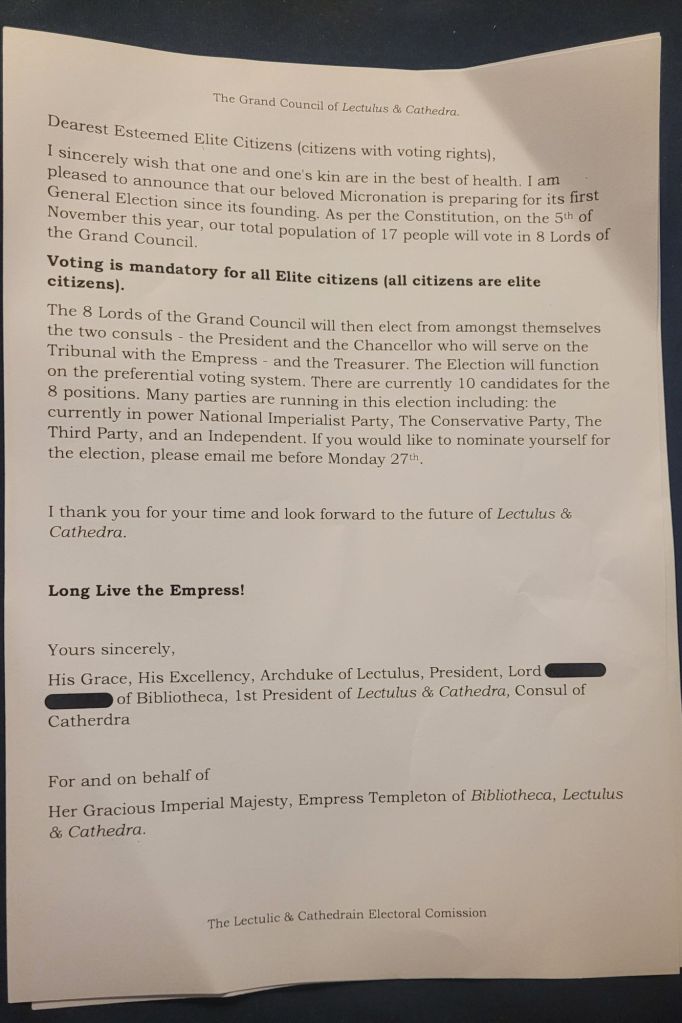
Letter of appeal to voters for the micronation of Lectulus and Cathedra.
Today, this quirky collective has grown to 17 members and is preparing for its first general election on 5 November. What began as a casual connection has evolved into a vibrant community, complete with governance, creativity, and camaraderie—all nurtured within the walls of a school library.
Libraries as Hubs of Wellbeing and Learning
While this story may sound whimsical, it highlights a deeper truth: school libraries are far more than repositories of books. They are sanctuaries of connection, creativity, and wellbeing.
Student wellbeing is increasingly recognised as a priority in Australian schools. Research indicates that poor wellbeing and associated mental health concerns affect between 10–20% of young people (Merga, 2020). In response, the Australian Government launched the “National School Wellbeing Framework” in 2018 to support schools in fostering positive relationships and wellbeing within safe, inclusive, and connected learning communities (Education Council, 2018). Although the framework does not explicitly mention libraries, many of its initiatives can be effectively implemented through a library lens.
School libraries have long served as safe havens for students, offering refuge for a variety of reasons. Merga (2021) notes that contemporary school libraries provide students with a peaceful space to recharge and relax. Similarly, Willis, Hughes, and Bland (2019) affirm that libraries contribute to both physical and emotional wellbeing by enabling vital social connections to flourish.
Merga’s research validates what many educators have long known: school libraries are places where students feel they belong, feel safe, and feel welcome. Some seek sanctuary and solitude; others come to connect and unwind. As school library professionals, our role is to create spaces where young people continue to feel secure—whether they are reading a book, playing a board game or Minecraft, or, as my students do, establishing a micronation on the couch outside my office.
Merga, M. (2020). How can school libraries support student wellbeing? Evidence and implications for further research. Journal of Library Administration, 60(6), 660–673. https://doi.org/10.1080/01930826.2020.1773718
Merga, M. K. (2021). Libraries as wellbeing supportive spaces in contemporary schools. Journal of Library Administration, 61(6), 659–675. https://doi.org/10.1080/01930826.2021.1947056
Willis, J., Hughes, H., & Bland, D. (2019). Students reimagining school libraries as spaces of learning and wellbeing. In J. Franz, H. Hughes, & J. Willis (Eds.), School spaces for student wellbeing and learning: Insights from research and practice (pp. 121–137). Springer. https://eprints.qut.edu.au/126979/
Fairy tales have long served as cultural touchstones as they passed down through generations to teach values, warn against danger, and reflect the beliefs of the societies that created them. Though often associated with bedtime reading, fairy tales are far more than simple entertainment. They are rich with symbolism, moral lessons, and cultural nuance. Across the world, these tales take many forms and espouse a range of cultural values and traditions. In West Africa, the Anansi stories feature a clever spider who uses wit and trickery to navigate challenges, often blurring the line between hero and villain. In Russia, Baba Yaga, a fearsome witch who lives in a house with chicken legs is a treated as both a threat and a source of wisdom. Japanese tales like Momotaro (Peach Boy) celebrate loyalty and courage, while Indigenous Australian Dreamtime stories embed spiritual and ecological knowledge, linking people to land, ancestry, and community.
Fairy and folk tales are shaped by the values and fears of the cultures that tell them. Take Little Red Riding Hood, for example. In the original French version by Charles Perrault, the story ends with Red being eaten. A stark warning about the dangers of naivety and talking to strangers. Two centuries later, the Grimm brothers added a huntsman who rescues her, softening the tale but still portrays Red as a naive child with no common sense that needs a man to rescue her from her own stupidity. In China’s Lon Po Po, three sisters cleverly defeat a wolf disguised as their grandmother. In West Africa’s Pretty Salma, the story is reimagined with vibrant market scenes and a trickster dog. However, in some modern versions, Red is a sweet girl who outsmarts the wolf and saves her grandmother. Each version reflects different cultural fears, values, and expectations.
Fairy tales offer insight into social norms, gender roles, and moral expectations. However, many students today encounter fairy tales primarily through Western adaptations, for example, Anderson, Perrault, Grimm and more recently, Disney. As we are all aware, the latter often simplifies complex narratives into polished versions where good triumphs, evil is vanquished, and everyone lives happily ever after. However, we all know that life is not a happily ever after scenario. We also know that many of these fairy tales have not aged well and their depictions of women and other minority groups are outdated and sometimes offensive.
Fractured fairy tales offer a powerful way to revisit these traditional stories and challenge the assumptions they carry. By twisting familiar plots, reimagining characters, and shifting perspectives, fractured tales invite students to question stereotypes and explore alternative narratives. These adaptations provide a meaningful way to integrate classic and traditional tales into the curriculum as shared cultural knowledge as these stories are familiar, accessible, and often deeply embedded in popular media and literature. By engaging with them critically, students can recognise the stereotypes they contain, such as passive heroines, villainous outsiders, or heroic princes, and begin to unpack the social messages behind them.
As mentioned previously, traditional tales often portray female characters are passive, villains are irredeemable, and heroes are defined by their ability to rescue others. Fractured versions ask: What if the princess saved herself? What if the villain had a backstory? What if the tale took place in a modern classroom, a refugee camp, or a suburban street?
Fractured fairy tales are re-imaginings of traditional fairy tales and they are more than just creative exercises. They are acts of critical literacy. Fracture tales encourage students to analyse how stories shape our understanding of identity, power, and justice. They also provide space for students to insert their own voices, experiences, and cultural perspectives into the storytelling tradition.
A compelling example is Disney’s Maleficent (2014), which reinterprets Sleeping Beauty through a postmodern lens. Rather than portraying Maleficent as a one-dimensional villain, the film gives her emotional depth and agency. It highlights the impact trauma can have on emotional stability and the ability to make future connections. Maleficent’s loss of her wings to Stefan’s violence triggers a cascade of vengeance. This violent action of Stefan gives the viewer a reason why Maleficent cursed Aurora. It was not a random event, but rather retribution for past actions. Furthermore, Aurora awakens not through a prince’s kiss, but through Maleficent’s maternal love that grew despite the hatred and anger. It assuaged her internal trauma and avoided the trope of romantic salvation. Maleficent uses intertextuality to challenge the “grand narrative” of the original tale, offering a more nuanced and inclusive version of the story.
For educators, fractured fairy tales are a rich tool for both literary analysis and creative writing. They allow students to explore genre conventions, experiment with structure, and reflect on the social messages embedded in familiar texts. By comparing global versions of tales and then reworking them with a modern lens, students learn that storytelling is not fixed. Instead it celebrates how stories continue to be fluid, diverse and deeply personal.
There are numerous fractured fairy tales that can be used effectively for academic and recreational purposes. So… why not use them for your own teaching and learning… And fracture some stereotypes along the way.
Books:
The True Story of the 3 Little Pigs by Jon Scieszka m- Told from the wolf’s point of view, this witty retelling flips the narrative on its head.
The Stinky Cheese Man and Other Fairly Stupid Tales by Jon Scieszka – A collection of absurd and hilarious twists on familiar fairy tales.
The Wide-Awake Princess by E.D. Bakerm – Princess Annie is immune to magic and sets out to rescue her enchanted sister, challenging traditional gender roles.
Peter and the Starcatchers by Dave Barry and Ridley Pearson – A prequel to Peter Pan that adds depth and adventure to the original tale.
The Wishing Spell (Land of Stories series) by Chris Colfer – Two siblings fall into a world where fairy tales are real—and not always as expected
Films
Maleficent (2014) – Reimagines Sleeping Beauty from the villain’s perspective, exploring themes of agency and maternal love.
Shrek (2001) – A satirical mash-up of fairy tale tropes that challenges beauty standards, heroism, and social norms.
Into the Woods (2014) – Intertwines multiple fairy tales with darker consequences, highlighting moral ambiguity and personal responsibility.
Ella Enchanted (2004) – A feminist twist on Cinderella, where the heroine fights against magical obedience and societal expectations.
Enchanted (2007) – A fairy tale princess lands in modern-day New York, confronting real-world complexities and stereotypes.
Hoodwinked! (2005) – A comedic retelling of Little Red Riding Hood as a crime investigation, with multiple unreliable narrators.
Each year, Banned Books Week invites us to reflect on the importance of intellectual freedom and the dangers of censorship. Around the world, books are challenged or removed from shelves due to content deemed offensive or ideologically inappropriate by local authorities. These decisions often reflect broader societal tensions around race, gender, sexuality, and political beliefs.
In Australia, the free flow of information is protected by legislation such as the Freedom of Information Act, and championed by organisations like the Australian Library and Information Association (ALIA). ALIA upholds core values of open access to knowledge and ideas, ensuring that libraries remain spaces where diverse perspectives can be explored without fear or restriction. Public libraries, in particular, play a vital role in this mission by offering equitable access to information and digital resources for all citizens. Platforms like Trove, hosted by the National Library of Australia, further support this by providing access to a vast and growing collection of digitised newspapers, books, images, and more.
However, the conversation around banned books takes on a different tone in school libraries. Here, the issue is not so much about banning books, but about what to include. School libraries operate within a framework of collection development and management policies, which guide decisions about which resources best support the needs of the school community. The point of a school library is to support student success by providing access to resources that meets the curriculum whilst also fostering skills in reading, research and informational literacy. Therefore, any policies regarding the breadth and depth of a collection will factor in curriculum relevance, age appropriateness, and the diversity of student experiences.
So when I look at the list of most commonly banned books worldwide… I realise we have most of them on the shelves.
Most Commonly Banned Books Worldwide (All-Time)
The Catcher in the Rye – J.D. Salinger Banned for profanity, sexual content, and themes of rebellion.
We have this title as it is considered a classic as is in our senior collection aimed for sophisticated readers in Grade 10 and above.
To Kill a Mockingbird – Harper Lee Challenged for racial themes and language
We have this title as it is considered a classic. It currently sits in our Classics collection and is available for students to borrow. It is also a class text and is frequently used as part of novel studies.
1984 – George Orwell Banned for political themes and criticism of totalitarianism
We have this title as it is considered a classic. It currently sits in our Classics collection and is available for students to borrow. It is also a class text and is frequently used as part of novel studies.
Harry Potter series – J.K. Rowling Challenged for promoting witchcraft and occultism
We have numerous copies of this!
The Satanic Verses – Salman Rushdie Banned in several countries for blasphemy
We don’t have this text as it does address the curriculum.
The Handmaid’s Tale – Margaret Atwood Banned for sexual content and perceived anti-religious themes
We have this title as it is considered a classic. We do have this novel in our senior collection aimed for sophisticated readers in Grade 10 and above. It is also a class text and has been used as part of novel studies.
Beloved – Toni Morrison Challenged for graphic depictions of slavery and violence.
We don’t have this text as part of our collection. We do have 12 years a slave, The Colour Purple and Uncle Tom’s Cabin.
Lolita – Vladimir Nabokov Banned for being “obscene” in several countries
We do not have this novel because it does not meet any curriculum requirements.
Fifty Shades of Grey – E.L. James Banned for erotic content and BDSM themes
We do not have this novel because it does not meet any curriculum requirements.
The Grapes of Wrath – John Steinbeck Banned for political reasons and profanity.
We do have this novel in our senior collection aimed for sophisticated readers in Grade 10 and above.
I will point out that one of the challenges of being in a school with students from Grade 5-12 is that what may be appropriate for a senior student to read may not me developmentally appropriate for a younger boy. To manage this, we have further classified the fiction texts into general (all years), middle fiction (Grades 7-9) and senior fiction (Grades 10-12). Students are able to freely access resources within their ‘age range’. However, they require parental permission to access more sophisticated readers. This ‘limiting’ of access is our way of supporting the free movement of information whilst acknowledging that some novel themes could cause distress to an immature brain.
This distinction of inclusion versus exclusion of texts is crucial. While public libraries are bound by principles of universal access, school libraries must balance educational goals with community values. This is where the role of a teacher librarian is imperative because school libraries need staff that are fully trained and qualified. They need someone who is an informational professional and an educator to be able to craft a collection development policy that helps ensure that resource selection is transparent, consistent, and inclusive, rather than reactive or restrictive. It is this combined capacity that empowers teacher librarians to advocate for collections that reflect the richness of student identities and the complexity of the world they inhabit. Unfortunately, here in Queensland, many schools lack a qualified informational professional in their school library, that is if they have a library at all! This an absolute travesty for the children and their wider communities.
Ultimately, Banned Books Week reminds us all why intellectual freedom matters. This week serves as a poignant reminder of the fragile nature of intellectual freedom as it honours the fundamental right to read, to explore ideas from all perspectives, and to seek truth without interference. Each year, the spotlight falls on books that have been challenged or removed because they represent discomfort or dissent for a select few individuals. However, in doing so, we need to think about the deeper cost of censorship: the narrowing of thought, the silencing of voices, and the erosion of a society built on open inquiry and democratic exchange. Whether in public or school libraries, our responsibility is to foster environments where curiosity is encouraged, critical thinking is nurtured, and all voices have the opportunity to be heard.
If you’ve ever heard the term “weeding” in the context of school libraries and pictured yourself in gumboots pulling dandelions from the fiction section—don’t worry, you’re not alone. But while it might sound like a gardening chore, weeding in libraries is a vital part of collection development. Think of it as removing the junk so the flowers can stand out—because every great library deserves to blossom.
Weeding, or deselection, is the process of removing outdated, damaged, irrelevant, or unused resources from the collection. It’s not about discarding books for the sake of it; it’s about curating a vibrant, purposeful collection that supports student learning, teacher needs, and curriculum goals. A well-weeded collection is easier to navigate, more appealing to browse, and more likely to be used. It’s the difference between a cluttered storeroom and a well-organised learning hub.
Here in our library, we’re about to begin a weeding process ahead of our fiction stocktake. From a logistical perspective, it gives us a chance to winnow what is not being effectively utilised and what is not supporting the ethos of our library. It also gives us the perfect opportunity to refresh the shelves and make space for stories that truly resonate with our readers. We’ll be using our Collection Development and Management Policy to guide our decisions, focusing on books that are outdated, physically unattractive (yes, those yellowed pages and cracked spines count!), or simply no longer meeting the needs of our school community. If it hasn’t been borrowed in years, doesn’t reflect current values, or makes students wrinkle their noses, it’s probably time to say goodbye.
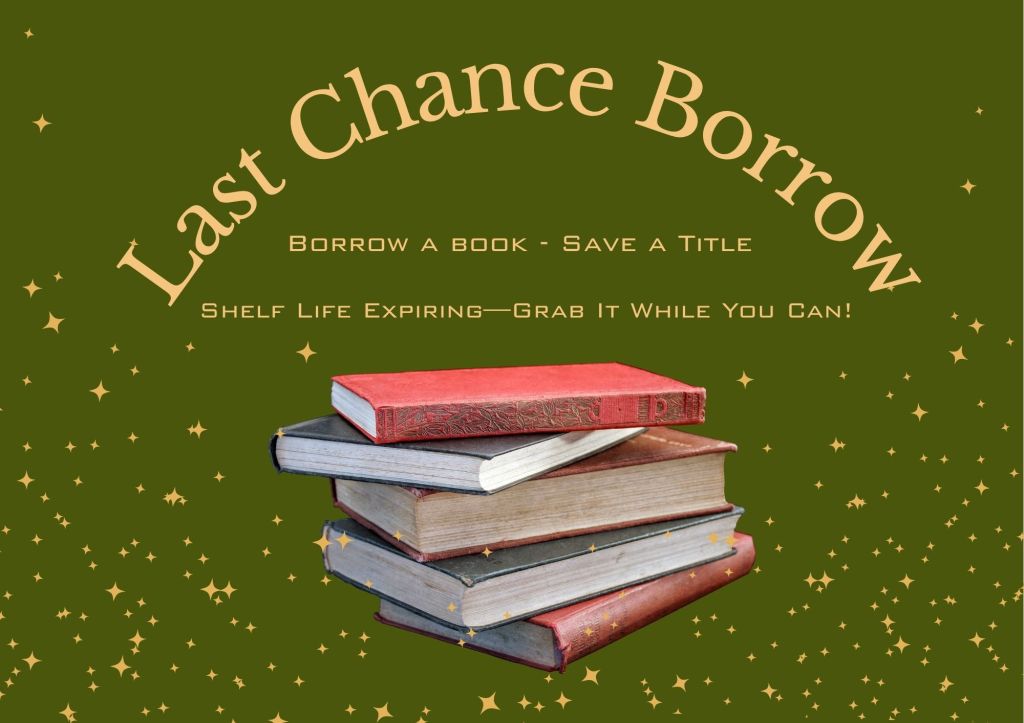
However, I will add that I have an inner Book Dragon and that one is loathe to get rid of books. Therefore, just to make sure, we are going to give these books one last hurrah, we’re setting up a “Last Chance Borrow” display. This is a fun and engaging way to spotlight forgotten titles that might still have a spark of interest left in them. Students and staff will have the chance to browse and borrow these books before they’re officially retired. Who knows—maybe a hidden gem will find a new fan! It’s also a great opportunity to start conversations about what makes a book worth keeping and how our reading tastes evolve over time.
Our process of weeding is made easier by having a very clear policy and process. Our LMS, Oliver, provides us with a list of titles that have not been borrowed in recent times. This list, combined with our policy, helps us set clear parameters and ensures that our choices are thoughtful and consistent. We’re not just tossing out books—we’re making room for new voices, fresh ideas, and engaging reads that support literacy and learning. Weeding also helps us maintain a collection that’s inclusive, relevant, and aligned with our school’s educational goals.
Of course, weeding can be emotional. Saying goodbye to old favourites isn’t easy. But remember: a library isn’t a museum. It’s a living, breathing space for discovery and growth. And just like a garden, it needs regular tending. So grab your metaphorical secateurs, consult your policy, and let those literary flowers bloom. Your students—and your shelves—will thank you.





 Learning through the Library