
Last week I had the privilege of presenting at the National Education Summit here in Brisbane, sharing a body of work that has evolved over the past five years, three schools and two states. What began in 2021 as a response to disrupted learning during Covid lockdowns has since developed into a sustained, evidence informed approach to vocabulary instruction, grounded in collaboration, inquiry and the role of the teacher librarian.
In the early stages of this work, my fellow teacher librarians and I were grappling with a shared challenge. Students were returning to classrooms with uneven access to the curriculum, and many lacked the language needed to engage meaningfully with content. We began asking a simple but powerful question. How do we support students to connect with learning at their point of access? The answer, we found, lay in vocabulary.
Vocabulary is more than word knowledge. It is the foundation for deeper thinking, richer comprehension and academic success across all learning areas. Drawing on Vygotsky’s understanding of learning as a social process, this work has always prioritised scaffolded, collaborative learning experiences where language is explicitly taught, modelled and applied. Halliday’s theory of language as a social semiotic further reinforced the importance of teaching students how language works within different disciplines, enabling them to access and produce increasingly complex texts.
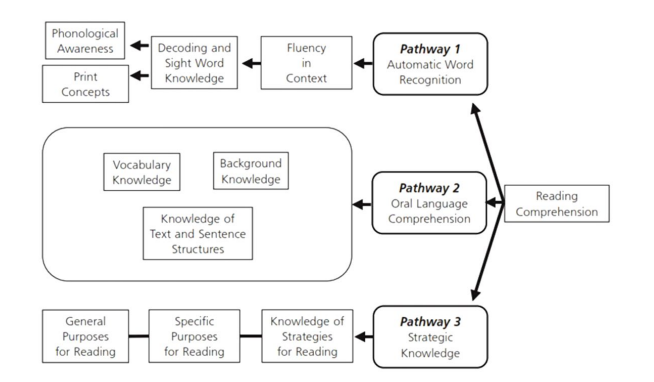
Central to my approach is the belief that vocabulary must be taught explicitly before students are asked to engage in close reading or complex content. This thinking is informed by the cognitive reading model of Stahl & McKenna, as well as Scarborough’s Reading Rope, both of which highlight the interdependence of language comprehension and word knowledge in skilled reading. When students do not understand key terms, comprehension falters. When they do, learning accelerates.
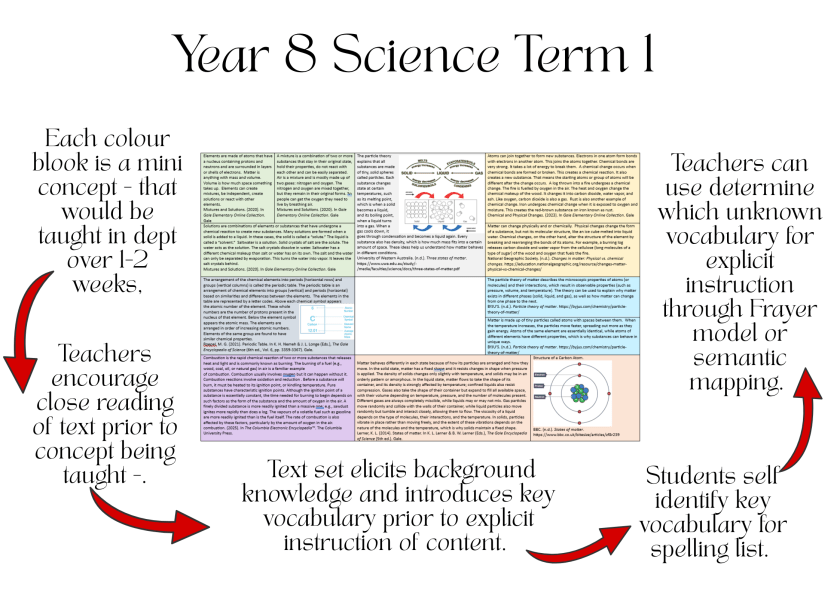
In practice, this begins with carefully curated text sets. By introducing students to genre based texts at appropriate Lexile levels, they encounter Tier 2 and Tier 3 vocabulary in context. This is particularly powerful in subjects such as science, health and the humanities, where disciplinary language can be abstract and highly specific. Seeing vocabulary embedded within authentic texts allows students to connect meaning to purpose, rather than encountering words in isolation.
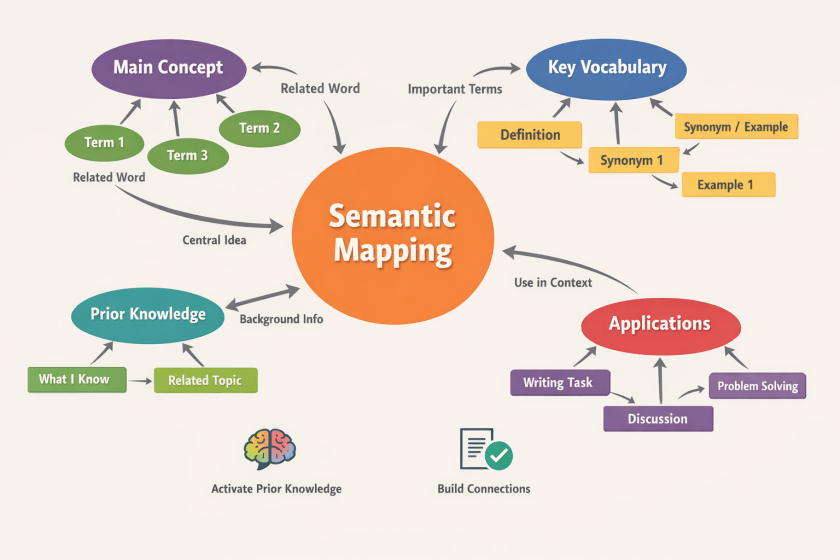
From here, explicit strategies such as the semantic mapping and the Frayer Model are used to connect schemas and deepen understanding. This is especially effective for terms that students commonly misunderstand or struggle to define, which is often the case in scientific contexts. By unpacking definitions, characteristics, examples and non examples, students build a more nuanced and transferable understanding of key concepts.
Throughout this process, resource based learning has been essential. The library is not simply a place where resources are housed, but a dynamic space where literacy and learning are designed in partnership with teachers. As a teacher librarian, I have worked closely with colleagues to co plan units that embed vocabulary instruction within inquiry based learning. Together, we create literacy rich environments where students engage with ideas, language and content in meaningful ways.
What has been most powerful is seeing the cumulative impact of this work. When vocabulary is positioned as a cornerstone of learning, students become more confident readers, more precise thinkers and more capable communicators. They are better equipped to navigate complex texts, engage in disciplinary thinking and articulate their understanding.
Presenting at the Summit this year was an opportunity to reflect on this journey and to share practical, adaptable strategies with other educators. It also reinforced the critical role that teacher librarians play in leading literacy across the curriculum. Through curation, collaboration and intentional teaching, libraries can drive approaches that ensure all students have access to the language of learning.
This work continues to evolve, but the core principle remains unchanged. If we want students to think deeply and learn effectively, we must first give them the words.

