

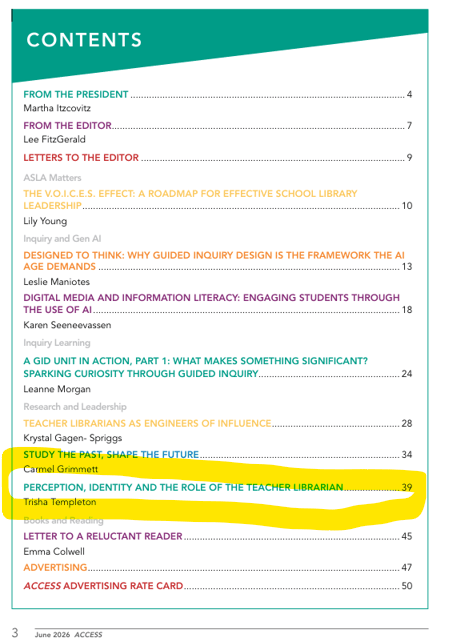
Publishing my recent article in ACCESS: The Journal of the Australian School Library Association prompted a level of reflection that extended beyond professional practice. While the article itself explores how perception shapes the identity and positioning of teacher librarians within schools, the process of writing it brought into sharper focus how deeply questions of identity are also personal.
Social identity theory provided a useful framework within the article, particularly in understanding how individuals construct a sense of self through group membership, shared norms and the value ascribed to those groups by others. However, as I engaged more deeply with the theory, it became increasingly difficult to separate the professional from the personal.
As a migrant, identity has never been entirely fixed or internally defined. It has always been shaped in relation to context, to perception, and to an ongoing negotiation of belonging. There is a heightened awareness of how one is read by others, and how those readings can influence not only external opportunities but also internal confidence and voice. In this sense, the central premise of social identity theory is not abstract. It is lived.
This experience resonated strongly with the arguments explored in my article.
The role of the teacher librarian similarly exists within a space shaped by perception rather than fully understood practice. Despite the complexity of the work, including explicit teaching of information literacy, inquiry skills and critical evaluation, the role is often reduced to narrow or outdated interpretations. As social identity theory suggests, this devaluation is not confined to how the role is viewed externally. It has the potential to influence how the role is inhabited, enacted and, at times, limited.
What became evident through both the research and my own reflection is the parallel between these experiences. In both contexts, identity exists in the tension between self definition and external perception. In both cases, there is a continual negotiation between adapting to expectations and asserting a more accurate representation of who we are and what we contribute. Understanding this has shifted the way I think about professional identity. The question is no longer simply how teacher librarians are perceived, but how we actively position ourselves within that perception. In my ACCESS article, this is explored through the idea of anchoring identity in the “teacher” dimension of the role, not as a rejection of librarianship, but as a deliberate affirmation of pedagogical expertise and educational contribution.
Seen through a social identity lens, this becomes more than professional preference. It is a form of identity construction that resists marginalisation and repositions the role within core learning conversations. My own experience as a migrant has reinforced that identity is rarely passively received. It is shaped, negotiated and, at times, deliberately claimed. The same can be said for teacher librarianship. The reflections that sit alongside my published work suggest that the challenge is not only to articulate the value of the role, but to inhabit it with clarity and confidence. In doing so, the distance between perception and reality begins, slowly, to close.

