A Season of Reading and Reflection: A Year in Review.

As the school year wrapped up last week, I found myself reflecting on the many moments that shaped our library community in 2025. There have been challenges, yes, but also plenty of reasons to celebrate.

One of the brightest sparks has been our book clubs. What started as a simple idea, a few snacks and a chance to talk about stories, has grown into something much bigger. My secondary Book Club stands out. At the beginning of the year they were a small group, some unsure of what to read, others firmly attached to their favourite genres. Over time, though, their borrowing soared. They began exploring fantasy, contemporary fiction and graphic novels, and while one dedicated manga reader still resists branching out, the group as a whole has broadened its horizons. More importantly, they began to see reading as part of who they are. They recommend titles to each other, debate endings, and even suggest new books for the library. Watching that transformation has been a joy.

Research reminds us that this is exactly what book clubs are meant to do. They make reading social, they build confidence, and they help young people see themselves as readers. The secondary Book Club Boys proved that in the most authentic way, showing how a community of peers can turn reading from a solitary task into something shared and celebrated.

From a whole school review, borrowing levels across the school have also risen, returning to pre COVID rates. Much of this growth has come from our younger readers, whose enthusiasm has been infectious. Their excitement has created a vibrant culture of reading in the primary years, and their participation in activities has been a highlight of the year.

Of course, there are challenges we cannot ignore. Very few of our Year 10 to Year 12 students are reading recreationally, and this is concerning. Intertextuality, the ability to connect ideas across texts, is vital for analysis and for building strong cognitive connections. Without regular reading, those skills are harder to develop. We also continue to see limited engagement from Years 7 to 10 English classes, despite enthusiastic promotion. There seems to be a reluctance to lose curriculum time.

Our team dynamic has shifted too, with members coming and going. Change always brings adjustment, but it has also brought fresh perspectives and energy. We have expanded our digital resources, and while uptake has been slow, steady gains are being made as students and staff grow more comfortable with these platforms.

Perhaps the greatest success of all has been the way the library has become recognised as a social space where everyone is welcome. It is not only a place for books, but a hub for connection, collaboration and belonging. That sense of community is something we can all be proud of.

We closed the year with our Books & Bites Christmas party, a joyful celebration of new releases and Christmas treats. Each student received a reading journal with a challenge to read four books over the summer, along with handmade gifts, ornaments, bookmarks, and pen holders, sewn over the past few weeks. These tokens were a way of honouring the shared love of reading that binds us together.

As we finish the 2025 chapter, I am reminded that reading is not just about borrowing books, it is about building minds, fostering empathy and preparing students for the complexities of the world.

“As we finish this chapter and look ahead to the new year, I am reminded that Christmas is a season not only of rejoicing, but of reflection. May the joy of stories, the warmth of community, and the promise of new beginnings carry us into the year ahead.”

Reflecting on the story of the shelves.

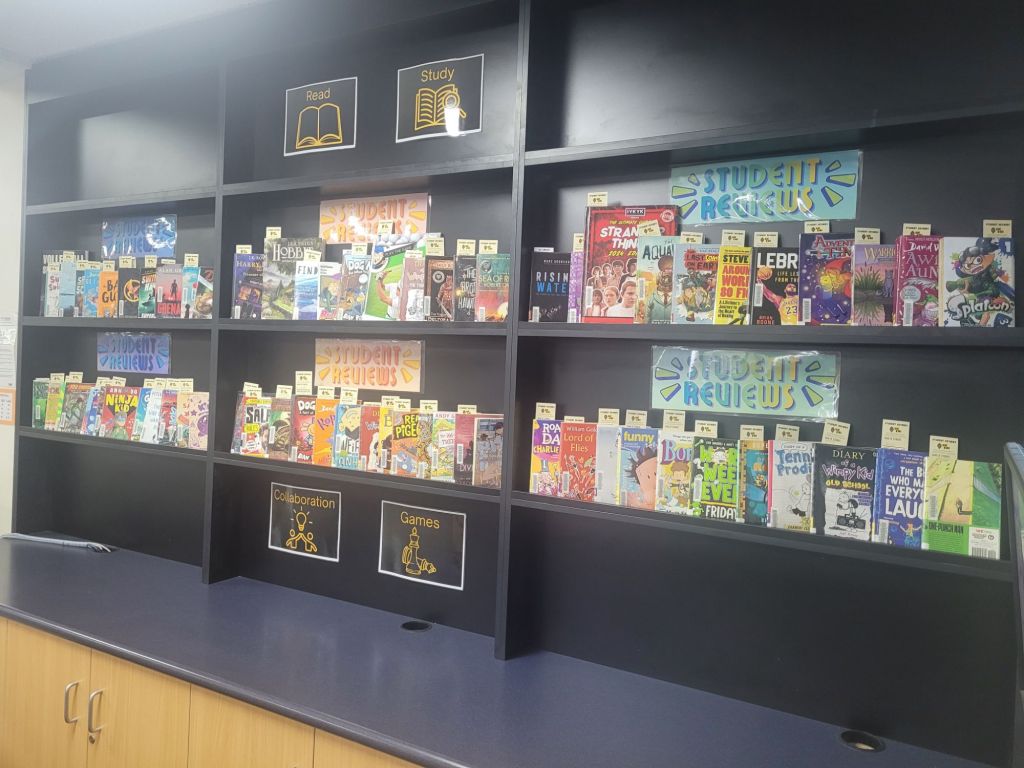
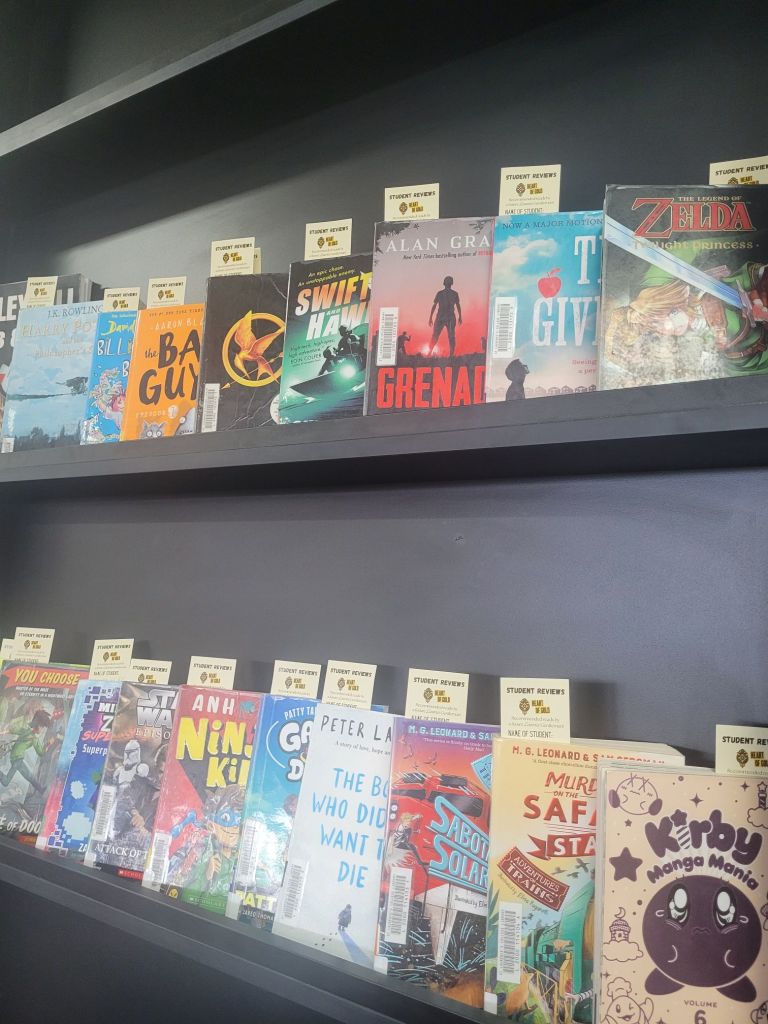
At the end of each school day, I wander through the library and notice the gaps and blank spaces.  Why? It is because the shelves never lie about the books that are loved the most.  These are the ones that stack tall on our return trolleys.  To be fair, they are also the ones that leave with another student almost instantly.  They are the ones with worn spines, grubby covers and suspicious stains on the pages.  Yet all of them tell me a story.  They all tell me something about our school community.

Non‑fiction loans follow the interests of the boys themselves, whether it be cars, music, military equipment, or funnily enough… anatomy. These choices show me that curiosity is not confined to the classroom but stretches into the interests, curiousities, passions, and fascinations that shape their lives outside the school grounds.

The sports shelves mimic the seasons almost perfectly. Footy fades as winter ends, and suddenly, cricket biographies and fiction surge forward, especially anything tied to the upcoming Ashes. It is as if the rhythm of the sporting calendar beats through the borrowing habits of our students, reflecting not just their interests but the pulse of the wider culture around them.

The novels tell another kind of story. Fantasy sagas rarely rest long before they are whisked away again, dragons, quests and magical lands offering both escape and courage. Contemporary stories about identity and belonging circulate steadily too, often returned with dog‑eared pages. Those books feel like companions, helping students navigate questions of who they are and where they fit.

Certain authors move faster than most. This year we have seen a sharp update in request for Orwell’s works that seemed to be borrowed by students who want to think critically, because his sharp observations on society still resonating decades later. King’s novels vanish quickly from the shelves too, his blend of horror and humanity appealing to readers who crave both thrills and reflection. Griffiths brings laughter and lightness, his quirky humour and imaginative plots offering relief from the seriousness of school life. Kinney’s books are snapped up by younger readers, his diary‑style storytelling capturing the awkwardness and comedy of growing up. Walliams adds another layer of fun, his playful characters and outrageous scenarios proving irresistible to students who want a quick, joyful read. Bancks, with his Australian voice and relatable themes, connects directly to the local experience, showing students their own world reflected back at them. Heath’s stories move quickly too, often chosen by readers who enjoy adventure and fast‑paced plots. And then there is Rowling. Her magical universe remains evergreen, with titles borrowed again and again by students who want to lose themselves in a world of spells and friendship. Dashner’s dystopian tales race through the library as well, his fast‑moving plots and high stakes gripping readers who love suspense.

And then there are the comfort reads. During exam season, familiar series, lighthearted tales and joke books fly off the shelves, as if students are reaching for something steady and reassuring when stress runs high. When headlines outside the school walls grow louder, books on social issues suddenly become popular, showing me how our community is engaging with the wider world.

Over time, these borrowing trends become a mirror. They reflect curiosity, resilience, joy and sometimes vulnerability. They remind me that the library is not just a place to find information, it is a living record of what matters most to our students at any given moment. Each book borrowed is a quiet signal, a way of saying, this is what I need right now.

Together, these authors form a chorus of voices that shape the identity of our school community. Orwell challenges us to question, King dares us to feel fear and empathy, Griffiths and Kinney make us laugh, Walliams and Heath keep us entertained, Bancks grounds us in our own backyard, Rowling invites us into magic, and Dashner pushes us to imagine futures both thrilling and uncertain. Their collective presence on our shelves is more than entertainment, it is a reflection of the many ways our students seek to learn, to grow and to belong.

And as the year turns, the shelves whisper back, carrying the heartbeat of our community in every borrowed book.

Sundays, Libraries, and the Quiet Crisis in Reading

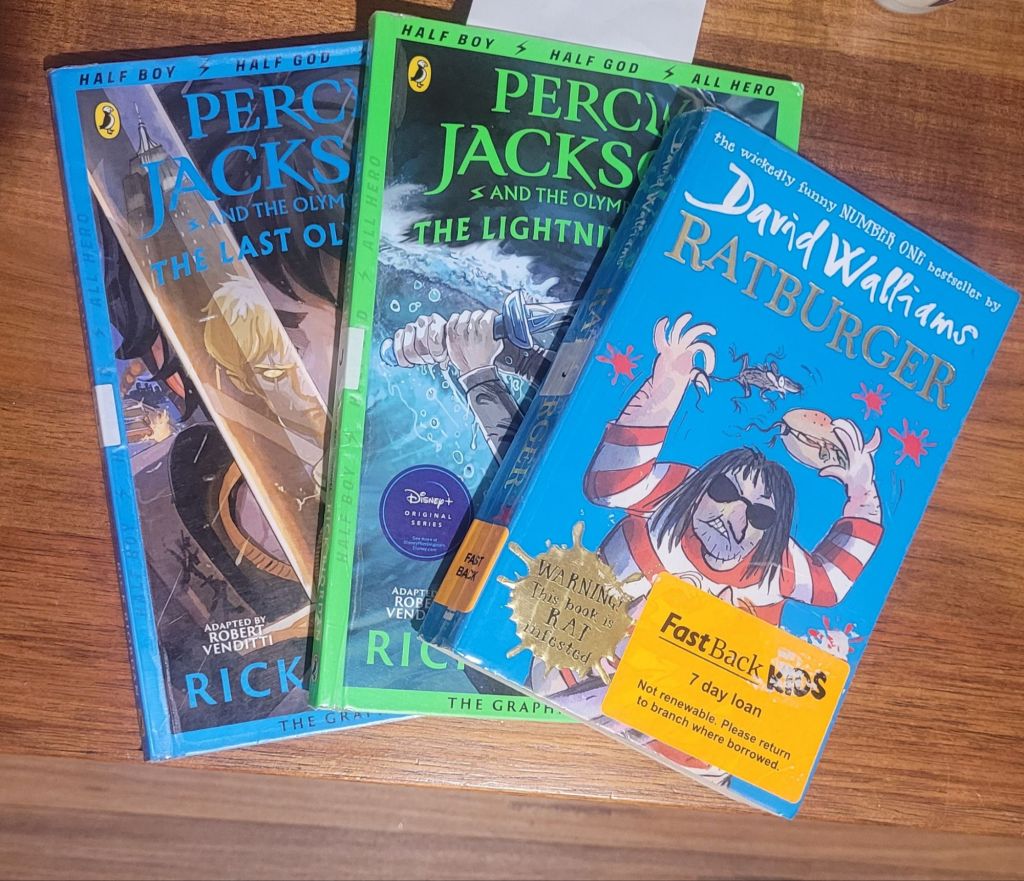
The 10 year old child’s haul.

On Sundays, our family has a rhythm. We go to church in the morning, then its off to our local library. The kids scatter to their favourite corners, borrowing books and settling in to read whatever strikes their fancy. The only rule is, that for every book that is a re-read, there must be one you have not read before.

This week’s book haul – mine.

Whilst my children scurry to their favourite genres, I grab a coffee and wander the shelves, letting my eyes land on whatever catches my eye. My husband always chuckles at this part. “You work in a library,” he says, amused. He’s right, of course. I do. But I work in a boys’ school library, and let’s just say the collection doesn’t quite float my boat. We then settle down for 30-45min of quiet reading together, but all on individual journeys.

Cook, S. (2025, November 5). It will take more than the new Children’s Booker Prize to arrest the dramatic decline in reading enjoyment. The Conversation. https://theconversation.com/it-will-take-more-than-the-new-childrens-booker-prize-to-arrest-the-dramatic-decline-in-reading-enjoyment-268777

There’s something different about being in a space where reading is chosen, not assigned. Where stories are picked for pleasure, not performance. That contrast has been sitting with me lately, especially after reading Loh et al.’s 2025 report on the decline in volitional reading and a recent piece in The Conversation about the new Children’s Booker Prize. Both paint a sobering picture: young people are reading less, and they’re enjoying it even less than that.

Loh, C. E. et al. (2025) The Decline in Volitional
Reading: Evidence-Informed Ways Forward.
National Institute of Education, Nanyang
Technological University, Singapore.

Loh’s recommendations to improve literacy success.

  • agency
  • access to literature
  • time in daily routines
  • reflection and connection
  • social interaction
  • developing a positive reading identity

What struck me most in Loh’s report was what wasn’t there. None of the key principles mention curriculum reform. None suggest that testing is the answer. Instead, the focus is on joy, choice, and connection. Reading for pleasure is framed not as a luxury, but as a necessity. It’s a stronger predictor of reading attainment than socioeconomic status. That’s huge. It means that if we want to close literacy gaps, we need to open up space for enjoyment.

In my school library, I see the tension. Boys who associate reading with assignments, comprehension questions, and accelerated reader points. Not with curiosity or escape. Not with laughter or awe. And I wonder: what would happen if we let go of the scaffolds and trusted them to choose? The Conversation article makes a similar point. Awards like the Children’s Booker are lovely, but they won’t shift the culture on their own. What we need is a reimagining of reading in schools. Less about outcomes, more about experience. Less about control, more about trust.

Furthermore, parents need to remember that they are their children’s first educators. Is reading and literacy your household value? One of the key findings in Loh’s research is that children need access to literature and to see it modelled by the adults around them. Do parents take their kids to the library? Do they read in front of their children? Or do they presume that schools will take care of it? Do they even ask their children how often they visit the school library? These questions matter. Because when reading is visible and valued at home, it becomes part of a child’s identity, not just a school subject.

So here’s my quiet Sunday reflection: maybe the best thing we can do as educators is to make room and provide time. Room for stories that speak to our students. Room for browsing, for borrowing, for reading without a worksheet attached. Room for libraries that float their boats and time to lie back and float away.

Because when reading becomes a choice again, it becomes a joy again. And that’s where the magic lives.

To go digital or hardcopy, that is the question …

I’ve just returned from a wedding overseas. It was a beautiful celebration, and between the flights and lounges, I had time to catch up on some reading. Normally, I’d pack a couple of paperbacks, but this time, I decided to travel light and for the first time,  go digital only.

This was not a lightly made decision! Before I left, I logged into eWheelers through my school account and downloaded a few titles I’d been meaning to read and others for my children. I also used BorrowBox via my Brisbane City Council library membership. I accessed both platforms on my phone, which made it incredibly easy to dip in and out of books whenever I had a spare moment. One of the great things about eWheelers is that it works across multiple devices, so whether you’re on a tablet, laptop, or mobile, your library is always within reach. It can also be read offline, as can books on Borrowbox which makes it perfect for when WiFi is not available.

Pool side reads

Ebooks are brilliant for travel. They offer the flexibility to read whatever you fancy without the bulk. It’s quick, convenient, and surprisingly satisfying to flick through pages with just a tap. For students, ebooks and or audiobooks, are becoming an increasingly valuable library resource. Many prefer them because they’re easy to access, allow for tech engagement, and offer features that physical books simply can’t.

Digital reading platforms often include options to change font sizes, switch to dyslexia-friendly fonts, or even translate texts into different languages. This makes eBooks especially helpful for students with vision impairments, learning differences, or those studying in multilingual environments. It’s a more inclusive way to read, and it’s reshaping how libraries support diverse learning needs.

And let’s be honest, eBooks also preserve a bit of anonymity. I’ll admit, I indulged in a cheeky bit of romantasy and adult fiction on the plane, the kind of titles that might raise eyebrows if I were carrying the physical copy around in public or completely mortify my children next to me! For young people, this privacy is gold. It allows them to explore genres they might be embarrassed to share with peers, especially when it comes to romance or identity-focused narratives.

This ties into a broader issue: many teens feel pressure to conform to social norms, especially around gender expectations. Ebooks offer teens a quiet refuge—a way to read without the gaze of others. For students navigating the delicate terrain of romance, identity, or emotionally expressive stories, this privacy matters. These genres, often unfairly stigmatised among peers, can feel too vulnerable to carry in plain sight. Smith and Wilhelm (2002) observed that boys, in particular, are more inclined to engage with emotionally rich narratives when the fear of judgement is lifted. In this way, digital reading becomes more than convenience, it becomes a gentle permission to explore, reflect, and connect with stories that might otherwise remain untouched.

eBooks also allow for customisation, changing fonts, adjusting layouts, and even switching languages, which makes reading more accessible and less intimidating for students with dyslexia, vision impairments, or those learning English as an additional language. For teens navigating identity, peer pressure, and personal growth, digital reading can be a quiet revolution, one page at a time.

That said, I do miss the tactile joy of a real book. The smell of the pages, the feel of the spine, and the quiet ritual of turning each leaf offer a kind of bibliotherapy that digital formats can’t replicate. There’s something grounding about physically interacting with a book that screens just don’t deliver. This feeling is evident from what the research tells us and what my experience has been as a teacher librarian in high schools because teenagers still express a strong preference for physical books despite the popularity of digital reading platforms. This inclination is often tied to the sensory and emotional experience that printed books provide such as the feel of the pages, the smell of the paper, and the visual satisfaction of seeing progress through a tangible object. Young readers, in particular, report screen fatigue and eye strain from prolonged digital use, making physical books a welcome reprieve from their tech-saturated lives (World Economic Forum, 2023). Additionally, cultural trends like #BookTok have reignited enthusiasm for printed books, with teens embracing the aesthetic and social aspects of owning and sharing physical copies (Literary Hub, 2023). Research also shows that teens retain information better and concentrate more effectively when reading print, especially in academic settings (ResearchGate, 2024). These findings suggest that while ebooks offer convenience and accessibility, physical books continue to hold a meaningful place in teen reading habits.

Still, for this trip, convenience won. And who knows, maybe next time I’ll sneak a paperback in for old time’s sake.

references

Australia Reads. (2024). 7 ways to support Australian teens in reading for pleasure. https://australiareads.org.au/news/7-ways-support-teen-reading

Literary Hub. (2023, March 14). In a surprise to no one, Gen Z prefers printed books over e-books. https://lithub.com/in-a-surprise-to-no-one-gen-z-prefers-printed-books-over-e-books/

ResearchGate. (2024). A comparative analysis of the student preferences for digital and physical books in library usage. https://www.researchgate.net/publication/385616029_A_Comparative_Analysis_of_the_Student_Preferences_for_Digital_and_Physical_Books_in_Library_Usage

Queensland Department of Education. (2024). Impact of eBooks: Exploring student health, learning and implications. https://education.qld.gov.au/about/reporting-data-research/research/Documents/impact-ebooks-report.pdf

Smith, M. W., & Wilhelm, J. D. (2002). Reading don’t fix no Chevys: Literacy in the lives of young men. Heinemann.

University of Edinburgh. (2024). Supporting teenagers’ reading enjoyment and engagement: A guide for teachers and librarians. https://blogs.ed.ac.uk/literacylab

World Economic Forum. (2023, March 13). Gen Zers are bookworms but say they’re shunning e-books because of eye strain, digital detoxing and their love for libraries. https://www.weforum.org/stories/2023/03/gen-zers-are-bookworms-but-say-theyre-shunning-e-books-because-of-eye-strain-digital-detoxing-and-their-love-for-libraries

From Bottle Caps to Ballots: How school libraries can become kingdoms of connection and wellbeing.

Eighteen months ago, a group of misfit boys were introduced to one another in what could only be described as a playdate orchestrated by fate, and a well-meaning informational professional. At first glance, these four boys had little in common. Yet over time, something extraordinary unfolded. They began meeting regularly in the library, and from those gatherings emerged a fully-fledged micronation.

The couch that sparked a nation.  As you can see, I have a crown made from paper printed with the Constitution of this micronation.

They appointed ministers: an Archduke, a President, a Minister for Finance who oversees a coffee jar filled with bottle caps, and a Secretary of Defence whose primary qualification is being the tallest. Together, these young men drafted a constitution, designed coinage (featuring my profile, no less), and issued passports and other official documentation. Eventually, I was graciously crowned their Head of State—Her Gracious Imperial Majesty, Empress Trish.

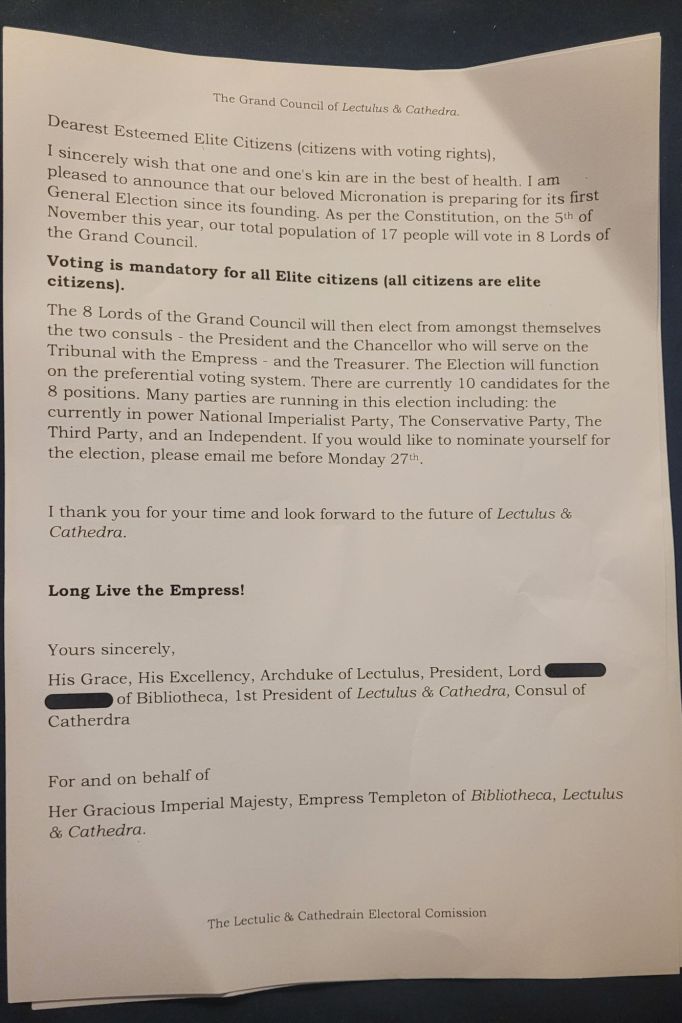
Letter of appeal to voters for the micronation of Lectulus and Cathedra.

Today, this quirky collective has grown to 17 members and is preparing for its first general election on 5 November. What began as a casual connection has evolved into a vibrant community, complete with governance, creativity, and camaraderie—all nurtured within the walls of a school library.

Libraries as Hubs of Wellbeing and Learning

While this story may sound whimsical, it highlights a deeper truth: school libraries are far more than repositories of books. They are sanctuaries of connection, creativity, and wellbeing.

Student wellbeing is increasingly recognised as a priority in Australian schools. Research indicates that poor wellbeing and associated mental health concerns affect between 10–20% of young people (Merga, 2020). In response, the Australian Government launched the “National School Wellbeing Framework” in 2018 to support schools in fostering positive relationships and wellbeing within safe, inclusive, and connected learning communities (Education Council, 2018). Although the framework does not explicitly mention libraries, many of its initiatives can be effectively implemented through a library lens.

School libraries have long served as safe havens for students, offering refuge for a variety of reasons. Merga (2021) notes that contemporary school libraries provide students with a peaceful space to recharge and relax. Similarly, Willis, Hughes, and Bland (2019) affirm that libraries contribute to both physical and emotional wellbeing by enabling vital social connections to flourish.

Merga’s research validates what many educators have long known: school libraries are places where students feel they belong, feel safe, and feel welcome. Some seek sanctuary and solitude; others come to connect and unwind. As school library professionals, our role is to create spaces where young people continue to feel secure—whether they are reading a book, playing a board game or Minecraft, or, as my students do, establishing a micronation on the couch outside my office.

References

Education Council. (2018). National school wellbeing framework. https://www.teachermagazine.com/au_en/articles/research-news-the-changing-landscape-of-school-libraries

Merga, M. (2020). How can school libraries support student wellbeing? Evidence and implications for further research. Journal of Library Administration, 60(6), 660–673. https://doi.org/10.1080/01930826.2020.1773718

Merga, M. K. (2021). Libraries as wellbeing supportive spaces in contemporary schools. Journal of Library Administration, 61(6), 659–675. https://doi.org/10.1080/01930826.2021.1947056

Willis, J., Hughes, H., & Bland, D. (2019). Students reimagining school libraries as spaces of learning and wellbeing. In J. Franz, H. Hughes, & J. Willis (Eds.), School spaces for student wellbeing and learning: Insights from research and practice (pp. 121–137). Springer. https://eprints.qut.edu.au/126979/

Banned Books Week: Censorship, Selection, and the Role of the Teacher Librarian.

Each year, Banned Books Week invites us to reflect on the importance of intellectual freedom and the dangers of censorship. Around the world, books are challenged or removed from shelves due to content deemed offensive or ideologically inappropriate by local authorities. These decisions often reflect broader societal tensions around race, gender, sexuality, and political beliefs.

In Australia, the free flow of information is protected by legislation such as the Freedom of Information Act, and championed by organisations like the Australian Library and Information Association (ALIA). ALIA upholds core values of open access to knowledge and ideas, ensuring that libraries remain spaces where diverse perspectives can be explored without fear or restriction. Public libraries, in particular, play a vital role in this mission by offering equitable access to information and digital resources for all citizens. Platforms like Trove, hosted by the National Library of Australia, further support this by providing access to a vast and growing collection of digitised newspapers, books, images, and more.

However, the conversation around banned books takes on a different tone in school libraries. Here, the issue is not so much about banning books, but about what to include. School libraries operate within a framework of collection development and management policies, which guide decisions about which resources best support the needs of the school community. The point of a school library is to support student success by providing access to resources that meets the curriculum whilst also fostering skills in reading, research and informational literacy. Therefore, any policies regarding the breadth and depth of a collection will factor in curriculum relevance, age appropriateness, and the diversity of student experiences.

So when I look at the list of most commonly banned books worldwide… I realise we have most of them on the shelves.

Most Commonly Banned Books Worldwide (All-Time)
  1. The Catcher in the Rye – J.D. Salinger
    Banned for profanity, sexual content, and themes of rebellion.
    • We have this title as it is considered a classic as is in our senior collection aimed for sophisticated readers in Grade 10 and above.
  2. To Kill a Mockingbird – Harper Lee
    Challenged for racial themes and language
    • We have this title as it is considered a classic. It currently sits in our Classics collection and is available for students to borrow. It is also a class text and is frequently used as part of novel studies.
  3. 1984 – George Orwell
    Banned for political themes and criticism of totalitarianism
    • We have this title as it is considered a classic. It currently sits in our Classics collection and is available for students to borrow. It is also a class text and is frequently used as part of novel studies.
  4. Harry Potter series – J.K. Rowling
    Challenged for promoting witchcraft and occultism
    • We have numerous copies of this!
  5. The Satanic Verses – Salman Rushdie
    Banned in several countries for blasphemy
    • We don’t have this text as it does address the curriculum.
  6. The Handmaid’s Tale – Margaret Atwood
    Banned for sexual content and perceived anti-religious themes
    • We have this title as it is considered a classic. We do have this novel in our senior collection aimed for sophisticated readers in Grade 10 and above. It is also a class text and has been used as part of novel studies.
  7. Beloved – Toni Morrison
    Challenged for graphic depictions of slavery and violence.
    • We don’t have this text as part of our collection. We do have 12 years a slave, The Colour Purple and Uncle Tom’s Cabin.
  8. Lolita – Vladimir Nabokov
    Banned for being “obscene” in several countries
    • We do not have this novel because it does not meet any curriculum requirements.
  9. Fifty Shades of Grey – E.L. James
    Banned for erotic content and BDSM themes
    • We do not have this novel because it does not meet any curriculum requirements.
  10. The Grapes of Wrath – John Steinbeck
    Banned for political reasons and profanity.
    • We do have this novel in our senior collection aimed for sophisticated readers in Grade 10 and above.

I will point out that one of the challenges of being in a school with students from Grade 5-12 is that what may be appropriate for a senior student to read may not me developmentally appropriate for a younger boy. To manage this, we have further classified the fiction texts into general (all years), middle fiction (Grades 7-9) and senior fiction (Grades 10-12). Students are able to freely access resources within their ‘age range’. However, they require parental permission to access more sophisticated readers. This ‘limiting’ of access is our way of supporting the free movement of information whilst acknowledging that some novel themes could cause distress to an immature brain.

This distinction of inclusion versus exclusion of texts is crucial. While public libraries are bound by principles of universal access, school libraries must balance educational goals with community values. This is where the role of a teacher librarian is imperative because school libraries need staff that are fully trained and qualified. They need someone who is an informational professional and an educator to be able to craft a collection development policy that helps ensure that resource selection is transparent, consistent, and inclusive, rather than reactive or restrictive. It is this combined capacity that empowers teacher librarians to advocate for collections that reflect the richness of student identities and the complexity of the world they inhabit. Unfortunately, here in Queensland, many schools lack a qualified informational professional in their school library, that is if they have a library at all! This an absolute travesty for the children and their wider communities.

Ultimately, Banned Books Week reminds us all why intellectual freedom matters. This week serves as a poignant reminder of the fragile nature of intellectual freedom as it honours the fundamental right to read, to explore ideas from all perspectives, and to seek truth without interference. Each year, the spotlight falls on books that have been challenged or removed because they represent discomfort or dissent for a select few individuals. However, in doing so, we need to think about the deeper cost of censorship: the narrowing of thought, the silencing of voices, and the erosion of a society built on open inquiry and democratic exchange. Whether in public or school libraries, our responsibility is to foster environments where curiosity is encouraged, critical thinking is nurtured, and all voices have the opportunity to be heard.

Spring cleaning your shelves.

Last chance reads & Literary weeds.

If you’ve ever heard the term “weeding” in the context of school libraries and pictured yourself in gumboots pulling dandelions from the fiction section—don’t worry, you’re not alone. But while it might sound like a gardening chore, weeding in libraries is a vital part of collection development. Think of it as removing the junk so the flowers can stand out—because every great library deserves to blossom.

Weeding, or deselection, is the process of removing outdated, damaged, irrelevant, or unused resources from the collection. It’s not about discarding books for the sake of it; it’s about curating a vibrant, purposeful collection that supports student learning, teacher needs, and curriculum goals. A well-weeded collection is easier to navigate, more appealing to browse, and more likely to be used. It’s the difference between a cluttered storeroom and a well-organised learning hub.

Here in our library, we’re about to begin a weeding process ahead of our fiction stocktake. From a logistical perspective, it gives us a chance to winnow what is not being effectively utilised and what is not supporting the ethos of our library. It also gives us the perfect opportunity to refresh the shelves and make space for stories that truly resonate with our readers. We’ll be using our Collection Development and Management Policy to guide our decisions, focusing on books that are outdated, physically unattractive (yes, those yellowed pages and cracked spines count!), or simply no longer meeting the needs of our school community. If it hasn’t been borrowed in years, doesn’t reflect current values, or makes students wrinkle their noses, it’s probably time to say goodbye.

However, I will add that I have an inner Book Dragon and that one is loathe to get rid of books. Therefore, just to make sure, we are going to give these books one last hurrah, we’re setting up a “Last Chance Borrow” display. This is a fun and engaging way to spotlight forgotten titles that might still have a spark of interest left in them. Students and staff will have the chance to browse and borrow these books before they’re officially retired. Who knows—maybe a hidden gem will find a new fan! It’s also a great opportunity to start conversations about what makes a book worth keeping and how our reading tastes evolve over time.

Our process of weeding is made easier by having a very clear policy and process. Our LMS, Oliver, provides us with a list of titles that have not been borrowed in recent times. This list, combined with our policy, helps us set clear parameters and ensures that our choices are thoughtful and consistent. We’re not just tossing out books—we’re making room for new voices, fresh ideas, and engaging reads that support literacy and learning. Weeding also helps us maintain a collection that’s inclusive, relevant, and aligned with our school’s educational goals.

Of course, weeding can be emotional. Saying goodbye to old favourites isn’t easy. But remember: a library isn’t a museum. It’s a living, breathing space for discovery and growth. And just like a garden, it needs regular tending. So grab your metaphorical secateurs, consult your policy, and let those literary flowers bloom. Your students—and your shelves—will thank you.

Boys, Biscuits, and the Book Club Revolution

There’s something quietly radical about a group of students gathering to talk about books; in a world of endless scrolls and fleeting attention, the act of sitting together, face to face, page to page, is an act of resistance; it’s also an act of connection. Book clubs are often seen as quaint or optional, but research increasingly shows they are anything but; they are lifelines, especially for boys.

“A space for boys and books is a space for possibility.”Nichols-Besel et al., 2018

Reading is, by nature, a solitary pursuit; but when we read together, when we discuss, debate, and share, we transform that solitude into community. The National Library of New Zealand (n.d.) emphasizes that social reading increases understanding, introduces diverse perspectives, and fosters authentic engagement; it’s not just about comprehension, it’s about connection. This matters deeply for boys, who often disengage from reading during adolescence. Nichols-Besel, Scharber, O’Brien, and Dillon (2018) found that boys respond positively to book clubs when given access to interest-based reading materials and male role models; their study showed that boys’ engagement and reading outcomes improved significantly in these settings. Similarly, a recent UK study trialed social book clubs across 17 school libraries and found that boys’ reading ages increased by an average of 1 year and 3 months or more than double the expected growth when reading was framed as a social, low-pressure activity (School Library Association, 2025).

“Book clubs create a space where stories become shared experiences, and readers become friends.”J.N. Polleck (2022)

One of the primary roles of the teacher librarian is to foster a love of reading; this goes beyond managing resources and catalogues, it’s about cultivating curiosity, joy, and lifelong habits. Polleck (2022) argues that youth-led book clubs, especially those facilitated by librarians, are transformative spaces that prioritize student voice, identity, and emotional safety. Book clubs provide opportunities for students to review books, select new titles for the library collection, participate in reading competitions, and model positive reading behaviour for peers; these activities not only build literacy skills but also empower students to take ownership of their reading journey (Cutrer-Párraga & Hall-Kenyon, 2024).

Facilitating book clubs and fostering a love of reading aligns directly with the Australian School Library Association’s (ASLA) Standards of Professional Excellence for Teacher Librarians. Specifically, it reflects the standard that teacher librarians “develop and promote literacy and literature programs that encourage and engage learners” (ASLA, 2004). By creating inclusive, student-led book clubs, supporting reading for pleasure, and modelling positive reading behaviours, teacher librarians demonstrate excellence in both pedagogy and leadership. These practices not only build literacy but also nurture lifelong learning and a strong reading culture within the school community.

For boys, reading can feel like a chore; a subject; a test. But in a book club, it becomes a conversation; a safe space; a place to laugh, question, and be heard. Literacy circles and book clubs allow boys to explore texts in small, student-led groups, which fosters deeper understanding and emotional connection (The Weary Educator, 2024). And yes, food helps; at our school, we’ve learned that no boy can resist a food bribe. Biscuits, humble, crumbly, and beloved, have become our secret weapon; they lure students in, but it’s the stories and the friendships that keep them coming back.

In 2024, our school launched a student book club called Books & Bites for Years 7–9; just six students came. It was small, but it was something. I bribed them with food and with this lure, they came. Now, in 2025, our Years 7–10 club has grown to 28 students; that’s 28 young minds choosing to read, choosing to talk, choosing to belong. Whilst they still come for the biscuits, they stay for the books. Therefore, I felt emboldened with such a strong uptake, and decided to start one for our younger readers. So, this August, we started a primary book club called Lauries Literature Legends. On day one, 15 students turned up. Some came for the biscuits; all stayed for the books. Even more came to the second session… apparently the lure of sitting in the library reading and eating was stronger than playing out in the quad.

Book clubs are not just about literacy; they’re about identity, empathy, and agency. They teach students to listen and to lead; they offer a space where boys can express emotions, challenge ideas, and discover who they are—not just as readers, but as people. In a time when reading is increasingly seen as a subject to learn rather than a joy to experience, book clubs remind us that stories are meant to be shared. So, we’ll keep offering biscuits; we’ll keep making space; because every book club meeting is a quiet revolution, and every student who shows up is part of it.

References

Australian School Library Association. (2004). Standards of professional excellence for teacher librarians. https://asla.org.au/resources/Documents/ASLA%20standards.pdf

Cutrer-Párraga, E. A., & Hall-Kenyon, K. M. (2024). Facilitating youth-led book clubs as transformative and inclusive spaces [Review of the book by J. N. Polleck]. UCL Press. https://journals.sagepub.com/pb-assets/cmscontent/TCZ/Book%20Reviews/2024%20Book%20Reviews/January/Facilitating%20Youth-Led%20Book%20Clubs%20as%20Transformative%20and%20Inclusive%20Spaces-1705521637.pdf

Nichols-Besel, K., Scharber, C., O’Brien, D. G., & Dillon, D. R. (2018). A space for boys and books: Guys Read book clubs. Children and Libraries, 16(2). https://journals.ala.org/index.php/cal/article/view/6682/8971

Polleck, J. N. (2022). Youth-led book clubs and the power of student voice. UCL Press.

School Library Association. (2025). New study shows positive impact of social reading spaces. https://www.sla.org.uk/Services/Public/News/Articles/2025/social-reading-spaces.aspx

The Weary Educator. (2024, July 8). Implementing literacy circles/book clubs in your classroom in 10 steps. https://thewearyeducator.com/2024/07/08/literacy-circles/

National Library of New Zealand. (n.d.). Social reading and book clubs. https://natlib.govt.nz/digital-literacy/stories/projects-to-improve-student-learning/schools/reading-engagement/strategies-to-engage-students-as-readers/book-clubs

Book Review – The Secret of Secrets

Once again… at 12.01 on the 9th of September, I downloaded the latest Dan Brown novel as I was eagerly awaiting the next installment of the Robert Langdon stories. But urgh…. I even switched to paperback at 5pm in hope that the feel of an actual book would improve the storyline. But alas, it did not. Now I am out $17 for the eBook and $30 for the physical copy with little to show for it.

Dan Brown’s The Secret of Secrets reads more like a glitzy façade than a compelling novel—an elaborate construct designed to dazzle, but lacking any real substance. It’s the literary equivalent of fake veneers: glossy, over-polished, and desperate to be taken seriously. While it promises a deep dive into consciousness and ancient mysteries, what it actually delivers is a recycled thriller dressed up in pseudo-intellectual jargon.

All Shine, No Substance

The story sees Robert Langdon once again caught up in a convoluted plot, this time involving noetic science and a missing manuscript that supposedly holds the key to unlocking human potential. But instead of genuine intrigue, we’re handed a tired formula: cryptic symbols, secret societies, and chase scenes that feel like they’ve been lifted straight from his earlier books or a poorly made James Bond (Yes Timothy Dalton, I am thinking of you!). The pacing is frantic, but not in a good way—it’s like being dragged through a trivia night hosted by someone who’s memorised the answers but lost the passion.

FYI – Noetic comes from the Greek for inner wisdom and intuition—none of which made it into this book. Honestly, I’ve had deeper thoughts staring at the Bunnings sausage sizzle queue.

Prague, one of the novel’s main settings, should be a rich, gothic playground for mystery and intrigue. As one of the oldest cities in Europe, Brown could have leaned into its heritage and legend in a far more effective manner like he did in Angels and Demons. But Brown’s use of it in this novel feels opportunistic. The city’s legends and architecture are reduced to mere backdrop, with little emotional weight or narrative depth. It’s all surface-level spectacle, with historical references thrown in like confetti to distract from the lack of character development.

The book’s central theme—consciousness as a cosmic force—could have been fascinating. Instead, it’s treated like a buzzword, tossed around without any real exploration. The science is muddled (and stupid), the philosophy is shallow, and the dialogue often reads like a motivational seminar gone off the rails. Rather than provoking thought, it provoked a significant number of eye-rolls and venting.

Pretentious much? A bit of pomposity from Ole Mate Danny Boy.

Even Langdon, once a likeable and cerebral lead, feels like a parody of himself. His quirks—like the ever-present Mickey Mouse watch—now seem forced, and his reactions to danger border on slapstick. The villains are cartoonish, the twists are predictable, and the stakes never feel authentic.

It’s a far fall from Brown’s earlier works like Angels & Demons and The Da Vinci Code, which—while not perfect—had a sense of urgency and originality that kept readers hooked. His last truly engaging novel was Inferno, which at least attempted to grapple with real-world ethical dilemmas and global stakes. Since then, it feels like Brown has been chasing the shadow of his own success, layering spectacle over substance in hopes of recapturing the magic.

And to be fair, The Secret of Secrets had a tough benchmark to meet—Galbraith’s Hallmarked Man has officially been my best read this year. Compared to that, Brown’s latest effort feels like a pale imitation of depth and drama.

In the end, The Secret of Secrets tries to be profound but lands as pretentious. It’s a book that wants to be taken seriously, but beneath the polished surface, there’s not much going on. If you’re after a thriller that genuinely challenges your thinking, this one might leave you feeling short-changed—like you’ve been sold wisdom in a shiny wrapper, only to find it’s all gloss and no grit.

Celebrating Australian School Library Day: Why Every School Needs a Library and a Qualified Teacher Librarian

Today, across the country, we celebrate Australian School Library Day—a moment to shine a light on the heartbeat of our schools: the library.

This year’s theme, All the Literacies, reminds us that school libraries are not just about reading. They’re about empowering students with the full spectrum of literacies needed to thrive in a complex world. As educators, this day invites us to reflect on the transformative role libraries play in our schools and to advocate for the qualified teacher librarians who make these spaces come alive.

More Than Just Books: The Role of School Libraries

Modern school libraries are vibrant, inclusive environments that support curriculum delivery, foster independent learning, and build critical and creative thinking skills (ACT Government, 2022). When led by a qualified teacher librarian, these spaces become central to a school’s teaching and learning culture.Yet in Queensland and beyond, many schools still lack a dedicated library space or a qualified teacher librarian—especially in communities where literacy outcomes are already at risk (Queensland Teachers’ Union [QTU], 2023).

Why qualified Teacher Librarians matter?

Teacher librarians are dual-qualified professionals with expertise in both education and information science.

They:

  • Collaborate with classroom teachers to support curriculum goals.
  • Promote reading for pleasure and academic success.
  • Guide students in navigating digital and print resources.
  • Create safe, inclusive spaces that support student wellbeing.

Then there is nothing quite like seeing a student fall in love with reading for the first time. That joy is irreplaceable!

Literacy and Wellbeing: A Powerful Connection

Literacy is foundational and not just for academic achievement, but for emotional and social wellbeing. Research shows that reading and writing can significantly support children’s mental health, especially during times of stress (National Literacy Trust, 2020).

This year’s theme, All the Literacies, highlights the many ways libraries support students, from reading and information literacy to digital, cultural, and wellbeing literacy. A well-resourced library is a launchpad for lifelong learning. Emerging frameworks like wellbeing literacy emphasize the importance of teaching students how to communicate about their emotional and mental states (Oades, Robinson, Green, & Spence, 2021).

The Reading Crisis.

Merga (2017) has revealed a troubling trend: while many adolescents possess basic literacy skills, they are increasingly disengaged from reading for pleasure which is known as aliteracy. Between 2017 and 2021, the percentage of Australians who read books at least once a year dropped from 92% to 75% (Merga, 2022). This decline has serious implications for literacy development, academic performance, and future opportunities. Merga’s findings also underscore the vital role of teacher librarians in reversing this trend. By fostering reading habits and building relationships with students, they help bridge the gap between ability and motivation.

Australian School Library Day – A call to action.

Australian School Library Day was created to celebrate the incredible work of school library staff and to raise awareness of the essential role libraries play in education (Australian Library and Information Association [ALIA], 2025). It’s a day to:

Share appreciation for your library staff.

Showcase student voices and library stories.

Advocate for well-resourced libraries in every school.

If your school doesn’t yet have a qualified teacher librarian or a dedicated library space, today is the perfect time to start the conversation.

After all, every student deserves access to a library that supports all the literacies.

References

Merga, M. K. (2022). Reading engagement in Australian adolescents: Beyond ability. Springer.National Literacy Trust. (2020). Children and young people’s reading in 2020 before and during lockdown. https://literacytrust.org.uk/research-services/research-reports/children-and-young-peoples-reading-2020-before-and-during-lockdown/

Oades, L. G., Robinson, P., Green, S., & Spence, G. B. (2021). Wellbeing literacy: A capability model for wellbeing science and practice. International Journal of Wellbeing, 11(1), 1–27. https://doi.org/10.5502/ijw.v11i1.727

Queensland Teachers’ Union. (2023, May 5). Do you have a qualified teacher-librarian in your school library? Queensland Teachers’ Journal, 128(3), 22. https://www.qtu.asn.au/journal/queensland-teachers-journal-vol-128-2023/queensland-teachers-journal-vol-128-no-3/do-you-have-qualified-teacher-librarian-your-school-library