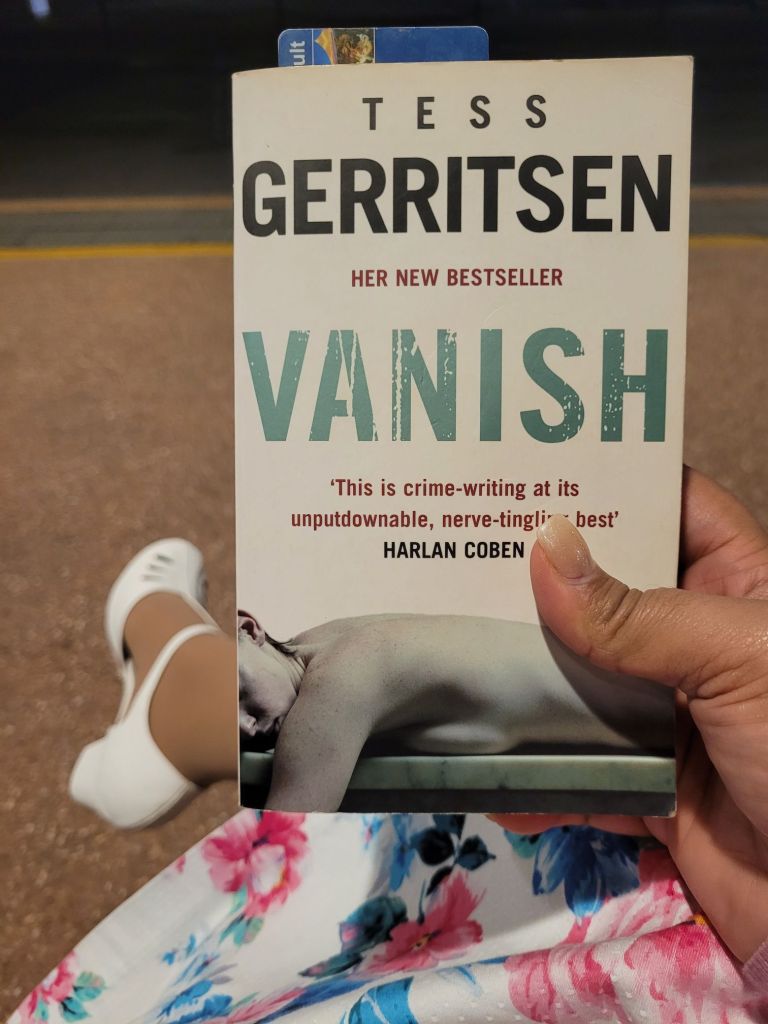
In Vanish (2005), Tess Gerritsen delivers a taut, socially conscious thriller that goes beyond the conventions of crime fiction. As the fifth instalment in her Rizzoli & Isles series, the novel showcases her signature blend of forensic realism and emotional intensity—thanks in no small part to her background as a physician and student of anthropology. That scientific lens gives the story a grounded, credible edge, especially in its depiction of evidence collection and trauma response.
The novel centres around two formidable women: Detective Jane Rizzoli and Medical Examiner Maura Isles. In a world dominated by male authority figures, these protagonists stand out not just for their competence but for their resilience and moral clarity. Gerritsen writes from two perspectives—one from the cop, the other from a mysterious victim—which adds layers of suspense and empathy to the narrative. It’s a structure that humanises the crime and gives readers a visceral sense of what’s at stake.
What makes Vanish especially compelling is its thematic ambition. Gerritsen tackles human trafficking head-on, portraying it as a deeply entrenched and horrifying reality of the 21st century. The novel also hints at the unsettling power of military-industrial entities, suggesting that these corporations can manipulate justice and policy in ways that undermine democratic institutions. It’s a bold move for a crime novel, and it pays off.
While Gerritsen’s prose may not reach the literary heights of Patricia Cornwell, her storytelling is sharp, emotionally resonant, and socially aware. In fact, Vanish gives James Patterson a serious run for his money—especially in its ability to weave action, character development, and ethical complexity into a single, gripping narrative.
If you’re looking for a crime novel that’s more than just a whodunit, Vanish is a standout. It’s a page-turner with a conscience, and it proves that thrillers can be both entertaining and enlightening.
In every corner of a school library, stories wait to be discovered. Stories that open minds, build empathy, and reflect the rich tapestry of human experience. But what happens when those stories are missing? When shelves lack the voices of different cultures, identities, and lived experiences?
As an educator and lifelong reader, I’ve come to believe that diverse books aren’t just nice to have in a collection. But rather, that they’re essential. They shape how students see themselves and others, and they help build inclusive communities where every child feels seen and valued.
Representation Matters
Research consistently shows that representation in literature has a profound impact on students’ self-esteem, academic engagement, and social development. When children see characters who look like them, speak their language, or share their cultural background, they feel validated. And when they read about lives different from their own, they develop empathy and understanding.
A study by the Cooperative Children’s Book Center found that in 2022, only 33% of children’s books featured characters from diverse backgrounds.
According to the Australian Institute for Teaching and School Leadership, inclusive education improves student outcomes and fosters respect among peers.
The “Windows, Mirrors, and Sliding Glass Doors” framework by Dr. Rudine Sims Bishop emphasizes how books can reflect our own lives, offer insight into others’, and invite us into new worlds.
Growing up as a teen in Australia, I rarely saw characters in books who looked like me or came from my cultural background. It wasn’t until university that I encountered authors who spoke to my experience, and it was transformative. That moment of recognition made me realize how powerful literature can be in shaping identity and belonging.
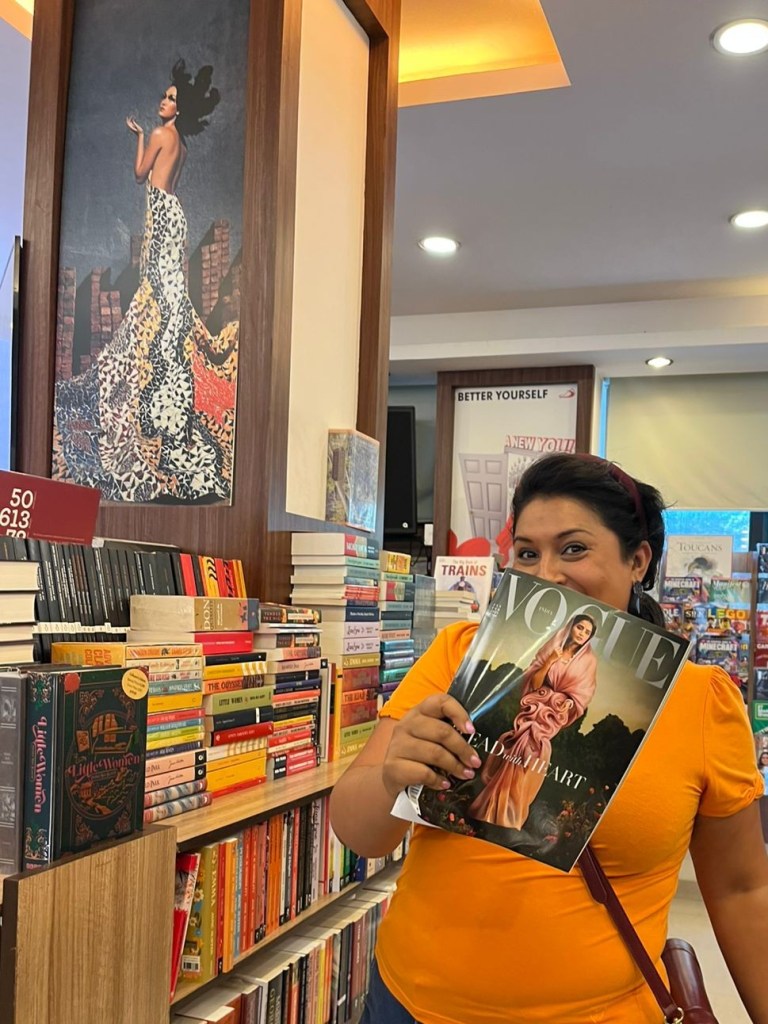
One of the most vivid memories I have of feeling truly represented was during a recent trip to Mumbai. I walked into a bookstore and saw the latest issue of India Vogue. I was drawn to it because the cover featured models who looked like me, wore traditional fabrics with pride, and radiated a beauty that felt familiar. I stood there, overwhelmed. For the first time, I saw my heritage celebrated in a way that was bold, glamorous, and unapologetically authentic. That moment reminded me how powerful visibility can be, not just in fashion, but in every form of storytelling.
Now, as a teacher, I’m committed to curating a library space that reflects the diversity of our world. I’ve seen firsthand how students light up when they find a book that resonates with them. As one Year 9 student told me earlier this year when I handed him The White Tiger by Arvind Adiga, “This book feels like it was written for me.” That’s the magic we should strive for.
🏫 What should Teacher Librarians do?
To ensure every student has access to diverse stories, Teacher Librarians and schools must:
Regularly audit their library collections for representation across race, gender, ability, and culture.
Partner with local communities and authors to source authentic voices.
Provide professional development for educators on inclusive literature.
Encourage student-led book clubs and reading initiatives that celebrate diversity.
💬 Final Thoughts
Diverse books aren’t just about ticking boxes, they’re about opening hearts and minds. They help students navigate the world with compassion, curiosity, and confidence. When we fill our shelves with stories that reflect the full spectrum of human experience, we send a powerful message: You belong here. Your story matters.
Let’s go beyond the bookshelf—and make every library a gateway to understanding.
“A reader lives a thousand lives before he dies. The man who never reads lives only one.” – George R.R. Martin
This weekend we celebrated an unusual day. A truly inclusive day, where anyone and everyone can join in the festivities. This day celebrates the peculiar joy of falling headfirst into a story, where dragons roam, detectives brood, and friendships bloom between pages. Book Lovers Day is a gentle reminder that quality literature doesn’t just entertain the mind, rather it transforms. It tickles the imagination, sharpens the mind, and teaches us to see the world through someone else’s eyes.
“Reading is an exercise in empathy; an exercise in walking in someone else’s shoes for a while.”
Malorie Blackman
Reading fiction is more than a leisure activity as it is a cognitive and emotional exercise that cultivates empathy, enhances wellbeing, and supports lifelong development. Classic novels such as 1984, The Handmaid’s Tale, Rebecca, and The Three Musketeers exemplify how literature invites readers to inhabit diverse perspectives, a process closely linked to the development of Theory of Mind (ToM).
ToM refers to the ability to understand that others have beliefs, desires, and emotions different from one’s own. Research shows a reciprocal relationship between ToM and reading comprehension: engaging with narrative fiction improves our capacity to infer characters’ mental states, which in turn strengthens our understanding of complex texts. This cognitive skill is foundational not only to reading but to social interaction and emotional intelligence.
Moreover, (and this is the part I absolutely love!), reading fiction contributes to stress reduction and emotional regulation. Works like Life of Pi, The Scarlet Pimpernel, Gone with the Wind and Wind in the Willows offer immersive experiences that promote relaxation and introspection. As noted in The Conversation, reading also fosters curiosity—a trait linked to career success and psychological resilience.
In sum, literature nurtures the body, mind, and spirit. On Book Lovers Day, we celebrate fiction not just as art, but as a vital tool for cultivating empathy, enhancing wellbeing, and deepening our understanding of others.
They capture your imagination with words and imagery.
Similar to a siren singing her tune, an author draws the reader in with stories of heroes, villains, mysteries and magic. There are several writers that come to mind when one thinks about perspicacity at understanding a developing mind. Enid Blyton comes to my thoughts immediately, as it was her books of Faraway trees, Wishing Chairs, Mallory Towers and the adventurous children that beguiled and transformed me into a certifiable bookworm. Other authors with these same mystical powers include Emily Rodda, A A Milne, Dr Seuss, C. S Lewis, Beatrix Potter, E.B White, Lewis Carrol, Eric Carle, Rick Riordan, J K Rowling and of course, Roald Dahl.
Dahl’s popularity has enthralled generations of children with his fantastical tales. Even 30 years after the publication of perspicacious Matilda, the lure is still strong according to Kelly (2019) who recently published an article in the Sunday Times just short of the author’s birthdate. Dahl’s books have inspired generations of children to read. His stories of redemption and resilience appeal to both children and adults. I found it particularly interesting that the books often seem to be narrated by the child protagonist. By doing so, Dahl places the reader in the central position and thus immediately engages their interest. The books often place the child in the role of an underdog and their eventual vanquishment of the bigger and older (usually an adult) enemy gives great satisfaction. Darby (2016) believes that this narrative style is appealing to children as it makes them feel like “someone is in their court”.
Some people assert that Dahl’s books are macabre and filled with violence, racial slurs, misogyny and vindictive behaviour. Anderson (2016) argues that the books caused great disturbance among adult readers when they first started being published in the late 60’s. Stories where witches turn children into mice, people are fed worms and or eaten by giants, and let us not forget principals that swing cute girls by their hair like a discus and push children into nail studded cupboards.
In fact, “James and the Giant Peach has been lambasted for its racism, profanity and sexual innuendo” Anderson (2016) states.
It appears Dahl was provoking everyone, as he offended numerous demographics in equal measure. But I am starting to believe that the provocation is what lured children to read and re-read his books. It was just that little bit naughty and disgusting. Just enough to make children feel superior and more wise than the character, but not too much as to disengage the reader. Arguably this is probably what explains Dahl’s longevity as an author. Nice clean stories such as Wilder’s Little House series has its staunch clientele but it does lacks the Dahl’s drawcard in that the majority of children do not identify with these characters. Kole (2018) suggests that it is when the reader can draw upon their own experience with the subject matter that engagement with the text occurs. This could be contended similar for L M Montgomery’s Anne or White’s Charlotte’s Web. All extremely well written and received books, but not as far reaching as Dahl. Whilst their stories do have points of personal travail, they simply are not dark enough.
This need for darkness is important for children’s literature
as Anderson (2016) and Kole (2018) further elucidate. One can only think of the popularity of the Grimm fairy tales, Rowling’s Harry Potter, Collins ’Hunger Games and Meyer’s Twilight to realise that the desire for grim has not changed in centuries. The adage about literature reflecting life is the underlying support for this need for fear and fright in children’s books. Stories of children overcoming great difficulty has the ability to build great resilience and empathy in the reader.
We are all aware of how reading builds empathy. Readers identify with the characters in the story and thus the feelings from one are juxtaposition-ed on the other . But reading fictitious stories of giants, witches and wizards, whilst unrealistic, also gives children an important cathartic release according to Bettelheim (2010). Rochelle (1977) whilst dated, firmly believes that adults and children both require fantastical literature to interweave the complex strains of good and evil in humanity. Fantastical tales give children innate strength to overcome hurdles life throws at them, no matter how bizarre it is (Kole, 2018). Children are aware that these stories are unreal in the fantastical sense but the situation that the characters are facing are very real indeed (Rochelle, 1977). Wakefield (2014) agrees and points out that fairy tales are there to protect rather than terrify, as the protagonist is forced to seek inner strength to overcome the villain. The stories illustrate that these situations can be overcome, and in that, give hope and possibly a way out.
Fantastical tales are more than just entertainment. In their own way, they give children (and adults) the ability to fight demons in both the real world and in their dreams. After all, the lives of children are not always filled with rainbows and unicorns. Many children live in shadows. Reading stories such as Dahl’s encourage children (and adults) to go past their grim quagmire and find their inner strength.
So this Roald Dahl day on September 13, read a fantastical story… and at the same time, gain some humanity.
Rochelle, L. (1977). The search for meaning through fantasy. The English Journal. Vol. 66, No. 7, pp 54-55. Retrieved from https://www.jstor.org/stable/814365
Wakefield, M. (2014). Why scary fairy stories are the best. The Spectator.