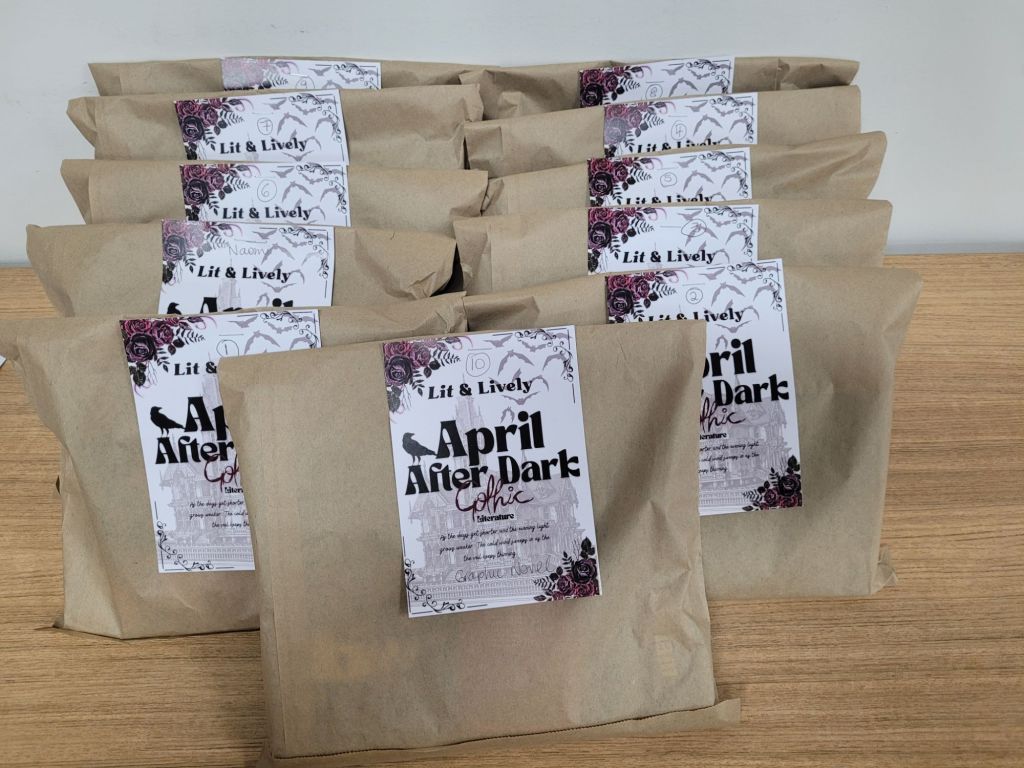
Lit & Lively, the school’s staff book club, is embracing the shadows this month with a gothic themed gathering titled April After Dark. This month’s meeting is centred around gothic literature, inviting staff to explore darker moods, mysterious settings, and stories that linger long after the final page. The format is welcoming and flexible. Staff read one shared text together, giving everyone a common starting point for discussion, before branching out into a range of gothic titles from the library collection. Each participant received a carefully prepared book pack, lovingly packed with the novels, a tea bag, and a chocolate biscuit, turning the reading experience into a small but meaningful indulgence during the autumn break.
April After Dark has also been a practical and creative way of using class sets that usually sit out of season. By repurposing these texts for staff reading, the library is reintroducing overlooked titles and highlighting how versatile the collection can be. Many participants have discovered books and genres they might never have explored without a themed invitation. It also reflects an important part of the Teacher Librarian role, which is not only to support students, but to guide and encourage staff in their own reading journeys and engagement with literature.
Through Lit & Lively, staff are gaining a deeper understanding of the breadth and depth of the school’s collection and reinforces the library as more than a curriculum support space. It is a place for curiosity, enjoyment, and reading for pleasure, modelling the reading culture we encourage in students.
There is also a strong wellbeing element. Reading for pleasure can act as a form of bibliotherapy, offering comfort, escape, and emotional renewal. Teachers often have little opportunity to read during the term, and the autumn break provides a rare pause to do so. Finally, Lit & Lively celebrates the social side of reading. Book clubs create space for conversation, shared reflection, and connection, reminding us that reading is often richest when it is shared.
As April grows darker, April After Dark reminds us that reading together can be restorative, enriching, and deeply human. Lit & Lively continues to affirm that teachers deserve time to read, reflect, and reconnect too.
Reading is widely recognised as a critical skill for young people, supporting the development of strong cognition, mental health and empathy. A growing body of research consistently shows that recreational reading in particular is linked with academic achievement, improved emotional regulation and more nuanced interpersonal understanding. Building a culture of reading, therefore, is not a peripheral task for schools. It lies at the heart of nurturing thoughtful, resilient and socially capable young people.
Yet despite these well established benefits, many children and teenagers do not naturally turn to teachers or teacher librarians for book recommendations (Merga, 2012). To be blunt, young people do not necessarily see adults as cool. Recommendations from teachers, no matter how well intentioned, may lack what adolescents consider to be genuine social credibility. The street cred factor is real, and it is powerful.
Further evidence comes from the work of Dr Margaret Merga, a well respected Australian researcher in literacy and reading engagement. In a mixed methods program examining the influence of social attitudes on reading behaviours, Merga (2012) noted that “perceived friends’ attitudes can have a more significant influence on boys than girls, [therefore] making books socially acceptable for boys should be a priority for educators.” This underscores the idea that book talk among peers is not merely casual chit chat. It is a mechanism of social permission. When books gain traction within a peer group, they gain legitimacy and ethos (Merga, 2012; Merga 2014).
Australia Reads similarly emphasises the importance of social engagement in building sustainable reading habits. Its principles highlight that young people need “positive social reading experiences” and opportunities to “recommend, discuss and share books and other texts in ways that are personally enjoyable and relevant”. In other words, reading thrives when it is relational.
At Lauries, we see these principles in action every day. While staff recommendations certainly have their place, it is peer driven reading culture that most reliably sparks curiosity, especially among reluctant readers. This is why we actively encourage students to reflect on and review the books they read. Their voices matter. Their opinions shape the reading landscape for others. The broader research base supports this emphasis on social recommendation and discussion as a driver of voluntary reading.
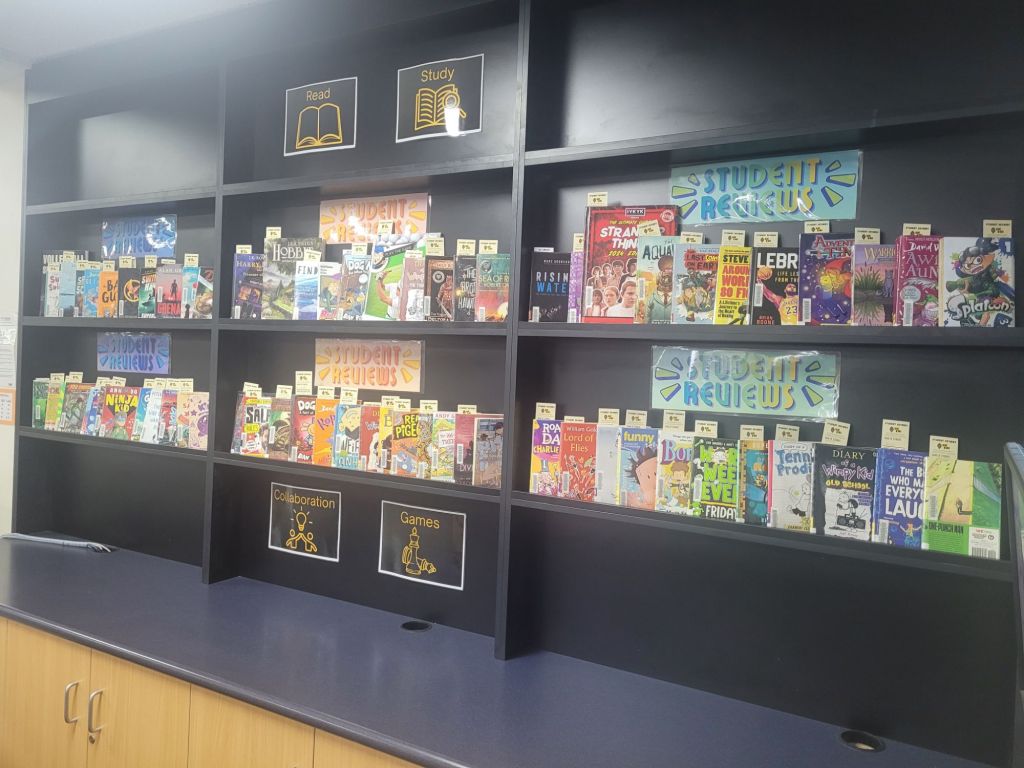
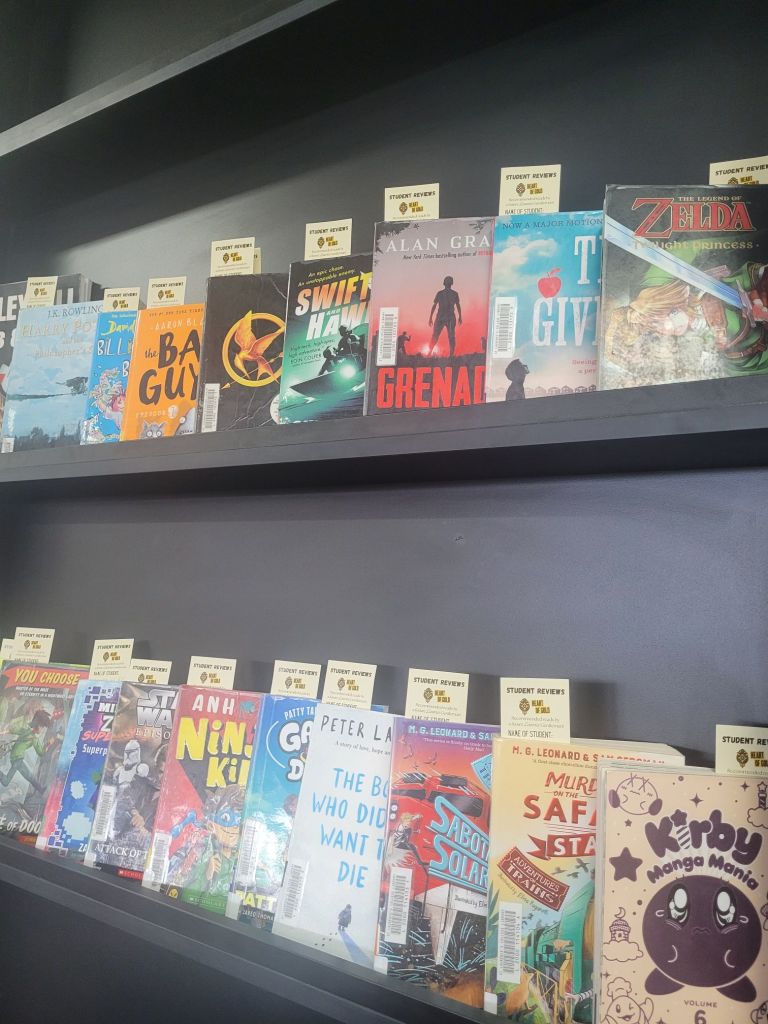
A visible expression of this culture is our wall of Lauries Lads Lit Picks. This growing collection showcases books that our students have personally endorsed. We often see reluctant readers wandering over, flicking through the displayed reviews until they discover a familiar name. That moment of recognition is powerful. When a friend or respected peer has enjoyed a book, the barrier to entry drops dramatically. The book becomes not just a text but a shared experience waiting to happen. The pattern aligns with evidence that peer attitudes and friend recommendations play an outsized role in adolescent book choice.
Cultivating a socially rich reading environment therefore requires more than simply providing access to books. It involves elevating student voice, valuing peer influence and creating spaces where reading is openly shared, discussed and celebrated. The evidence is unequivocal. When young people are given opportunities to recommend books to one another, their engagement deepens and their confidence as readers grows. Reading becomes woven not only into their academic lives but into their friendships, identities and everyday conversations.
By continuing to champion peer driven discovery, we support our students not only to read more but to read with curiosity, connection and purpose. That is a foundation that benefits them far beyond the walls of the library
Rutherford, L., Singleton, A., Reddan, B., Johanson, K., & Dezuanni, M. (2024). Discovering a Good Read: Exploring Book Discovery and Reading for Pleasure Among Australian Teens. Deakin University. https://eprints.qut.edu.au/247629/[eprints.qut.edu.au]
Lunchtime in a library can sometimes be overlooked as a quiet or transitional part of the day. In reality, it is one of the most powerful opportunities libraries have to connect with their community. Lunchtime events turn a regular break into a moment of discovery, drawing people into the space, engaging those who may feel unsure or disconnected, and strengthening the library’s role as a welcoming and active hub.
Library events are vital for building a rapport between a school community and their library because participating in a simple activity can lead to conversations. From there, it becomes easier to talk about books, recommend reading, or explain what the library can offer. This is because for many people, a lunchtime event is someone’s first positive and relaxed experience in the library, helping them feel more confident and welcome. The brilliance lies in the fact that lunchtime events naturally attract foot traffic. Students and staff are already moving around, looking for somewhere to go or something to do. Hosting activities during this time removes barriers to participation. There is no need to stay after hours or commit to a long session. People can simply wander in, take part, and head off again because these activities are flexible and easy to join. Not everyone wants a formal workshop or a structured program during their break. Drop in challenges and creative prompts allow people to engage at their own pace, whether they stay for two minutes or twenty.
Heartfelt Haiku and prizes for winning entries.
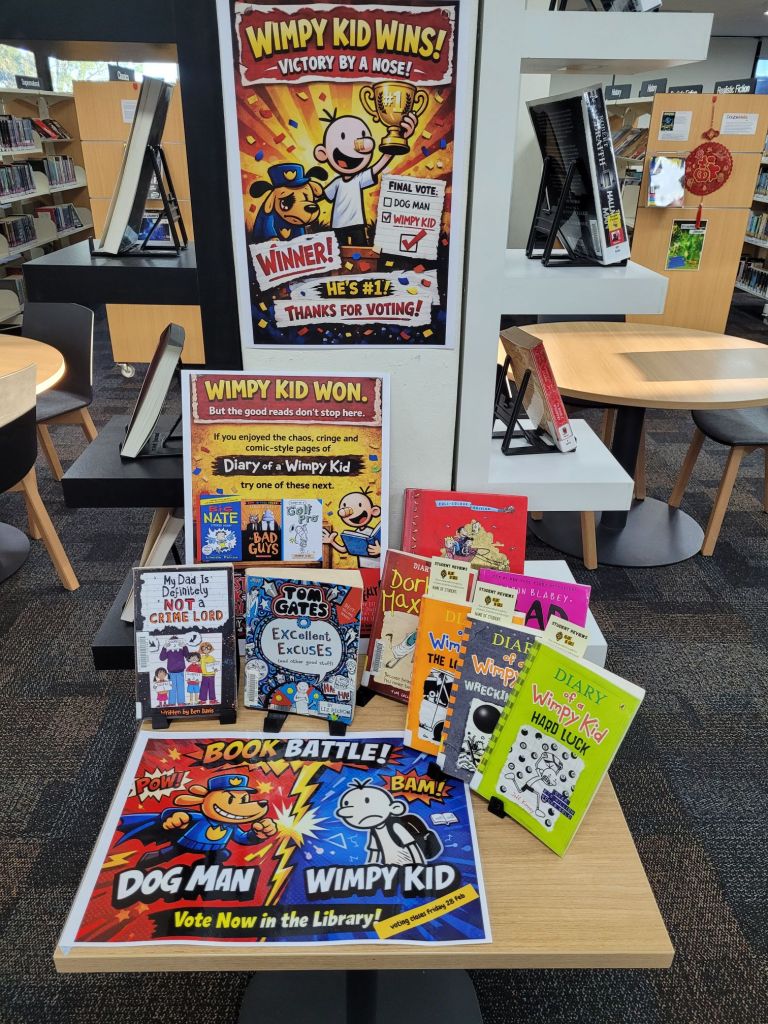
Furthermore, connecting lunchtime challenges to theme days and seasonal events helps keep them fresh and relevant. It gives people a reason to take part right now and adds a sense of fun and anticipation. Over the past few weeks, our library has run challenges such as Heartfelt Haiku for Valentine’s Day and Library Lovers’ Day invited participants to reflect on their love of reading and libraries. Lantern making for Lunar New Year created a hands on way to celebrate culture and tradition. A recent voting challenge between Dog Man and Diary of a Wimpy Kid tapped into popular reading interests and friendly competition. Now, in this past week, the Falling into a Book challenge has encouraged readers to embrace the new season with a new story.
Book Battle: Dogmas V Wimpy Kid
Lunchtime events transform the library into a social and welcoming space. A table set up with a challenge, a craft activity, or a voting station often sparks curiosity. Someone who had no intention of visiting the library may step inside just to see what is happening. Once they do, they are surrounded by books, displays, and friendly faces. Lunchtime events create opportunities for spontaneous engagement that might not happen at any other time of day. They also show that the library values participation in many different forms, not just quiet reading. Afterall, when people participate together, even briefly, they share experiences that build a sense of belonging. Over time, these shared moments help strengthen relationships between library users and staff. The library becomes known not just as a place to borrow books, but as a place where people feel comfortable, included, and valued.
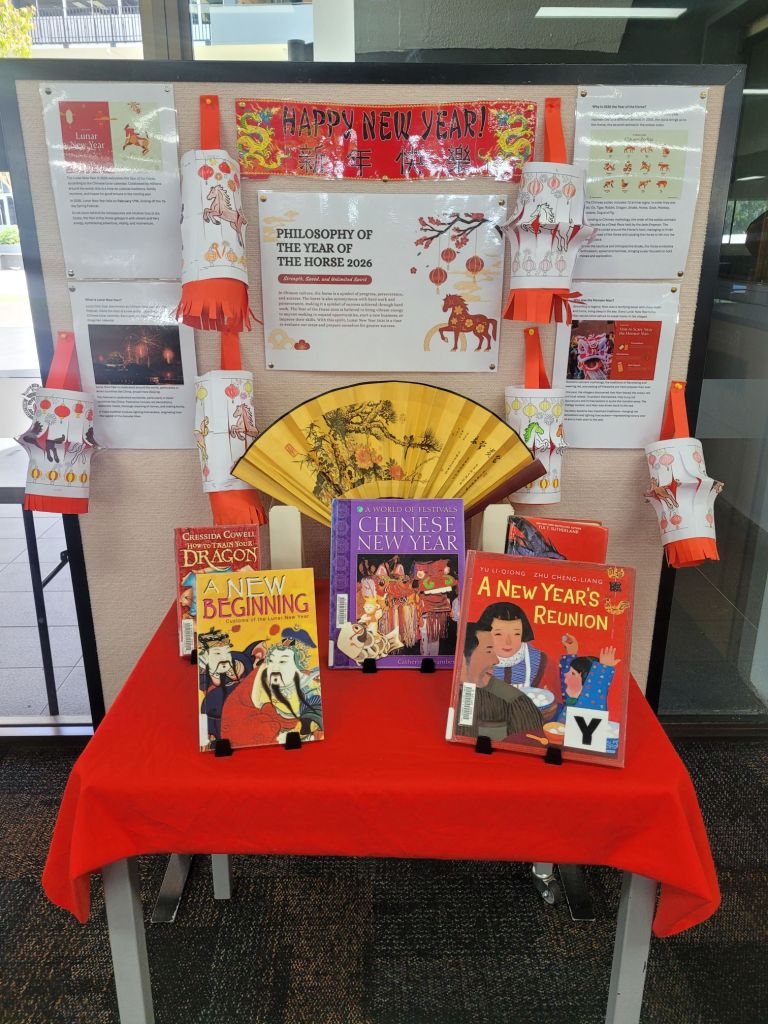
Lunar New Year Display and handmade lanterns.
Lunchtime events quietly demonstrate the broader role of libraries. They show that libraries are dynamic spaces that respond to their communities, encourage creativity, and support wellbeing as well as learning. School libraries that use their lunchtime activities or challenges to build connections and rapport with their communities can turn an ordinary break into a meaningful connection and remind everyone why libraries matter.
History is often presented as a clean line of dates and deeds, with women’s voices muted or missing. Yet when I read historical fiction, I hear those voices rise. It is in the imagined conversations, the textured inner lives and the careful stitching of research to narrative that women like Eleanor of Aquitaine step out from the margins and take their rightful place at the centre of the story. Historical fiction does not replace the archive. It complements it. It gives shape to the silences and lets Her story speak.
Eleanor of Aquitaine has captivated me for years. She was queen of France, then queen of England, duchess in her own right, patron of culture and mother to kings. Even through the writings of men who often judged powerful women harshly, she still appears intelligent, beautiful, strong of will and frequently labelled as wilful. That tension between what the record says and what it leaves unsaid is exactly where historical fiction does its best work. Through fiction, we can inhabit the rooms where the clerks did not sit, hear the words no chronicler bothered to write, and feel the force of a woman who shaped her world.
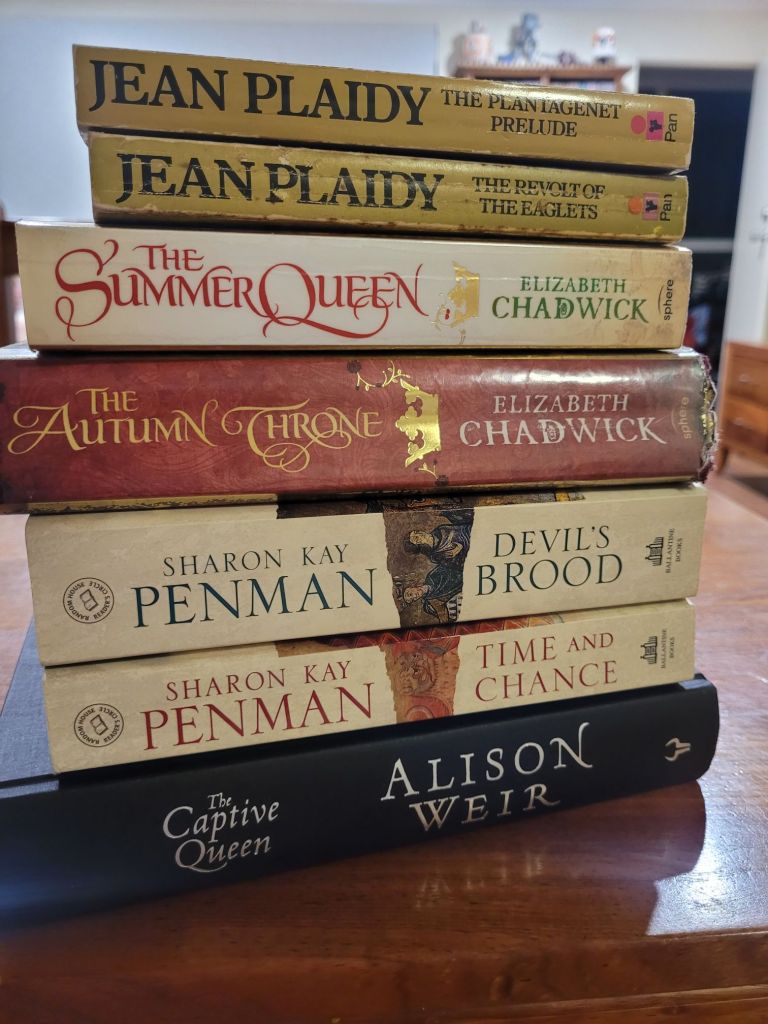
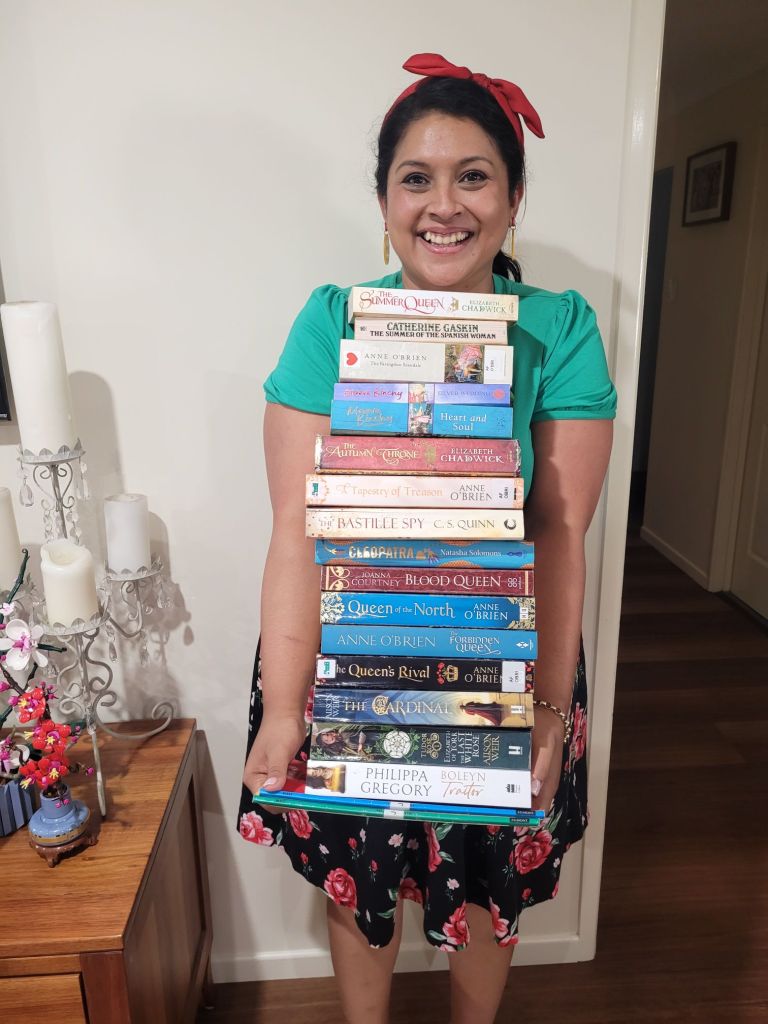
Because I am fascinated by Eleanor, I have read widely across authors who approach her life from different angles over my last summer holidays. Each one balances fact and imagination to reveal a fuller portrait. In their hands, Eleanor becomes more than a figure on a timeline. She becomes a person, with agency, complexity and heart. Reading these books has reminded me again and again that history is not only his story. It is also her story, and it deserves to be heard.
Why Historical Fiction Lets Her Story Speak
Historical fiction gives us the space to ask human questions that sources do not answer. What did courage feel like to a woman whose decisions could alter a dynasty. How did she manage loyalty and love in a world that traded both for advantage. What language did she use for her ambitions, her fears and her hopes. Novelists use careful research and responsible imagination to explore these questions. They do not invent the past. They interpret it with empathy, so that readers can understand lives very different from our own.
For women, this matters deeply. The written record often reflects the priorities of men who held the pen. Fiction can step into the gaps and consider the private sphere where much of women’s labour and influence took place. It can restore friendships, mentorships, rivalries and choices that formal chronicles overlook. Reading such stories changes how we see the past. It prompts us to look again at the sources, to notice what was omitted and to seek out voices that were ignored.
This is why I keep returning to Eleanor of Aquitaine through fiction as well as history. Each book adds texture to the tapestry. Each author brings a new hue to the same thread. Together they create a portrait that feels whole. In listening to these imagined yet carefully grounded voices, we are not abandoning truth. We are widening it. We are acknowledging that history is a chorus, and that Her story deserves to sing just as clearly.
Her life reminds us that the past belongs to all of us. Reading and sharing these novels is one way to make sure that our understanding of history includes the women who shaped it. His story has been told for a long time. It is time for Her story to be heard alongside it, fully and without apology.
So if you would like to know a bit about Her-Story, here are some of the amazing authors who wrote about Eleanor:
Books by Elizabeth Chadwick featuring Eleanor of Aquitaine The Summer Queen The Winter Crown The Autumn Throne
Books by Jean Plaidy featuring Eleanor of Aquitaine The Courts of Love Eleanor of Aquitaine: The Young Queen Eleanor of Aquitaine: The Rebel Queen
Books by Sharon Penman featuring Eleanor of Aquitaine When Christ and His Saints Slept Time and Chance Devil’s Brood Lionheart A King’s Ransom
Books by Alison Weir featuring Eleanor of Aquitaine Eleanor of Aquitaine: By the Wrath of God, Queen of England (non fiction) Captive Queen (fiction)
This week we celebrate Queensland School Library Week and this year’s theme, School Libraries Light the Way, perfectly captures what our library aims to do every day. School libraries illuminate pathways to learning, belonging, curiosity and joy. They guide students in reading, research, creativity and personal growth while promoting equity and inclusivity for every learner.
Here is how our library is commenced lighting the way in the first few weeks of 2026.
Lighting the Way for Reading, Research and Recreation
Book Clubs in Full Swing: Our book clubs for primary and secondary students have been meeting since Week 2 and the enthusiasm has been wonderful to see. These groups give students opportunities to read for pleasure, discuss ideas and connect with other readers across the school.
Sharing New Books: We continue to promote new books to staff and students. Whether it is a fresh fantasy adventure, a gripping nonfiction title or the newest young adult novel, we work hard to help every reader find something they will enjoy.
Supporting Teacher Professional Learning: We are also lighting the way for staff by ensuring our digital access to teacher journals is current, reliable and easy to use. We share these resources across school networks so that teachers can stay informed, inspired and connected to current practice.
Library Lessons for Years 5 to 8: Our library lessons support student interest and reading engagement. These sessions are planned to build student efficacy in navigating their own reading journey.
Information Literacy for Years 7 and 8: I collaborated with classroom teachers to deliver information literacy instruction that is authentic and practical. Students are learning to locate information, evaluate sources and use material ethically, which helps prepare them for success in school and beyond.
Lighting the Way for Equity and Inclusivity
Lunar New Year Activities: From this week we will offer Lunar New Year activities during language classes and at lunchtime. These activities build cultural understanding and celebrate the rich diversity of our school community so that every student feels valued and represented.
The Happy Book Dragon: Our library is also home to its resident happy book dragon (aka ME) who lives and breathes book trivia and reading joy. Sometimes lighting the way simply means sharing enthusiasm and creating a space where curiosity thrives.
Lighting the way together
Queensland School Library Week is a reminder of the powerful role a school library plays in the life of a community. From nurturing readers to supporting staff and celebrating cultural diversity, our library is proud to be a guiding light in our school.
Here is to a bright and book filled week and to the many ways libraries continue to light the way every day.
Last week I went back to work. It was very difficult to swap my afternoon naps for faculty meetings and my long lunches for a quick bite on the go. It was also very difficult to not indulge in my favourite early evening activity of a cocktail with a book.
Like with many people returning to work, the common question was..
“how was your break?” Or “what did you do?”.
Well… at first, I mentioned hanging with my family, visiting friends, travelling for Christmas. But the reality, the actual reality of my holidays was that I read books.
I read a lot of books.
I read every spare moment I had. Between lunch dates, on the bus, in the car, waiting for friends at coffee shops. I even had my book with me on late nights out for my 2.30am bus ride home. I stayed up late and woke up early just to finish my latest novel. At one point, my husband was getting frustrated with my late nights… but to no avail. I needed to read! As Maverick and Goose once said in a quote that I am going to appropriate…
I feel the need, the need to read…
January Reads
As teachers we know it is very hard to read what we want during the term. We are often reading class novels, essays, assignments, emails and meeting notes that should have been emails. I knew, that to fill my bucket of prose, I needed to read till my heart was full before I started the new academic year.
So, over the six weeks of summer holidays I did just that- I read 34 physical books, 4 eBooks and 2 comics. I am still on the mission to finish the rest of the Tintin series over the next few weeks – but for now, this particular book dragon is exceedingly happy.
As the scholastic year draws to a close, children and teenagers eagerly anticipate the long summer holidays filled with play, family time and relaxation. While this break is important for wellbeing, research consistently shows that it can also lead to what is known as the summer reading slump. This phenomenon refers to the decline in literacy skills that many children experience during extended school breaks. Studies have found that children can lose up to a month of learning over summer, particularly in reading and spelling, with the effect most pronounced among children from lower socio-economic backgrounds who may have limited access to books and literacy-rich environments (National Library of New Zealand, n.d.).
Evidence from New Zealand highlights the importance of structured literacy teaching in preventing this decline. A study published in the New Zealand Journal of Educational Studies determined that the impact of explicit phonics, phoneme awareness and decoding strategies can embed foundational skills deeply enough to withstand the summer gap (Vosslamber, Walker, Millar-Swan, Motha, & Gillon, 2025). This reinforces the idea that strong classroom instruction can provide a buffer against learning loss.
Alongside structured teaching, regular reading at level is critical. When children engage with texts that match their ability, they reinforce vocabulary, comprehension and decoding skills while building confidence and motivation. Reading at level prevents cognitive decline associated with long breaks from literacy activities. Research also shows that children who participate in summer reading programs are more likely to maintain or improve their literacy skills. Benefits include increased motivation, improved comprehension and stronger connections between home and school learning (Reading Eggs, n.d.).
Governments and councils are aware of the risks posed by summer learning loss, which is why many have invested in free summer reading programs. These initiatives encourage children to keep reading for pleasure and skill development during the holidays. The Brisbane City Council Summer Reading Program, for example, offers fun challenges, rewards and community engagement to keep children motivated throughout the break (Brisbane City Council, n.d.). Programs like these not only support literacy but also foster a love of reading that lasts well beyond the summer months.
At my school, we have taken this one step further by setting up a summer reading challenge for both staff and students in the form of bookmarks. Students were given bookmarks that encouraged them to read a funny book, a book with a hero, a book by an Australian author and a book with an animal character.
Staff were challenged to read a book that made them laugh, one that made them cry, a book that gave hope and one recommended by a friend. This shared challenge not only promotes literacy but also builds a sense of community, with staff and students alike engaging in conversations about their reading choices and discovering new perspectives together.
The summer holidays should be a time of joy, but they do not have to mean a setback in learning. With structured teaching approaches, regular reading at level, community programs that make books accessible and fun, and school-based initiatives like reading challenges, children and adults alike can return to school inspired and ready to thrive. The evidence is clear: consistent engagement with reading is one of the most effective ways to prevent the summer slump and ensure that literacy skills continue to grow.
Suggestions for Teachers and Parents
Encourage children to read daily, even for short periods, with books that match their reading level.
Provide access to a variety of texts, including humorous stories, adventure tales, and culturally relevant works.
Model reading behaviour by sharing your own reading experiences and discussing books together.
Participate in local library programs or community reading initiatives to maintain motivation.
Create family reading routines, such as bedtime stories or shared reading times, to embed literacy into everyday life.
Celebrate reading achievements with small rewards or recognition to sustain enthusiasm.
Vosslamber, A., Walker, J., Millar-Swan, A., Motha, J., & Gillon, G. (2025). The impact of Better Start Literacy Approach teaching on the retention of children’s early literacy skills over the summer holidays. New Zealand Journal of Educational Studies, 60(3), 435–449. https://doi.org/10.1007/s40841-025-00405-2
As the school year wrapped up last week, I found myself reflecting on the many moments that shaped our library community in 2025. There have been challenges, yes, but also plenty of reasons to celebrate.
One of the brightest sparks has been our book clubs. What started as a simple idea, a few snacks and a chance to talk about stories, has grown into something much bigger. My secondary Book Club stands out. At the beginning of the year they were a small group, some unsure of what to read, others firmly attached to their favourite genres. Over time, though, their borrowing soared. They began exploring fantasy, contemporary fiction and graphic novels, and while one dedicated manga reader still resists branching out, the group as a whole has broadened its horizons. More importantly, they began to see reading as part of who they are. They recommend titles to each other, debate endings, and even suggest new books for the library. Watching that transformation has been a joy.
Research reminds us that this is exactly what book clubs are meant to do. They make reading social, they build confidence, and they help young people see themselves as readers. The secondary Book Club Boys proved that in the most authentic way, showing how a community of peers can turn reading from a solitary task into something shared and celebrated.
From a whole school review, borrowing levels across the school have also risen, returning to pre COVID rates. Much of this growth has come from our younger readers, whose enthusiasm has been infectious. Their excitement has created a vibrant culture of reading in the primary years, and their participation in activities has been a highlight of the year.
Of course, there are challenges we cannot ignore. Very few of our Year 10 to Year 12 students are reading recreationally, and this is concerning. Intertextuality, the ability to connect ideas across texts, is vital for analysis and for building strong cognitive connections. Without regular reading, those skills are harder to develop. We also continue to see limited engagement from Years 7 to 10 English classes, despite enthusiastic promotion. There seems to be a reluctance to lose curriculum time.
Our team dynamic has shifted too, with members coming and going. Change always brings adjustment, but it has also brought fresh perspectives and energy. We have expanded our digital resources, and while uptake has been slow, steady gains are being made as students and staff grow more comfortable with these platforms.
Perhaps the greatest success of all has been the way the library has become recognised as a social space where everyone is welcome. It is not only a place for books, but a hub for connection, collaboration and belonging. That sense of community is something we can all be proud of.
We closed the year with our Books & Bites Christmas party, a joyful celebration of new releases and Christmas treats. Each student received a reading journal with a challenge to read four books over the summer, along with handmade gifts, ornaments, bookmarks, and pen holders, sewn over the past few weeks. These tokens were a way of honouring the shared love of reading that binds us together.
As we finish the 2025 chapter, I am reminded that reading is not just about borrowing books, it is about building minds, fostering empathy and preparing students for the complexities of the world.
“As we finish this chapter and look ahead to the new year, I am reminded that Christmas is a season not only of rejoicing, but of reflection. May the joy of stories, the warmth of community, and the promise of new beginnings carry us into the year ahead.”
On Sundays, our family has a rhythm. We go to church in the morning, then its off to our local library. The kids scatter to their favourite corners, borrowing books and settling in to read whatever strikes their fancy. The only rule is, that for every book that is a re-read, there must be one you have not read before.
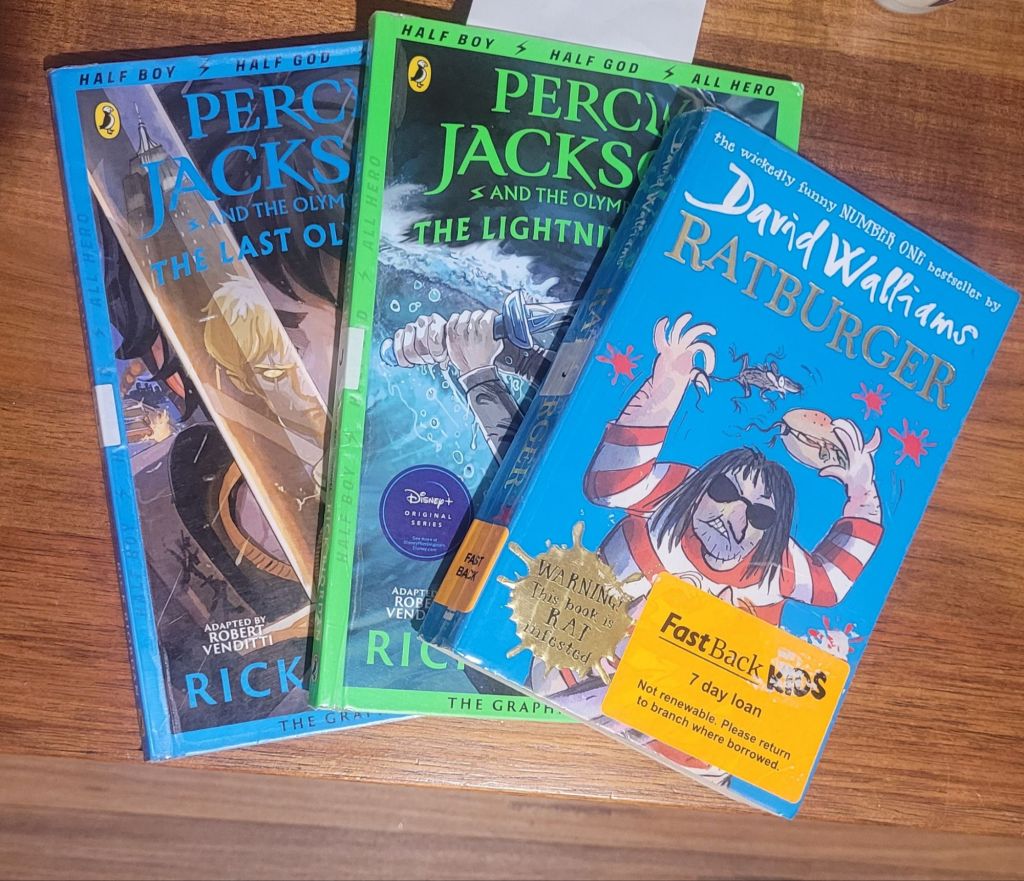
This week’s book haul – mine.
Whilst my children scurry to their favourite genres, I grab a coffee and wander the shelves, letting my eyes land on whatever catches my eye. My husband always chuckles at this part. “You work in a library,” he says, amused. He’s right, of course. I do. But I work in a boys’ school library, and let’s just say the collection doesn’t quite float my boat. We then settle down for 30-45min of quiet reading together, but all on individual journeys.
There’s something different about being in a space where reading is chosen, not assigned. Where stories are picked for pleasure, not performance. That contrast has been sitting with me lately, especially after reading Loh et al.’s 2025 report on the decline in volitional reading and a recent piece in The Conversation about the new Children’s Booker Prize. Both paint a sobering picture: young people are reading less, and they’re enjoying it even less than that.
Loh, C. E. et al. (2025) The Decline in Volitional Reading: Evidence-Informed Ways Forward. National Institute of Education, Nanyang Technological University, Singapore.
Loh’s recommendations to improve literacy success.
agency
access to literature
time in daily routines
reflection and connection
social interaction
developing a positive reading identity
What struck me most in Loh’s report was what wasn’t there. None of the key principles mention curriculum reform. None suggest that testing is the answer. Instead, the focus is on joy, choice, and connection. Reading for pleasure is framed not as a luxury, but as a necessity. It’s a stronger predictor of reading attainment than socioeconomic status. That’s huge. It means that if we want to close literacy gaps, we need to open up space for enjoyment.
In my school library, I see the tension. Boys who associate reading with assignments, comprehension questions, and accelerated reader points. Not with curiosity or escape. Not with laughter or awe. And I wonder: what would happen if we let go of the scaffolds and trusted them to choose? The Conversation article makes a similar point. Awards like the Children’s Booker are lovely, but they won’t shift the culture on their own. What we need is a reimagining of reading in schools. Less about outcomes, more about experience. Less about control, more about trust.
Furthermore, parents need to remember that they are their children’s first educators. Is reading and literacy your household value? One of the key findings in Loh’s research is that children need access to literature and to see it modelled by the adults around them. Do parents take their kids to the library? Do they read in front of their children? Or do they presume that schools will take care of it? Do they even ask their children how often they visit the school library? These questions matter. Because when reading is visible and valued at home, it becomes part of a child’s identity, not just a school subject.
So here’s my quiet Sunday reflection: maybe the best thing we can do as educators is to make room and provide time. Room for stories that speak to our students. Room for browsing, for borrowing, for reading without a worksheet attached. Room for libraries that float their boats and time to lie back and float away.
Because when reading becomes a choice again, it becomes a joy again. And that’s where the magic lives.
I recently attended the QSLA conference at the beautiful State Library of Queensland. It was a fantastic day for school informational professionals to gather, share emerging news, identify new trends and trade in good old fashioned work chit chat.
Andy Griffiths – author of the famous Treehouse series, was our keynote speaker. I have known of Andy’s work for almost a decade. Whilst I have admired his works, I hadn’t fully appreciated his philosophy until now. His words, much like his books, were playful on the surface but deeply subversive underneath. They invited us to reconsider not just how children read, but why they need stories that break the rules.
Griffiths and his co-creator, illustrator Terry Denton have created the inventive, imaginative chaos that is the Treehouse series. I found it amusing that they named the main characters after themselves. Their fictional versions live in an ever expanding treehouse that defies logic and gravity, expanding with each book to include ludicrous additions like a marshmallow machine, a tank of man-eating sharks, and even a volcano. Their adventures are reckless, absurd, and often dangerous. But that danger is never real. It’s theatrical. It’s safe. It’s fiction.
… and that is the point. It is fiction as Andy pointed out last week to a large group of educators and informational professionals.
This was so true. In a world increasingly obsessed with safety, structure, and supervision, Griffiths’ books offer a counterbalance. They don’t just entertain their readers… they liberate them! They allow children to imagine running across six lanes of traffic or jumping into a volcano, not because they should, but because they can. In fiction, the consequences are exaggerated, the outcomes are ridiculous, and the lessons are embedded in laughter. Griffiths uses humour to engage the reader and builds into that playful sense that children have. As Griffiths said last week, “Reading is a game between the reader and the author. Authors make black marks on pages. Readers use these marks to make an image in their heads.”
I then thought about all the other books that ‘helped me break rules’. Darryl and Sally hosting midnight feasts at Mallory Towers, Matilda using her brain to solve problems, Trixie Belden and Nancy Drew resolving mysterious events. Each of these characters and books gave me option I may not have thought of previously.
Leaving the conference, I felt a renewed appreciation for the role of literature in childhood. Not just as a tool for literacy, but as a sanctuary for wild thought. Griffiths reminded us that imagination isn’t just fun. It’s vital. It’s how children rehearse life, test boundaries, and build resilience.
And maybe, just maybe, it’s how they learn to be free.










 Learning through the Library