Book Review – Hangman

Hangman by Jack Heath, published in 2018, marks his first foray into adult fiction after a successful career writing young adult novels. Known for fast-paced, clever storytelling in the YA space, Heath takes a bold leap into darker territory with this gripping thriller—and he doesn’t hold back.

The novel is centred around Timothy Blake, a consultant for the FBI with a disturbingly dark secret: he’s a cannibal. Heath crafts a character who is both brilliant and deeply unsettling, challenging readers to grapple with their own sense of right and wrong. One could argue that the end justifies the means.  Others would say that the dignity of a person should always be at the forefront of any decision making.

The novel leans heavily into thriller territory, with relentless tension and a breakneck pace. However, it’s also more graphic than many traditional mysteries, featuring scenes that some readers may find unsettling or overly gory. If you’re sensitive to violence or visceral detail, this one might push your limits.

Despite the intensity, Hangman stands out for its originality and daring. It’s a bold start to a series that explores the darker edges of justice and human nature. If you can stomach the gore, it’s a compelling read that redefines what a crime thriller can be.

Book Review – Mistress of Rome by Kate Quinn.

Mistress of Rome, published in 2010, is the first book in Kate Quinn’s Empress of Rome series. Set during the reign of Emperor Domitian—the last of the Flavian dynasty and arguably the most paranoid—the story plunges readers into a world of opulence, brutality, and political intrigue. Quinn’s Rome is vividly imagined, with strong historical elements woven throughout, though she does take artistic license, particularly in her depiction of gladiatorial combat.

At the heart of the novel are two women whose lives are inextricably linked by rivalry and fate. Thea is a slave of Judean origin, quiet and intelligent, with a traumatic past that fuels her resilience. Lepida Pollia, born into the patrician elite, is vain, manipulative, and cruel. Their relationship is marked by betrayal, jealousy, and a constant struggle for power—both personal and social. Through their contrasting journeys, Quinn explores themes of agency, survival, and revenge in a society where status can mean everything or nothing.

Violence is a dominant theme throughout the novel. From the blood-soaked sands of the gladiatorial arena to the psychological torment inflicted behind closed doors, Quinn does not shy away from the darker aspects of Roman life. These scenes are not gratuitous; rather, they serve to underscore the fragility of life and the brutal cost of ambition in a world ruled by fear and spectacle.

Domitian himself is portrayed as a chilling figure—charismatic yet unstable, capable of both charm and cruelty. His presence adds a layer of tension to the narrative, reminding readers that in Rome, even the favour of an emperor can be deadly. Quinn’s depiction of his court is rich with intrigue, paranoia, and danger, offering a compelling backdrop to the personal dramas unfolding within it.

Mistress of Rome is more than historical fiction—it’s a story of transformation, endurance, and the fight for freedom. Quinn’s prose is accessible yet evocative, and her characters are complex and emotionally resonant. As book one of a gripping series, it lays a powerful foundation for the stories that follow.

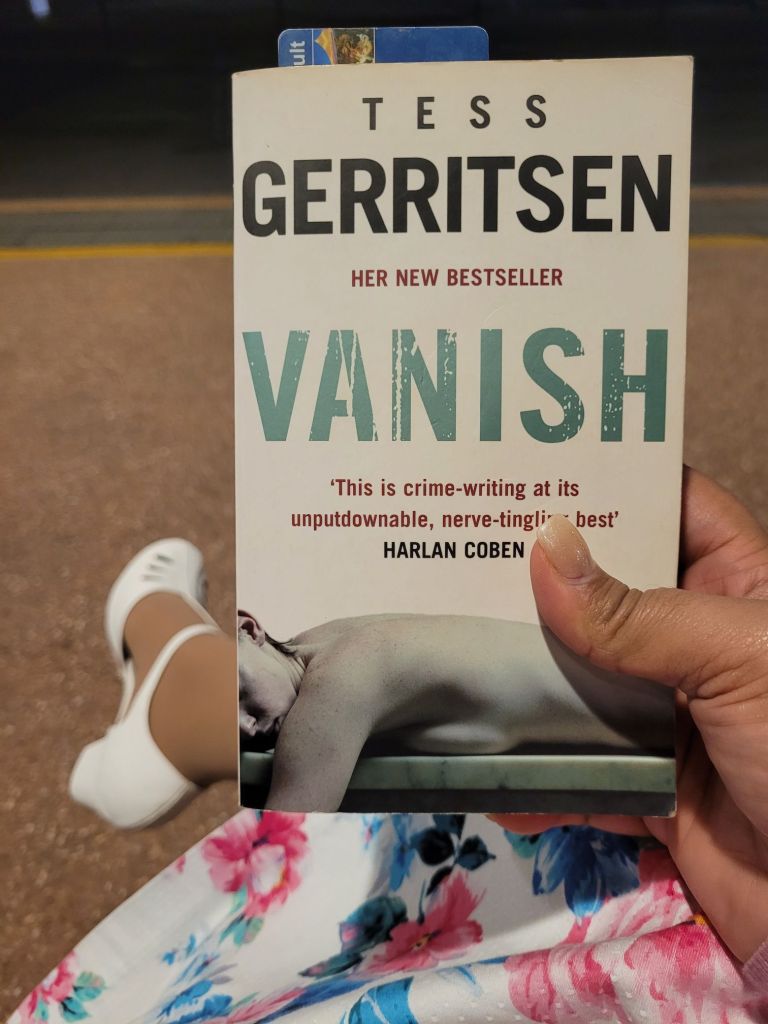
Book Review – Vanish by Tess Gerritsen

In Vanish (2005), Tess Gerritsen delivers a taut, socially conscious thriller that goes beyond the conventions of crime fiction. As the fifth instalment in her Rizzoli & Isles series, the novel showcases her signature blend of forensic realism and emotional intensity—thanks in no small part to her background as a physician and student of anthropology. That scientific lens gives the story a grounded, credible edge, especially in its depiction of evidence collection and trauma response.


The novel centres around two formidable women: Detective Jane Rizzoli and Medical Examiner Maura Isles. In a world dominated by male authority figures, these protagonists stand out not just for their competence but for their resilience and moral clarity. Gerritsen writes from two perspectives—one from the cop, the other from a mysterious victim—which adds layers of suspense and empathy to the narrative. It’s a structure that humanises the crime and gives readers a visceral sense of what’s at stake.

What makes Vanish especially compelling is its thematic ambition. Gerritsen tackles human trafficking head-on, portraying it as a deeply entrenched and horrifying reality of the 21st century. The novel also hints at the unsettling power of military-industrial entities, suggesting that these corporations can manipulate justice and policy in ways that undermine democratic institutions. It’s a bold move for a crime novel, and it pays off.

While Gerritsen’s prose may not reach the literary heights of Patricia Cornwell, her storytelling is sharp, emotionally resonant, and socially aware. In fact, Vanish gives James Patterson a serious run for his money—especially in its ability to weave action, character development, and ethical complexity into a single, gripping narrative.

If you’re looking for a crime novel that’s more than just a whodunit, Vanish is a standout. It’s a page-turner with a conscience, and it proves that thrillers can be both entertaining and enlightening.

Book Review – The Hallmarked Man.

Robert Galbraith’s The Hallmarked Man is a riveting addition to the Cormoran Strike series, delivering a classic whodunnit with a modern edge. Published two years after the last book in the series, avid readers (aka me) were very excited about the release. The Running Grave (Book 7) was easily the best book I read in 2023, so I was very, very excited about this new title which was released today around the world. I excitedly opened up my Kindle edition at 12.01AM and picked up my hardcopy version at 10.15am. The eBook/Kindle version may be portable, but the hardcopy will always win with me!

The story opens with a gruesome discovery—a mutilated corpse whose identity has been deliberately obscured. Strike and Robin Ellacott are tasked with unraveling not just who the victim is, but why someone went to such lengths to erase him. The mystery is layered and atmospheric, steeped in London’s underbelly and the world of antique silver, with plenty of red herrings and unexpected turns.

I found the references in the novel to the Freemasons interesting, and the novel did often allude to the role Freemasons have in public office may be compromised by their own allegiances. This theme of secret societies is rather popular and does seem to appear in several crime and thriller fiction across a range of authors.

As the investigation deepens, Strike finds himself under media scrutiny, with past indiscretions resurfacing and threatening to derail both the case and his reputation. This subplot adds tension and continuity for longtime readers, tying in threads from earlier books and forcing Strike to confront uncomfortable truths.

The novel also tugs at the heartstrings, especially when Strike reflects on the death of his beloved uncle Ted—a man he calls a “proper man”—whose quiet strength and moral compass shaped Strike’s own. In a surprising emotional turn, Strike rekindles a relationship with his estranged father, Jonny Rokeby, adding layers of vulnerability and reconciliation to the narrative.

Ellacot, meanwhile, is navigating her own emotional minefield. Her feelings for Ryan Murphy—a charismatic, Paul Newman lookalike—are complicated by her loyalty to Strike and the unresolved tension between them. She’s also forced to confront the eternal juggle between motherhood and career, a theme that’s handled with nuance and realism, reflecting the pressures many women face in balancing ambition with personal life.

The novel is rich with minor plot twists that add texture without overwhelming the central mystery. Each twist feels earned, contributing to a narrative that’s both intellectually satisfying and emotionally resonant. Galbraith doesn’t shy away from darker realities either—human trafficking of young women is woven into the case, serving as a sobering reminder that this global crisis remains urgent and unresolved.

Galbraith’s prose is sharp, the pacing tight, and the resolution deeply rewarding. The Hallmarked Man is a triumph—gritty, elegant, and impossible to put down.

Book Review – The Vanishing Bride

Bella Ellis’s The Vanished Bride (2019) is more than a historical mystery—it’s a poignant reflection on the constraints and quiet rebellions of women in Victorian England. Set in 1845, the novel imagines the Brontë sisters—Charlotte, Emily, and Anne—as amateur detectives, drawn into the case of a young bride who disappears under violent and mysterious circumstances. While the plot is rich with gothic suspense and clever twists, its emotional core lies in the exploration of female suffering, silencing, and survival.

This book was an unexpected surprise. I have always been a fan of Austen adaptations, but I had never really looked for other works. Then I saw this book. Just sitting on a shelf in Chermside Library…. What drew me in, pulled my eye onto a shelf filled with books, was the cover and the beguiling title – who vanished?

The vanished bride herself becomes a symbol of the countless women whose voices were erased by marriage, patriarchy, and social expectation. Her disappearance from a blood-soaked room is not just a mystery to be solved—it’s a metaphor for how women were often consumed by the institutions meant to protect them. The Brontë sisters, still unpublished and largely dismissed by society, are portrayed as fiercely intelligent and empathetic women who refuse to accept the limitations imposed on them. Their determination to uncover the truth is an act of resistance, a refusal to be passive observers in a world that demands their silence.

Ellis’s depiction of the sisters is deeply respectful of their historical reality. Each woman brings her own perspective shaped by hardship: Charlotte’s yearning for recognition, Emily’s wild defiance of convention, and Anne’s quiet moral clarity. Their investigation is not just about solving a crime—it’s about asserting their right to think, to question, and to act. In doing so, they challenge the rigid gender roles of their time, offering a glimpse into the emotional and intellectual lives of women who were often denied both agency and autonomy.

What makes The Vanished Bride especially compelling is its ability to weave these themes into a gripping narrative without ever feeling didactic. The gothic setting, the eerie clues, and the complex characters all serve to highlight the emotional toll of being a woman in a world that sees you as property, decoration, or burden. Through the Brontës’ eyes, Ellis invites readers to consider not just the mystery of a missing bride, but the deeper mystery of how women endured, resisted, and ultimately reshaped the world around them—often through the power of storytelling itself.

The Whimsical Wonder of Readathons: Reading for Joy, for Fun, for Pleasure!

Normally, my annual fundraiser is Frocktober, where for the month of October, I celebrate the gloriousness of frocks whilst fundraising for the Ovarian Cancer Research Fund. But this year, I’m mixing it up with something equally delightful and just a bit more bookish: a readathon! And not just any readathon—The World’s Coolest Readathon, hosted by the Australian Book Foundation. I saw that another wonderful Teacher Librarian Barbara from Bourke High School had signed up and then I thought… why not do it myself?

And what better way to kick things off than with a mystery? My first book for this readathon is Diabolical Bones by Sue Ellis—a Brontë Girls Mystery, borrowed from the ever-wonderful Brisbane City Council libraries. Gothic Yorkshire, clever heroines, and a touch of the macabre? Yes please.

A readathon, I’ve decided, is the perfect sequel to Book Month—like the epilogue where the characters (aka readers) get to celebrate their love of stories with wild abandon. It’s the encore performance, the bonus chapter, the literary afterparty.

Once upon a time, in a land not so far away (okay, it was my bedroom in Brisbane’s Southside), I embarked on a noble quest: the MS Readathon. Armed with a stack of books taller than my bedside lamp and a sponsorship sheet that made me feel like a literary philanthropist, I read my way through mysteries, adventures, and magical lands—all while raising money for a good cause. It was glorious.

Fast forward to today, and I find myself whispering reminders like a mantra: Read for fun. Read for joy. Read for pleasure. Because somewhere between grown-up responsibilities and inbox avalanches, the simple delight of reading can slip through the cracks.

Why Readathons Are Brilliant (and Backed by Science!) 

Readathons aren’t just nostalgic—they’re powerful tools for literacy, wellbeing, and community. Here’s why they’re so magical:

They Spark a Love of Reading: Choosing your own books makes reading feel like breathing—natural and joyful.

“Until I feared I would lose it, I never loved to read. One does not love breathing.

Harper LeeTo Kill a Mockingbird

They Boost Brains and Wellbeing: Reading for pleasure improves mental health and cognitive skills.

“Reading gives us someplace to go when we have to stay where we are.”
— Mason Cooley

They Create Lifelong Readers: Even reluctant readers get swept up in the fun.

“A reader lives a thousand lives before he dies. The man who never reads lives only one.”
— George R.R. Martin

They Build Community: Fundraising through reading turns stories into shared kindness.

“No act of kindness, no matter how small, is ever wasted.”
— Aesop

A Readathon Renaissance

Whether you’re a teacher, parent, librarian, or just a book-loving human, readathons offer a delightful way to reconnect with the joy of reading. They’re flexible, inclusive, and can be tailored to any age or interest. Plus, they’re a fabulous excuse to wear pajamas all day and call it “literary immersion.”

So if you, like me, sometimes need a nudge to read for the sheer pleasure of it, consider joining or hosting a readathon. You’ll be part of a movement that’s not just fun—it’s transformative.

And if you’re ready to dive in, check out The World’s Coolest Readathon. It’s got all the charm of the MS Readathon days, with a modern twist and a mission to make reading joyful again.

References

Real Men Read

Empowering Boys Through the Power of Story

The “Real Men Read” initiative, recently hosted at my school was intentionally held between Book Week and Father’s Day as a event to bring our Primary students and their male caregivers to reinforce the importance of positive male role models in improving literacy outcomes for boys. The event brought together fathers, grandfathers, and male mentors together for a pleasant evening celebrating the positive outcomes from reading. Two dads kindly volunteered to talk about how and why they read. They discussed their own role models and how they support their sons in their literacy journey. We also had a fabulous guest speaker from Brothers and Books – Dylan Conway to talk about the impact reading has on building resilience and reducing stress. The impact was immediate—students were more engaged, more curious, and more eager to pick up a book themselves. In fact, I received an email from a dad that next morning.

Thanks again for all of your efforts last night.  We are lucky to have such wonderful teachers that genuinely care for our sons.  Conor actually got up this morning and said he wants to read his new library book with me tonight.  Success!

This event powerfully demonstrated that when boys see and hear about men they value and respect reading, they begin to associate literacy with strength, intelligence, and emotional depth. In a world increasingly shaped by digital distractions and narrow stereotypes, the presence of caring, literate male figures offers boys a broader vision of what it means to be a man.

The research backs this up! A study by Merga and Ledger (2019) found that boys are more likely to engage with reading when they see male role models actively participating. Furthermore, recent findings by Smith and Taylor (2023) suggest that boys who regularly read with male caregivers demonstrate improved vocabulary acquisition, reading comprehension, and a more positive attitude toward school. These outcomes are not only academic but also social, as reading together fosters empathy and communication.

The National Literacy Trust (2025) further supports this, stating: “Fathers today are more involved in their children’s lives than ever before, and their engagement in early learning activities like playing, reading, singing, drawing and visiting parks or libraries supports children’s emotional, cognitive and educational development, as well as their early language and literacy skills.”

As Dylan Conway pointed out from the not-for-profit organisation Brothers and Books, their campaigns have shown that when boys see men reading, they begin to associate reading with strength, curiosity, and emotional intelligence. Their organisation has championed the cause, encouraging men to read and donate books across Australia.

The Real Men Read event served as a powerful reminder that literacy is not just a school responsibility—it is a community effort. When fathers and male mentors take the time to read with boys, they are investing in a future where literacy is linked to confidence, connection, and lifelong learning.

References

Merga, M., & Ledger, S. (2019). Parents’ perceptions of the importance of reading and the efficacy of reading aloud: Implications for fostering reading engagement in the home. Australian Journal of Education, 63(2), 163–178. https://doi.org/10.1177/0004944119840077

Smith, J., & Taylor, R. (2023). Male role models and literacy development in boys: A longitudinal study. Journal of Educational Research and Practice, 14(1), 45–59.

National Literacy Trust. (2025). Fathers’ engagement in early childhood literacy. https://literacytrust.org.uk

Australian Bibliotherapeutic Society. (n.d.). About us. https://bibliotherapy.org.au

Brothers and Books. (n.d.). Our mission. https://brothersandbooks.org

The Teacher Librarian’s Role in Elevating Literacy Through Quality Literature

Timothy Shanahan’s blog offers teacher librarians a powerful lens through which to re-evaluate long-held assumptions about reading instruction. By challenging the instructional level theory and advocating for the use of complex, grade-level texts, Shanahan equips librarians with evidence-based insights that support the promotion of high-quality literature. His work reinforces the librarian’s role in curating rich collections, scaffolding student engagement, and collaborating with teachers to foster deeper, more meaningful reading experiences.

Timothy Shanahan’s critique of the instructional level theory—and the growing body of research supporting the use of challenging texts—has profound implications for teacher librarians. Far from being custodians of books, teacher librarians are literacy leaders, curriculum collaborators, and champions of equitable access to high-quality literature. Their work sits at the intersection of pedagogy, inquiry, and imagination.

For decades, the instructional level model influenced how books were selected for students. It suggested that matching texts to a student’s reading level would yield the best learning outcomes. However, recent research has challenged this assumption. Studies by Lupo, Strong, and Conradi Smith (2019) and Young, Lagrone, and McCauley (2020) show that students make significant gains when exposed to complex texts, especially when supported by skilled educators. This shift calls for a re-evaluation of how we curate and use literature in schools.

Teacher librarians are uniquely positioned to lead this change. Rather than relying solely on readability formulas or levelling systems, they can advocate for literature that offers rich vocabulary, nuanced themes, and diverse perspectives. Quality literature provides opportunities for deep discussion, critical thinking, and emotional engagement—elements that are often missing from simplified texts. This approach aligns with the Australian Curriculum’s emphasis on engaging students with increasingly sophisticated texts across year levels (ACARA, n.d.).

Beyond curation, teacher librarians play a vital role in scaffolding student engagement with challenging texts. By collaborating with classroom teachers, they help design literature experiences that support comprehension and inquiry. Whether through literature circles, guided reading sessions, or integrated inquiry units, teacher librarians ensure that students are not only exposed to complex texts but are also equipped to understand and enjoy them. Research by Pérez Buelvas (2024) highlights how scaffolding strategies—such as task-based activities and formative assessment—can significantly improve reading comprehension, especially among English language learners.

Moreover, teacher librarians contribute to equity in literacy education. Stocker et al. (2023) argue that integrating the science of reading with behavioural science can address systemic inequities in Australian schools. By ensuring all students have access to high-quality literature and the support to engage with it meaningfully, teacher librarians help close the literacy gap and foster lifelong learning.

Top 3 Ways Teacher Librarians Can Elevate Reading Through Quality Literature

1. Curate and Promote Rich, Diverse Texts Select literature that challenges students intellectually and emotionally—books with layered themes, sophisticated language, and diverse voices. Use displays, flipguids and reading lists to spotlight these titles and spark curiosity.

2. Scaffold Access to Complex Texts Support students as they engage with challenging material through guided reading, literature circles, and strategy instruction. Help them build confidence by modelling how to navigate difficult vocabulary and abstract ideas.

3. Collaborate with Teachers to Embed Literature into Learning Work alongside educators to integrate high-quality texts into curriculum units. Suggest titles that align with learning goals while encouraging deeper thinking and discussion across subjects.

References

ACARA. (n.d.). National Literacy Learning Progression. Australian Curriculum, Assessment and Reporting Authority. https://v8.australiancurriculum.edu.au/resources/national-literacy-and-numeracy-learning-progressions/national-literacy-learning-progression/

Lupo, S. M., Strong, J. Z., & Conradi Smith, K. (2019). Text difficulty and adolescent literacy: A randomized study of challenging texts and instructional supports. Reading Research Quarterly, 54(3), 342–375. https://doi.org/10.1002/rrq.241

Pérez Buelvas, H. G. (2024). Enhancing reading skills through scaffolding strategies in eighth-grade EFL students. HOW Journal, 31(2), 70–88. https://doi.org/10.19183/how.31.2.754

Shanahan, T. (2023, March 15). Why children should be taught to read with more challenging texts. Shanahan on Literacy. https://www.shanahanonliteracy.com/blog/why-children-should-be-taught-to-read-with-more-challenging-texts

Stocker, K. L., Fox, R. A., Swain, N. R., & Leif, E. S. (2023). Between the lines: Integrating the science of reading and the science of behavior to improve reading outcomes for Australian children. Behavior and Social Issues, 33, 504–531. https://doi.org/10.1007/s42822-023-00149-y

Young, C., Lagrone, S., & McCauley, J. (2020). Read Like Me: An intervention for struggling readers. Education Sciences, 10(3), 57. https://doi.org/10.3390/educsci10030057

Chai, Cinnamon, and Childhood Summers: A Whimsical Wander Through Chai Time at Cinnamon Gardens

“The stories we tell are the temples we build. They must not be erased.”

Some books feel like a warm hug. Others feel like a cup of spiced masala chai, comforting, layered, and just a little bit fiery. Shankari Chandran’s Chai Time at Cinnamon Gardens is both. It’s the kind of novel that wraps itself around your heart and whispers stories you didn’t know you needed to hear.

And for me, it was more than just a read. It was a nostalgic journey. You see, I used to spend my summer holidays in Sri Lanka as a child. The scent of cinnamon in the air, the sound of monsoon rain on tin roofs, the laughter over mangoes and mischief. It’s all etched into my memory. So when I opened this book, I wasn’t just reading. I was time-traveling.

Cinnamon Gardens: A Home Full of Stories

Set in a fictional retirement home in Western Sydney, Cinnamon Gardens is run by Shiva and Maya, Tamil immigrants who’ve built a sanctuary for elders from all walks of life. But this isn’t your average aged care facility. It’s a place where stories simmer like pots of curry on the stove. A story that is rich, complex, and full of spice.

When a racially charged attack shakes the community, Maya is forced to confront her past as a survivor of the Sri Lankan civil war. The novel dances between timelines of Sri Lanka’s turbulent history and Sydney’s multicultural present. The dance revealing how trauma, memory, and resilience are passed down like heirlooms.

Each resident has a tale to tell, and Chandran listens with compassion and clarity. It’s a reminder that behind every quiet face is a thunderstorm of experience.

Sydney’s West – A melting pot.

Image from article by Handley (2022).

Let’s talk about Western Sydney, shall we? If you’ve never been, you’re missing out on the most eclectic, electric, and downright delicious food scene in Australia. As Handley (2022) from the ABC pointed out the change that is happening in Western Sydney. One street might offer Sri Lankan hoppers, Lebanese falafel, Vietnamese pho, and Congolese grilled fish, all within walking distance.

Chandran captures this beautifully. The setting isn’t just a backdrop. Instead it’s a character in itself. Western Sydney is where cultures collide, stories unfold, and chai is served with a side of soul.

Why This Book Should Be in Every Senior English Syllabus.

If I were a senior English teacher (and let’s be honest, I’d probably assign mango-eating as homework), I’d put this book front and center in any senior English or EALD classroom. Chai Time at Cinnamon Gardens aligns beautifully with the QCAA English and EALD syllabuses, especially in its exploration of key concepts like identity, cultural perspectives, and representation. The novel’s themes of migration, intergenerational trauma, systemic racism, and the politics of memory offer rich terrain for unpacking how texts shape and reflect social and cultural contexts. Chandran’s use of narrative techniques such as flashbacks, multiple perspectives, and lyrical prose supports deep textual analysis and encourages students to consider how language constructs meaning. Most importantly, the book invites critical and creative responses to the guiding questions of the syllabus: Who gets to tell history? How do we heal through storytelling? It’s a novel that doesn’t just teach a student. It invites them to experience the journey themselves as it asks students to listen, reflect, and maybe even share their own stories, making it a perfect companion for units on perspectives and voices, narratives that shape identity, or texts that challenge social norms.

Reading Chai Time at Cinnamon Gardens felt like sitting down with an old friend over tea. One who’s lived a thousand lives and isn’t afraid to tell you the truth. It reminded me of my childhood summers in Sri Lanka, of the power of memory, and of the quiet strength found in community.

So if you’re looking for a book that’s bold, beautiful, and brimming with heart. This is it. Just don’t forget to brew a cup of chai before you dive in. Trust me, it pairs perfectly.

Rating: 4 out of 5.

Rating

Beyond the Bookshelf: Why Diverse Stories Belong in Every School Library

In every corner of a school library, stories wait to be discovered. Stories that open minds, build empathy, and reflect the rich tapestry of human experience. But what happens when those stories are missing? When shelves lack the voices of different cultures, identities, and lived experiences?

As an educator and lifelong reader, I’ve come to believe that diverse books aren’t just nice to have in a collection. But rather, that they’re essential. They shape how students see themselves and others, and they help build inclusive communities where every child feels seen and valued.

Representation Matters

Research consistently shows that representation in literature has a profound impact on students’ self-esteem, academic engagement, and social development. When children see characters who look like them, speak their language, or share their cultural background, they feel validated. And when they read about lives different from their own, they develop empathy and understanding.

  • A study by the Cooperative Children’s Book Center found that in 2022, only 33% of children’s books featured characters from diverse backgrounds.
  • According to the Australian Institute for Teaching and School Leadership, inclusive education improves student outcomes and fosters respect among peers.
  • The “Windows, Mirrors, and Sliding Glass Doors” framework by Dr. Rudine Sims Bishop emphasizes how books can reflect our own lives, offer insight into others’, and invite us into new worlds.

Growing up as a teen in Australia, I rarely saw characters in books who looked like me or came from my cultural background. It wasn’t until university that I encountered authors who spoke to my experience, and it was transformative. That moment of recognition made me realize how powerful literature can be in shaping identity and belonging.

One of the most vivid memories I have of feeling truly represented was during a recent trip to Mumbai. I walked into a bookstore and saw the latest issue of India Vogue. I was drawn to it because the cover featured models who looked like me, wore traditional fabrics with pride, and radiated a beauty that felt familiar. I stood there, overwhelmed. For the first time, I saw my heritage celebrated in a way that was bold, glamorous, and unapologetically authentic. That moment reminded me how powerful visibility can be, not just in fashion, but in every form of storytelling.

Now, as a teacher, I’m committed to curating a library space that reflects the diversity of our world. I’ve seen firsthand how students light up when they find a book that resonates with them. As one Year 9 student told me earlier this year when I handed him The White Tiger by Arvind Adiga, “This book feels like it was written for me.” That’s the magic we should strive for.

🏫 What should Teacher Librarians do?

To ensure every student has access to diverse stories, Teacher Librarians and schools must:

  • Regularly audit their library collections for representation across race, gender, ability, and culture.
  • Partner with local communities and authors to source authentic voices.
  • Provide professional development for educators on inclusive literature.
  • Encourage student-led book clubs and reading initiatives that celebrate diversity.

💬 Final Thoughts

Diverse books aren’t just about ticking boxes, they’re about opening hearts and minds. They help students navigate the world with compassion, curiosity, and confidence. When we fill our shelves with stories that reflect the full spectrum of human experience, we send a powerful message: You belong here. Your story matters.

Let’s go beyond the bookshelf—and make every library a gateway to understanding.