

Ariadne continues my Greek mythology phase, but unfortunately it never quite reaches the heights of Clytemnestra. While Ariadne lends her name to the title, she often feels more like a passenger in the story, with her sister Phaedra emerging as the far more compelling and complex character. At times, it feels as though the novel should have been named after Phaedra instead.
That said, the book offers an engaging retelling of the myths surrounding Theseus and the Minotaur. Reading it transported me back to my own visit to Knossos in Crete, wandering through the ruins of the Minoan palace with its maze-like rooms and winding passageways. Standing there years ago, it was easy to imagine how stories of a labyrinth and a monster at its heart might have emerged.
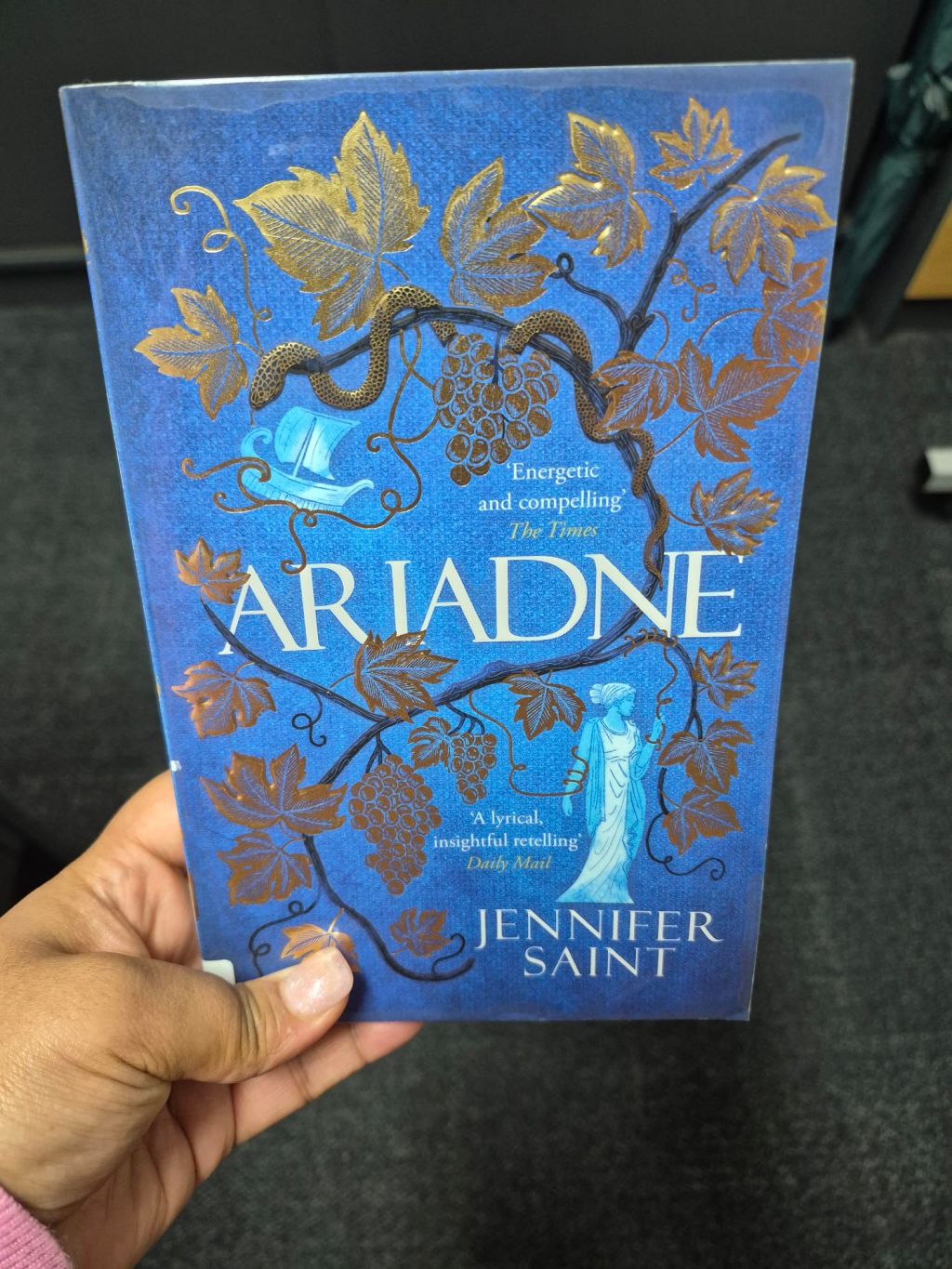
Whilst mythology offers various explanations for why Theseus abandoned Ariadne on Naxos, Jennifer Saint absolutely captures the hero’s arrogance. One can almost see it radiating from the page. This is a man who seems convinced of his own greatness, perhaps viewing himself as the human successor to Hercules, destined for glory and admiration. Saint’s portrayal strips away much of the traditional heroic sheen and reveals a figure whose pride and self-importance often overshadow the people around him.
More importantly, Ariadne continues a theme that Saint explores throughout her mythological retellings: women paying the price for men’s actions. Again and again, Greek mythology tells stories in which male pride, ambition and hubris set tragedy in motion, while women bear the consequences. Just as Medusa is transformed into a Gorgon by Artemis after Poseidon’s violation… or as Scylla monstrous fate because of Glaucus, Ariadne ultimately becomes collateral damage in Dionysus’s war against Argos. Throughout the novel, Saint reminds readers that the destruction wrought by men rarely falls upon men alone. Instead, it is often women who suffer, endure and die because of decisions they never made.
Greek mythology is full of stories where male pride is paid for in female blood. Just ask Hera. Time and again she is forced to bear the consequences of Zeus’s infidelities, directing her wrath not at the god responsible but at the mortal women and children caught in his wake. Saint highlights this recurring pattern across the myths, encouraging readers to look beyond the celebrated deeds of heroes and gods to the women left to clean up the devastation they create.
While Ariadne did not captivate me as completely as Clytemnestra, it remains an enjoyable read for anyone interested in Greek mythology and fresh perspectives on familiar legends. My main takeaway is that Ariadne herself never feels quite as fully realised as her sister Phaedra. However, I will say that Saint succeeds in shining a light on the women who stand in the shadows of heroes and gods, reminding us that their stories deserve to be heard as well.

